
Photo of the Week – March 3, 2011

 Katydids are a diverse group of species – about 243 different species reside in the U.S. and Canada.  We have about the same number of katydid species as we do grasshopper species in our Platte River Prairies, but grasshoppers tend to grab a lot more attention.  In fact, katydids are often called “long-horned grasshoppers”, though they’re actually much more closely related to crickets than grasshoppers.  Katydids are often difficult to see because of their camouflaged appearance, but it’s impossible not to hear the distinctive songs they make by rubbing their front legs together – especially in late summer. 
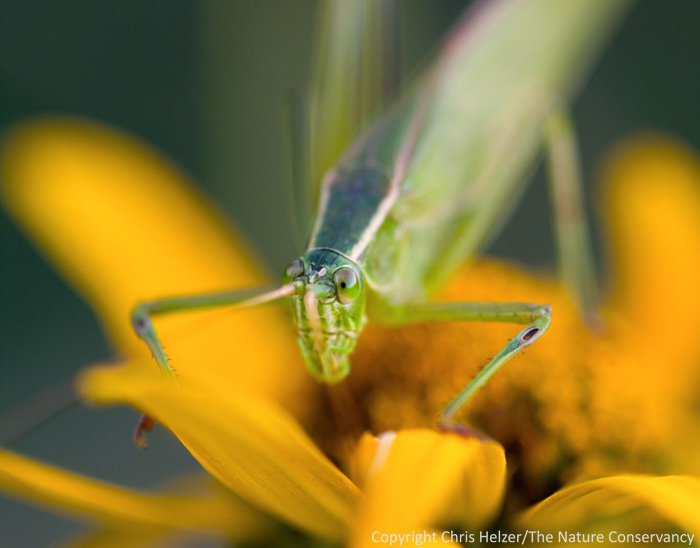
Katydid on false sunflower. Sarpy County, Nebraska.

In the above photo, you can see the tympana on the katydid’s front leg – right below its “elbow”.  The tympana is the hearing organ katydids and crickets use to hear the songs of others of their kind.

Telling grasshoppers and katydids apart is usually as easy as looking at the antennae (see below).  Grasshoppers have short antennae – much less than the length of their bodies.  Katydids have very long antennae that usually exceed their body length.
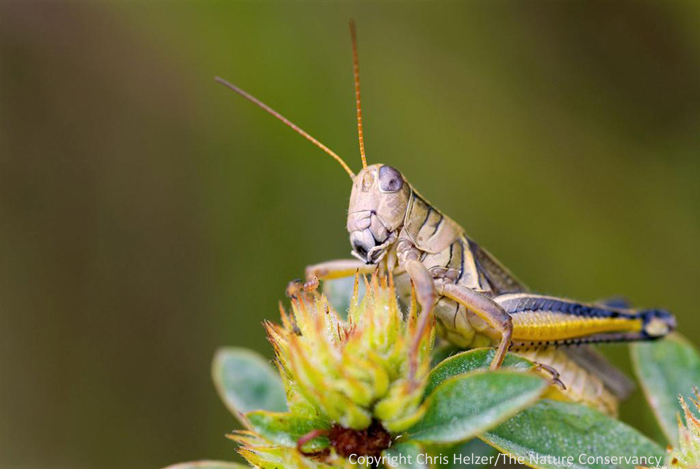
A grasshopper showing off its short antennae.
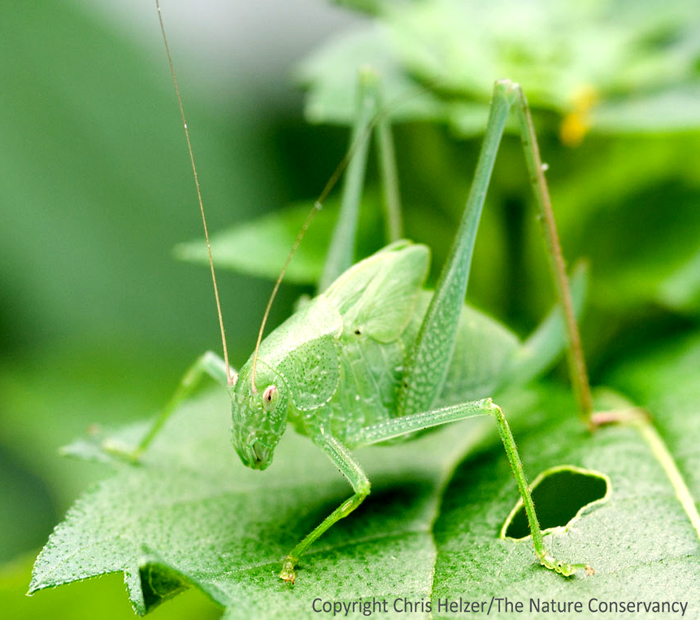
A katydid nymph (hence the short wings) with its long antennae - long enough I didn't capture their entire length in the photo.

Photo of the Week – February 10, 2011

I found this molting grasshopper nymph as I was walking through one of our restored prairies a couple summers ago.  Grasshoppers go through “incomplete metamorphosis” as they mature, meaning that they hatch from an egg as nymphs that look much like they will as adults – only a lot smaller.  As the nymphs grow, they have to periodically shed their old exoskeleton , which doesn’t grow with them.

Before shedding the old exoskeleton the grasshopper grows a new one underneath the old.  Once the new skin is ready, the grasshopper takes in as much air as it can to swell its body size and contracts its muscles to split the old skin along the back.  Then it squeezes itself out of its old skin and puffs itself up again to fill out its new exoskeleton.  The next several hours are a dangerous time for the newly molted nymph, because its new shell hardens slowly – making it particularly vulnerable to predators. 

Differential grasshopper nymph emerging from its old exoskeleton. Notice how much larger the emerged nymph is than its old exoskeleton. The Nature Conservancy's Platte River Prairies.

This particular grasshopper is a 5th instar (stage) nymph of a differential grasshopper (Melanoplus differentialis) – a common grasshopper of grasslands, but better known as a major pest in cropfields.  In prairies, the differential grasshopper feeds on both grasses and forbs. 

When I noticed this one emerging, I didn’t have my “good” camera with me, so I had to mark the location and run back to the truck to grab my camera and tripod.  A few minutes after I took the photo, the newly emerged nymph swung itself over to the stem of the switchgrass plant it was on (photo below) and sat there – I assume – until its new shell had hardened sufficiently that the grasshopper could go about the rest of its day.

Differential grasshopper nymph waiting for its new exoskeleton to harden. The Nature Conservancy's Platte River Prairies.