
The diversity of insect species in prairies – and other ecosystems – is simply mind boggling. One of my favorite activities with kids is to hand them an insect sweep net and let them find out for themselves just how many different kinds of “bugs” there are in a prairie. There’s a lot more than just grasshoppers out there…
I also like to quote impressive insect statistics when I give presentations, and one of my favorites comes from a 2000 report by Richard Redak. Do you know which group of insects has the most species in North America? (The group includes 37% of all insect species on the continent.) I’ll make it multiple choice, and you can choose from the following:
a) beetles
b) flies
c) wasps/bees/ants
d) butterflies/moths
e) true bugs
Made your guess? Ok, scroll down to see if you’re right.
.
.
.
.
.
.
.

A flower fly (Syrphidae) on yellow/hairy stargrass (Hypoxis hirsuta) along the Platte River in Nebraska.
Surprisingly – to me, anyway – the answer is Flies (the order Diptera). Would you have guessed that there are more than 36,000 species of flies in North America? That means that one in three insect species in North America is a fly. How many species of fly can you name?? Three? (house fly, horse fly, …uh….) No, butterfly and dragonfly don’t count.
I think it’s fantastic that there are 36,000 variations on those noisy flies that buzz around my head. Because I’ve been paying attention to pollinators recently, I know that there are many kinds of flies that are valuable pollinators – in fact, flies are second only to bees in terms of effectiveness and importance. As a photographer, I see a lot of flies hanging around flowers and elsewhere, and I’ve got quite a few fly photos that do look fairly different from each other. But I still wouldn’t have guessed there were that many kinds.
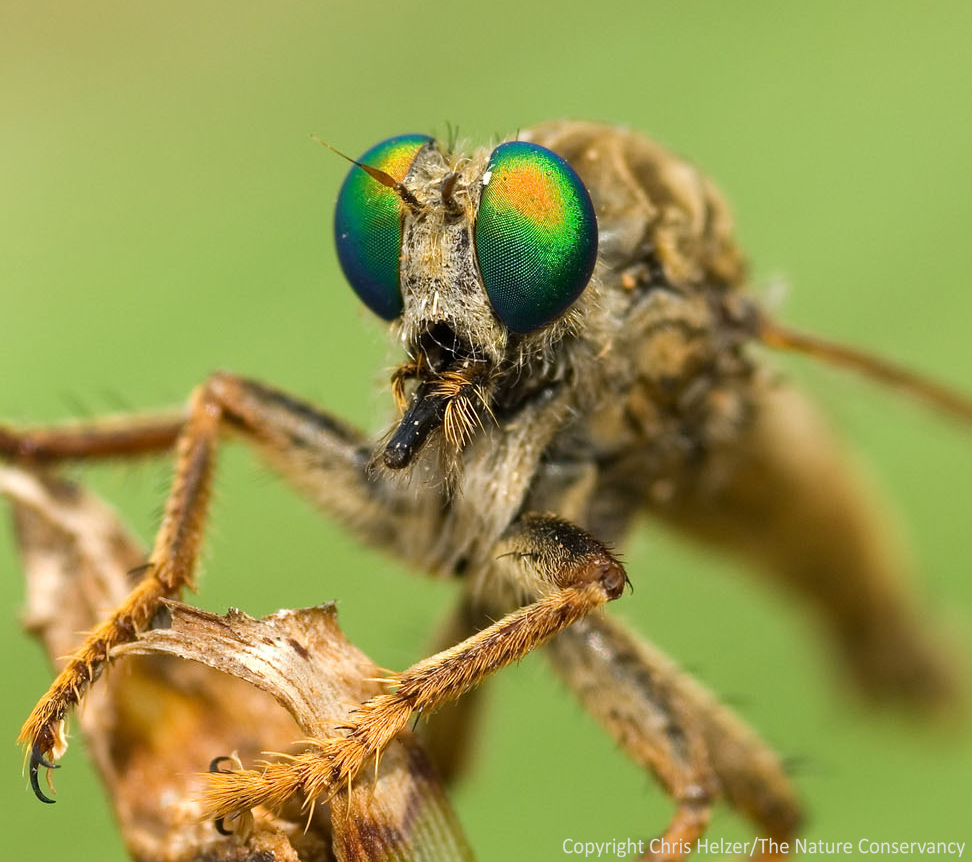
A robber fly photographed along the Platte River in Nebraska. I love the eyes and claws, especially. ...Just another one of the 36,000 species out there.
Why is it important to have 36,000 kinds of flies? I’m not sure, but isn’t it great to know they’re out there? We could discuss the diversity of the ecological roles that flies fill – and they ARE important in many ways – but for me, those things are secondary to the simple fact that they exist. We live in a great world.
By the way, if you guessed beetles on the quiz above, it’s a great guess – and you’d have been right if the question was about the entire earth. The tropics have astounding numbers of beetle species, and that pushes them above flies. But in North America it really is flies.



 The Prairie Ecologist