Hubbard Fellowship Blog – Stewardship Positivity

The following post was written by Evan Barrientos, of our two Hubbard Fellows for this year.  Evan is a talented writer and photographer, and while you’ll get the chance to see some of his work here during the next year, I also encourage you to check out his personal blog.

Although I’ve been participating in land management since high school, I still find myself learning so much from it, although perhaps not in the way you’d expect. Yes, I’ve learned several management techniques and strategies since starting the fellowship, but the lessons I consider most valuable are the ones that teach me how to think about land stewardship. Let me explain.

If you were a Hubbard Fellow during the second week of June, you would probably find yourself riding an ATV back and forward across one of our restored prairies, searching for the fluffy purple flowers of Musk Thistle. Upon spotting a thistle, you would pluck off all the flowers, thrust your spade through the base of the thistle with a satisfying crunch, pull out the plant, and then knock the dirt off of any uprooted roots. Over the next three weeks you would repeat this process thousands of times until you had covered every inch of all 14 of our Platte River properties and their 4,000+ acres. Then you would check them all again.

We celebrated the end of thistle season by burning the flowerheads in a bonfire.

When we finally finished musk thistles we celebrated by burning the seed heads that we had collected in a bonfire.

This may sound like exhausting and repetitive work, and it can be, but that wasn’t the hard part for me. The hard part was staying positive when it felt like I wasn’t doing enough. I felt this way when I returned to a prairie for its second thistle check and found piles of thistle seed below “zombie thistles” (thistles that flowered and produced seed after I chopped them because I left too much dirt on the roots). Or when I walked through a prairie that I had already checked twice and still found thistle stalks that had already released their seed to the prairie. Most of all, deciding to spend July 2nd chopping thistles before they released more seed instead of spending time with my family forced me to think hard about my role as a land steward.

As a land steward you develop a strong connection to the land you are working on. Seeing a healthy community of native species flourish on your property is extremely gratifying, but it also pains you to see invasive species spreading. Land stewards almost always have more tasks than they can complete and it’s very easy to let this make them feel overwhelmed and stressed, but it doesn’t have to be this way. After reflecting upon the first month of my fellowship, here are three lessons I’ve learned so far about being a happy steward:

  1. I cannot control nature. I am a steward, not a god. Expecting myself to control exactly which species grow on a property will only bring me frustration. The role of a land steward is not to dominate the forces of nature, but to regulate its extremes. Translation: my job isn’t to exterminate musk thistles, but to prevent them from outcompeting other species and lowering overall biodiversity.
7D1_9675

A Regal Fritilary (Speyeria idalia) on Musk Thistle (Carduus nutans). Like it or not, Musk Thistles have become part of the local ecosystem. Being a steward doesn’t mean exterminating thistles, but keeping them under control.

  1. There is no endpoint. A land steward’s work is never “done.” My job isn’t to “fix” a property; it’s to guide the property toward a range of conditions that meet our management goals. Removing thistles from the same property year after year does not mean that we are failing at our job of “restoring” the prairie. On the contrary, it means we are doing our job of actively fostering biodiversity.
06042015_nebraska_0322

Common Mullein (Verbascum thapsus) is non-native, but also non-invasive. We don’t remove it because it doesn’t lower plant diversity.

  1. Stewardship should be viewed as a positive action, not negative. There are two very different ways to look at land management. From one angle, a day spent chopping thistles could be considered a violent battle against an evil enemy; a task to evict an unworthy invader. From another angle, it could be considered a process of creating beautiful and biodiverse prairies. In my experience, viewing invasives as enemies just leads to exhaustion and bitterness. Only by viewing stewardship as a process of care and creation, in my opinion, can one generate the tremendous amount of energy needed to take on its many tasks.
07112015_nebraska_caveny_0353

Black-eyed Susans (Rudbeckia hirta) in the Platte River Prairies, Nebraska.

Land stewardship is an essential component of conservation and it’s imperative that we do it well. Unfortunately, it also is a very demanding job that can burn you out if you’re not careful. I’m happy to say that the first month of this fellowship taught me some very important lessons about setting realistic expectations and viewing my work as a positive contribution to prairie biodiversity. It’s important to be a happy steward!
Categorizing Invasive Plants

Managing invasive plant species is often the greatest challenge faced by land managers.  Because there are so many invasives and so little time, it’s critically important to be thoughtful about how to approach them.  There is much good advice available about how to prioritize which species to focus on and how to approach those priority species.  My own approach to invasives continues to change over time.  For what it’s worth, here’s how I think (today) about categorizing invasive plants on our sites here in Nebraska.

I can put most invasive plant species into one of four categories that describe how we approach control.

  1. Thin the matrix
  2. Beat them back
  3. Nip them in the bud
  4. Live with them


Category 1 – Thin the matrix.

Invasive grasses, such as Kentucky bluegrass, smooth brome, and tall fescue are excellent examples of species in this group.  They are plant species that are common enough that they occur throughout most of our sites, and – if left unmanaged – can form thick monocultures that exclude most other plant species.  Eradication of these species is not possible without losing many of the other plants we are hoping to conserve.  Instead, our general approach is to reduce their dominance and limit their impact on the diversity of the plant community.  (I wrote about this approach in an earlier post, using Kentucky bluegrass as an example.)

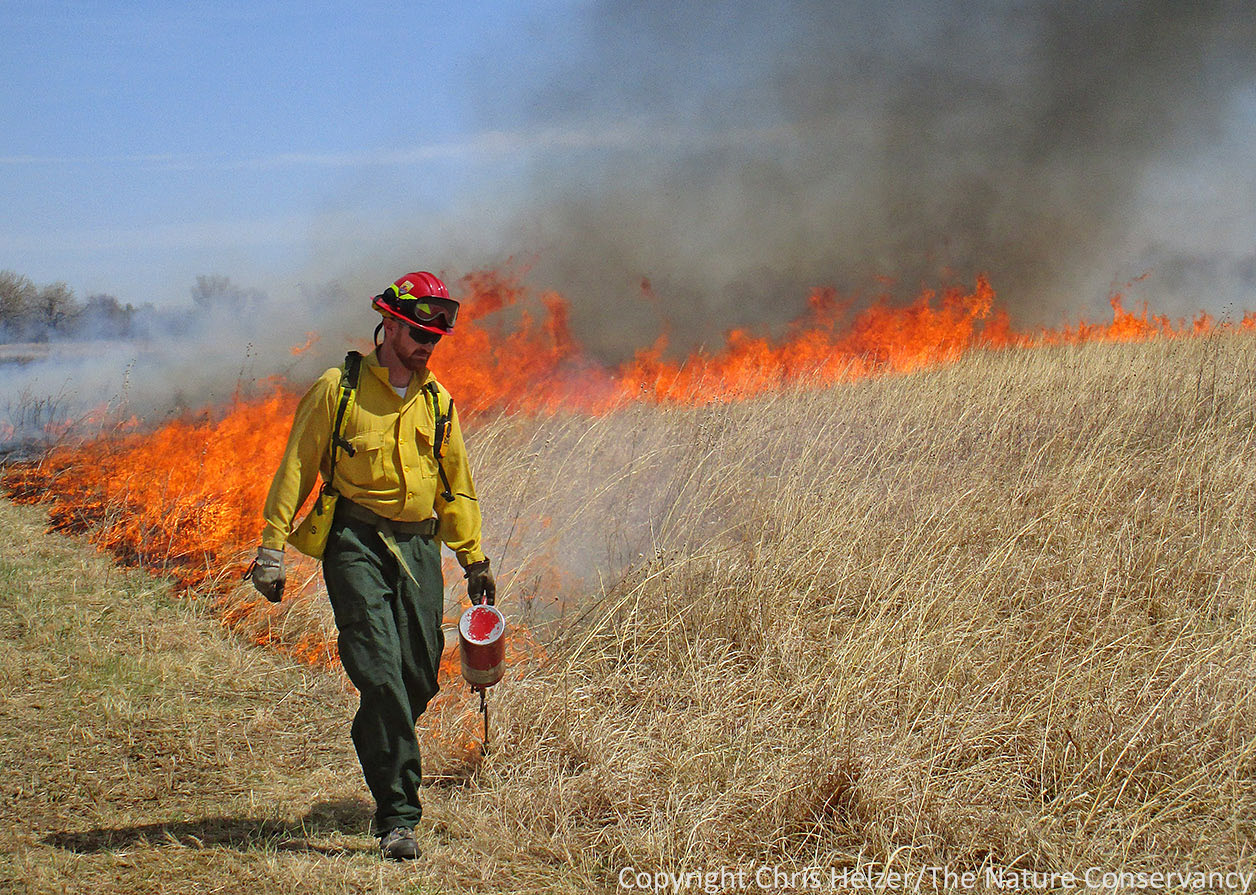
Essentially, we try to use fire, grazing, and/or mowing to weaken invasive grass plants and open up space between them for other species to flourish.  Because these suppression strategies also have negative impacts on some native species, we are careful not to use them too many years in a row.  Instead, we apply them periodically, whenever it looks like the invasives are starting to exert their dominance a little too much.

Prescribed fire and grazing are the two best ways we attack invasive grasses such as smooth brome and Kentucky bluegrass.

Prescribed fire and grazing are the two best ways we attack invasive grasses such as smooth brome and Kentucky bluegrass.

Category 2. Beat them back.

This group includes perennial plants that radiate outward other otherwise spread from an established source population.  Species we commonly deal with that fit into this category include purple loosestrife, sericea lespedeza, and Canada thistle.  It can be tempting to jump in and start attacking (with herbicides or other approaches) the biggest thickest patches of these, but that’s rarely the smartest strategy.  Instead it usually makes more sense to work from the outside edges of an infestation toward the middle – or source – so that the problem doesn’t continue to get worse as you attack.  I wrote an earlier post on that topic as well…

An exception to the “work from the outside edge first” rule applies to species such as Siberian elms that may be spreading from a single discrete patch of parent trees.  If it’s possible to eliminate that source population by cutting down a handful of trees, it absolutely makes sense to do that first.  Next, it’s smart to target other elms that are big enough to produce seed before working on the smaller ones – rather than blindly following the rule about working from the edges of an infestation.  Rules are meant to be broken, after all.


Category 3. Nip them in the bud.

This category contains invasive species that are just starting to show up in our area or at a particular site.  Here, the tactic is to seek and destroy new plants as soon as they arrive, to prevent the species from becoming established.  After all, it’s always better to attack an invasive species before it gains a foothold.

Many species can fit within this group.  For us, Common reed (Phragmites australis), crown vetch, garlic mustard, and Queen Anne’s Lace (aka wild carrot) are good examples.  Sometimes, we’re not sure if a species will really cause serious problems if it becomes established at our sites (e.g., Queen Anne’s Lace) but if minimal effort can prevent that establishment, it seems  like time well spent.

Our approach to musk thistle sort of fits into this “nip it in the bud” category, but for other reasons.  Musk thistle is an officially-designated noxious weed in Nebraska, and all landowners (including us) are required to eradicate it from their property each year.  If it weren’t for the state law, musk thistle would not be among our highest priority species because it really doesn’t cause big problems in most cases (on our sites).  It is most abundant where the dominant vegetation has been recently weakened by fire, grazing, or drought, but quickly diminishes in abundance when grasses recover their dominance.  However, to abide by the law and to prevent thistles on our land from going to seed and affecting our neighbors, we do our best each year to eradicate musk thistle.


Tier 4. Live with them.

This last group includes species we don’t actually consider to be invasives, at least by the criteria that a truly invasive plant acts to reduce biological diversity or otherwise simplify (and thus weaken) natural communities.  Many native species are considered weeds by some of our neighbors, but we like having them around.  Prime examples include annual sunflower and ragweed species.  However, many non-native plants fall within this category as well, including common mullein, dandelions, goatsbeard, marestail, and sweet clover.  Sometimes, we spend some time collecting and/or analyzing data to help ensure that we’re categorizing these species correctly.  A good example of that was discussed in an earlier post on sweet clover.

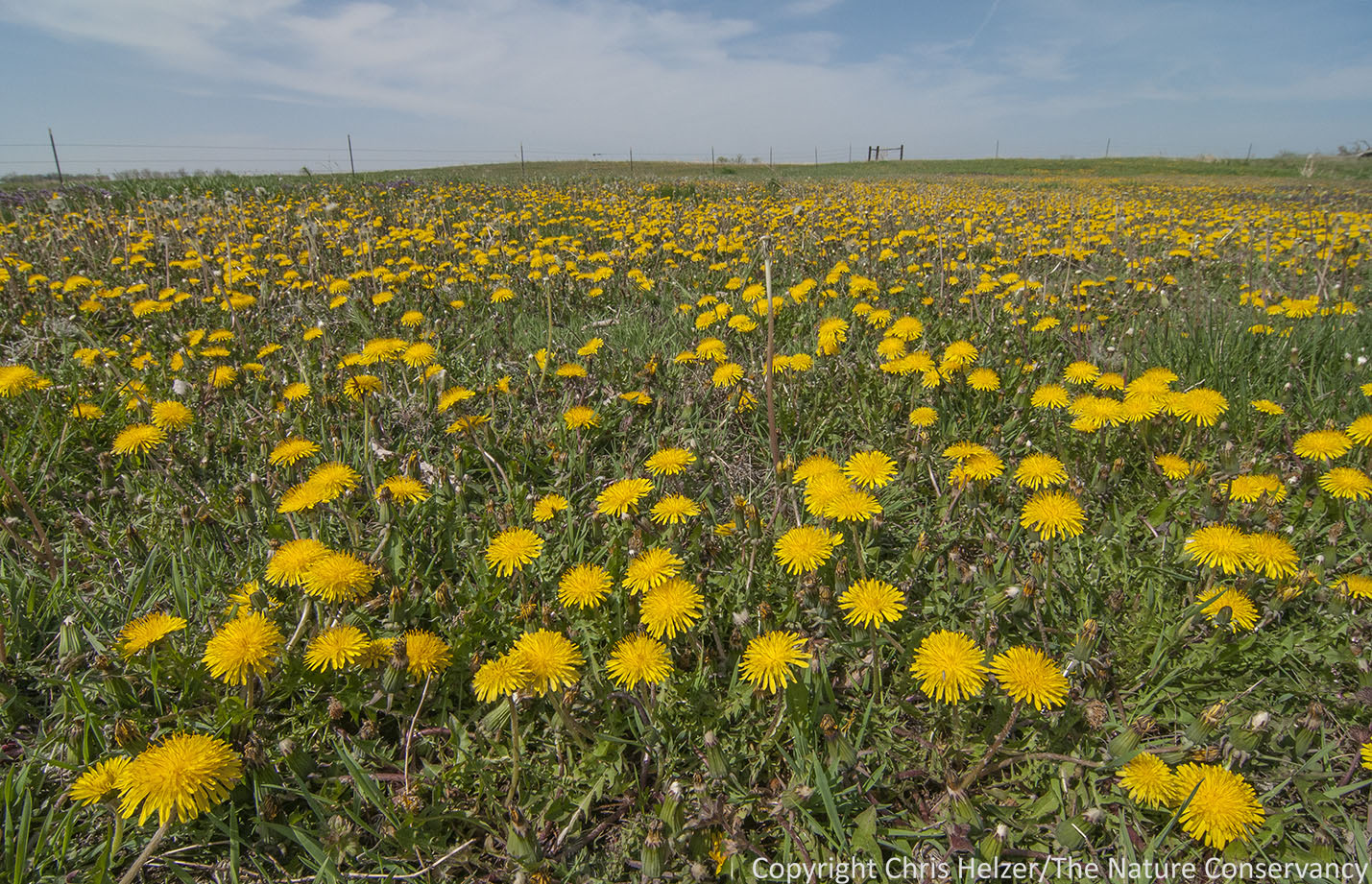
Dandelions are a species we just live with.  They're great for early season pollinators, and aren't aggressive - they just fill space when the perennial plant community is weakened (as they are doing here in the lot around our shop buildings).

Dandelions are a species we just live with. They’re great for early season pollinators, and aren’t aggressive – they just fill space when the perennial plant community is weakened (as they are doing here in the lot around our shop buildings).

Switching Categories.

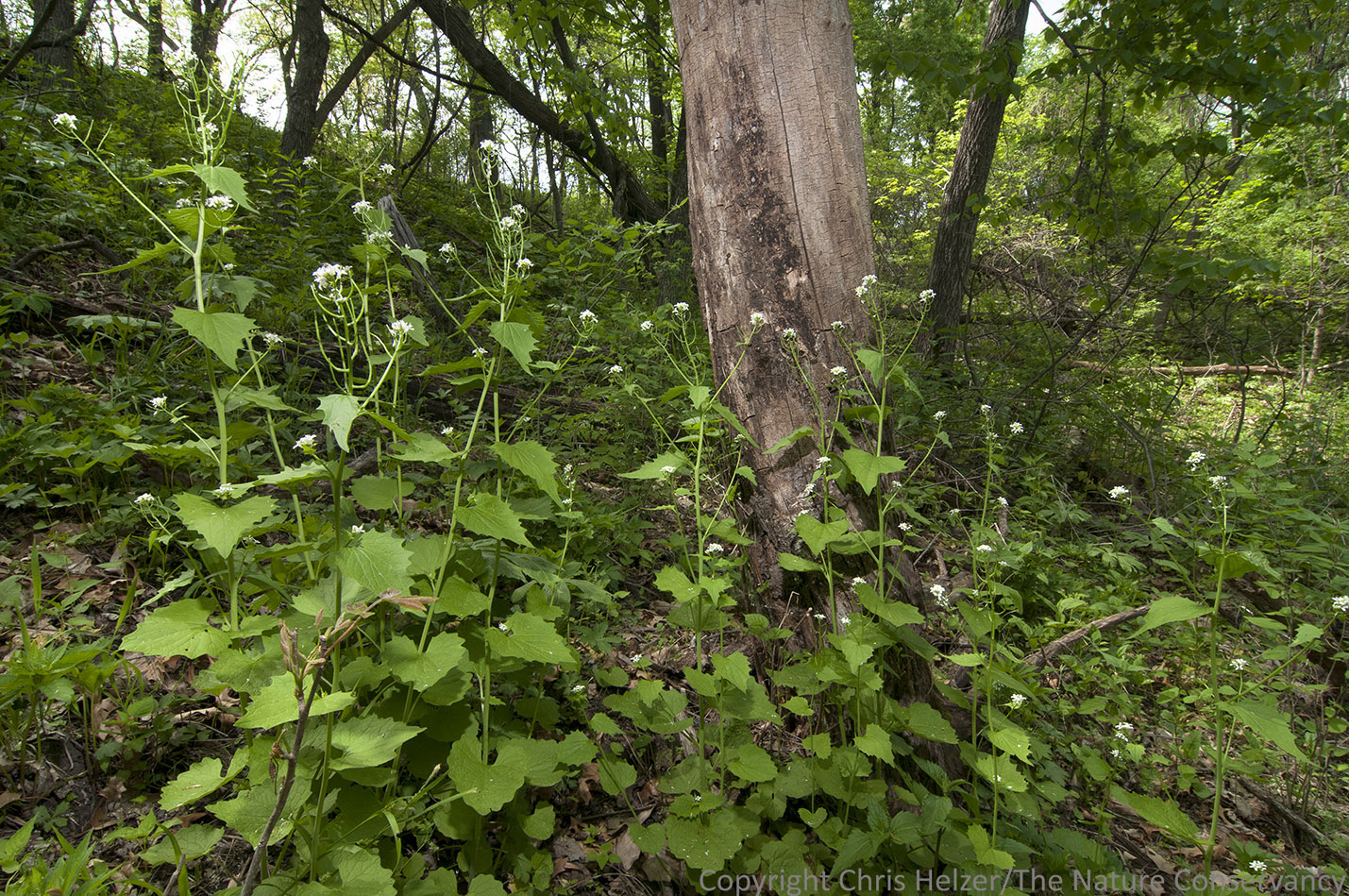
Ideally, of course, we’d be able to move some invasive plant species from one category to another, so that populations of “matrix” invasives shrink to the point they are in discrete patches and we can “beat them back.”  Likewise, it’d be great if “beat them back” invasives became rare enough that we could eventually “nip them in the bud”.  Unfortunately, reality usually goes the other direction.  For example, we’re dangerously close to having to shift garlic mustard from “nip it in the bud” into the “beat them back” category (if not the “thin the matrix” category!) at a nice woodland site we manage.  We’ll see what the next year or two brings.

We hope that using more frequent fire (along with other methods) will help us prevent garlic mustard from spreading across our whole property at the Rulo Bluffs Preserve, but it's a big challenge.

We hope that using more frequent fire (along with other methods) will help us prevent garlic mustard from spreading across our whole property at the Rulo Bluffs Preserve, but it’s a big challenge.

Regardless, I find it helpful to think about our invasive plants within categories like these because we can more easily define both our control strategies and objectives.  Putting a species into the “nip it in the bud” category helps make it a top priority and we can prioritize resources toward keeping it rare.  Just as importantly, if we know that we’re only trying to suppress the dominance of smooth brome, not eradicate it, we don’t have to beat our heads against the wall in frustration because smooth brome is still present.

We spend more time on invasive plant control than on any other land management activity.  Unfortunately, that’s true of most land managers I know.  More unfortunately, invasive species numbers are going up, not down.  It’s not time to throw in the towel just yet, but it is absolutely critical to be organized and thoughtful about how we approach these invaders.

Hopefully, being organized will allow us to spend less time on invasives and more time enjoying the sites we manage!