Hubbard Fellowship Blog – Stewardship Positivity

The following post was written by Evan Barrientos, of our two Hubbard Fellows for this year.  Evan is a talented writer and photographer, and while you’ll get the chance to see some of his work here during the next year, I also encourage you to check out his personal blog.

Although I’ve been participating in land management since high school, I still find myself learning so much from it, although perhaps not in the way you’d expect. Yes, I’ve learned several management techniques and strategies since starting the fellowship, but the lessons I consider most valuable are the ones that teach me how to think about land stewardship. Let me explain.

If you were a Hubbard Fellow during the second week of June, you would probably find yourself riding an ATV back and forward across one of our restored prairies, searching for the fluffy purple flowers of Musk Thistle. Upon spotting a thistle, you would pluck off all the flowers, thrust your spade through the base of the thistle with a satisfying crunch, pull out the plant, and then knock the dirt off of any uprooted roots. Over the next three weeks you would repeat this process thousands of times until you had covered every inch of all 14 of our Platte River properties and their 4,000+ acres. Then you would check them all again.

We celebrated the end of thistle season by burning the flowerheads in a bonfire.

When we finally finished musk thistles we celebrated by burning the seed heads that we had collected in a bonfire.

This may sound like exhausting and repetitive work, and it can be, but that wasn’t the hard part for me. The hard part was staying positive when it felt like I wasn’t doing enough. I felt this way when I returned to a prairie for its second thistle check and found piles of thistle seed below “zombie thistles” (thistles that flowered and produced seed after I chopped them because I left too much dirt on the roots). Or when I walked through a prairie that I had already checked twice and still found thistle stalks that had already released their seed to the prairie. Most of all, deciding to spend July 2nd chopping thistles before they released more seed instead of spending time with my family forced me to think hard about my role as a land steward.

As a land steward you develop a strong connection to the land you are working on. Seeing a healthy community of native species flourish on your property is extremely gratifying, but it also pains you to see invasive species spreading. Land stewards almost always have more tasks than they can complete and it’s very easy to let this make them feel overwhelmed and stressed, but it doesn’t have to be this way. After reflecting upon the first month of my fellowship, here are three lessons I’ve learned so far about being a happy steward:

  1. I cannot control nature. I am a steward, not a god. Expecting myself to control exactly which species grow on a property will only bring me frustration. The role of a land steward is not to dominate the forces of nature, but to regulate its extremes. Translation: my job isn’t to exterminate musk thistles, but to prevent them from outcompeting other species and lowering overall biodiversity.
7D1_9675

A Regal Fritilary (Speyeria idalia) on Musk Thistle (Carduus nutans). Like it or not, Musk Thistles have become part of the local ecosystem. Being a steward doesn’t mean exterminating thistles, but keeping them under control.

  1. There is no endpoint. A land steward’s work is never “done.” My job isn’t to “fix” a property; it’s to guide the property toward a range of conditions that meet our management goals. Removing thistles from the same property year after year does not mean that we are failing at our job of “restoring” the prairie. On the contrary, it means we are doing our job of actively fostering biodiversity.
06042015_nebraska_0322

Common Mullein (Verbascum thapsus) is non-native, but also non-invasive. We don’t remove it because it doesn’t lower plant diversity.

  1. Stewardship should be viewed as a positive action, not negative. There are two very different ways to look at land management. From one angle, a day spent chopping thistles could be considered a violent battle against an evil enemy; a task to evict an unworthy invader. From another angle, it could be considered a process of creating beautiful and biodiverse prairies. In my experience, viewing invasives as enemies just leads to exhaustion and bitterness. Only by viewing stewardship as a process of care and creation, in my opinion, can one generate the tremendous amount of energy needed to take on its many tasks.
07112015_nebraska_caveny_0353

Black-eyed Susans (Rudbeckia hirta) in the Platte River Prairies, Nebraska.

Land stewardship is an essential component of conservation and it’s imperative that we do it well. Unfortunately, it also is a very demanding job that can burn you out if you’re not careful. I’m happy to say that the first month of this fellowship taught me some very important lessons about setting realistic expectations and viewing my work as a positive contribution to prairie biodiversity. It’s important to be a happy steward!
Hubbard Fellowship Blog – Jasmine and Tractors

This post is written by Jasmine Cutter, one of our Hubbard Fellows.  

I Like Big Tractors and I Cannot Lie

I think I’ve had unacknowledged tractor-envy for a while. Growing up in the suburbs, the biggest piece of “machinery” I dealt with was probably our push lawnmower. When I moved to Minnesota and the prevalence and presence of large farm machinery increased greatly, I’d often find myself feeling a little jealous of the people who got to drive combines (once I learned that’s what those giant things are called) and the other mysterious, long-limbed machines; they commanded so much power at their fingertips, and I wondered what the world looked like from so high. When I got to use a riding mower in Montana (my first time on non-automotive machinery), I thought that was fantastic. Thankfully, living in Nebraska has provided an antidote to my tractor-envy, and has given me a chance to refine my mowing abilities.

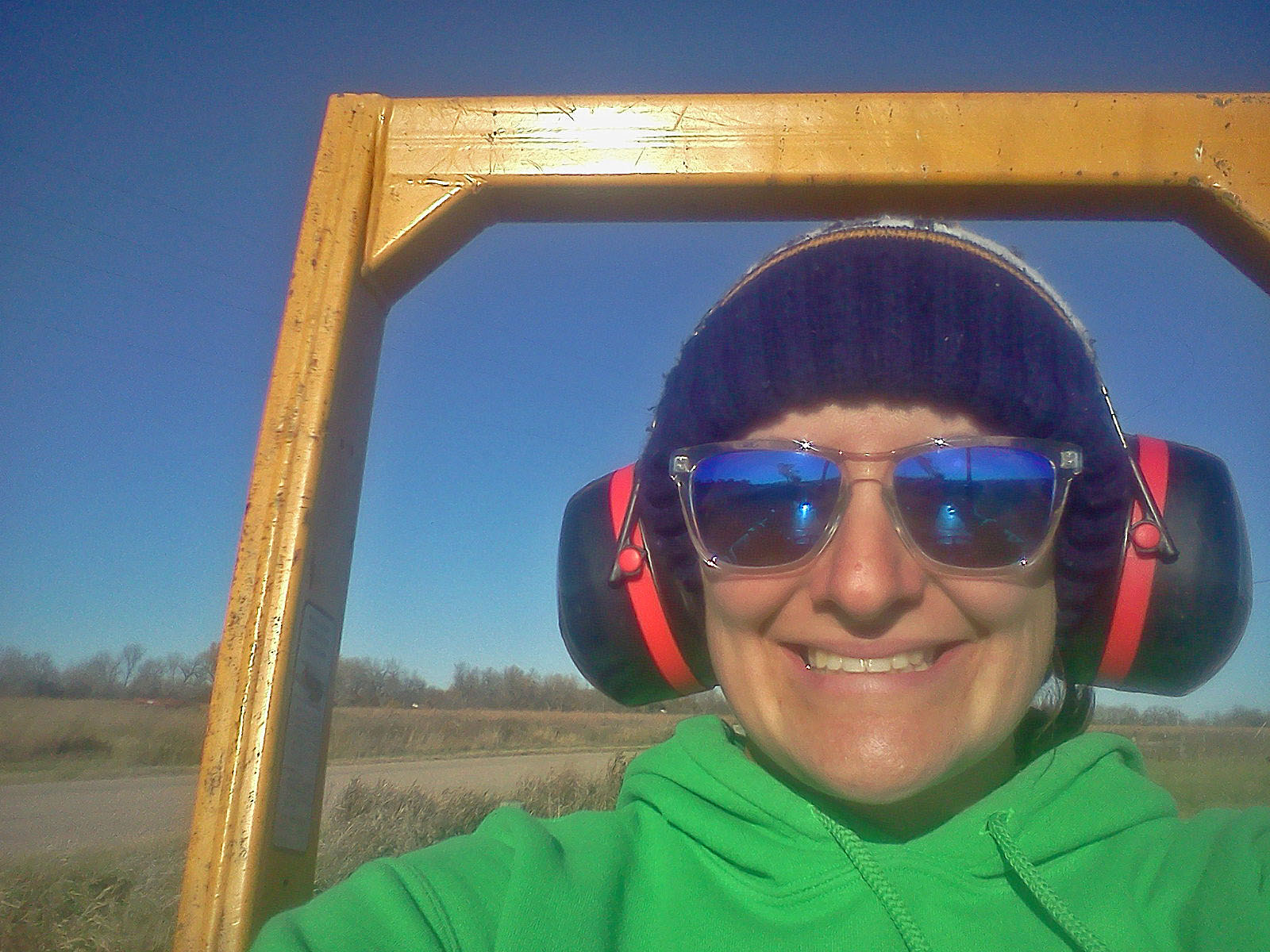
Ear protection: check! Cold protection: check! Awesome sunglasses: check! Don’t worry, I was parked.  Photo by Jasmine Cutter.

Ear protection: check! Cold protection: check! Awesome sunglasses: check! Don’t worry, I was parked. Photo by Jasmine Cutter.

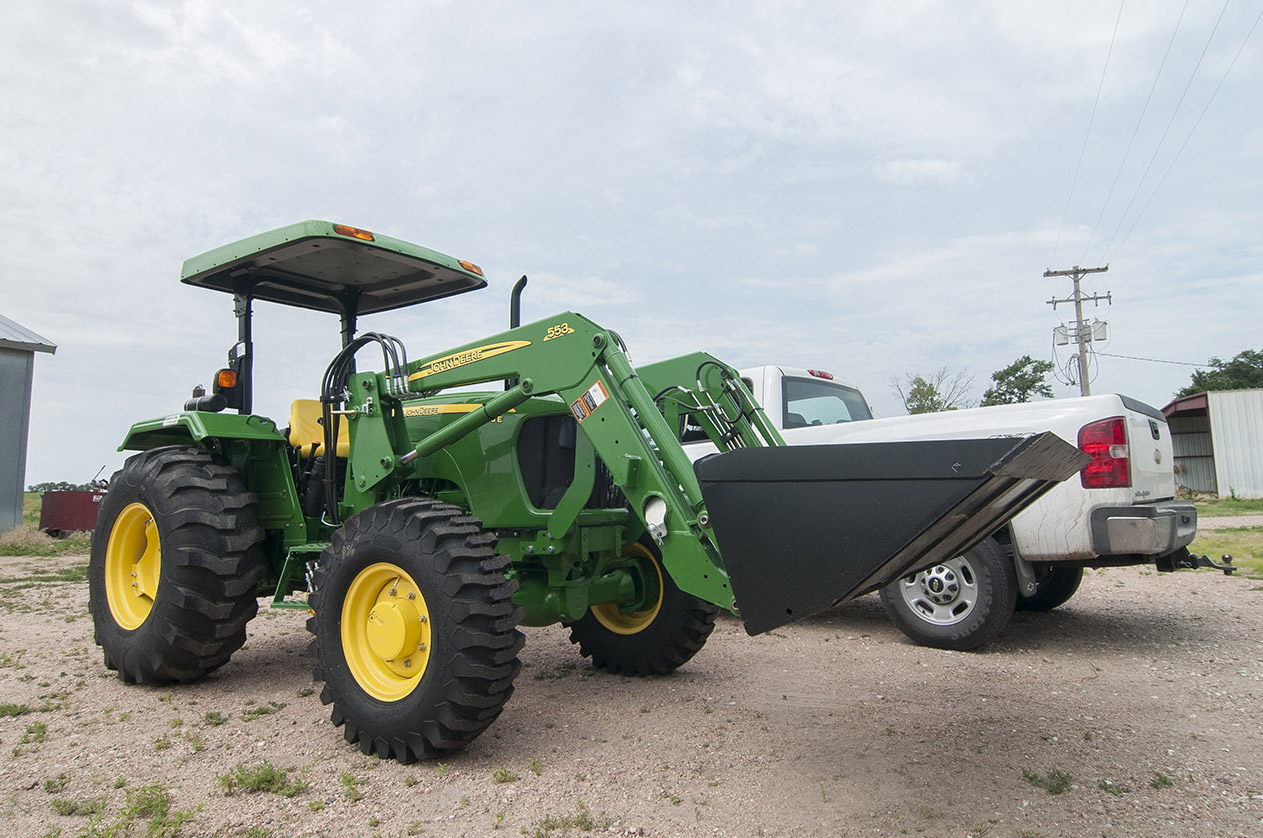
Dillon and I were lucky that soon after our arrival, Platte River Prairies acquired our new, shiny green John Deere 5075E tractor. There is also a well-used, slightly less intimidating, yellow John Deere 401B tractor. I knew that we would get to learn how to operate tractors as part of the Fellowship, but I was unaware of how vital the tractors are to our management here. Most of that was due to ignorance about how many ways a tractor can be put to use (sooo many ways!), but I was also generally naive about how precious labor and time is to land stewards. My previous stewardship experience at Carleton College was in a relatively labor-rich context – working in the Arboretum was a work-study option – and many management objectives were tackled by teams of students wielding hand tools. The dynamic here is very different: there is Nelson, there are the two Fellows (we spend a lot of time on stewardship, but also have other projects diverting our attention), Sam for the last few summers, and Chris and Mardell come and help when they can. Even with the help of our wonderful volunteers who help collect seed and tackle other projects for us, we’re dealing with a lot less available labor. Needless to say, I’m learning a lot about how to prioritize management and how to efficiently tackle our management objectives.

Ownership of a reliable tractor that is the right size and has the right attachments to fit our needs is essential to efficiently completing our stewardship goals. For example, we’ve been spending the last two weeks pulling out old fence line, and while we might be strong, we’re not fence-has-been-buried-by-six inches-of-dirt-and-sod-and-is-now-one-with-the-earth strong. I have tried tugging on those fences, and while we can make some progress, it’s amazing to operate the tractor and feel how easily our hydraulics enable us to tear out these wires that would take us days to uncover and pull out by hand.

.

The mighty green beast in all its glory!  Photo by Chris Helzer.

Our tractors certainly help with efficiency, but simply stated, we depend on them as our primary implement for a lot of our stewardship and maintenance. Our tractors are essential to mowing firebreaks and fence lines, and for shredding invasive vegetation to a height that delays its growth and makes it short enough for our sprayers. When we need to spray a large area (which isn’t too often), the tractor – and Nelson’s innovative spray setups – save us a lot of time, and give us a powerful tool against our more entrenched patches of invasive plants. The tractors are also used for pulling out stuck vehicles (not that we ever do that) and for navigating terrain that’s too swampy for our other vehicles.

I love our tractors because they enable us to accomplish our objectives, but I also appreciate that they give me a chance to hone a different set of skills. Tractor operation requires attention to detail, especially spatial awareness. I need to be able to judge terrain so I don’t tip over, I need to make sure I’m far enough from co-workers and vehicles that I’m not going to damage anything or anyone, and I also need to know which part of the tractor is going to move when I pull a certain lever. Because they are so powerful, it’s hard to undo something once you’ve done it with a tractor. There’s also a lot of multi-tasking. It’s surprisingly challenging to simultaneously steer, manage my speed, avoid obstacles, engage the correct lever, and ensure that I’m spraying (or mowing) what I intend to. But I’m feeling more confident in my abilities every day.

During the corn harvest, our neighbors invited us out to ride along with them in their combine and corn wagon. Years of curiosity finally fulfilled!

During the corn harvest, our neighbors invited us out to ride along with them in their combine and corn wagon. Years of curiosity finally fulfilled!  Photo by Jasmine Cutter.

Tractor time is also appreciated because mowing or spraying is relatively slow-paced compared to most of our stewardship tasks. For all their might, when you’re mowing with a tractor, the swath you’re able to cover is only as wide as the shredder attachment, which is a relatively unimpressive nine feet or so. When you’re covering several dozen acres nine feet at a time at 5mph, that is a lot of laps. But honestly, I really value this time, and the chance to examine every foot of our property (or at least every foot of the perimeter). I’ve honed my ability to identify plants while in motion, discovered gates I never knew existed, observed how voles move through the thatch, and gained a better understanding of how the plant composition of our units shifts with topography.

Our tractors are also indirectly beneficial to my life here. When the farmers are talking about their machinery, I have at least some idea of what they’re talking about, even if our tractor is maybe half the size of theirs. I now know what a PTO (Power Take-Off) is, I have stories about nearly tipping over (there was a buried beaver lodge), and I am able to get some respect when people learn that I drive the tractor, just like Nelson or Dillon.

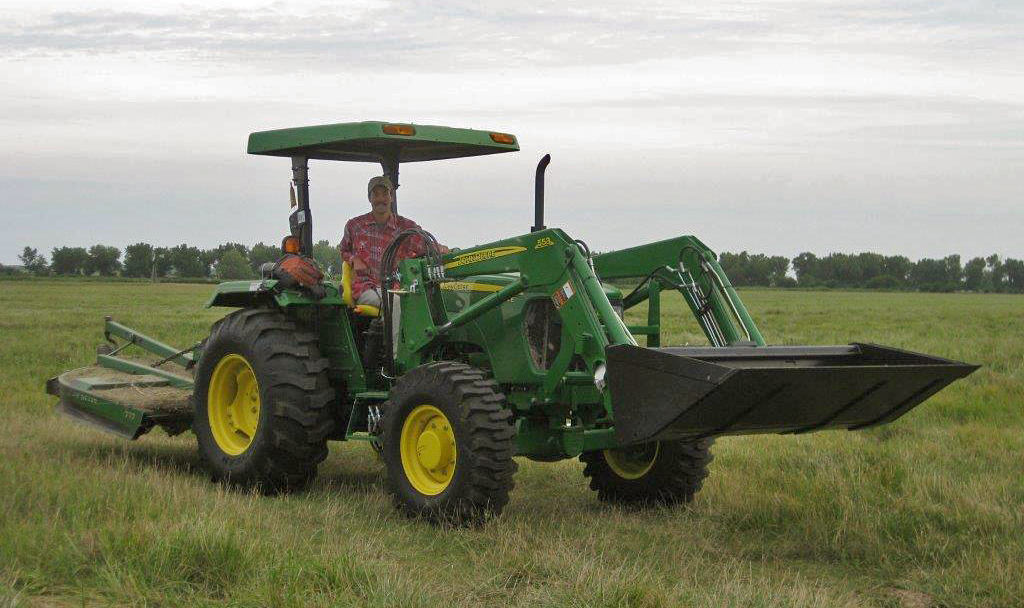
Dillon driving the John Deere.  Self portrait by Dillon Blankenship.

Dillon driving the John Deere. Self portrait by Dillon Blankenship.

While I’ve satiated the majority of my machinery-related curiosity, my only remaining wish is that I have a chance to operate the mythical skidsteer. I saw one in action at Carleton and marveled at its ability to wrench stumps from the ground (something we desperately need help with along our old fence line). Nelson has told us tales of their dexterity and usefulness at our Rulo site. Hopefully I will get a chance to drive the beast when we rent one in the spring; just think of all the farm cred I’ll garner!