Prairie Word of the Day – Habitat Heterogeneity

Do you know what time it is?  It’s time for another PRAIRIE WORD OF THE DAY!

Today’s Prairie Word of the Day (fine, it’s actually two words) is:

Habitat Heterogeneity

Heterogeneity is really just a longer word for Diversity, which is another way of saying “lots of different things”.  So why use the word “heterogeneity” instead of just saying “lots of different things”?  Well, for one thing, using big words makes a person sound smart, and when you’re a prairie ecologist and no one really understands what it is you do for a living, it’s good to at least sound smart.

More importantly, there’s a nice alliterative (another big word!) feel to the phrase Habitat Heterogeneity, which happens to be one of the most important phrases in prairie ecology.  In fact, I would argue that the foremost objective of any prairie manager should be to create habitat heterogeneity within the prairie(s) they manage.

Habitat heterogeneity simply means diversity or variety in habitat types.  Habitat homogeneity is the opposite – a lot of habitat that is all the same.

Every organism in a prairie has its own unique habitat requirements, so the number of different habitat types in a particular prairie is correlated with number of species that can live there.   Let’s use prairie birds as an example.  Birds such as upland sandpipers like to nest in large patches of relatively short-stature grassland.  Around here, a big hay meadow is great habitat for them, especially if it was cut fairly late in the previous year and is still short in stature when the subsequent breeding season starts.  On the other hand, Henslow’s sparrows want to nest in prairie habitats with relatively tall and dense vegetation.  It would be highly unusual to find Henslow’s sparrows and upland sandpipers nesting in the same patch of prairie because their habitat preferences are very different.  So, if you want both species in your prairie, you have to provide both short and tall/dense habitat.  Other birds have their own unique habitat requirements, including nearly bare ground (e.g., horned lark), relatively short, but with abundant thatch (grasshopper sparrow), tall with lots of tall/weedy wildflowers (dickcissels), tall and nearly impenetrably dense vegetation (sedge wrens), and many others.  Only if your prairie provides all those different habitat conditions will you attract all those different bird species.

Dickcissels prefer

Dickcissels prefer habitat with lots of tall wildflowers or weeds.  They often weave their nest into the stems of a tall clump of vegetation.

The same diversity of habitat preferences exists in other groups of prairie species as well.  Among small mammals, for example, voles tend to prefer habitats with abundant thatch, while pocket mice are more often found where bare ground is abundant – and there are many others.  Insects and other invertebrates have the same kind of diversity in habitat preferences

Scale is important.  While a bird, mammal, or insect might have a broad preference for a certain kind of habitat structure, it is likely to need some heterogeneity within that habitat too.  A mouse, for example, might prefer patches of prairie with fairly sparse vegetation, but it is likely to need a few clumps of vegetation dense enough to hide in when predators are near.  Insects and reptiles are ectothermic (cold blooded) and need to regulate temperature, so while a snake might like to hide in tall dense so it can bite your ankle as you walk by (I’M KIDDING!), it also needs some places to bask in the sun.  All of this means that habitat heterogeneity is important any many different scales.  Heterogeneity at a fairly large scale (acres) helps provide places for many different animals to live in a prairie, but heterogeneity within the home range or territory of each animal (square meters, or even centimeters) can be important too.

Some habitat heterogeneity occurs simply because soil texture, nutrients, and moisture, along with topography all vary across a landscape.  A prairie is likely to have areas of more productive soils where vegetation grows tall and thick, and less productive soils where vegetation is more sparse, for example.  In addition, water will pool in some areas of a prairie more than others because of topography, altering the habitat for both plants and animals.  However, despite this “naturally occurring” heterogeneity, it’s still important for prairie managers to look for ways to provide more.

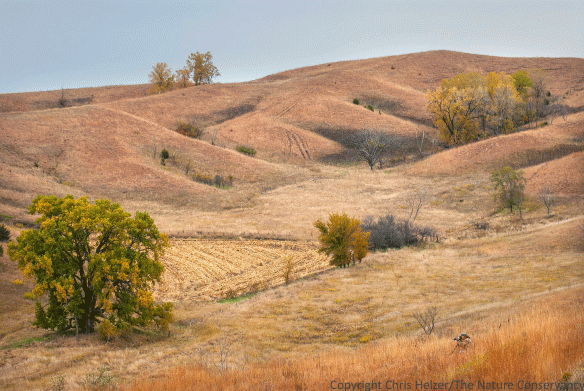
This landscape at The Nature Conservancy's Broken Kettle Grasslands in northwest Iowa shows the kind of natural heterogeneity that occurs in many landscapes.

This landscape at The Nature Conservancy’s Broken Kettle Grasslands in northwest Iowa shows the kind of natural heterogeneity that occurs in many landscapes.  Topography, soil variability, and other factors create a diverse set of conditions for plant growth and habitat structure.  Land management can add to that heterogeneity and improve it even more.

Prescribed fire and haying/mowing do a great job of altering habitat structure at a fairly large scale (acres).  By applying those treatments in different parts of a large prairie each year (and varying the timing of each from year to year), a manager can create a shifting mosaic of habitat patches that supports a wide diversity of animals.  However, both fire and mowing are pretty non-selective – most or all of the vegetation within a burned or mowed area gets the same treatment.  Leaving unmowed patches of grass here and there and varying the height of the mower as it moves across the site can help leave more heterogeneity behind.  Designing prescribed fires so that not all vegetation burns (e.g., mowing around some patches ahead of time, burning on days with lower temperatures or higher humidity, etc.) can also help with habitat heterogeneity – though those kinds of fire might also be less effective at killing trees or accomplishing other objectives.

In prairies where livestock grazing (cattle or bison, for example) is feasible, it is much easier to create small scale heterogeneity because grazers pick and choose which plants, and how much of each plant, to eat at any one time.  By controlling grazing intensity, and varying it across both time and space, managers can create prairie patches that are ungrazed, almost completely grazed, and in various stages of partial grazing – with a mixture of tall vegetation and nearly bare ground.  The uneven application of “fertilizer” from the rear ends of grazers contributes even more to habitat heterogeneity by temporarily altering soil productivity in lots of little spots across the prairie.

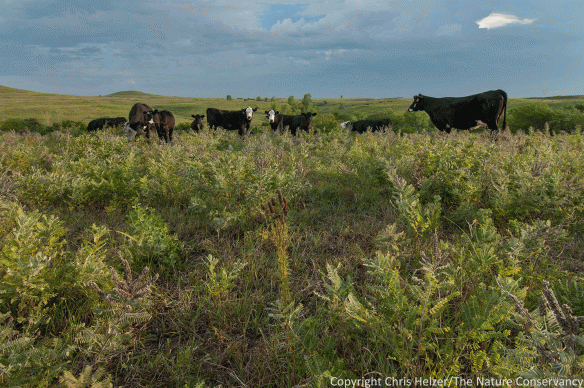
These cattle at Konza Prairie in Kansas

These cattle at Konza Prairie in Kansas have created a nice example of small scale habitat heterogeneity by grazing many of the grasses short while leaving leadplant, purple prairie clover, and other wildflowers ungrazed.

Whether it’s fire, mowing, grazing, herbicides or various combinations of those, creating habitat heterogeneity may the most important job of a prairie manager.  We still have a lot to learn about how the scale and configuration of habitat patches affect wildlife and insect populations.  What we do know, however, is that the prairies thrive when they have a lot of different types of habitat.  …When they have habitat heterogeneity.

And that, folks, is your Prairie Word of the Day.

Prairie Word of the Day – Disturbance

It’s been too long since the initial installment of what was intended to be a regular feature of this blog – the Prairie Word of the Day.  Since one blog post does not make a series, I figured I’d better at least write one more.  I will try to add more to the series relatively soon. 

If you read this blog or any other source of information about prairie ecology or management, you’re likely to have seen the term “disturbance” used in some context (e.g., “ecological disturbance,” “disturbance regime,” “disturbance in the force”).  Ok, that last one is from a different context, but nevertheless.

Outside of prairie ecology or other ecological conversations, a disturbance is often something that requires contacting the police.  However, in almost every case, prairie managers would appreciate you not calling the police in response to disturbances in a prairie.  So what does the word “disturbance” mean in an ecological context?

Fire is one of the big three historical disturbances to which prairies are adapted to and rely on.

Fire is one of the big three historical disturbances to which prairies are adapted to and rely on.

It’s probably easiest to think about a disturbance in a prairie as something that disrupts the lives and processes of prairie organisms and creates a shift in the competitive balance among those species.  Historically, the big three disturbances in grasslands were fire, grazing, and drought.  Fire and grazing are still used as management strategies today, along with mowing/haying and, sometimes, herbicide treatments.  Drought (and other significant weather events such as a flood) is not something managers prescribe or apply to a prairie, but it certainly has significant impacts.

Both “natural” disturbances and those prescribed by prairie managers are critically important to the health of prairies, despite the fact that they have significant impacts on species.  In fact, many animals, plants, and other organisms often die as a result of disturbances.  Prairies, however, more than most other ecosystems, are not only well suited to survive disturbances, they are defined by and rely on those disturbances.  Without fire and drought, for example, prairies wouldn’t even exist – they would be woodlands instead (and who wants that??).

Every time a fire burns through a prairie, grazers chomp off much of the vegetation, or an extended drought turns a prairie brown in mid-summer, the competitive balance in a prairie is altered.  Depending upon the timing and intensity of a fire, for example, it’s likely to kill some trees and “top-kill” others, forcing them to restart from buds at or below the surface of the ground.  Fires can also kill or suppress the growth of other plant species, especially those most actively growing at the time of the fire.  At the same time, fires create opportunities for other plants – especially those in direct competition with the ones suppressed or killed.  Plants that thrive best in full sunlight and don’t do well under layers of thatch or beneath tall plants also respond very favorably after a fire.

These cedar trees died in a recent fire, but the vegetation around them is regrowing strongly. In fact, the cattle (in the distance to the top right) in this prairie will be attracted to that growth and graze this part of the prairie much harder than unburned parts.

These cedar trees died in a recent fire, but the vegetation around them is regrowing strongly. In fact, the cattle (in the distance to the top right) in this prairie will be attracted to that growth and graze this part of the prairie much harder than unburned parts – adding a second disturbance to the first.

Of course, fires can also kill or injure wildlife or insect species (not to mention microorganisms and other life forms) that are aboveground at the time of the fire and can’t evade the heat and/or smoke.  The season in which a fire burns plays a big role in which organisms are affected.  Dormant season fires can kill insects and other species that overwinter in vegetation or along the surface of the ground, but growing season fires cause even more fatalities because so many more species are active during that time of year.  Even animals that survive the fire itself may have to travel to unburned areas in order to find suitable habitat, and those trips can be hazardous as well.

Despite the immediate negative impacts of fire on individual insects, wildlife, and other species, however, periodic fire usually has longer-term benefits – even for those species that suffer fatalities.  Without fire – or some other disturbance that removes vegetation – prairies can become so overgrown that most species can’t survive there.  Suffocating layers of thatch, encroachment by trees and shrubs, and the potential for diseases and predator populations to build up over time are all conditions that can be found in prairies that go undisturbed for long periods of time.  In addition, if the same habitat and growing conditions prevail year after year in a particular patch of prairie, some species will thrive but others will not – leading to a loss of species diversity and overall prairie health.

Without going into details here, the impacts of drought and grazing on prairie species are similar to those of fire – each event will favor some species over others.  Prairie plants are well adapted to periodic burning, grazing, or drought.  Perennial plants have numerous buds at their base, from which they can grow new shoots after they’ve been burned or cropped off, and most can enter dormancy during a severe drought in order to conserve resources for better days.  Shorter-lived plants often rely on disturbances to create opportunities for them to grow with less competition from nearby perennials.  Those annual and biennial plants produce copious amounts of seed that fall to the ground and wait until the next time conditions favor their germination and growth.

Every vertebrate and invertebrate animal species relies on a particular set of habitat conditions.  Some thrive when vegetation is short and sparse, and others prefer tall dense vegetation.  The highest diversity of animals and insects is usually found where perennial plants have been recently weakened by fire, grazing, and/or drought, and short-lived plants are thriving while those perennials recover.  In any case, habitat conditions are tied to disturbances – some conditions are created during or in response to a disturbance, and others (tall dense vegetation) are created when a disturbance hasn’t occurred for a while.

Prescribed fire, along the grazing and mowing, are important ways for prairie managers to introduce disturbances into grasslands in order to maintain prairie health and biological diversity.

Prescribed fire, along the grazing and mowing, are important ways for prairie managers to introduce disturbances into grasslands in order to maintain prairie health and biological diversity.

As prairie managers, our job is to provide habitat and growing conditions for as many prairie species as possible.  We burn, graze, and mow prairies at prescribed intervals (and usually in patches, rather than across an entire prairie) in order to maintain a competitive environment in which all those prairie species can survive.  Whenever we burn a prairie or introduce large grazers to it, we know that some species will be harmed by that action, but that others will flourish because of it.  As long as we allow a patch of prairie to recover between disturbances and create a patchwork of habitats (some recently disturbed and others not), the prairie community will remain diverse and resilient.

Prairie management is complicated, and it can be difficult to make decisions and take actions that you know are going to negatively impact some species.  On the other hand, the other choice is to do nothing.

And that would be disturbing.