
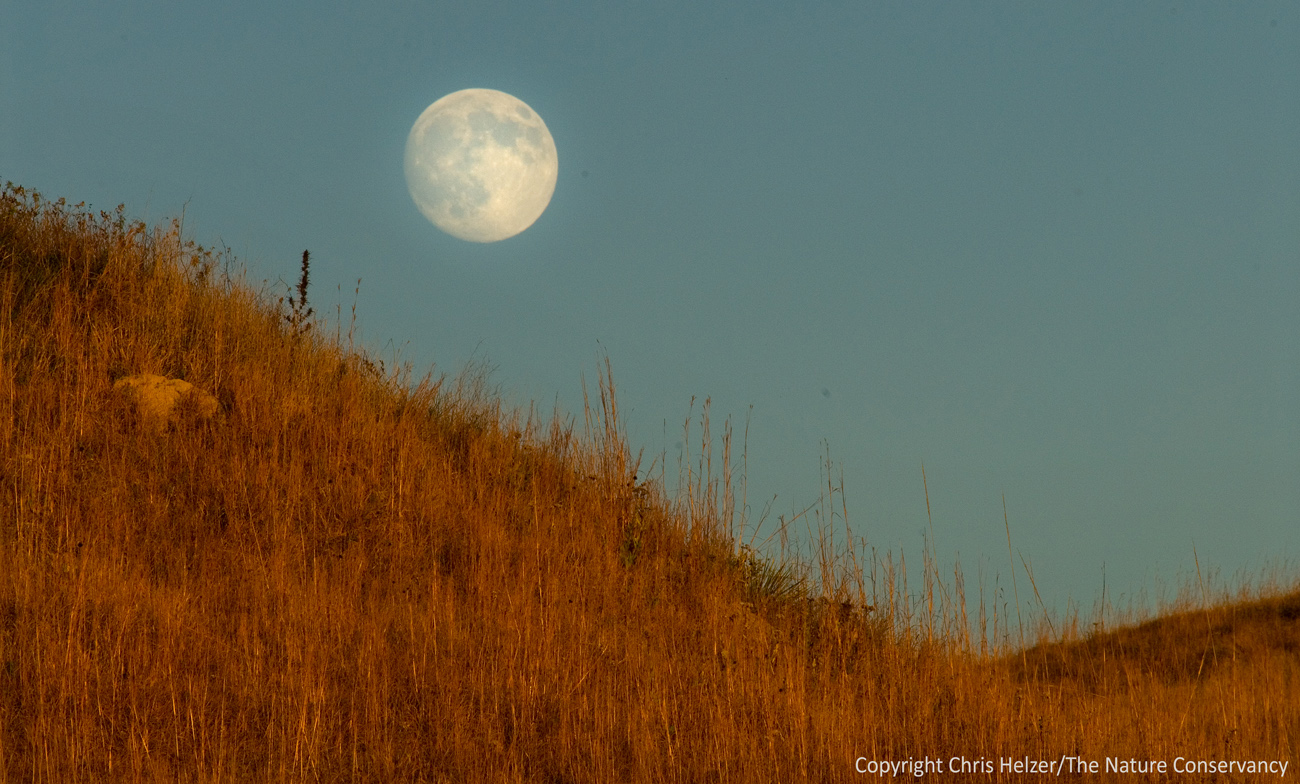
This photo was taken in October of 2007 at The Nature Conservancy’s Broken Kettle Grasslands in Iowa. The sun was going down as the moon was coming up – always a magical time for photographers.

- Moonrise over loess hill prairie at The Nature Conservancy’s Broken Kettle Grasslands – Iowa.
.
I had to use a long telophoto lens to get the moon to appear as large in the photo as it actually looked that evening. The technical trick was to get both the moon and the hillside in focus at the same time (the moon was quite a bit farther away than the hillside!).
The Broken Kettle Grasslands sit at the north end of Iowa’s Loess Hills – a great tallgrass prairie landscape. The Loess Hills of Iowa are a tremendous natural resource with some very nice prairie landscapes – along with plenty of threats, including woody plant encroachment and habitat fragmentation.
Interestingly, the Iowa’s Loess Hills get a lot more attention than Nebraska’s Loess Hills, which are 3 to 4 times (or more) the acreage. That lack of recognition is likely due to the fact that the Nebraska Loess Hills largely sit between Nebraska’s Sandhills and Platte River, both of which are world-renowned ecological landscapes. Nebraska’s hills are mixed-grass prairie, but have essentially the same soil type and topography as those in Iowa, along with some very nice prairie plant communities (in some places). They also suffer from the same threats as the Iowa Loess Hills – especially rapid expansion eastern red cedar trees. Even within Nebraska, few people are aware that there are Loess Hills in the state, let alone that those hills contain tremendous biological diversity.
 The Prairie Ecologist