
It’s fire season! Or, at least, it’s the season that many of us start conducting prescribed fires in prairies. For various reasons, March and April tend to be the months during which the vast majority of prescribed fires take place. Here in Nebraska, we missed the last big snowstorm that came through, so if the current weather forecasts hold, we hope to start sending smoke into the air next week.
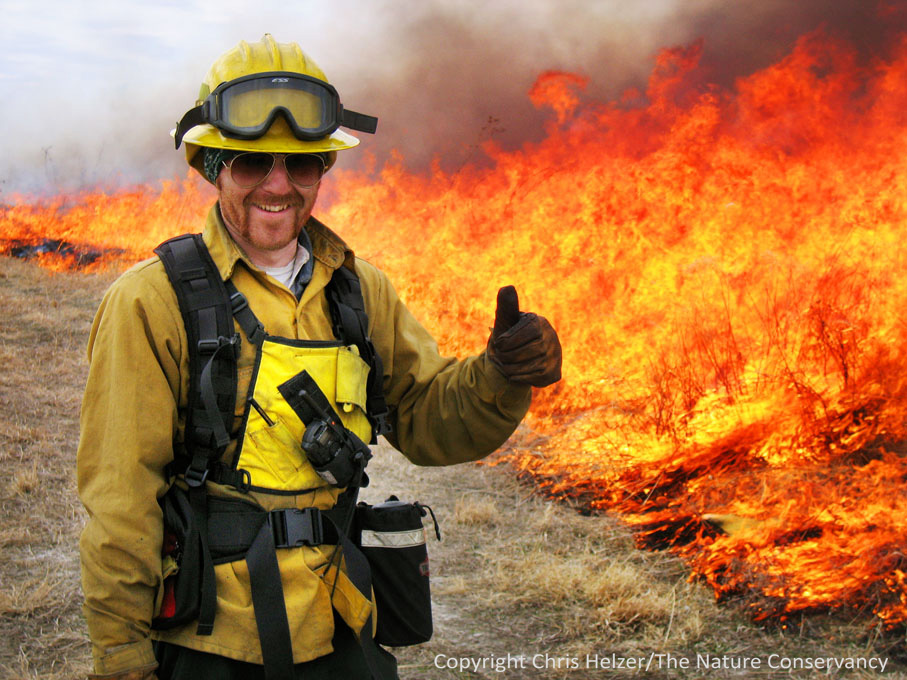
Our technician Matt is enjoying the opportunity to light things on fire. ...sure he is - he's not in charge! I still enjoy prescribed fire season, and feel a sense of accomplishment when we finish one, but it was a lot more fun when I wasn't the burn boss.
Before each spring fire season starts, we get together with local partners and hold a refresher course to go over safety procedures and generally remind ourselves that prescribed fire is a complicated and dangerous undertaking. One of the most useful – and goofy – parts of that refresher course is the sand table exercise, where grown-up biologists from multiple agencies and organizations play make-believe in sandboxes. We lay out hypothetical prescribed fire situations, complete with roads, houses, people, equipment, and hazards, and then run through various scenarios to give everyone a chance to think about how they’d respond in real life. Once you get over the initial silliness of the idea, it’s actually very useful.

Staff from the Nature Conservancy and partner organizations and agencies participate in a sand table exercise to simulate prescribed fire scenarios.
Because prescribed fire is not something to take lightly, it’s important to make sure the objectives are being met when a fire is conducted. The success of a fire shouldn’t be measured by the percentage of a grassland that turns black, but by whether or not objectives for habitat manipulation, plant community impacts, etc. are met. Remember that prescribed fires can be conducted during any season of the year, and that it can be good to shake up the timing – and other aspects – of your fires to ensure that you don’t always favor the same species (at the expense of others). See an earlier post on this subject here.
Above all – be safe out there!
 The Prairie Ecologist