
I spent much of this week at our Niobrara Valley Preserve. During most of that time, photography was difficult because of bright sunlight, no clouds, and strong winds, but the place was still beautiful. Most of the colorful leaves had already fallen from the sumac, ash, oak, and cottonwood trees, and I only found a few asters that still had flowers. Regardless, there was plenty of life to be seen. I spotted a kangaroo rat in my headlights as I drove down the lane to the headquarters my first night. Bald eagles were wheeling above the river, and I saw red-tailed hawks, American kestrels, and northern harriers hunting as well. Flocks of other birds went here and there, either migrating through or just moving nomadically in search of food. During a couple evening walks, the relative quiet was broken by high-flying squadrons of sandhill cranes passing overhead.

Late day light on ponderosa pine skeletons, burned in the 2012 wildfire.
One evening, I climbed up to the top of the ridge north of the river and photographed the landscape as the sun went down. By the time I got back down to my truck, it was pretty dark, and I became very aware of how many shadowy places were available for creatures to hide. I started musing that I still hadn’t seen a mountain lion at the Preserve, even though we know they’re here, and have had several documented recently. Then I realized that it was less important to think about how many mountain lions I had seen and more important to think about how many lions had seen me! I’m pretty sure that second number is higher than the first.

Many of the pines killed by the 2012 fire have lost their tops to the wind, but this one was still standing tall and intact.
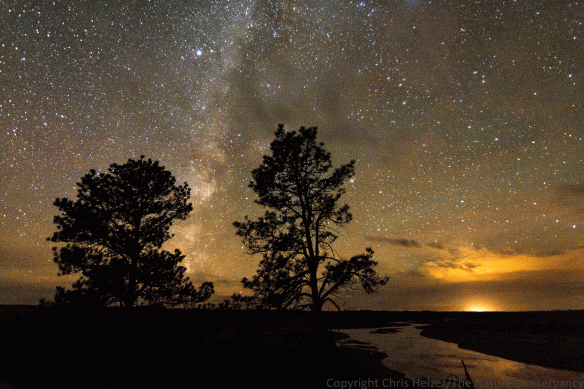
While cloudless skies make daytime photography difficult, they do have their advantages at night, especially when the wind calms down enough for long exposures (the camera shutter was open about 25 seconds to capture this starry scene). The light along the horizon is not from the setting sun, but from the closest town of any size (Valentine, Nebraska, population 2700) which was about 25 miles away.

Only a few trees still had their leaves this week, making them stand out in the river valley.
I will be up on the Niobrara again late next week, and I’m really looking forward to it. Even in the dormant season, there’s always plenty to see.


 The Prairie Ecologist