
Prairie landscapes are often defined by broad sweeping vistas and big skies. A wide-angle lens can be great for capturing that kind of huge open landscape. However, I’ve gotten some of my favorite Nebraska landscape photos when I’ve exchanged my wide angle lens for a telephoto.
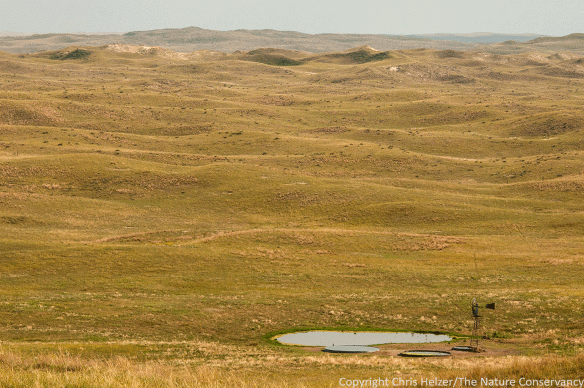
Sandhills and windmill in Cherry County, Nebraska. My zoom lens was set at 122 mm for this shot, just long enough to get both the horizon and windmill in the photo, but still short enough to still show some landscape breadth too.
Using a long lens compresses a landscape and shows off the depth and texture of a landscape in a way that is very different from an image taken with a wide angle lens. The above photo of the Nebraska Sandhills came after several attempts to capture the immensity of the prairie with a wide-angle lens. My wide-angle lens showed a lot of the landscape, but it looked relatively flat and unimpressive – especially because there wasn’t anything going on in the sky. A longer lens brought the distant hills closer and made them more prominent. It also cut most of the sky from the image, leaving only the interesting parts of the scene.
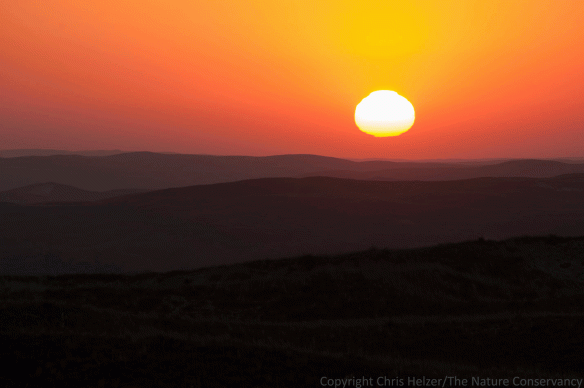
In this Nebraska Sandhills photo, a 300mm lens not only compressed the hills, it also made the rising sun look large enough in the image to reflect the way it looked in real life.
Sunrises and sunsets, along with moonrises and sets, can often be disappointing in photographs because the sun/moon looks much smaller in the photograph than it does in real life. A long lens can help make the orb look more like our eyes see it when we’re there.
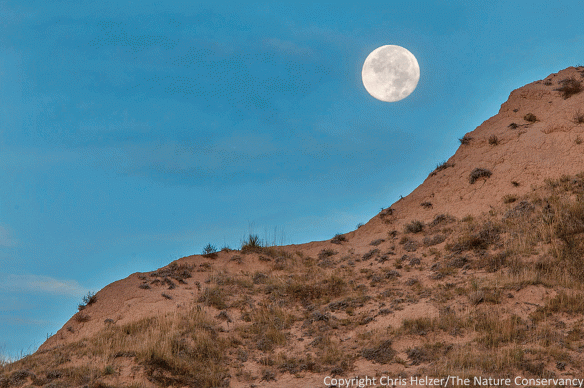
What works for the sun also works for the moon. On this early morning, the moon was going down behind the bluffs at Scottsbluff National Monument in western Nebraska. (Zoom lens set at 230 mm)
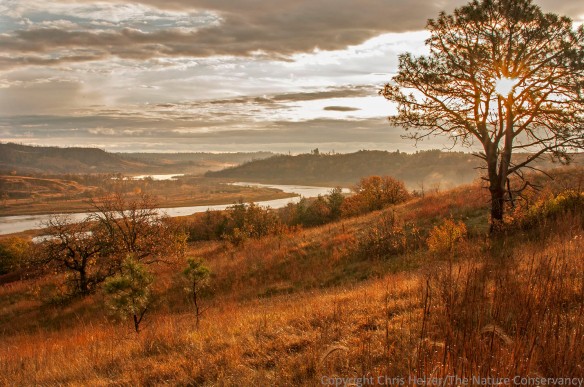
The photo below is one of my all-time favorites from the Niobrara Valley Preserve, and is actually a scan of a slide from back when color slide film (Fuji Velvia!!) was the state of the art in nature photography. Just as in the windmill/hills photo above, there wasn’t anything interesting happening in the sky, but the light was good (getting close to sunset) and the sideways light provided great texture on the distant hills. One of the hallmarks of the Niobrara Valley Preserve is that it hosts a convergence of multiple ecosystems, and this photo shows many of them.
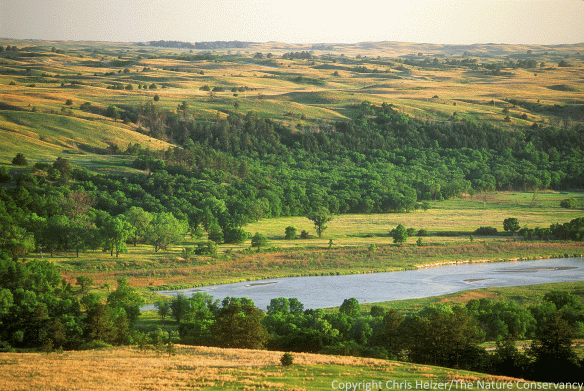
The Niobrara Valley Preserve as seen from a ridgetop north of the river. The use of a 300mm lens allowed me to include many of the different ecosystem types all in one photo, including tallgrass prairie/oak savanna in the foreground, the Niobrara river and its floodplain, deciduous woodland and ponderosa pine stands, and Sandhills prairie.
If you find yourself standing on a high ridge or hilltop and can’t seem to make the landscape look as impressive on camera as it does in real life, try using a longer lens (or using the zoom on your phone or point-and-shoot camera). Though it seems counterintuitive, zooming in can sometimes help show off a broad landscape better than zooming out.





 The Prairie Ecologist