
I have to admit it – my job is pretty sweet. Every job has its ups and downs, but this week has been mostly ups (apart from being without my family). I’ve spent the last several days with about 240 other scientists and conservation staff of The Nature Conservancy here in Austin, Texas. It’s hard not to be inspired and energized when discussing fire, invasives, grazing, ecology, and many other conservation topics with incredibly smart and innovative people.
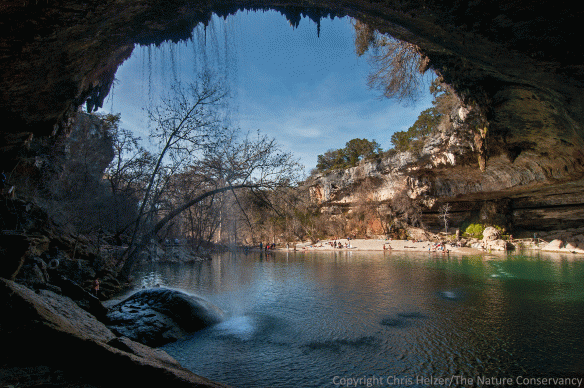
I wrote earlier this week about the first half of the field trip we took in the Hill Country around Austin. During the second half of that trip, we visited Reimers Ranch Park and Hamilton Pool, the latter of which is an iconic natural feature and recreation site. It is so popular that demand far outstrips the capacity of the parking lot and park, and we were told that and incredible 70% of visitors are turned away. (We visited on a Tuesday afternoon in February and the parking lot looked full.)
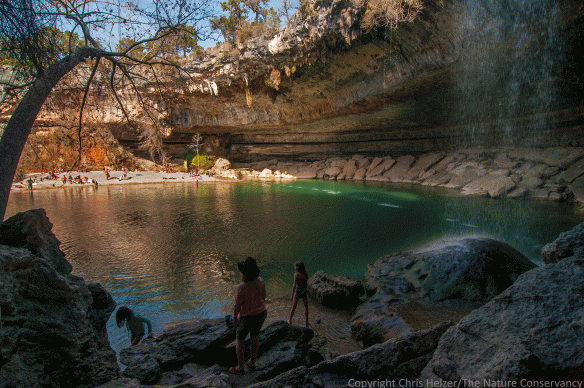
Hamilton Pool – the beautiful result of a collapse roof of a cave over an underground river.

Since my post earlier this week on our tour of the Barton Creek Preserve, I’ve gotten considerable feedback, both in person and electronically, about my description of the site. The intent of the post was primarily to explore the idea that land managers often have very different objectives from each other because each deals with unique landscapes and situations. I described the Barton Creek Preserve and its management as it had been presented to me during our field trip there. Well, apparently, there are some very disparate views about the historical conditions at Barton Creek and the surrounding Hill Country. I’ve had a fair amount of feedback from Texas ecologists who disagree with the way I characterized the site.
Most everyone agrees that there was soil loss due to years of heavy grazing, but I’m also hearing that the site may have had pretty shallow soils even before domestic cattle and goats were introduced. Those shallow soils supported (and still support) a diverse flora, including plants that are endemic to the Hill Country. I’ve also gotten to listen to and read competing accounts of whether the pre-European vegetation of the site’s uplands consisted of grasslands, shrublands, savannahs, or open woodlands.
It’s clear that I’ve unwittingly wandered into a discussion in which I am completely unqualified to participate. I am very happy (and eager) to leave further discussion of the historic conditions of Barton Creek Preserve and the Texas Hill Country to others, and I’ve edited my earlier post to reflect a more balanced account of the site’s ecology.



 The Prairie Ecologist