
Hubbard Fellowship Blog – Lobelias and Pollinators

A guest post by Anne Stine, one of our Hubbard Fellows.  All photos are by Anne.

Derr Sandpit Wetland Restoration - The Nature Conservancy's Platte River Prairies, Nebraska.

Derr Sandpit Wetland Restoration – The Nature Conservancy’s Platte River Prairies, Nebraska.  September 12, 2013

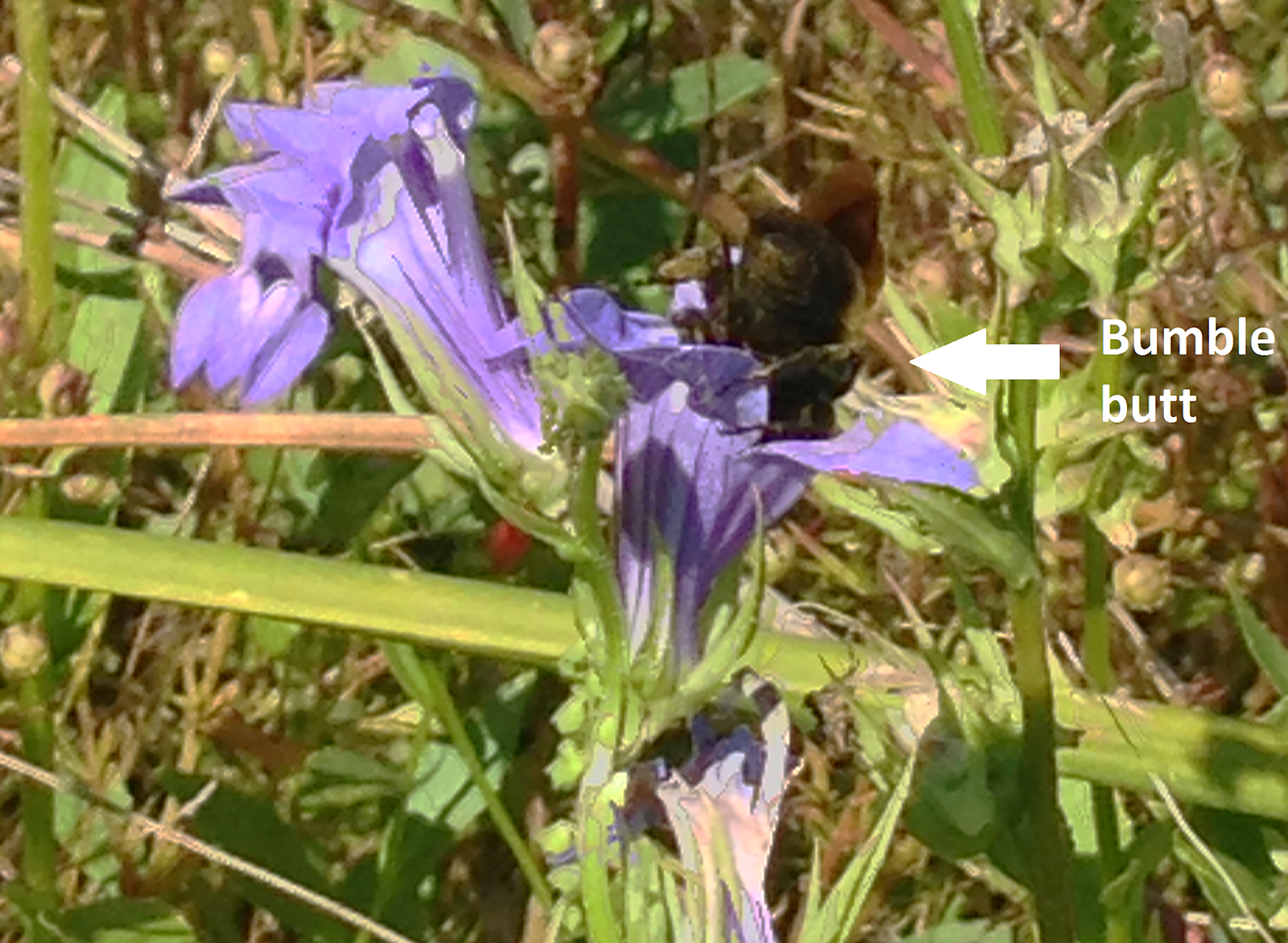
I was scouting for native seeds in our sand pit restoration across from the crew quarters when I noticed a fascinating pollinator-plant interaction. This activity would’ve been best captured on video with a high quality zoom (which I did not have), but I was able to take pictures.  Bumble bees, and only bumble bees, were fighting their way into great blue lobelias along the edge of our restoration.  Meanwhile, their neighboring cardinal flowers were visited by butterflies exclusively.  Why, and how, were these two closely related flowers so specialized with their pollinator partnerships?

First, let’s consider the great blue lobelia (Lobelia siphilitica).  The architecture of this flower insures that only burly bumble bees can gain access to the pollen and nectar.  Some other insects “cheat” and chew holes in the flower to by-pass the petal-gate, but bumble bees are their primary visitors. Watching the bumble bees pry open the flowers was entertaining. First, they climb onto the flower’s extending ‘tongue’. Then, they push aside the two top petal ‘lips’ and dunk themselves head first into the flower.  Their front half is completely inside the blossom. Only their bottoms and back legs stick out.  They clamber up the stalk, climbing from flower to flower until they reach the top, and then they fly off to visit a neighboring plant.  Because great blue lobelia seems to grow in patches, this is an efficient operation for both bee and blossom.  The bees act drunk on nectar, and the flowers are practically guaranteed a thorough pollination.

Ghh

How bumblebees gain entry to lobelia flowers.

.
Success!

Success!

Conversely, cardinal flower (Lobelia cardinalis) is traditionally considered to be a ‘hummingbird-specialist’ plant.  We are just outside the range of the ruby throated hummingbird here on the Platte River Prairies.  Instead, butterflies with their long tongues seem to have taken over the majority of the nectaring and pollination duties.  Or perhaps cardinal flowers in this part of Nebraska predominately self-pollinate.  At any rate, bees weren’t the major customers on cardinal flowers.  Cardinal flowers were visited by butterflies.

How strange that these two wetland con-generics, great blue lobelia and cardinal flower, could grow in intermingled patches and still rely on totally distinct pollinator communities.  Nature is weird and wonderful.

This monarch had the choice between blue lobelia and cardinal flower.  She chose cardinal flower. So did all the other butterflies.

This monarch had the choice between blue lobelia and cardinal flower.  She chose cardinal flower. So did all the other butterflies.

This monarch had the choice between blue lobelia and cardinal flower. She chose cardinal flower. So did all the other butterflies.

The Softer Side of Wasps

A couple weeks ago, I posted a photo of a wasp (along with some other shots from a walk through one of our wetlands) and mentioned that I’d have a story about that wasp in an upcoming post.  Here you go…

As I was looking for something interesting to photograph on my wetland walk, I noticed this paper wasp (Polistes fuscatus) nectaring on swamp milkweed (Asclepias incarnata).  It was moving slowly enough – and was focused so strongly on nectar – that it was relatively easy to get some photos of it.  In fact, I ended up watching and photographing it for about 10 minutes.

A paper wasp (Polistes fuscatus) feeding on milkweed nectar.

A male paper wasp (Polistes fuscatus) feeding on milkweed nectar.

You may or may not know that most (all?) wasps in our prairies feed on nectar as adults, but feed invertebrates to their offspring.  Many wasps are parasitoids – they capture and paralyze their prey, stuff it into a burrow or other similar structure, and then lay an egg on it.  When the egg hatches, the wasp larva feeds on the paralyzed invertebrate.  Most wasp species specialize in capturing a particular kind of invertebrate; some attack spiders, others go after cicadas, bees, flies, etc.  Parasitoid wasps tend not to be aggressive toward humans, and are (at least most of them?) solitary – just a single female provisioning food for her nest.  The mud dauber is an example of a parasitoid that is often seen in yards.  Their mud tubes often show up on the sides of houses or inside garages.

A mud dauber wasp creates a ball of mud to build her nest.

A black and yellow mud dauber wasp creates a ball of mud she’ll use to build her nest – a mud tube – which she’ll then fill with paralyzed spiders and her eggs.  A second species of mud dauber (irridescent blue/black) doesn’t make her own nest, but instead opens up the mud tubes of the black and yellow dauber, takes out the original eggs, and replaces them with her own!

The paper wasp is a little different.  Paper wasps are social, and their familiar hanging nests are initiated each spring by a fertilized queen.  Often, the queen will be joined by other females who help build the nest and feed the young.  However, any eggs laid by those other females are eaten by the queen, ensuring her dominance.  As the nest grows, multiple generations of wasps are produced, some of which become aggressive defenders of the nest – and that’s when the trouble starts for those of us who host paper wasps on our front porches.

Another difference between paper wasps and parasitoid wasps is that paper wasps catch and kill their prey (often caterpillars) rather than just paralyzing it.  In fact, after they kill a caterpillar, they’ll feed chunks of it to their older larvae and then give prechewed pieces to younger larvae.  You can read much more about paper wasps at this wonderful site from the University of Michigan.  In addition, here is a link to a short YouTube video with fantastic footage of paper wasps.

Returning to the wasp I was photographing in our wetland…

As I watched the wasp, I noticed that his feet were starting to accumulate quite a few sticky pollinia from the milkweed flowers.  Some of you who have been reading this blog for a while might remember a previous post that detailed the unlikely, but fascinating process of milkweed pollination.  Essentially, the process relies on an insect accidentally sticking its foot into one flower, pulling out a pollinia (a sticky packet of pollen), and then stepping into another flower and losing the pollinia as it pulls its foot back out.  Everything has to work just right for pollination to occur, and it seems as if it would hardly ever work, but the number of milkweed pods each fall are evidence to the contrary…

The same wasp a few minutes later, with multiple pollinia attached to its feet.

The same wasp as above, with multiple pollinia attached to its feet.  The pollinia are the yellow globs at the tips of its legs.

After the wasp accumulated a number of pollinia, it stopped feeding and started trying to remove the pollinia by running its legs through its mouth.  I couldn’t tell if it was eating the pollinia or just removing them.  Either way, it worked at it for quite a while, and it still didn’t get them all of (a good thing for the milkweed plant!)

The wasp trying to remove the pollinia from its feet (to eat?  because they're irritating? I don't know...)

The wasp trying to remove the pollinia from its feet (to eat? because they’re irritating? I don’t know…)

Wasps are common visitors to flowers, but in many cases are less effective pollinators than fuzzy bees that get coated with pollen. However, as I’ve been paying particular attention to bees and other pollinators during the last several weeks, I have seen numerous wasp species on milkweed flowers.  That probably works out pretty well for the milkweeds, since all they really need is a creature that steps into multiple flowers as it crawls around.

Paper wasps are not among most people’s favorite insects, and for good reason.  Many of us have been stung by the aggressive defenders of a paper wasp nest.  On the other hand, those stinging wasps are just defending their nest and queen – a noble and virtuous act, and something that’s hard to blame them too much for.  Regardless, it’s also nice to see a paper wasp doing something that contributes to the greater good, like pollinating a milkweed plant.  When I’m out taking photos of fluffy white milkweed seeds later this fall, I’ll be sure to mentally thank the paper wasp for a job well done.