The Problem with “Calendar Prairies”

I think I first heard the term “calendar prairie” from my friend Bill Whitney of Prairie Plains Resource Institute.  He was talking about the mental image many people have of prairies that comes from seeing photographs of grasslands full of big showy flowers in books, posters, and calendars.  The term, and its implications for prairie management, has stuck with me over the years. 


An example of a "Calendar Prairie" photo. The Henry C. Greene Prairie at the University of Wisconsin-Madison Arboretum.


Unrealistic Expectations

There are a couple of dangers associated with people holding a mental image of what a prairie is supposed to look like.  The first is that it’s easy for people to have unrealistic expectations for prairies.  I’m a photographer, so I know firsthand that flowery photos don’t always represent an accurate picture of the prairie in which the photos were taken.  Photographers are often drawn to the biggest patches of showy flowers, and by creative use of perspective they can make those patches look even showier than they look in real life.  The result is usually a beautiful photograph that someone familiar with the prairie might not recognize.  To be clear, I’m not saying this kind of photography is a bad; on the contrary, attractive photographs have been extremely important for building the public’s interest in prairies. 

However, photos dominated by big showy flowers have the potential to be counterproductive as well.  For example, I worry that someone whose only vision a prairie comes from a “calendar prairie” image will be disappointed when they first see a prairie in person.  Regardless of how wonderful that real-life prairie is, it’s unlikely to live up to the photograph(s) that person has seen.  If that happens, it’s possible that a possible prairie enthusiast might instead feel duped and decide that prairies aren’t their thing after all.

For people that are already prairie enthusiasts, or perhaps prairie owners/managers, calendar prairies can become an unfair standard by which they measure the prairies they’re familiar with.  I’ve been in some astonishingly showy tallgrass prairies, where photos full of big flowers are easy to take just by pulling out a camera and shooting randomly.  However, not all prairies look like that – nor should they – and the ones that do don’t usually look like that all season long.  There are numerous conditions (including topography, soil moisture, soil texture, management history, etc.) that determine the appearance of a prairie’s plant community.  Using a calendar prairie image as the standard by which all prairies is judged is obviously naïve – much like a young woman using a movie star as the standard by which she judges her own identity.  The value of a prairie can be judged in many ways, including by its habitat value for a wide range of animal and insect species, many of which do not rely on big showy flowers.  In fact, the biggest value of an individual prairie is its very individuality – its unique combination of species composition and habitat attributes makes a unique contribution to the larger prairie conservation mission.  (Read my earlier post on this topic.)

This is not to say that all prairies are perfect the way they are.  Most (all?) prairies can be improved, but goals for improvement should be based on increasing the value of those prairies for biological diversity – not on making them look more like a photograph.

Effects on Management

The second danger of a calendar prairie image is that it can affect the way a prairie is managed.  Prairie managers sometimes form a mental picture of what they want their prairie to look like.  Sometimes that picture is based on an unrealistic idea of what prairies should look like.  Other times, it’s based on a fond memory of what their prairie looked in a previous season.  Either way, the problem occurs when that manager tries to make the prairie look like that mental picture all the time.  Rather than managing the prairie in response to threats such as invasive species, or in ways that allow different plant and animal species to gain an advantage each year, the prairie gets the exact same management treatments every year.
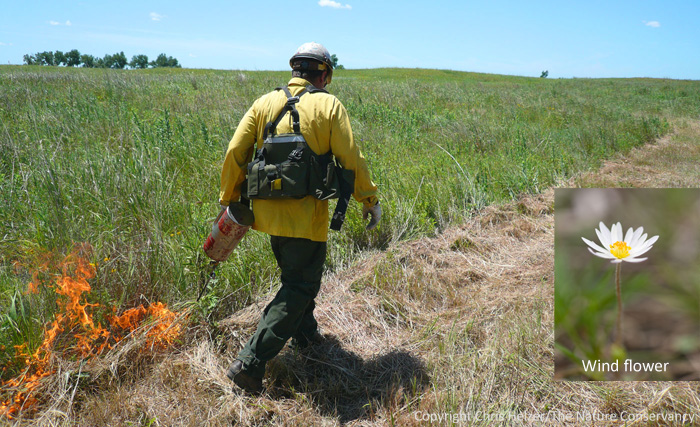
A summer fire on The Nature Conservancy's Platte River Prairies. We've seen very interesting and positive responses from summer fires, with and without grazing. For example, I've been managing this prairie for more than 10 years and have only seen wind flower (Anemone caroliniana) twice - both times it was growing in the portion of the prairie that had been burned the previous summer.


When a prairie gets the same management each year (e.g. early spring fire or summer haying) some plants, animals, and insects that are favored by that management and others are not – year after year.  Eventually, those species that are put at a disadvantage each year can disappear from the prairie.  Sometimes the strategy seems successful to the manager because the plant community appears the same each year; they always see the same big showy flowers blooming, for example.  However, other plant species may be slowly fading away.  More importantly, many animals and insects that have specific requirements for habitat structure will have a difficult time surviving in a prairie that provides only a single habitat structure type across the entire prairie each year.  Even those animals and insects that thrive may become more at risk from predation because the number of predators and their focus on particular prey species can both grow when their food source is consistently available in the same place and abundance each year.

 In a large contiguous grassland landscape, individual parcels of land that are managed the same way every year may not be a big deal – as long as there is variety among parcels.  If the Brown prairie is managed with annual late-spring fire, the adjacent Smith prairie is managed with annual summer haying, and nearby prairies are managed with other strategies, the conglomeration may retain good biological diversity, even if each individual tract of land contains a relatively narrow set of species.  However, when neighbors manage in similar ways, or when isolated prairies are managed in ways that decrease the number of resident species over time, the entire landscape can lose diversity.  If that happens, it’s unlikely that the diversity will recover because there are no places for the lost species to recolonize from.

 Ideally, every prairie would have multiple management treatments applied to various parts of it each year.  For example, a portion might be burned, a portion idled, and a portion grazed, with those treatments shifting from place to place each year – not necessarily in a predictable manner.  In a prairie managed that way, most or all plant species are likely to find favorable conditions in which to grow and bloom every few years – something that is critical to their long-term survival.  Animals and insects in a prairie that has multiple management treatments across it have a good chance to find suitable habitat each year by moving to the portion of the prairie that is most favorable in that year.

Light grazing on a restored Platte River Prairie - cattle are grazing the grass but leaving most wildflowers ungrazed. Periodic grazing can certainly change the appearance of a prairie, but plants that are grazed recover quickly. In the meantime, the grazing can provide different habitat structure and opportunities for plant species that are normally suppressed by dominant grasses.

 Some prairies are small enough that splitting them into multiple management units is not feasible.  In those cases, just shaking up the management so that it’s not exactly the same each year can be important.  Idling a different portion of the prairie each year – even if those portions are small – can provide a refuge for some of the plant and animal species that might not do well under the management applied to the majority of the prairie.  However, when prairies are both very small AND isolated from other prairies, some insect and animal species will simply be unlikely to survive long-term, even with good non-repetitive management.  In those cases, the management objectives may need to be altered – those sites could be treated more like museum pieces than prairies.

 Regardless of a prairie’s size, repetitive management over time can limit its biological diversity.  Prairies evolved under chaotic conditions; fires, grazing, outbreaks of herbivores, and drought came and went, and prairie animals and plants developed strategies to adapt.  Not only can prairie species survive management that changes year to year, they can thrive on it.

 Conclusion

Relying on idealistic visions of what prairies should look like (Calendar Prairies) creates an unrealistic image of what prairies really are.  Prairies evolved as dynamic natural communities that changed in appearance from day to day and year to year.  Rather than selling the public and ourselves on the idea that prairies should consistently look like showy flower gardens, we should celebrate and facilitate their changeable nature.  Real prairies are much more interesting (and valuable) than flower gardens anyway.
Why Every Prairie Really is Unique – and Why it Matters.

Confirmation that every prairie has its own unique composition of plant and insect species, and discussion about why that’s important for conservation.

Several years ago, I helped assemble a group of partners to begin some pilot research on what kinds of impacts habitat fragmentation may be having on the tallgrass prairies in southeastern Nebraska.  While those prairies are greatly fragmented compared to the extensive Nebraska Sandhills or Kansas Flint Hills prairies, there are still many blocks of hundreds to thousands of acres of prairie embedded within a matrix of cropland.  Those grassland complexes include a mixture of hayed prairies, grazed prairies, and Conservation Reserve Program (CRP) fields.  As conservation organizations consider the best ways to ensure continued survival of those important grasslands, many of the most pressing questions revolve around whether or not the prairie landscape is intact enough to support a functional ecosystem.

We still have a long way to go before we know much about the “functioning” of the southeast prairies, but we have collected enough data to know one thing:  every one of those prairies is unique.  While that not exactly earth shattering news, especially to biologists who have inventoried numerous prairies, it’s really very important.  To be more specific about what we’ve found, each prairie appears to have its own individual “signature” of plant and insect species compositions.  In other words, each has a mixture of species that is similar to, but also very different from, other prairies – even among prairies that are managed much the same way and that appear very similar from a distance.

For example, over the last couple of years we have done vegetation surveys in 24 hayed prairies as part of a couple of insect research projects.  We selected the 24 sites because we believed they were very similar to each other in plant community but varied in size and degree of isolation.  In other words, we tried to pick sites with identical plant communities.  Boy did we fail.  To be fair, the graduate student that selected the sites did so by driving gravel roads in April and May, and one hayed prairie looks a lot like another from the road at that time of year.  But we did try…

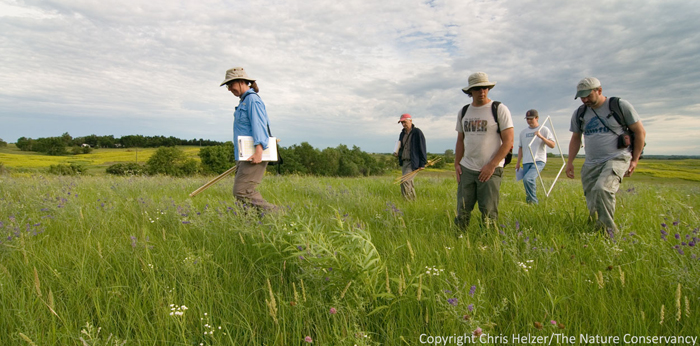
Staff from the Illinois Natural History Survey assisting with vegetation inventories in hayed prairies. Southeast Nebraska - Pawnee County.

There were some strong similarities among the prairies.  Most of them had had abundant cool-season grasses, but also strong representation from warm-season native grasses.  In addition, all of them had a good diversity of plant species – most averaged between 20 and 25 plant species per square meter.  Many of the more common wildflowers were found in all, or nearly all, of the prairies, and in similar amounts – including species like stiff sunflower (Helianthus pauciflorus), heath aster (Aster ericoides), black-eyed Susan (Rudbeckia hirta), pussytoes (Antennaria neglecta), and wild alfalfa (Psoralidium tenuiflorum).  Finally, the majority of the prairies had apparently been inter-seeded at some time in the past with non-native legumes such as red clover, sweet clover, and others, and those species were moderately to very abundant in those prairies – although not to the extent that they seemed to have an impact on overall plant diversity.

However, the differences among the prairies were as obvious as the similarities.  For example, of the 24 prairies, prairie phlox (Phlox pilosa) only appeared within our sampling plots (50 1m2 plots at each site) in three of them – but it was very abundant at those three sites.  Why is it abundant at a few sites and rare or missing from others?  Prairie blazing star (Liatris pycnostachya) showed a similar pattern.  Other important wildflower species – those considered to be among the core species of tallgrass prairie plant communities – only appeared in the data from about half of the sites.  Those species included compass plant (Silphium laciniatum), purple prairie clover (Dalea purpurea), hoary puccoon (Lithospermum canescens), and wild strawberry (Fragaria virginiana), among others.  To be clear, these data don’t indicate whether or not species were absent from an entire site – only that they were absent from the 50 1m2 plots we sampled from at each. Regardless, we saw significant differences in the relative abundance of those species from site to site.  Other important species that varied wildly in abundance among the prairies included prairie dropseed (Sporobolus heterolepis) and eastern gamagrass (Tripsacum dactyloides).  Those two species were in most of the prairies, but appeared in nearly 100% of the plots in some prairies and in only one or two plots in others.

Prior to initiating our research project that used those 24 hayed prairies, we did some broader surveys of prairies that included both hayed and grazed prairies to assess the degree of variety within plant and insect species at those sites.  (The grazed prairies, by the way, reflected many different kinds and intensities of grazing, but are lumped together here for simplicity.)  Because it was pilot data, we did some quick inventories of plants at each site, trying to list all the species we could find.  Not surprisingly, there were some stark differences between grazed and hayed prairies in their plant compositions.  In a few cases that variation could be explained by site conditions (such as rocky or steep terrain) because those conditions clearly made grazing more feasible than haying – in those cases plant species may have been responding to the site rather than the management.  In most cases, however, it was clear that the plants were responding to management.  Plant species like false gromwell (Onosmodium molle), tall boneset (Eupatorium altissimum), partridge pea (Chamaecrista fasciculata), and hoary vervain (Verbena stricta) have life strategies that allow them to thrive under grazing because they are less palatable to grazers than their neighbors and/or can respond more quickly to the space opened up by grazing.  Those and other similar species were found almost exclusively at grazed sites.  On the other hand, there were species like New Jersey tea (Ceanothus herbaceus) and golden alexander (Zizea aurea) that were found much more often at hayed sites than grazed.  While the majority of plant species were found across the entire range of site types, their relative abundances showed that most responded much better to either the hayed or grazed conditions.

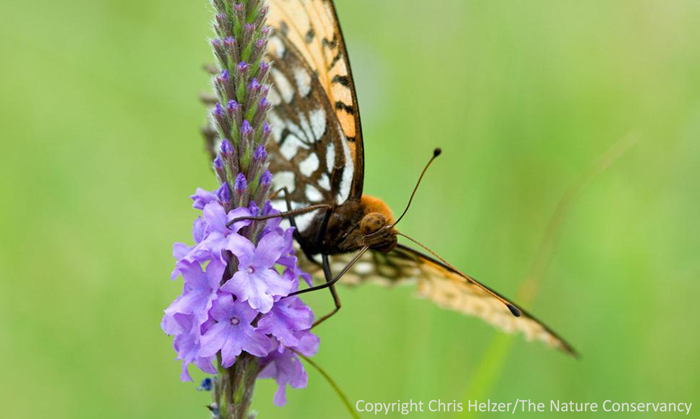
Hoary vervain is a wildflower found mostly in grazed prairies in southeastern Nebraska, and one that is extremely important to pollinators, including regal fritillary butterflies.

Within those same grazed and hayed prairies, we also did some sweep netting of insects.  We targeted our sweeping so that we collected insects off of the same plant species across all of the sites (using a couple different plant species).  We wanted to see whether the insect communities using a particular plant species were essentially the same at all of the prairies.  They’re not.  What we found was that the insect data were even more chaotic looking than the plant data.  Very few insect species were found at all, or even the majority of sites.  That’s likely due to the relatively small amount of sampling we did.  But even with our small samples, it was clear that a large number of species were abundant at one site but absent from many others.  The other strong pattern was that the total abundance of insects was often quite a bit higher – among many species – at the sites we’d considered to be “lower quality” based on our plant data.

There are a number of reasonable – even obvious – explanations for these variations among prairies, including soil type, topography, past management, random chance, etc.  But more important are the lessons that come from recognizing those differences.  First, I think the differences demonstrate the importance of management.  Surely some of the differences between the vegetation composition in those 24 hayed prairies stem from variations between sites relative to the timing and frequency of annual haying, the consistency of timing and frequency over many years, and whether or not the prairies are fertilized.  Later season haying, for example, allows more (and different) plant species to complete their life cycle prior to cutting than early season haying (or twice-annual haying).  Completing their life cycle now and then is critical for the long-term survival of plants because it allows them to reproduce and store energy for the coming winter.

The existence of a combination of hayed and grazed prairies within the landscape is also important.  Because there are plant species (and likely insect species) that do better under grazing management than haying management, and vice versa, having both types of management within a neighborhood can maintain more biological diversity than either of the management types alone.  Of course, managing each of those prairies with a combination of fire, grazing, and perhaps haying, might allow even more plant and insect species to persist on each prairie – although the local abundances of some species might go down because they would lose the consistent management that had allowed them to become dominant.

From a conservation standpoint, one big lesson is that it’s not sufficient to simply rank prairies by floristic quality, size, or other measurements, and act to “protect” the best of those.  In order to conserve the complete diversity of life in the southeastern Nebraska prairies, we need to keep as many of the remaining prairies as we possibly can.  While the grazed sites might look less attractive to a botanist driving by compared to hayed prairies full of compass plant and blazing star flowers, the aesthetic preferences of botanists don’t necessarily reflect the biological needs of ecosystems.  While there was surprising variation between the hayed prairies we looked at, a very significant degree of biological diversity would be lost if the grazed prairies were plowed up.

Even if it were the desired strategy, there’s no way conservation organizations would or could buy up a significant number of the grasslands in southeastern Nebraska, so working collaboratively with the landowners of those prairies is of the utmost importance.  Relying on private landowners to conserve prairies has been a tough pill for many conservation organizations to swallow – including the one that employs me – but during the last several decades most have recognized that need.    The next trick is to refine our skill at working with those landowners without coming across as know-it-all biologists.  The most successful private lands liaisons from the conservation community have been those who listen well, recognize the importance and value of individual landowners’ priorities (remembering that it is THEIR land), and build relationships on mutual trust.  Through those relationships, we can alert landowners to aspects of their prairies and management options they might not be aware of, but the decisions about how to manage their sites still have to be left to the landowner.  Clearly, that will result in some prairies being managed in ways that make some of us uncomfortable, but we don’t want all the prairies to look the same anyway, right?