
Stick with me – this isn’t as complicated as the title might lead you to believe…
I was involved in an interesting discussion a couple weeks ago among some fellow prairie ecologists about what makes a “good prairie”. The discussion brought into sharper focus something I had thought a lot about but only in general terms. Here is the discussion – with some over-simplification of the respective positions:
Position A – Species Composition:
A high quality prairie (tallgrass prairie, in this case) can be judged largely by its plant species composition. A “good” prairie might have 20 or 30 plant species per square meter, for example, and more than 100 species per acre – including a mixture of both common and rare species. Besides the value for the direct conservation of species, that kind of plant diversity provides multiple ecological benefits. More plant species means more choices for animal species that rely on them as food and/or habitat resources, as well as a more consistent supply of those resources through the season – because some plants will always be emerging/blooming as others go dormant. Because of that, prairies with lots of plant species tend to have lots of insect and other small animal species as well. In addition, prairies gain resilience from plant species diversity, because if multiple species fill similar ecological roles the prairie community can better withstand the temporary decline of some species due to drought or pest outbreak. A prairie that is missing many of its species, or that is dominated by a few species with only scattered small populations of others, can’t be considered to be of high quality or to be “conserved.”

A diverse prairie at the Madison Arboretum – Madison, Wisconsin.
Position B – Structure and Process:
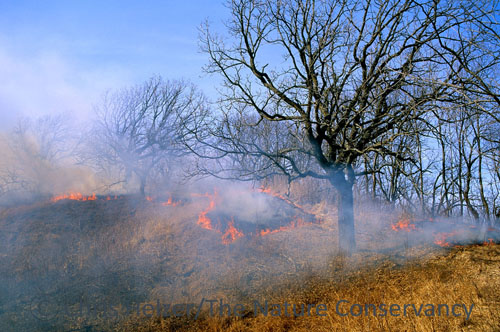
What really defines successful grassland conservation is the presence of large-scale and intense disturbances (e.g. fire and grazing). The combination of fire and grazing shaped historic prairies and that combination is needed today to maintain them. Without fire, prairies lose integrity in several ways – the most obvious being the encroachment of trees that fire otherwise suppresses. Fire also helps drive the cycling of nutrients and regulates the amount of standing dead vegetation and thatch in prairies. Furthermore, the high-quality of the fresh vegetative regrowth following a fire attracts intense grazing by herbivores large and small. Historically, there would have been few cases where a prairie would burn and not be intensively grazed right afterwards. That intense grazing suppresses dominant prairie grasses, opening up space for the abundant growth of weedy vegetation once the grazers move on. As the prairie recovers, the dominant grasses reassert themselves and the vegetation becomes tall and dense enough to carry fire once more. A landscape consisting of a heterogeneous mixture of recently burned patches and patches that haven’t burned for several years provides the full range of habitat structure – from very short to very tall – and thus supports the full range of prairie wildlife species. Perhaps most valuable in that range of habitat structure is the post-fire/grazing recovery phase that provides simultaneously provides a wealth of stemmy vegetation cover and abundant seeds for wildlife food.

An expansive prairie landscape in the Nebraska sandhills.
So is Position A or Position B correct? Well, yes. It’s like owning a sports car. You need to keep all the sparkplugs, tires, and other parts – and keep them in good condition. On the other hand, a sports car is no good if you can’t drive a standard transmission and/or don’t have good roads to drive on. Aldo Leopold said, “To keep every cog and wheel is the first rule of intelligent tinkering” – but those important components include both species and the processes that maintain them.
Interestingly, the two positions seem to be strongly correlated with geography. People who work with the fragmented tallgrass prairies in Midwestern States like Illinois, Wisconsin, and Indiana tend to fall more heavily in the first camp – emphasizing species composition. In contrast, people who work in the large expanses of grassland in Oklahoma, Kansas, western Nebraska, and the Dakotas, tend to hold Position B – emphasizing process and structure. In both cases, the positions are reasonable based on the local situation. In the eastern tallgrass prairie, most of the prairie is gone, so any remaining grassland is precious and there is great concern about the loss of prairie plant and insect species. Further west, where grasslands still dominate the landscape, there is much less concern about the loss of plant and insect species and more focus on larger wildlife like prairie chickens that require a range of habitat conditions not always found in those ranching-dominated landscapes.
As usually happens in a discussion among reasonable people, a partial consensus emerged in ours, and there was general agreement that neither Position A or B was sufficient by itself. Proponents of species composition as the measure of prairie conservation success would surely not be fully satisfied with a flowery prairie that was missing species like prairie chickens, upland sandpipers, and bison. They just don’t often have the opportunity to work with grasslands large enough to support all of those species. Likewise, proponents of structure and process wouldn’t be happy with 20,000 acres of switchgrass just because it had a heterogeneous mix of fire and bison grazing and lots of prairie chickens.
The point here is not that we need to subscribe fully to either Position A or Position B, but that we can’t afford to ignore either one. Those working in the fragmented eastern tallgrass prairie need to be sure to emphasize strategies like prairie restoration that can strategically convert crop fields back to prairie vegetation and enlarge remnant prairies to the point where they have a chance of supporting prairie chickens and upland sandpipers, if not bison. And even at smaller scales, finding creative ways to reintroduce the combination of fire and grazing, where possible, may help provide better wildlife habitat – and might even pay dividends for plant species conservation (more discussion on this in posts to come.)
Meanwhile, ecologists with the luxury of large unplowed expanses of native grassland need not to forget the importance of restoring and/or maintaining both large-scale and small-scale plant diversity. While adequate habitat structure for species like prairie chickens can be created in a landscape dominated by grasses and weedy forbs, pollinators and many other insects may have a much more difficult time surviving there. In addition, whether the intervening landscape is dominated by grass or corn, small isolated populations of prairie forbs (and the insects that rely on them) aren’t likely to survive forever if they’re not able to cross pollinate or otherwise interact with each other. Native bees that have to find consistent sources of nectar within a small radius from their nest rely on small-scale plant diversity to provide abundant blooms every day of the growing season – and pollination by those bees is critically important for the survival of many plant species. Finally, proponents of process should recognize and appreciate the potential (but understudied) values associated with a diverse plant community – including a diverse and vigorous soil fauna, and the overall resilience offered by a mix of species that provides redundancy of ecological function.
The danger for all of us is that we tend to look at prairie conservation through a cultural lens – and we sometimes don’t see what our prairies, and our strategies, are missing. It would be great if we could facilitate some cultural exchanges, in which we sent Texas cowboys to the Illinois black soil prairies and Wisconsin prairie restoration experts to the flint hills of Kansas. Imagine the discussions that would ensue – not to mention the neighborhood coffee shop gossip.

Participants in the Grassland Restoration Network discussing prairie conservation at The Nature Conservancy’s Nachusa Grasslands, Illinois.
I feel fortunate to be involved in two groups that do a great job of stimulating interaction and discussion – the Grassland Restoration Network and the Patch-Burn Grazing Working Group. The former is a loose affiliation of ecologists working to use prairie restoration as a tool for grassland conservation in fragmented landscapes. The latter is a network of scientists, land managers, and ranchers trying to find better ways to combine fire and grazing and create heterogenous prairie landscapes. (I’ll provide more information on both of those groups in future blog posts.) Now if I can just figure out how to convince the two groups to hold a joint meeting…

 The Prairie Ecologist