
Smooth Sumac Suppression

You might recall a couple posts back in the summer of 2025 about woody encroachment in prairies. In the first, I talked about how it is becoming increasingly difficult to prevent woody encroachment in many prairie landscapes. Within those landscapes, we need to start learning how to manage shrubbier grasslands for biodiversity and productivity. In the second post, I discussed a couple small trials we were conducting to examine various stewardship approaches to suppressing the height and density of shrubs (one of which is the subject of today’s post).

Feel free to go back and read those posts if you like. They’re reasonably well-written, if I do say so myself. To save you time, though, the quick summary of the first is that increased carbon dioxide in the atmosphere is making woody plants much more competitive these days. That, combined with altered fire regimes, changes in native browsers, and other factors, means many prairies are getting shrubbier.

Where we can maintain open prairies with minimal woody cover, we should do that. However, if you’re managing a prairie that already has a lot of shrubs or trees, or if your prairie is surrounded by a landscape full of woody plants, it might be time for a different approach.
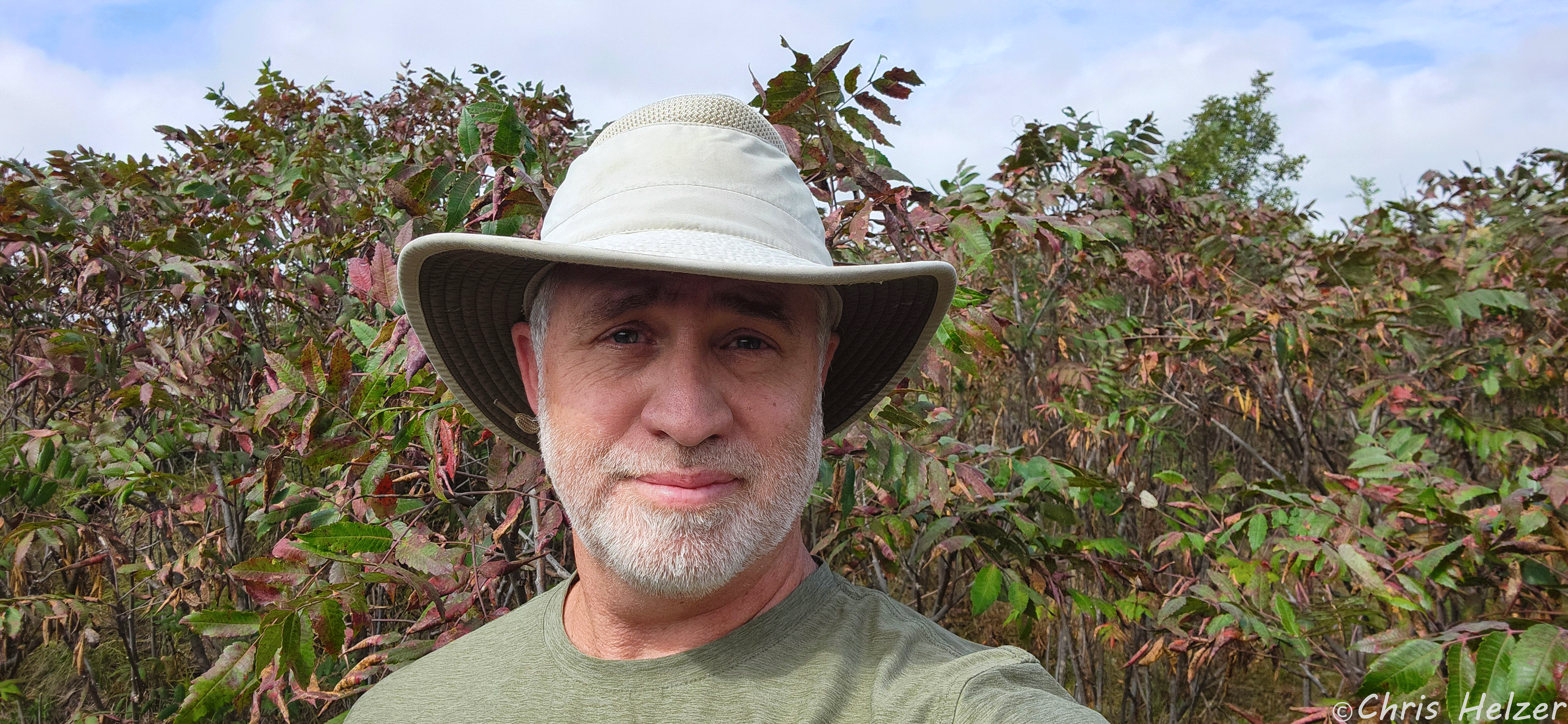
Your intrepid author, surrounded by smooth sumac taller than himself. Not all woody encroachment has to look like this. I, apparently, do.

Trying to eradicate big patches of shrubs from prairies, even if it’s possible (and it probably isn’t), is likely to cause losses in plant diversity and other negative impacts. Instead, what if we figure out how to mitigate some of the downsides of those shrubs and try to preserve diverse, if woodier, prairies? Again, I’m greatly simplifying this whole topic, so if this seems illogical or confusing, please go back and read those earlier posts.

We’ve been experimenting with various approaches toward managing the habitat structure of shrubby prairies. Today, I’m sharing some results of early trials with smooth sumac. I’ll report soon on some work we’re doing with roughleaf dogwood and western snowberry.
You can click on graphs and photos to see larger versions of them. If you’re reading this in an email, you might have to first click on the title of the post to open it online.

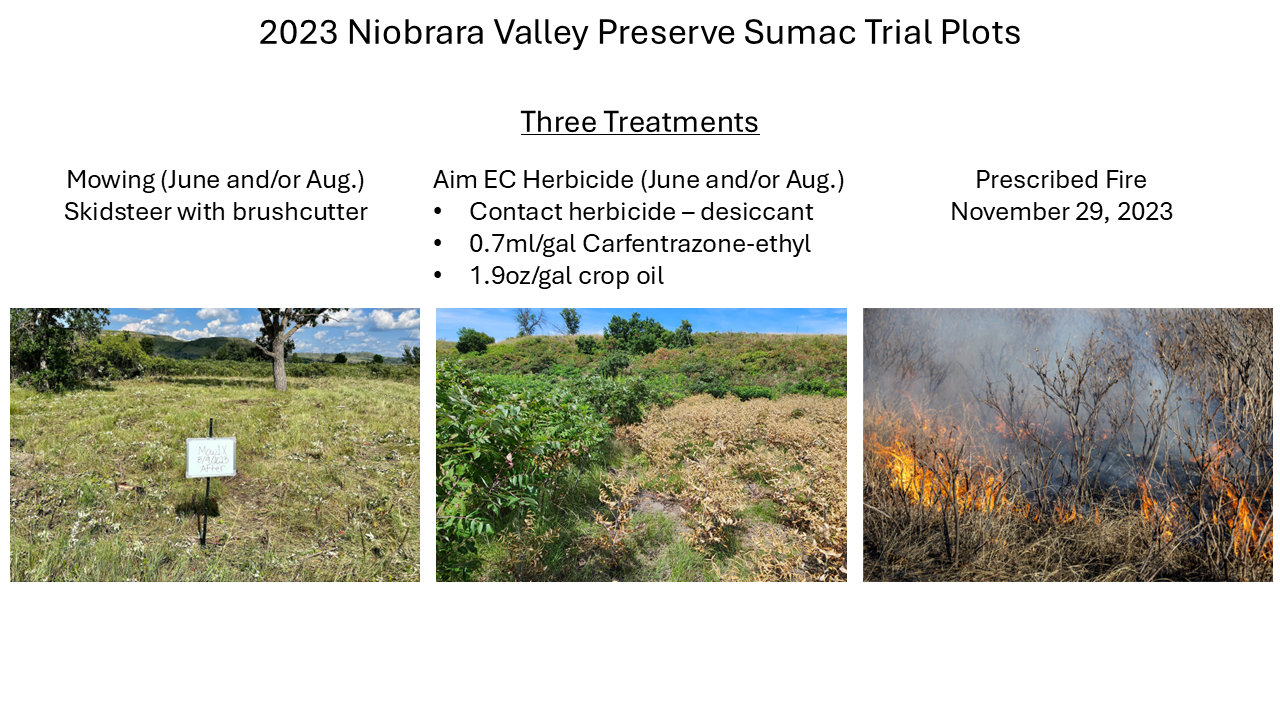
Back in 2023, we set up some trial plots at the Niobrara Valley Preserve to test the basic idea that multiple treatments in a growing season would have longer lasting effects than a single treatment. Others have seen that combining treatments leads to better results, so we were trying to build on those efforts. We tested combinations of three treatments – mowing, fire, and an herbicide called AIM, which is a contact herbicide that basically desiccates the foliage of broadleaf plants and shrubs. All these plots were treated in 2023 only. I went back to measure the results three years later in late 2026.

I was particularly interested in the herbicide because unlike most herbicides used for shrub control, this one won’t kill either the shrubs or any surrounding perennial wildflowers. The hope was that it would act similarly to a fire. The first thing we learned is that it doesn’t do very much to full-size sumac plants. The herbicide spray didn’t penetrate well into the canopy and just burned off some of the top leaves. However, it worked much better as a second treatment on the regrowth of mowed stems. As a result, we abandoned the plots where we sprayed AIM as a first treatment.
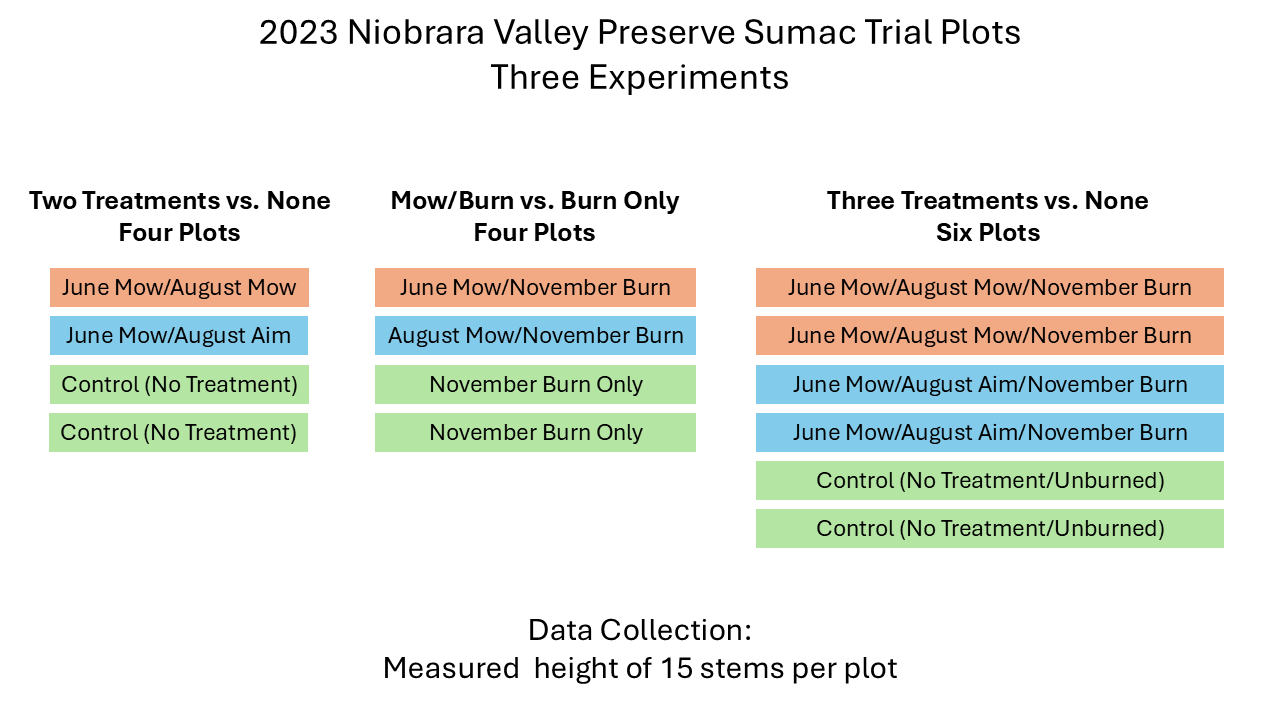
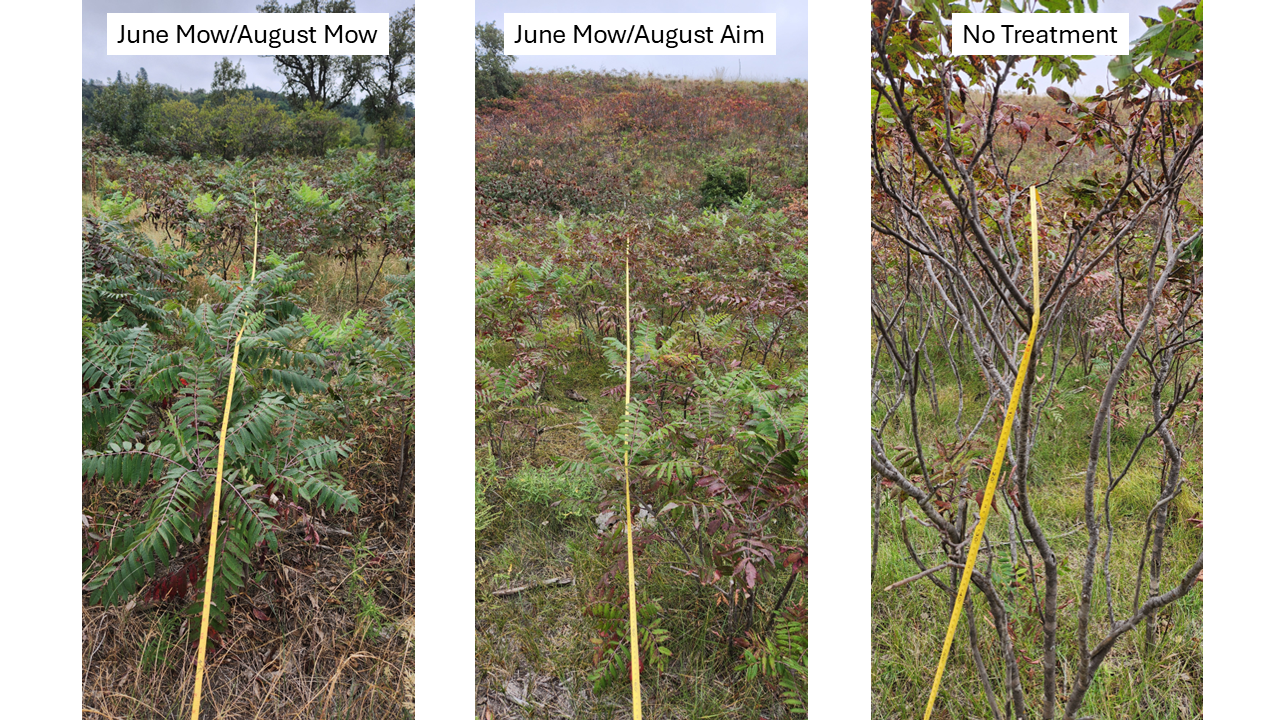
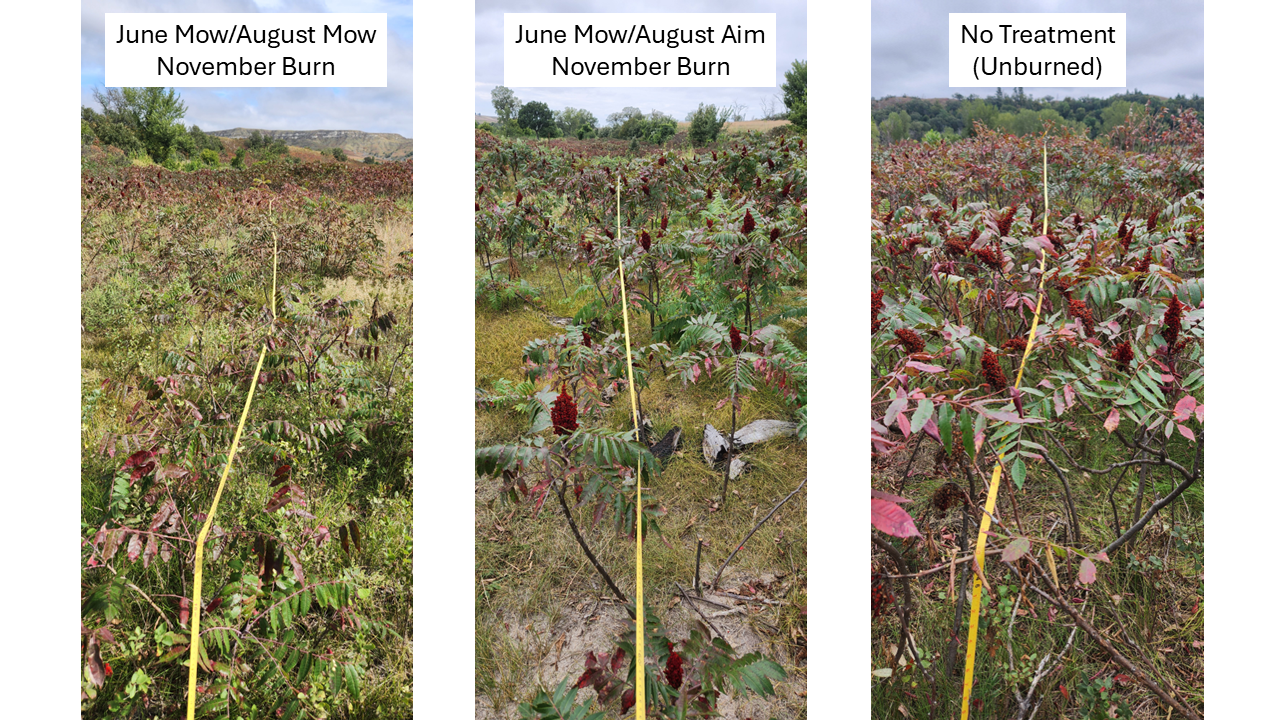
Through a series of intentional and unintentional circumstances, we ended up with three different small experiments (see above). Each has very little replication, so please remember that when you look at the results. THESE ARE VERY PRELIMINARY TESTS. We were just looking for hints of patterns to pursue more rigorously in the future.
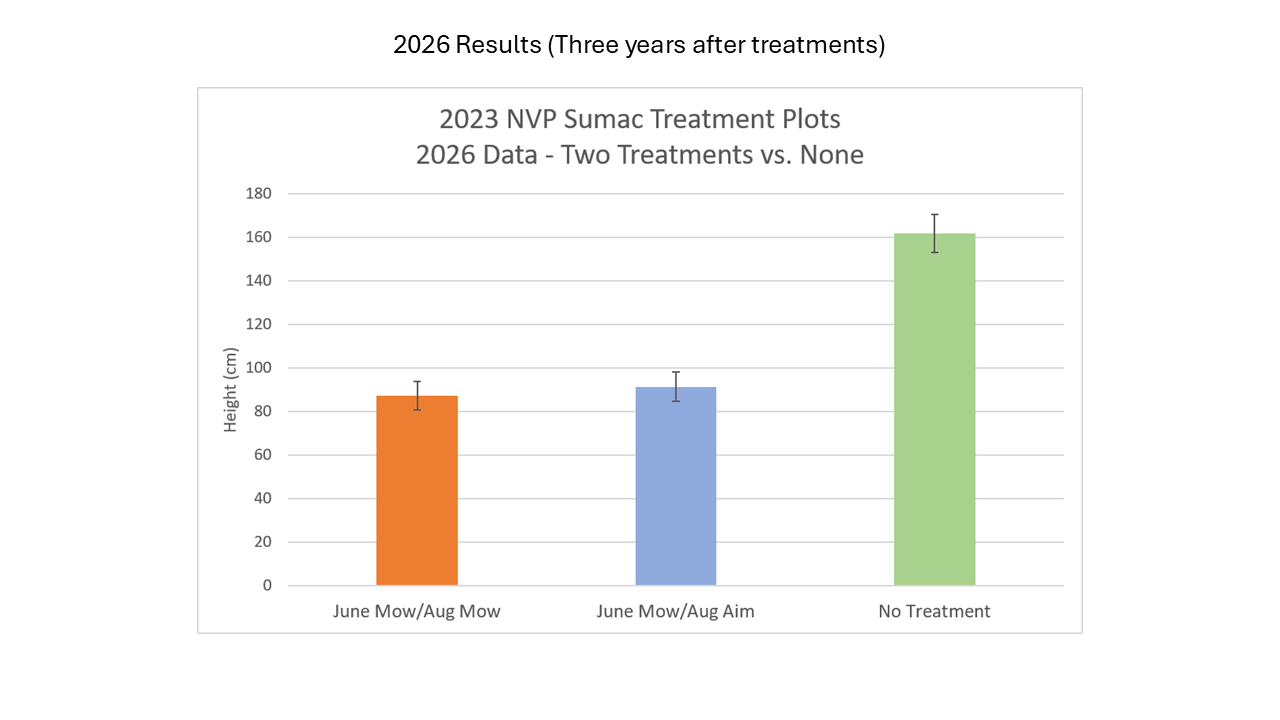
In 2026, I went back to the plots and measured the height of the sumac – three years after our treatments. I was surprised and pleased with how durable the impacts had been. I wish I’d measured changes in stem density too, especially because I saw a fair number of top-killed stems in the plots, but I didn’t, and we’ll all have to live with that.

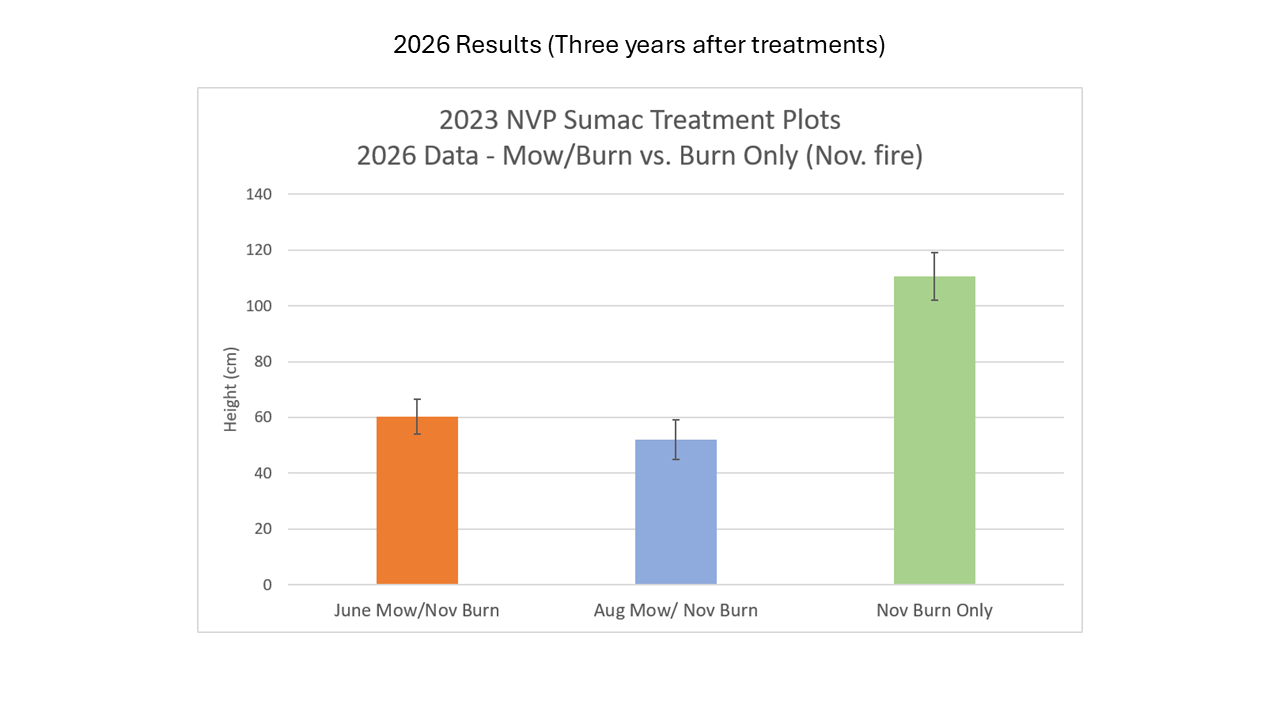
You can see the graphs above and photos below, showing the results of experiment #1. Three full field seasons after treatment, sumac stems that were either mowed twice or mowed and sprayed with AIM were still about half as tall as untreated stems. It’s a pretty striking difference.
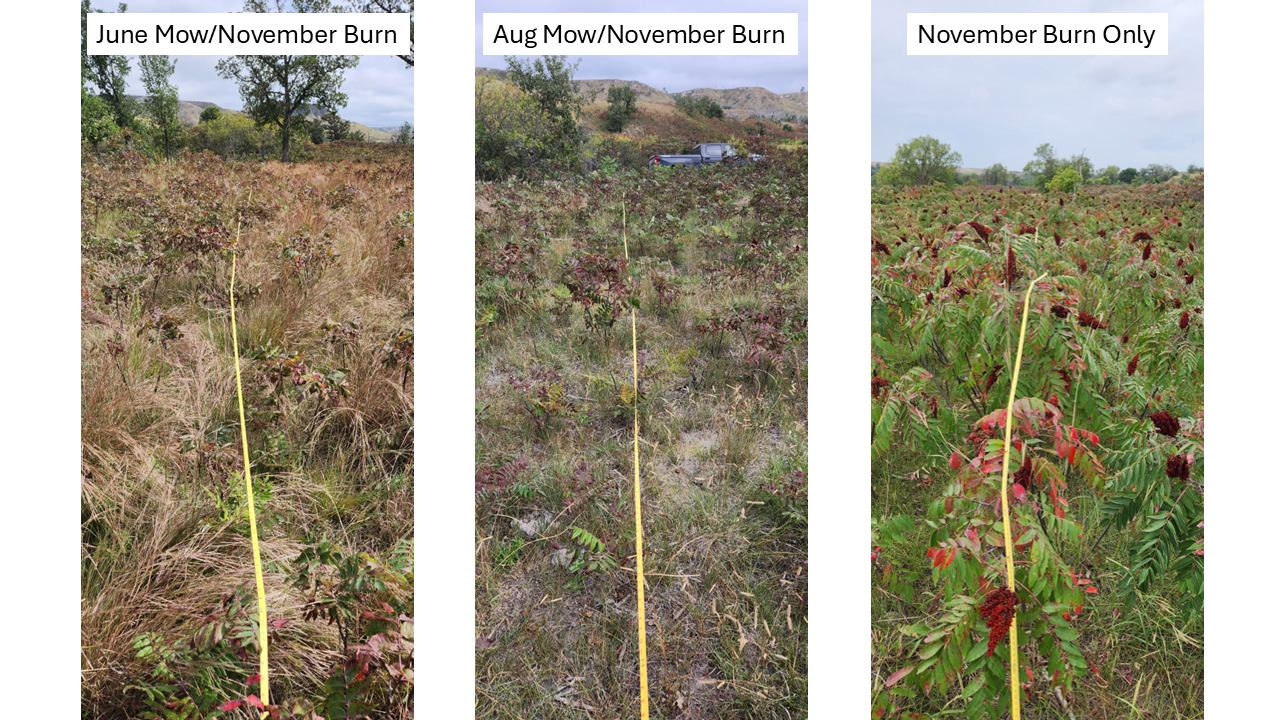
The second experiment looked at plots that were mowed in either June or August and then burned in late November of the same year. This took place on a site with a drier soil type (I think, based on aboveground observation only) than the first. As a result, the sumac grows shorter and less densely here than in the other nearby sites.

I was surprised that both the June and August mowing treatments seemed to significantly reduce sumac height (even three years after treatment!) when combined with a November fire. The stems that were burned without being mowed first seemed to rebound to their full height within two years (based on visual comparison to nearby patches the fire missed). The stems that were mowed first were still about half that height after three full field seasons.
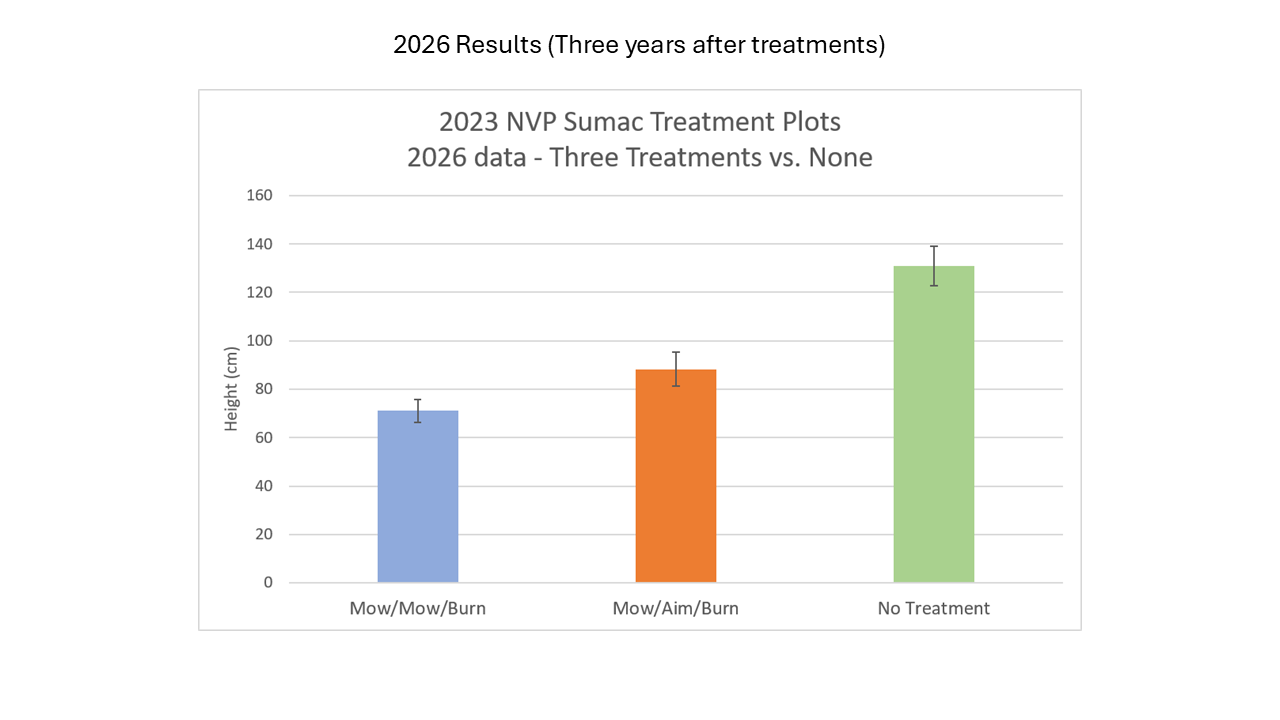
In experiment #3, we looked at the cumulative effects of three treatments, including mowing in June, mowing or AIM herbicide in August, and then a late November burn later that year. The treatment plots were again very different than the untreated plots. In this experiment, the Mow+AIM herbicide results looked a little less impressive than the Mow+Mow results, but remember that this was based on only TWO replications, so take those results with a grain of salt. However, even the Mow+AIM plots were still much shorter than the plots that weren’t treated at all.
We will be following up on this work in the coming years, hopefully with some larger treatment areas. I’m particularly intrigued by two things. First, adding a dormant season burn following summer mowing had a bigger impact than I’d expected. At a site like the Niobrara Valley Preserve where we have thousands of acres of sumac-encroached grassland, it’s not feasible to mow much of that twice in the same season. But if we can mow some of it before or after a burn and strongly amplify the effects of the burn, that might be worth trying.

Second, the AIM herbicide results were promising enough to warrant more testing. It is an herbicide treatment that shouldn’t decrease plant diversity around or beneath treated shrubs. It can also be used on topography that is too steep or rough to be mowed. That means we might be able to combine it with burning and (as above) greatly increase the effectiveness of that fire on shrub suppression.

All of this is great, of course, and provides me with more optimism that we can manage shrubby prairies in ways that sustain plant diversity, offer good habitat for most prairie wildlife species, and prevent big losses in livestock productivity. The simultaneous challenge, though, is to figure out what to aim for with our management. We don’t know much about how various wildlife species respond to different heights and densities of shrubs, or at what height/density shrubs start decreasing plant diversity or productivity beneath them. We’ll be trying to answer some of those questions in the coming years as well. Hopefully, some of you will be doing the same!
Konza Prairie Trip Part 2 – Tree and Shrub Encroachment

A couple years ago, I wrote about some work from Kansas State University related to woody plant expansion in prairies.  Many of us who work with prairies constantly wrestle with questions about trees in prairies. Why are they encroaching so quickly these days? What prevented them from doing that in the past?  During our recent trip to Konza Prairie, we got to discuss this topic more in-depth with Jesse Nippert and other researchers at Kansas State.

Clearly, a combination of factors influences how quickly trees and shrubs enter and spread in grasslands.  One big reason is the increase in “seed rain” in some of today’s prairies.  Prairies in fragmented landscapes with numerous trees and shrubs in nearby woodlots, road ditches, shelterbelts, etc., are deluged with seeds from those woody plants.  The vast majority of those seeds fail to establish, but the high number of seeds coming in means that some will find opportunities to grow.

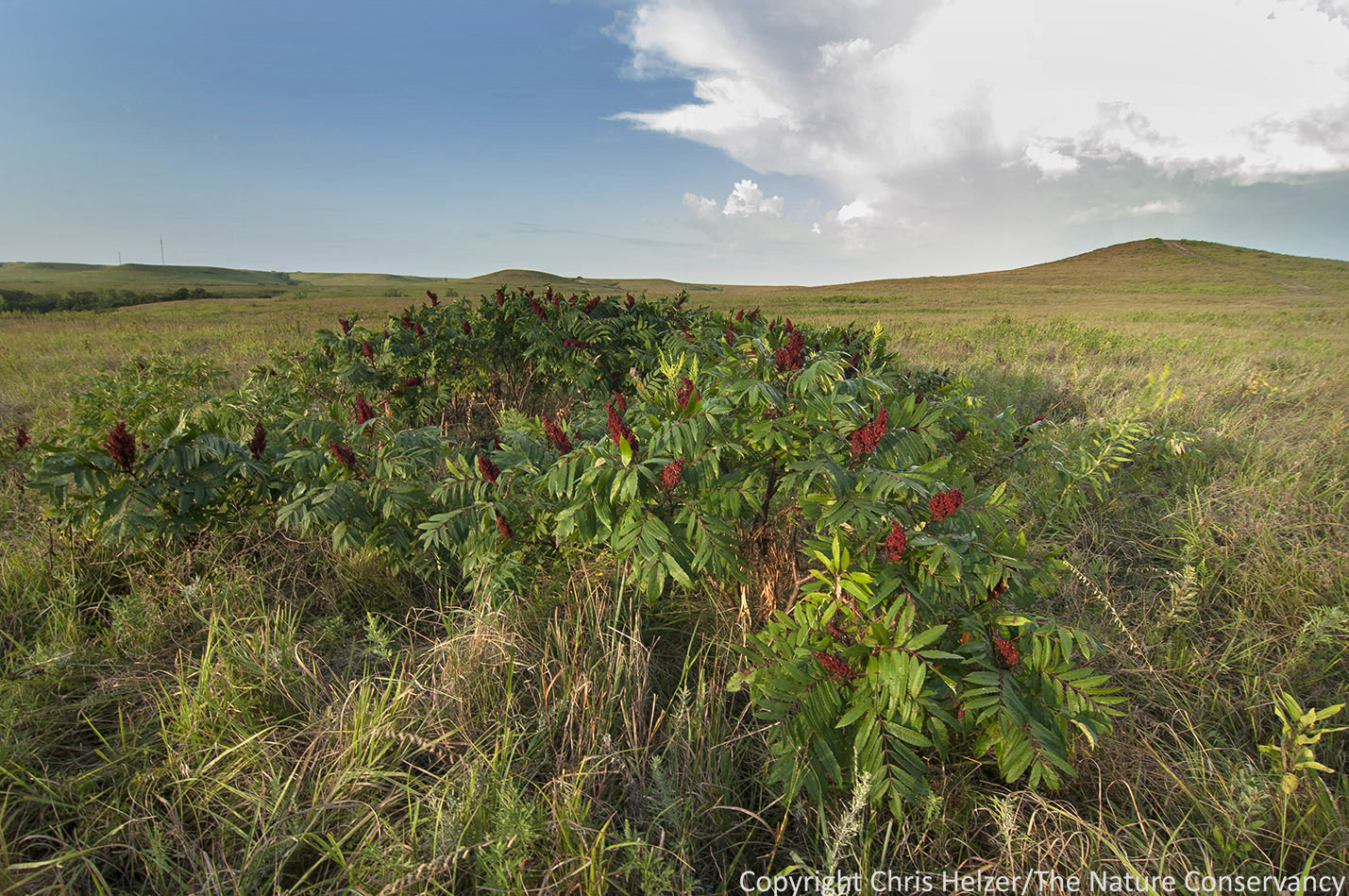
Smooth sumac clones like this small one are expanding at Konza Prairie, especially in areas burned less frequently than every other year.

Smooth sumac clones like this small one are expanding at Konza Prairie and many other sites in central North America.

Other factors may include the higher rates of carbon dioxide in today’s atmosphere and higher amounts of nitrogen deposition (from industry and agricultural facilities, for example), both of which tend to favor woody plant establishment.  In addition, we are in a relatively wet climatic period if you look at the geologic record.  While there have been droughts, including severe ones, in recent years, those droughts are nothing like the multi-decade severe droughts that can be seen in the relatively recent geologic records for the central United States.  Long and/or frequent droughts favor herbaceous plants (such as grasses and wildflowers) over trees.

However, Jesse Nippert’s research into the way trees, shrubs, grasses, and forbs (wildflowers) compete for water belowground provides some additional insight into the march of woody plants into prairies.  As we started talking about roots, Jesse confirmed something I’d heard from Dave Wedin at the University of Nebraska; even though grasses can have very deep roots, most of their water use is actually very shallow – within the top 25 cm of soil.  Jesse says the reason those grasses persist during very dry periods is not because of their deep root systems, but because they can continue to grow and function when available soil moisture is very low.  Forbs also pull a lot of their moisture from shallow roots, but utilize slightly deeper roots (50-75 cm deep) during droughts because they can’t compete well with the ultra-efficient fine-rooted grasses at the upper levels.

It turns out that understanding root competition might help us better understand woody plant encroachment as well.  In many parts of Konza prairie, clonal shrubs such as rough-leaved dogwood and smooth sumac have expanded rapidly over the last several decades.  As Jesse and his students have studied this phenomenon, they have concluded that an important factor behind this expansion is the strategy those shrub clones use to acquire water.  While grasses and forbs are mostly using water from the top 1/2m of the soil, shrubs pull much of their water from deeper in the soil profile, allowing them critical access to water not being utilized by their competition – especially in years when the upper soil layers are dry.

The clonal form of dogwood and sumac gives them another advantage.  As clones expand, the tillers (aboveground stems) on the outer edge of the clones have very small roots.  However, by studying the isotopic signatures of the water in those shallow-rooted tillers, Jesse can tell that they are also accessing water from deep in the soil profile.  He says this is almost surely because the older, deep-rooted plants in the center of the clone are sharing the water they acquire with the younger stems on the outside.  Not a bad strategy.

Of course, as these clones of dogwood and sumac use their water acquisition and sharing strategy to advantage and spread into the prairie, they also shade out their competition – especially beneath the tall/dense tillers toward the centers of clones.  Suppressing the growth of grassy undergrowth not only removes that competition for resources, it also helps make the clones fireproof.  Since dried grasses are the primary fuel for prairie fires, the absence of grasses beneath shrub clones means that fires can’t burn through them.  It’s not hard to see how the processes of deep water acquisition/sharing and fire-proofing can create a positive feedback loop that helps drive an inexorable expansion of shrubs into the surrounding prairie.

We didn’t talk about this in Kansas, but my experience is that fire-proof shrub clones are an important avenue for the establishment of trees as well.  Many tree seeds are deposited into those shrub patches by birds that see those shrubs as convenient and prominent perching sites.  If those seeds are able to germinate and establish within those clones – and they often can – the resulting trees can grow without fear of the fires that would otherwise threaten them.  Hiding in the middle of big shrub clones also gives those trees a chance to grow in relative safety from marauding prairie land managers…

Because much of Konza prairie has been managed under a variety of long-term fire regimes (1,2,4,10, and 20 year frequencies), Kansas State Researchers have some pretty good data on how fire frequency affects shrub expansion as well.  Essentially, prairies burned every year or every other year do not have encroachment by dogwood or sumac, but prairies burned less often are being gradually overtaken by shrubs.  Interestingly, the fastest expansion appears to be in prairie watersheds managed with a fire frequency of every four years (which is also about what the estimated average fire frequency was for that landscape during pre-European settlement).  While it might seem counterintuitive that a four year fire frequency allows for faster woody encroachment than a 10 or 20 year frequency, the explanation appears to lie in the way shrubs respond to fire.  Fire seems to stimulate radial growth in dogwood and sumac, meaning that the plants put an emphasis in growing horizontally rather than just vertically after they are burned.  Under very frequent fire, this is apparently immaterial, probably because the shrubs never get enough rest between fires to take advantage of that radial growth.  However, when they are given 3 years to recover between fires, that radial growth response after each fire means that burning actually stimulates faster expansion of shrub clones.  Under a 10 year fire frequency, that extra radial growth only occurs once every 10 years, so the overall expansion is actually slower than in under a four year fire regime.

Small research plots like these at Konza Prairie help demonstrate the impacts of various fire frequencies.  The treeless grassland to the left is burned annually.  The wooded area to the right is burned every 20 years.  Both started out looking the same.

Small research plots like these at Konza Prairie help demonstrate the impacts of various fire frequencies. The treeless grassland to the left is burned annually. The wooded area to the right is burned every 20 years. Both started out looking the same.

Before you jump to the conclusion that burning every year or two seems the obvious best strategy for shrub control, remember that woody plant suppression is only one of many objectives for prairie management.  I’ll address some of the other, less positive, effects of frequent fires at Konza in an upcoming post.

As I said earlier, there are multiple factors that affect the rate of tree and shrub encroachment on prairies.  Seed rain might be as important as anything, and climatic conditions, increases in nitrogen and carbon dioxide levels, and fire suppression are all likely contributors as well.  However, the way plants compete belowground, particularly the deep water use strategy of clonal shrubs such as dogwood and sumac, also seems to play an important role.   Frequent fire application can be one way to prevent encroachment, though it comes with other baggage (see upcoming post…) and may not help remove shrub patches once they’re established.  At Konza, they took some of the every-20-year-fire-freuency watersheds and started burning them annually to see if they could get rid of the shrubs and trees.  Thirteen years later, those patches are still there, though the individual stems are much smaller.  It seems that while frequent fire might help prevent woody plant establishment, frequent fire alone might not be able to reverse it – at least not on a very fast timeline.

Woody plant encroachment is one of the biggest challenges we face in prairie management today.  A solid understanding of the mechanisms behind that encroachment should help us design more effective strategies to combat it.  Shredding, burning and herbicide application are all useful tactics, but figuring out the timing, frequency, and intensity of those applications will be critical.  We need to use the various competitive strategies of grasses, forbs, and shrubs to our advantage.  As an example, some recent work by Dirac Twidwell (University of Nebraska-Lincoln) seems to indicate that burning under more extreme heat and drought conditions than we typically feel comfortable with might be one way to really tip the scales away from woody plants.  The feasibility of that will be limited in some landscapes, but surely there are other innovative tactics that can help.  If we work together and aren’t afraid to try some new ideas, we can figure this out.