
A “Restoration Note” published in the most recent issue of the journal Ecological Restoration (March/June 2011) caught my attention last week. I was initially interested because some of our sites had been part of the study but I hadn’t seen or heard about any of the results. However, after reading the note (a short research article) I found myself musing yet again about the kinds of expectations people have for prairie restorations. In this case, the authors were comparing bird communities in restored prairie to those in relatively degraded remnants with the idea that identical bird communities would equate to a measure of success for the restored prairies – something I strongly disagree with. I apologize for not being able to provide you with anything more than the citation below and some paraphrasing of the article. I requested permission from Ecological Restoration to post a PDF of the Restoration Note itself, but was turned down, and there is no abstract because of the short length of the article itself. I guess if you want to read the whole article and don’t have a subscription to the journal, you’ll have to either go to a library to find it or pay their fee ($17!!) to read it online.
Nevertheless, here’s the citation for the article:
Ramírez-Yáñez, L. E., Chávez-Ramírez, F., Kim, D., Heredia-Pineda, F. 2011. Grassland Bird Nesting on Restored and Remnant Prairies in South Central Nebraska. Ecological Restoration 29:1-2, pgs 8-10.
In the study, the authors measured grassland bird abundance and vegetation structure/composition in six restored prairies (former cropland) and six remnant prairies (relatively degraded) along the Central Platte River valley in Nebraska. The restored prairies ranged from 5-15 years in age, but the authors didn’t specify how many were in the younger vs. older stages. Of the restored prairies on our property that I think were used in the study, two were seeded in 2002 and the other in 2001 (the paper isn’t clear about how many years of data were used for the analysis, or what years they were). The researchers looked mostly at three bird species (bobolinks, grasshopper sparrows, and dickcissels) and located nests for each.
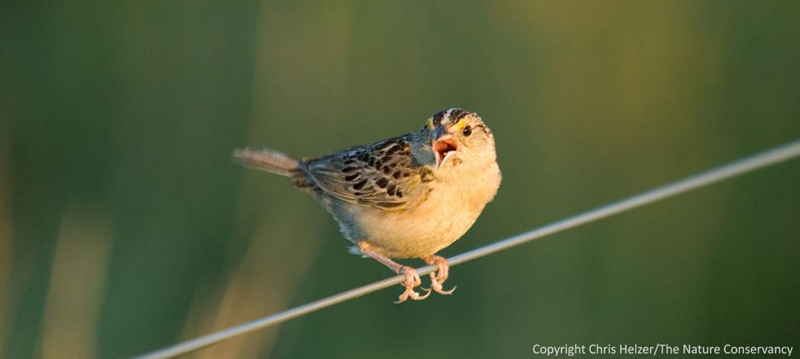
Grasshopper sparrows are nearly ubiquitous - often in high densities - in grazed pastures along the Platte River in Nebraska
From their vegetation data collection, the researchers found that the plant species richness of the remnant and restored prairies was very similar. However, remnant prairies had more cover of low-growing grass species such as Scribner’s panicum and tall and sand dropseeds. Restored prairies had more tall forbs such as sunflowers and goldenrods. The average height of the vegetation was quite a bit taller in the restored prairies than the remnant prairies (average of 96 cm in restorations and 59cm in remnants).
The researchers found 242 grassland bird nests in remnant prairies and 264 in restored prairies. There were significant differences between restored and remnant prairies in the abundance of nests of the three species they focused on. Bobolinks and grasshopper sparrows had more than twice as many nests in remnant prairies than in restored prairies. Dickcissels, on the other hand, had three times as many nests in restored sites as in remnants.

DIckcissels prefer tall forby vegetation structure like that found in young restored prairies.
Based on the vegetation data collected, the results of the bird data fits well with what would generally be expected – and what I observe in our sites. Dickcissels tend to like sites with taller vegetation, especially when abundant tall forbs are present. In contrast, grasshopper sparrows and bobolinks are most abundant in pastures and hayed prairies, respectively, where vegetation is kept short, and regular cropping of grasses favors those species with shorter stature. Up to this point, as I read the paper, everything the authors were reporting fit with what I see for bird use in our Platte River prairies. What threw me for a loop was the final paragraph of the article, in which the authors presented their interpretation of their data and the conclusions they had drawn from it. The following is that last paragraph:
“Our preliminary data suggest that these restorations, at this point in time, are not creating the nesting habitat required or preferred by birds in more natural grasslands. Most restoration practices focus on vegetation reestablishment and cover (Martin et al. 2005), which represent the restoration of primary production but do not ensure the recuperation of essential habitat components needed by native fauna (Whisenant 2005). Our preliminary results have promoted a change in our philosophy to include wildlife habitat requirements at the planning stage of restorations.”
There are three points I’d like to make about that paragraph and the conclusions drawn by the authors of the paper. The first is something I’ve dealt with in a previous post. The authors are assuming that the point of prairie restoration is to replicate existing prairies – at least, in this case, in terms of the vegetation structure and relative composition of the plant and bird communities. Even in cases where remnant prairies are very high quality, I feel strongly that trying to replicate them through prairie restoration is not only unwise, it’s a strategy that is doomed to fail. The management history, soil conditions, and many other factors are very different in a remnant prairie than they will be in a restored prairie. Moreover, along the Platte River, the remnant prairies are almost all degraded – many significantly so – by overgrazing, repetitive haying, and/or broadcast herbicide application. As a result most are missing many important prairie plant species and are largely dominated by grasses (including invasive grasses such as smooth brome and Kentucky bluegrass). I think that most botanists would cringe at the idea of trying to replicate those prairie plant communities because of their degraded state. Our restoration work, in fact, has focused not on replicating remnant prairies, but on enlarging and re-connecting them to each other by restoring cropland in between them with restored prairies planted with seed mixtures that maximize the diversity of locally-native plant species. Those seedings, as they mature, are managed to maintain their biological diversity (including birds) – not to make them resemble the remnant native prairies adjacent to them. In fact, we consider it to be a measure of success that the restored prairies contain many plant species no longer found in most nearby remnants.
The second point relates to the first, but deals specifically with the bird communities in the restored and remnant prairies. Grasshopper sparrows and bobolinks are among the most abundant bird species in the landscape surrounding our restored prairies, and dickcissels (and other species that prefer tall forby vegetation structure) are relatively rare. To me, creating restored prairies that complement the bird communities in the surrounding landscapes by providing habitat for dickcissels seems like a savvy conservation strategy. If restored prairies favored the same bird species as the remnants, very little would be gained in the landscape since the amount of restored prairie is very small compared to the amount of remnant prairie. We would simply be adding a few more grasshopper sparrows and bobolinks to the landscape – and we’d still be low on dickcissels.
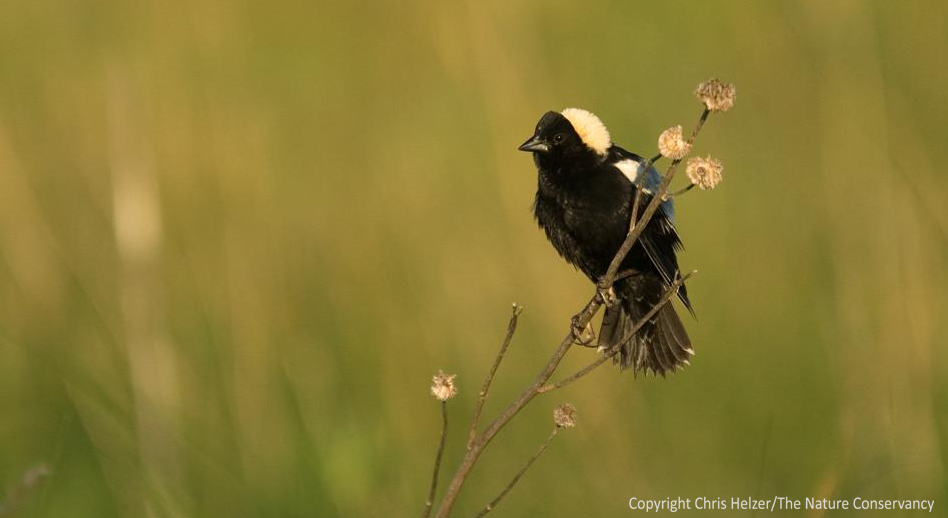
Bobolinks are frequently found in hayed prairies along the central Platte River, as well as in light-moderately grazed prairies. (This one is sitting in a restored prairie)
The third point is that the authors are comparing grasslands (restorations to remnants) that differ significantly in both current and historical management. The remnant prairies have long histories of either season-long intensive grazing and/or annual haying that has strongly influenced their plant species compositions. Even though the remnants in the study are now primarily managed with fire and grazing, the plant community composition in those prairies is much more a product of historic than recent management. In contrast to the remnant prairies, most of the restored prairies in the study have had mostly periodic dormant-season fire management that has encouraged dominance by the tall grasses and forbs that make up a large part of their plant community. Plant species (such as panic grasses, dropseeds, and exotic cool-season grasses) that thrive in repetitively grazed or hayed prairies are not dominant. Some of the restored prairies in the study are sufficiently established that they are now being grazed somewhat similarly to the remnant prairies – though generally at lighter stocking rates – but that management has not been going on long enough to greatly influence plant species composition. It is no surprise, therefore, that the species composition and vegetation structure of the remnant and restored prairies are different from each other. That difference reflects not a failure of the restoration process, but is rather a product of the difference in the length and type of management the sites have received.
To build a little further on the last point, IF the goal of the prairie restoration process along the Platte was to create prairies with plant species composition and vegetation structure similar to that of remnants, success would depend much more on management strategy than restoration planning and design. Yes, alterations in the initial seed mixture to favor panic grasses, dropseeds (and invasives?) could give those species a greater relative abundance more quickly during the establishment of the restored prairie. However, management is going to drive that establishment process much more than seeding design. With periodic dormant-season fire, those species will not thrive, and warm-season native grasses and large forbs will still dominate – even if they start with lower abundances. In contrast, relatively frequent and intensive grazing (or annual haying) would push the plant community toward high abundances of those lower-growing grasses (and probably fewer late-season tall forbs). If you started with two young restored prairies – one with lots of low-growing grasses and few tall grasses and forbs, and one with the opposite composition – those plant communities could be pushed in opposite directions through management until each became nearly identical to the other. In other words, if the authors of this paper want to favor grasshopper sparrows and bobolinks in future prairie restoration efforts, they could alter their restoration design to increase the abundance of low-growing grasses, etc., but they would be much better served spending their time on plans for an appropriate management regime instead.
To be clear, I don’t question or disagree with the data collected by the researchers on this project, I simply disagree with the conclusions and implications they drew from their results. First, I’m not sure why they are disappointed to see an abundance of dickcissels in restored prairie, given their relative scarcity in the surrounding landscape. More importantly, I have a much different set of objectives for restored prairies than they do. Mine are related to contributions of restored prairie to landscape function and population/species viability, rather than to an attempt to replicate existing remnant prairies.
However, this kind of discussion over what prairie restoration should aim to accomplish (and what it CAN accomplish) is very productive. The publication of articles that evaluate restored prairies – even those with a different perspective than mine! – is extremely valuable, and stimulates conversations that should move us significantly forward in our attempt to conserve and restore grassland ecosystems. I would appreciate hearing from you about your perspectives on this and other similar topics.

 The Prairie Ecologist