Should We Manage for Rare Species or Species Diversity?

Land managers constantly make difficult decisions without really knowing the long-term consequences of their choices.

Balancing the sometimes conflicting needs of rare plants like Canada milkvetch (Astragalus canadensis), pollinators, and many other components of prairie communities can be a major challenge. 

For those of you who aren’t ecologists, here are some important vocabulary terms you’ll need to know for this post. 

 1. Conservative species – plants or animals primarily restricted to “intact” or “high-quality” natural areas, as opposed to species that commonly occur in degraded habitats.

2. Species richness – the number of species found in a certain area. High species richness means there are lots of different kinds of plants and/or animals present

3. Species diversity – a kind of modified species richness that also takes into account the evenness, or relative abundance, of each species. When one site has a few dominant species and lots of uncommon ones, it is less diverse than another site with the same total number of species but with more evenly distributed numbers of individuals.


Imagine this situation:  You’re put in charge of managing a tallgrass prairie with thriving populations of several rare plant species.  The prairie is located in a highly fragmented landscape dominated by rowcrop agriculture.  The prairie has been managed with frequent spring burning for many years, and the populations of those rare plants has been pretty stable for at least the last couple of decades.  As you take over, the previous manager tells you she’d recently been considering management changes that might increase overall plant and animal diversity but would likely reduce the population sizes of some rare plant species.  You have to decide whether to stick with the existing management regime or try something different.  What would you do?
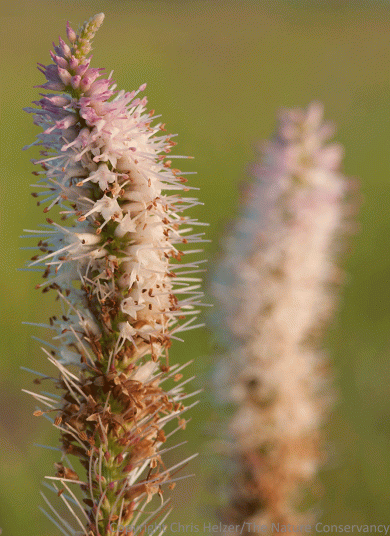
Culver’s root (Veronicastrum virginicum) is a conservative plant species found in a small subset of today’s tallgrass prairies.

It would be perfectly rational and defensible to stick with the strategy that has sustained healthy populations of rare plants for a long time.  Because those plants aren’t found at many other sites, prioritizing them in this prairie makes good sense.  However, before you lock in that choice, let’s consider some other information.

First, there is often an assumption that an abundance of rare plants is an indication that the rest of the prairie community is also intact and healthy. While that assumption seems logical, it’s not always the case.  A good example of this comes from an Illinois study by Ron Panzer and Mark Schwartz.  Their research in the Chicago region showed that neither the number of conservative plant species or rare plant species predicted the number of conservative or rare insect species at a site.  Instead, Panzer and Schwartz concluded that overall plant species richness was more important for insect conservation.

Plant diversity also helps support healthy populations of pollinators and herbivores (invertebrate and vertebrate) by ensuring a consistent supply of food throughout the year.  A wide variety of plant species allows pollinators and herbivores to find high quality food at all times, even though each plant provides those resources at different times of the season.  For this and other reasons, increasing plant species richness can increase both the abundance and diversity of animals, especially invertebrates.  In addition, managing for a variety of vegetation structure types (including a wide range of both plant stature and density) can also help support more animal diversity, including birds, mammals, reptiles, and insects.
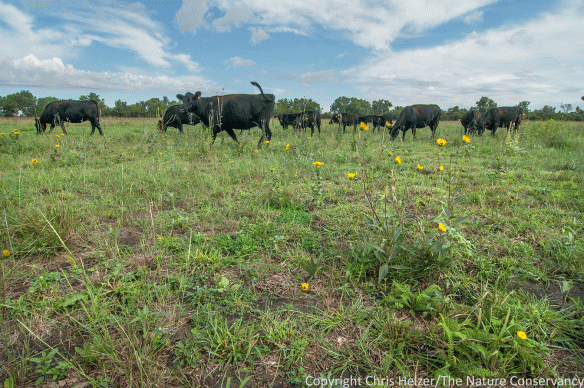
Grazing can decrease the size of rare plant populations, especially in comparison to sites under repetitive haying or burning management. However, carefully planned grazing can also increase plant diversity and provide more varied habitat structure for wildlife and invertebrates.

Every species of plant and animal plays a certain role within the prairie community.  High species richness provides redundancy of function and helps ensure that if one species disappears or can’t fill its role, others can cover for it.  That contributes to ecological resilience – the ability of an ecological community to respond to stress without losing its integrity.  Ecological resilience may be the most important attribute for any natural system, especially in the face of rapid climate change, continuing loss and degradation of habitat, encroaching invasive species and other threats.

Aside from the benefits of managing for species richness, a strict management focus on the needs of a few species can put others at risk.  The use of prescribed fire, for example, provides a competitive edge to some plant species, but has negative impacts on other plants, as well as on some animals.  There have been vigorous arguments between advocates for frequent burning and people concerned about rare butterflies and other insects, as well as reptiles and other animals that can be extremely vulnerable to prairie fires.  Repeated intensive grazing by cattle or bison is another management strategy that favors some plant and animal species, but can negatively impact many others, especially without adequate rest periods between grazing bouts. Management that consistently provides favorable conditions for a few species at the expense of others may eventually eliminate some species from a prairie altogether, or at least reduce their ability to effectively contribute to ecosystem functioning.  If those losses lead to decreased ecological resilience, the resulting impacts may end up negatively affecting the same species a site manager is trying to promote.
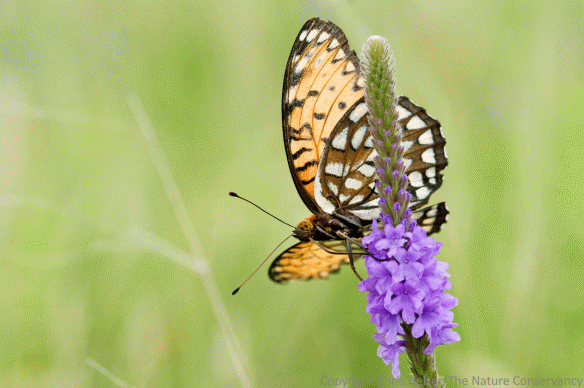
Regal fritillary butterflies are very sensitive to fire, and can be eliminated from isolated prairies if the entire site is burned at an inopportune time. However, populations can also thrive in large prairies managed with a combination of fire and grazing, as long as sufficient unburned areas are available, and many of their favorite nectar plants (like this Verbena stricta) are common, or even weedy.

So, what’s the right path?  Should we prioritize management for rare or conservative species, assuming that other species don’t need as much help?  Or should we focus on species diversity and ecological resilience because we need the strongest possible natural communities in today’s challenging environment?  How should scale (size of prairie) influence decisions?

There are plenty of potential benefits and risks associated with each path, and I’m not here to tell anyone which they should choose.  In most cases, my own tendency is to focus on diversity and resilience, but I completely understand why managers would go the other way, and I think every situation needs to be evaluated independently.  For example, if a species is teetering on the brink of extinction and we need to keep it alive while we create more habitat elsewhere, I’m perfectly fine with prioritizing management to favor that species.

In other cases, I worry that we’re too sometimes unwilling to manage prairies in ways that promote changes in plant composition.  Years of repetitive management (especially frequent haying or burning) create conditions under which plant communities seem very stable.  However, that stability may be a response to consistent management rather than an intrinsic quality.  Allowing plant populations, even of rare species, to fluctuate in size, or even persist at a lower abundance than we’re used to is not the same as driving those species to extinction.  If rare species survive in smaller populations but the surrounding community is more resilient, that may be a win.  Having said that, reducing the size of rare species’ populations can make them more vulnerable to local extinction, and I don’t take that kind of risk lightly.  These are challenging issues.

This bottle gentian plant (Gentiana andrewsii) is an extremely conservative plant, and was growing in a hayed meadow in the Nebraska Sandhills where management conditions are very stable from year to year.

The hard truth is that we don’t yet understand enough about ecological systems to make these kinds of decisions confidently.  I understand the impulse to manage conservatively, sticking with what seems to have been working for a long time – especially in small and isolated prairies.  At the same time, I also think we need to build as much diversity and resilience in our prairies as we can – focusing on both plants and animals – especially in landscapes where we don’t have many left.  I’m glad managers are experimenting lots of different strategies, but we should all take responsibility for collecting data that help us evaluate our management, and keep open minds as we share what we learn with each other.  None of this is easy, but it is certainly important.
A Milestone for Prairie Restoration

Because conservation work can sometimes seem like blowing into the wind, it’s important to pause periodically to celebrate progress.  For example, I am really excited about what has been accomplished in the field of prairie restoration.  We’ve known for a while that we can convert cropland to prairie vegetation with a high diversity of plant species (150 or more species per planting), and that we can do that on a scale of thousands of acres.  The Nature Conservancy has large projects in states like Indiana, Illinois, and Minnesota where restored prairie landscapes now range from about 5,000 to 20,000 acres in size.  The U.S. Forest Service is transforming an old U.S. Army Arsenal into 20,000 acres of prairie in Illinois.  Prairie Plains Resource Institute, the organization that pioneered restoration techniques in Nebraska, is planting up to 1000 acres a year now and has established well over 10,000 acres total across the state.

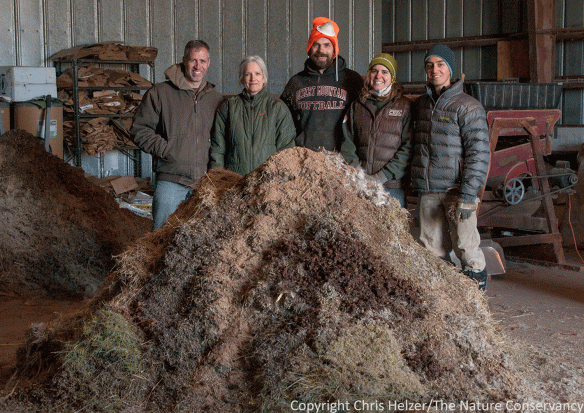
Our staff celebrates a successful year of seed harvest back in 2015.

Our staff celebrates a successful year of seed harvest back in 2015.

Here in our Platte River Prairies, we’ve restored more than 1,500 acres of cropland to prairie.  That’s not insignificant, but more importantly, we’ve been testing the idea that those restored prairies can help defragment the ecological landscape around them.  Habitat fragmentation is one of the largest threats to today’s prairies because it shrinks and isolates populations of species, making them vulnerable to becoming locally extinct without the chance of recolonization from nearby sites.  The real promise of prairie restoration is that it can enlarge and reconnect scattered remnants of native prairie, providing populations of animals and plants a much better opportunity to survive and thrive.  It’s not feasible or desirable to convert the majority of cropland in the central North America back to prairie, but there are particular sites where strategic restoration work could make a huge difference in the potential survival of prairie species and ecological services.

In order for prairie restoration to help defragment landscapes, restored prairies have to provide suitable habitat for the species living in small isolated prairies.  Many bees and other insects specialize on certain plant species, for example, and other animals rely upon an abundance of prey, a diversity of seeds, or other particular food or habitat conditions.  Satisfying the individual needs of all those prairie animals is a critical measure of success if prairie restoration is going to successfully stitch isolated prairies back together.

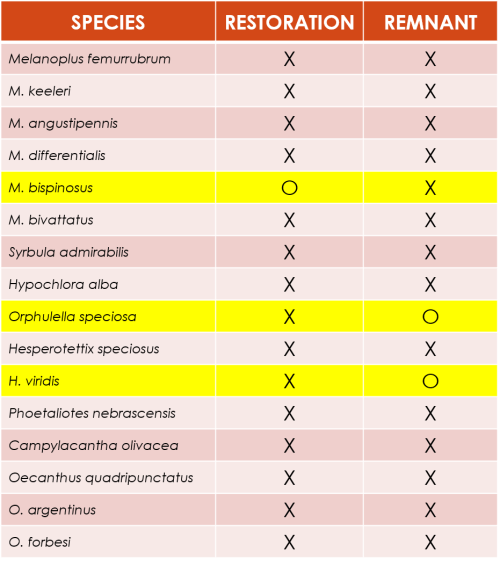
Over the last several years, we’ve been collecting data to see whether the species of bees, small mammals, grasshoppers, and ants in our unplowed prairie remnants have moved into adjacent restored habitat.  The results have been very positive.  While not every species of animal living in our remnant prairies has been found in nearby restored habitat, we’ve found the vast majority of those we’ve looked for.  We suspect that most of the remaining species are also present but that our limited sampling effort just hasn’t yet picked them up.  We’ll keep trying.

Dillon Blankenship, a Hubbard Fellow, compared grasshopper, katydid, and tree cricket communities on three pairs of remnant/restored prairies back in 2014. Almost all species were present in both restored and remnant habitats. In the three species that weren't, only one or a very few individuals were found, so it's likely just a sample size issue.

Dillon Blankenship, a Hubbard Fellow, sampled grasshopper, katydid, and tree cricket communities on three pairs of remnant/restored prairies back in 2014. Almost all species were present in both restored and remnant habitats. In the three species that weren’t, only one or a very few individuals were found, so it’s likely just a sample size issue.

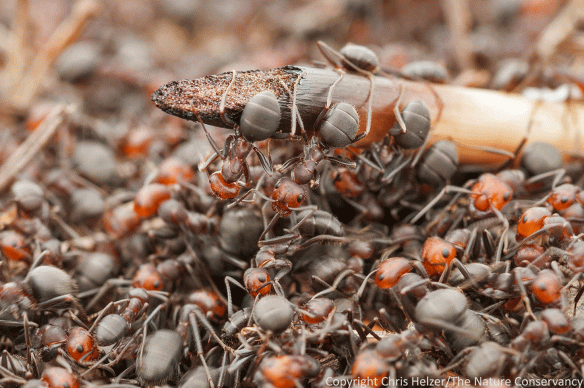
Data from James Trager and Kristine Nemec has helped us compare ant species composition in restored versus restored prairies along the Platte River. So far, we've documented 30 species and only one has been found exclusively in remnant prairie (and, again, it's likely to be a sample size issue).

Data from James Trager and Kristine Nemec has helped us compare ant species composition in restored versus restored prairies along the Platte River. So far, we’ve documented 30 species and only one has been found exclusively in remnant prairie (and, again, it’s likely to be a sample size issue).

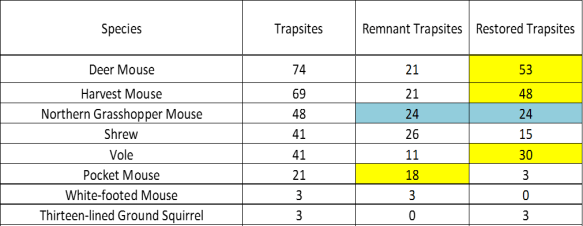
Master Naturalist Mike Schrad and Hubbard Fellow Jasmine Cutter have both helped us compare small mammal populations between restored and remnant prairies. This table shows some of Jasmine's data from one site. In general, we're finding that the same species are in both restored and remnant prairies, but the relative abundance of those species is often different - with some apparently favoring remnant habitat and others favoring restored areas.

Master Naturalist Mike Schrad and Hubbard Fellow Jasmine Cutter have both helped us compare small mammal populations between restored and remnant prairies. This table is from Jasmine’s data from one site, showing the number of trapsites in which each mammal species was caught back in 2014. In general, we’re finding that the same species are in both restored and remnant prairies, but the relative abundance of those species is often different – with some apparently favoring remnant habitat and others favoring restored areas.  We’re now looking at how our management affects presence and abundance of each species through time.

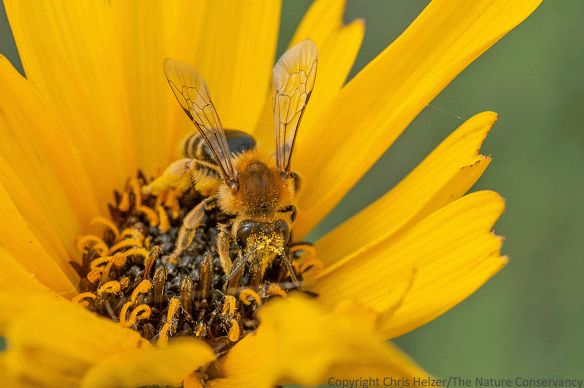
We've had several research projects look at native bees in our prairies. Mike Arduser, Anne Stine (Hubbard Fellow), Bethany Teeter, and Shelly Wiggam Rickets have all helped us compare restored and remnant prairies. So far, we've found over 72 species and the vast majority have been in both remnant and restored prairie.

We’ve had several research projects look at native bees in our prairies. Mike Arduser, Anne Stine (Hubbard Fellow), Bethany Teeters, and Shelly Wiggam Rickets have all helped us compare restored and remnant prairies. So far, we’ve found over 72 species and the vast majority have been in both remnant and restored prairie.

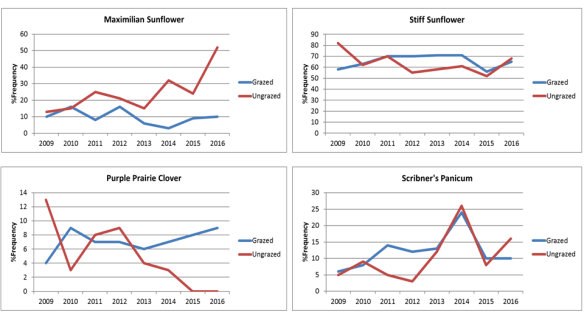
I've collected more than 15 years of data showing that plant diversity and the frequency of occurrence of prairie plant species has remained stable through time. These four graphs show four species in one restored prairie where we're comparing fire/grazing management to fire only management.

I’ve collected more than 15 years of data showing that plant diversity and the frequency of occurrence of prairie plant species has remained stable through time. These four graphs show four species in one restored prairie where we’re comparing fire/grazing management to fire only management.  The long-term persistence of prairie plants and diverse plant communities is critically important for plant communities, but also for the success of efforts to defragment habitat for animals.

These results mean that where prairie landscapes have been largely converted to row crops, we don’t have to just watch while insect or small mammal populations careen toward local extinction in tiny isolated prairies.  We’ve shown that we can make those prairies larger and more connected, and that animal populations can grow and use new restored habitat and diverse plant communities.  We’ve also shown that restored prairies can sustain their biological diversity for decades, even through periods of intensive grazing and drought.  While there are still plenty of questions and potential improvements we can make, we’re now at the point where society needs to decide whether and where to do this kind of restoration.

I don’t know about you, but I think that’s pretty exciting!

Nebraska and other states in central North America have large swaths of productive and important cropland.  As I said earlier, I’m not advocating that we convert most of that back to prairie.  However, there are specific sites where row crop agriculture is marginally productive/profitable and the long-term interests of both society and local landowners might be best served by putting land back into diverse and productive grassland.  Agricultural policies and subsidy programs will obviously play a huge role in this kind of strategic large-scale restoration, and getting the policies in place to facilitate this kind of common sense restoration will be plenty difficult.  That’s nothing new, however.  What’s new is our confidence that if we can implement targeted restoration work, it can make a real difference to prairie conservation.

Restoring the viability of prairies in fragmented landscapes is critically important to prairie conservation success.  The challenges of conserving species in small isolated prairies are immense, and many of those prairies will continue to see declines in biological diversity and ecological function over time unless we can make them bigger and more connected with other prairies.  Helping to document our ability to do that – at least for many prairie species – has been one of the most satisfying things I’ve done during my career.


Important footnote:  Restored prairies are not the same as remnant unplowed prairies.  Soil organic matter levels, for example, can take many decades to recover from tillage, and relationships between plant and microbial communities may take just as long to become reestablished.  Our success in prairie restoration should definitely not be used as justification for plowing up remnant prairie!  However, it’s equally true that prairie restoration efforts aren’t failures just because they can’t create an exact replica of prairie as it existed before it was converted to farmland.  If defragmenting prairie landscapes is the primary goal of restoration, we just need to create restored prairies that complement – not copy – remnant prairies.