Hubbard Fellowship Post – Ruminations While Disking

This post is written by Kim Tri, one of our two Hubbard Fellows for this year.  Kim is an excellent artist, as well as an ecologist, writer, and land steward.  As you can see, her drawings of animals are exceptional.

A Swainson’s hawk takes wing not 30 feet from me, and I feel vindicated.  It rises from a patch of ground which I’ve just disked, and answers the idle question I had when I began disking that day.  I wondered whether the turning under of vegetation and hence the cover of the little critters living there would attract hawks in search of an easy-to-spot snack.  I’d seen it happen on a prescribed burn which I’d sat in on last year, in the property just across the creek.  Once the flames and smoke died down, we counted at least 20 hawks—most of them Swainson’s—soaring overhead.  They were attracted by the aftermath, the ground cleared of protected cover for the disoriented prey.  The black earth left in the wake of the disk plow reminded me of the fire, and got me wondering.
gg

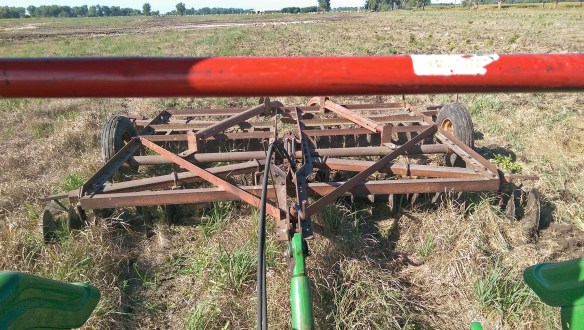
For those of you not familiar with the practice of disking, it involves plowing using a disk plot (pictured above) pulled behind a tractor.  Picture by Kim Tri

I should have kept a tally of how many voles, mice, rabbits, and lizards I saw clearly fleeing across the worked ground as I plowed.  Creatures visible to my weak human eyes would be easy pickings for a (much) sharper-eyed hawk.

Sure enough, a hawk showed up after an hour or so and answered my question.  The neighbor was haying in his field just across the fence, which I’m sure was turning up quite a bounty of prey as well.  I don’t have enough agricultural experience to know whether the hawks usually show up around haying time, but the intent circling of the hawks above the neighbor’s tractor made me think that they’ve cottoned on to it as well as they have to burning.

While disking later that week, also I kept (slowly) chasing groups of killdeer.  A contractor had come in with an excavator only a few weeks before to reconstruct wetlands on the property.  The killdeer scuttled around the newly excavated wetlands, where before they had not seemed to give this property much of their time.  They, too, appeared attracted to the open ground where they might find prey.  After all, the wetland excavation as well as the disk plowing had suddenly provided them with some quite preferable habitat.

kil

A group of startled killdeer flee alongside the track left by an excavator.  Graphite drawing by Kim Tri

It got me thinking about the consequences of our actions as land stewards – the whole ecology of it all.  So often, during a day’s field work, we focus on the plant community.  This makes sense, since it’s really the only thing about our prairies that we can directly manage, and where the effects of our work are most easily observable.  The larger aim, though, is to create a diverse ecosystem with quality habitat for as many faunal species as possible.  We do this intentionally through a variety of practices, such as seeding, prescribed burning, invasive species control, and grazing.

There are plenty of unintended beneficiaries to these.  I did not set out that day with the disk plow to provide a meal to the local Swainson’s hawks.  The objective was actually to clear the remaining vegetation of a low-quality “failed” restoration in order to create a blank canvas for seeding it into a high-quality prairie.  It had been recently sprayed completely to clear out the brome invasion that was its major fault, and since then I’d come to view the area as kind of a dead space.  While looking ahead to what the tract could be, I’d forgotten about all of the things that it still was.  It was still habitat for a wide variety of animal life, judging by the creatures I was seeing.  The cleared ground of the excavated wetlands showed trails of deer and coyote tracks, and even now, after the ground has been completely cleared, the deer and coyotes still keep leaving tracks.

I’ve noticed, too, while mowing fire breaks around our burn units, that there are creatures benefitting.  While making a third pass around with the tractor to widen the line, driving alongside the line I’d already mowed, I noticed many voles and mice scampering out of the clippings left behind.  They seemed drawn to the mowed line, and I felt that I’d just created dream foraging habitat for them.  As well as laying down a dense layer of cover to protect them, I’d just brought down to ground level a cornucopia of seedheads that had previously been out of reach for the little critters.

I acknowledge that there are also species negatively impacted by some of the things we do, but that is a thought for another time.  The mice were definitely not happy about the disking or the hawks, but I hope that we balance this out by working to improve their habitat.

We’ll reseed the disked tract with the seed we’ve collected this year, and in the spring a new prairie will grow, bringing with it an influx of creatures back to the property.  In another few years, it will be burned, and then likely the Swainson’s hawks will come again, drawn by the promise of bounty on the black earth.
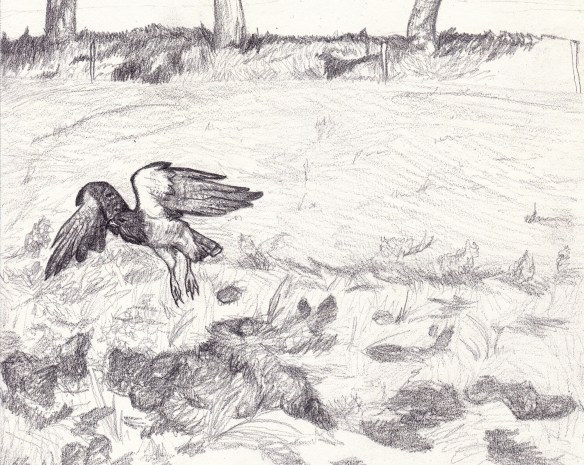
A Swainson’s hawk takes flight from a disked field. (Yes, the ground does look that messy) Graphite drawing by Kim Tri

A Swainson’s hawk takes flight from a disked field. (Yes, the ground does look that messy) Graphite drawing by Kim Tri
Chuck Norris of the Prairie

A big topic of conversation at this year’s Grassland Restoration Network (GRN) workshop had to do with designing seed mixes to combat potential invasive plant problems.  When converting cropland to prairie vegetation, the first few years of establishment are sometimes a race for dominance between prairie plants and invasives.  Once a strong native plant community becomes established, it is more difficult (but still possible) for invasive plants to become dominant, so those first few seasons are critically important.  Over the years, a number of people have tried using extra high seeding rates of various native plants to see if those natives could help stave off invaders.  In an ideal scenario, a high abundance of some showy wildflower would outcompete invasive plants but allow other native plants to establish.  Nice, right?  Lots of pretty flowers during establishment, no invasive species to worry about, and a nice diverse prairie community in the long run.

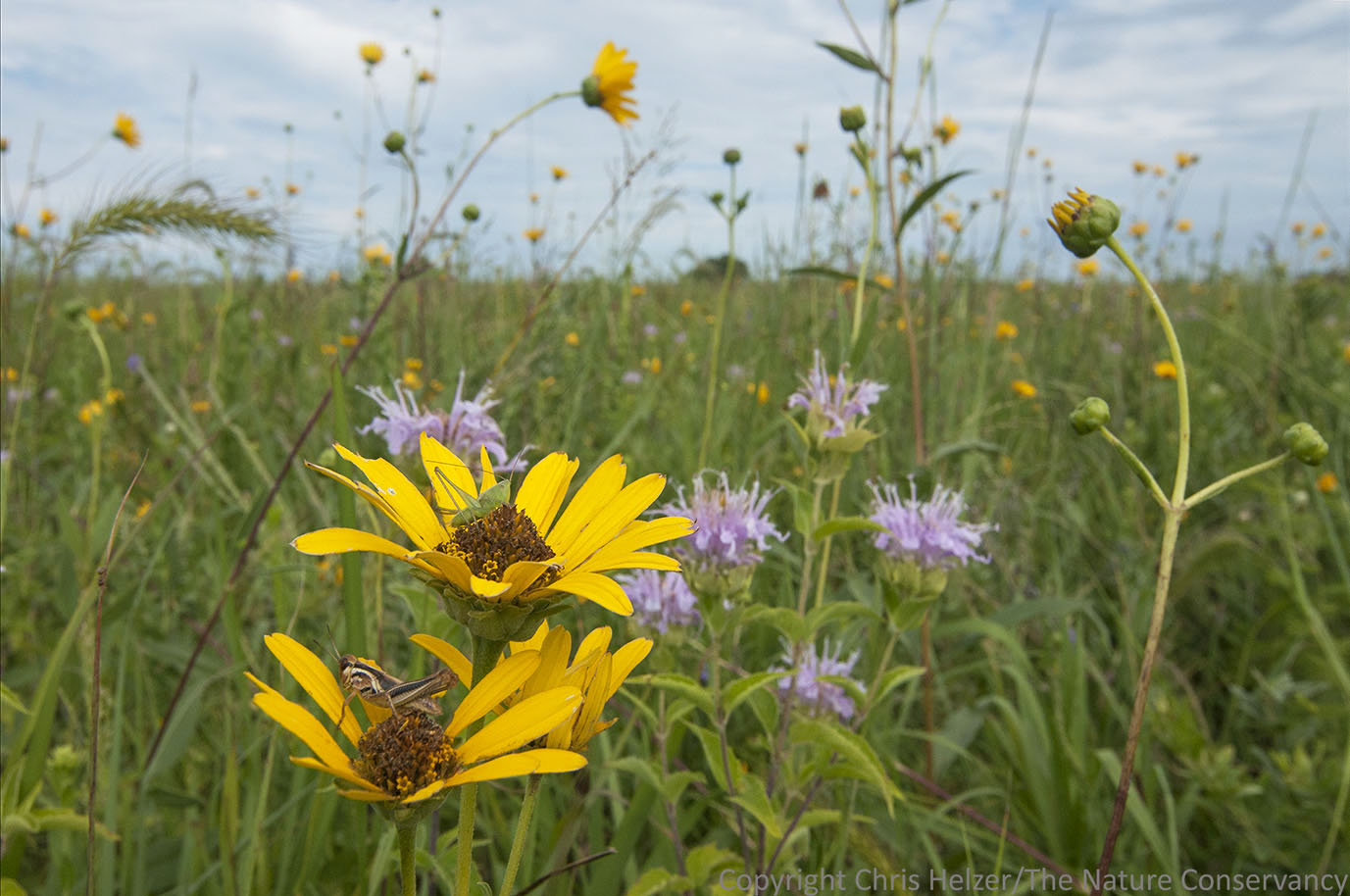
Black-eyed susans (Rudbeckia hirta) in restored prairie - TNC Platte River Prairies, Nebraska.

Black-eyed Susan is a species that has shown some promise as a species that can compete against invasives but still allow the establishment of a diverse plant community around it.   The Nature Conservancy’s Platte River Prairies, Nebraska.

I first heard about this idea at the 2004 North American Prairie Conference.  In one of my favorite presentations of all time, Shawn Schottler of the Science Museum of Minnesota compared various plant species to celebrities.  As he described his experiments, he said he was trying to find Chuck Norris plants (tough good guys) that could fight off Mike Tysons (aggressive invasives) while still allowing Patsy Clines (less competitive natives) to establish.  As I recall, he was having some luck with Chuck Norris species such as black-eyed Susan (Rudbeckia hirta), wild bergamot (Monarda fistulosa), and others.  At this year’s GRN workshop, Jack Norland of North Dakota State University described recent results of some similar experiments on U.S. Fish and Wildlife restoration projects.  The “spike” treatments they used consisted of ultra high seeding rates of species such as plains coreopsis (Coreopsis tinctoria), purple prairie clover (Dalea purpurea), Canada wild rye (Elymus canadensis), and others.  His data showed Canada thistle to be much less abundant in spike treatments than in the controls.

Interestingly, we’ve had some accidental experience with this topic here in our Nebraska Platte River Prairies.  During the drought years of the early 2000’s, some of our prairie plantings ended up with lots and lots of Canada wild rye.  In some cases, the species was so abundant that our plantings looked like wild rye monocultures.  We weren’t the only ones.  Prairie Plains Resource Institute had plantings that looked much the same during those years.  There was some hand wringing about whether or not the plantings had failed, especially given the drought conditions at the time, but Bill Whitney of Prairie Plains assured us that it wasn’t a big deal.  He was right, as usual.  The plantings eventually emerged from their wild rye phase and turned into very nice prairies.  In fact, our site that had the “worst” wild rye infestation is now the showiest (in terms of big colorful wildflowers) prairie we have.  I’m not sure the wild rye helped suppress any invasive species, but a high density of wild rye plants didn’t seem to keep Patsy Clines from eventually thriving.

This 2004 shows one of our Platte River prairie plantings in its third year of growth.  Canada wildrye is visually dominant, but other species are present as well.

This 2004 photo shows one of our Platte River prairie plantings in its third year of growth. Canada wild rye is visually dominant, but other species are present beneath its canopy.  Many of our young plantings from about that time period looked much like this for several years in a row.

After this prairie was seeded in 2000, it was a near monoculture of Canada wild rye for several years but today is our showiest wildflower patch.

After this prairie was seeded in 2000, it was a near monoculture of Canada wild rye for several years.  Today it is among our most diverse prairies and showcases our showiest wildflower patches.  (July 2015 photo)

Spike treatments/Chuck Norris species/etc., are really just variations on the idea of using a cover crop – planting something intended to establish early and then fade away (mostly or completely) as the desired vegetation takes hold.  In some places, cover crops are very useful in agricultural systems as a way to prevent soil erosion and loss of fertility, suppress weeds, and/or preserve soil moisture.  It seems logical that they would also help with prairie restoration establishment.  In fact, I recently talked to someone with the Natural Resources Conservation Service (NRCS) in north central Nebraska who says their best successes in restoring sandhill prairie come when they use a cover crop of millet.

On the other hand, I remember a GRN workshop about five or six years ago when we had a group discussion about our experiences with various cover crops.  Participants from across the Central U.S. seemed to reach consensus that cover crops were as likely to be counterproductive as helpful to prairie restoration efforts.  This seems to conflict with the successes seen by people like Shawn Schottler, Jack Norland, and others.  Why the differences?

Part of the issue is certainly that we’re still experimenting with different species, and still have a lot to learn.  Beyond that, though, anyone who has spent many years restoring prairie knows that establishment results can be very difficult to predict, even within the same site.  Just when you think you’ve got something figured out, your next planting turns out completely unlike what you’d expected.  Those kinds of inconsistencies, combined with differences in site attributes such as soil texture and fertility, rainfall, and latitude make it almost impossible to come up with restoration recommendations that apply everywhere.  In fact, if we’ve learned anything through the Grassland Restoration Network, it’s that it’s important to start big projects by doing some small experimental plantings to see what works best in that place before investing in larger scale work.

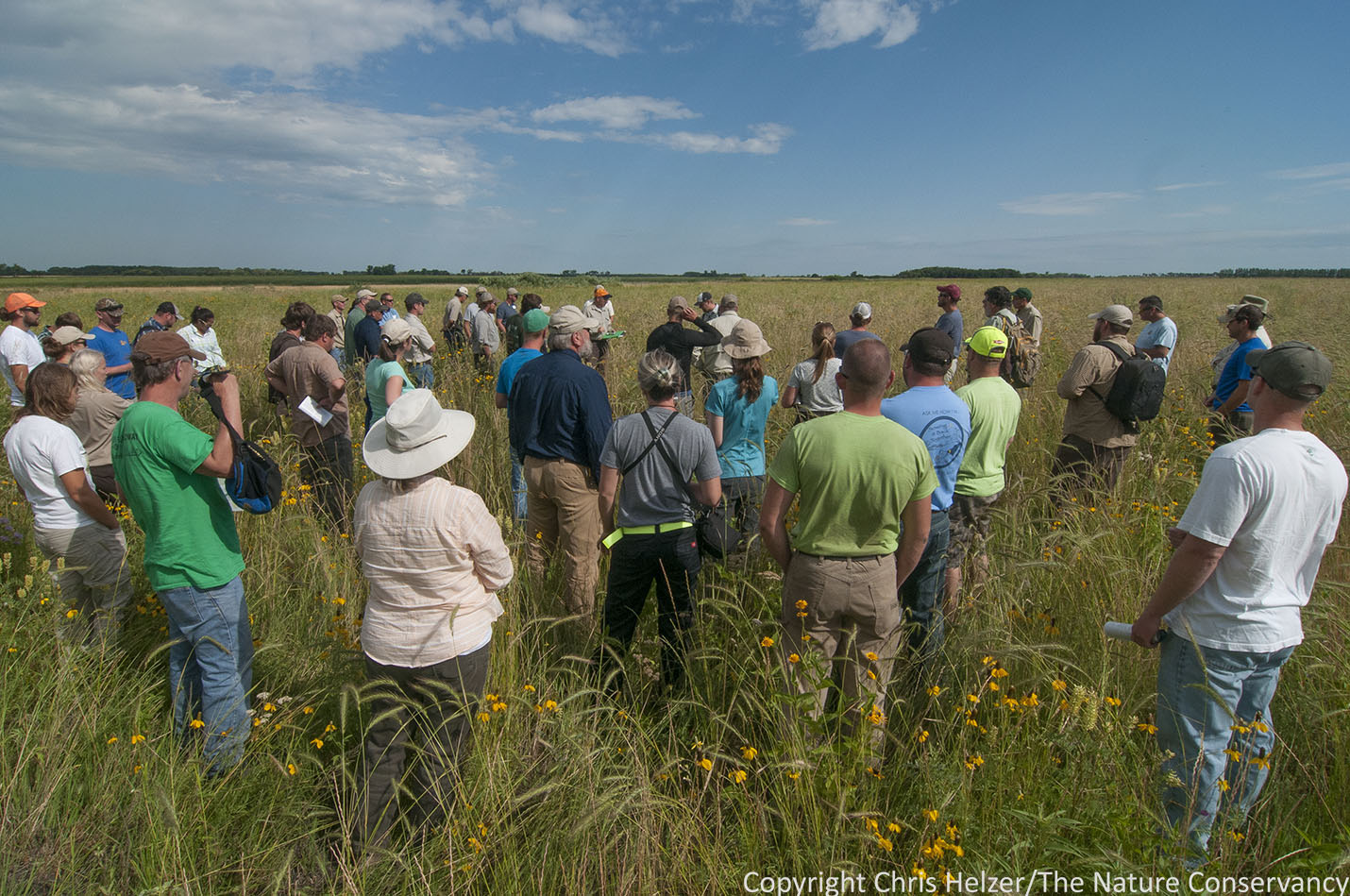
Grassland Restoration Network Meeting.  Hosted by TNC Minnesota.

There is great value in getting a bunch of restoration practitioners together in one place.  We often bring home new ideas to try.  Sometimes they even work.  2015 Grassland Restoration Network workshop – Minnesota.

Clearly, the idea of “spike” treatments and similar strategies hold a great deal of promise if they fulfill their promise of preventing invasives while facilitating establishment of diverse plant communities.  However, since it’s also clear that successful strategies from one site don’t always translate well to others, we may each have to find our own formula for success.  Hearing about Dr. Norland’ experiments in the Dakotas has inspired us to do some more experimentation here.  Maybe we can find a few Chuck Norris species to keep the peace in our Platte River Prairies.

If you’ve had positive or negative experiences with cover crops in prairie restoration, or have found your own Chuck Norris of the prairie, please share what you’ve learned in the comments section below.  Thanks.

P.S.  You may have seen or heard some of the many Chuck Norris jokes out there that play on the idea that he is seemingly invincible.  My 14-year-old son likes to share them with me now and then.  A few of my favorites are:

Chuck Norris doesn’t wear a watch. He decides what time it is.

Chuck Norris makes onions cry.

There used to be a street named after Chuck Norris, but it was changed because no one crosses Chuck Norris.

When Chuck Norris does a push up, he isn’t lifting himself up, he’s pushing the Earth down.

A bulletproof vest wears Chuck Norris for protection.