
Hubbard Fellowship Blog – The Sky is My Mountain

This post was written by Eric Chien, one of our Hubbard Fellows.  Eric comes from Minnesota and brings great energy to our prairie stewardship work.  He’s also very bright, and an engaging writer, as you’ll see in this and other posts.

The sky is my mountain. I recently heard Jeff Walk from Illinois Nature Conservancy articulate this notion of prairie geography. If westerners are defined by their mountains, those of us from the Midwest and Great Plains are defined by our skies. Prairies are open horizons. Even on the most heavily plowed landscapes, the ghosts of prairies loom as long as the land stretches toward an expansive sky.

Sky

Flat land compensates the viewer with tremendous skies.

All landscapes affect the prejudices about comfort and beauty of those born to them. I know someone who moved to Minnesota from the West for a job and was gone within the week, overcome by the flatness of the land. That might be a little dramatic, but I can understand the uneasiness. For me claustrophobia and paranoia rises in deeply wooded landscapes that lack the promise of a lake or field offering a glimpse beyond the trees. I think we all have that affinity for particular aesthetics to some degree, and because of that I think we can all empathize with the plight of prairie wildlife.

Unlike humans, most prairie wildlife lacks the flexibility to adapt to the uneasiness brought on by changes in their natal landscapes. Prairie chickens may be the most well known of the prairie wildlife terrorized when the land loses the sky, but they are almost certainly not the only ones. One needs only to watch the predatory efficacy of hawks and owls from their perches high atop the crowns of trees to understand why the development of tall vertical structure results in the extirpation of prairie species. There are more trees than ever closing off the sky, threatening to fundamentally alter the ecology, composition, and aesthetics of our prairies.

Historical records from the mid-late 1800’s in Nebraska’s Lower Platte River Valley (to the east of our Platte River Prairies) suggest trees occurred as widely scattered individuals and small clusters; a far cry from the ubiquitous shelterbelts and heavily wooded groves that cloak what almost certainly was formerly prairie. Trees and the changes they have already wrought and continue to promise are why most of our field season at the Platte River Prairies has played out to the whine of chainsaws.

The small row of trees on the horizon may seem insignificant, but the removal of those trees would visually reconnect three chunks of prairie; potentially having pronounced effects on grassland bird nesting occurrences and brood rearing success. Photo by Eric Chien.

The small row of trees on the horizon may seem insignificant, but the removal of those trees would visually reconnect three chunks of prairie; potentially having pronounced effects on grassland bird nesting occurrences and brood rearing success. Photo by Eric Chien.


I am haunted by trees. Back on June 8th, Katherine and I picked up chainsaws and walked into a grove of cottonwoods along a creek bottom. On September 23rd, another 10ft tall Siberian elm twirled to the ground. In between, we spent hundreds of more hours felling, bucking, and stacking trees. Always to the backdrop of more deep green tree lines on the near horizon; a reminder of how far trees have come, and how far prairie stewards have to go.
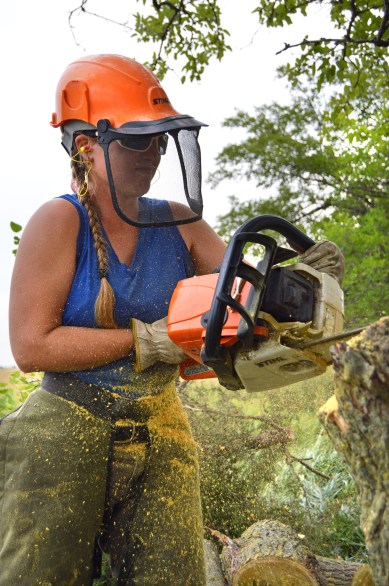
Katharine Hogan (Hubbard Fellow) wields a chainsaw

Katharine Hogan (Hubbard Fellow), technician Calla Olson, and I spent several days extracting a row of large twisting mulberry trees from between two stretches of fence. Photo by Eric Chien

Looking down the fence line of this tree removal project illustrates the process. Sawyers fell, limb, and buck trees, while a tractor follows behind and piles material into burn piles within the interior of the prairie. Photo by Eric Chien
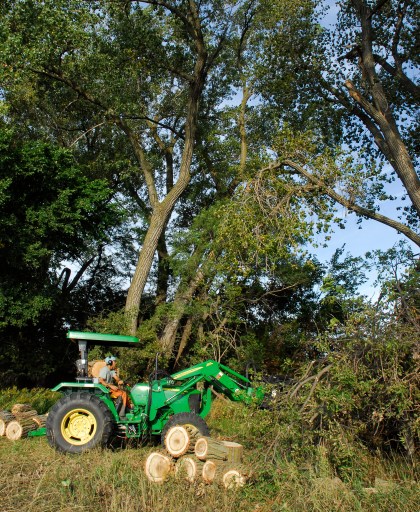
Looking down the fence line of this tree removal project illustrates the process. Sawyers fell, limb, and buck trees, while a tractor follows behind and piles material into burn piles within the interior of the prairie. Photo by Eric Chien

The most time intensive portion of tree removal, and thus limiting factor, is the organization and removal of downed tree material. Left on the ground, mature trees rarely burn up well in prescribed fires, and the skeletons impede maneuvering within the area during future management actions. Photo by Eric Chien

The most time intensive portion of tree removal, and thus limiting factor, is the organization and removal of downed tree material. Left on the ground, mature trees rarely burn up well in prescribed fires, and the skeletons impede maneuvering within the area during future management actions. Photo by Eric Chien

Despite the specter of an advancing forest, I love tree cutting. I like to think of tree control on the prairie as the big game hunting version of plant management. Removing mature trees demands thorough planning, and constant attention to one’s surroundings.  To date, I am not aware of an incidence of death by reed canary grass. Put that focus factor together with the fact that there are few prairie management activities with as immediately noticeable impact as the removal of dramatic woody encroachment, and it is a task ready made for those of us brain dead from spraying, and still cultivating patience for observing the effects of our work. Walking through a completed tree removal, or thinning, noting the full sunlight, and the unrestrained wind, gives me the same feeling as looking at a maturing prairie restoration. I think in many ways it is an equally profound change in the land; a taking back of the sky, and a return of a prairie.
Hubbard Alumni Blog: Volunteer Findings

This post was written by Evan Barrientos, one of our Hubbard Fellows from June 2015 through May 2016.  He’s working for Montana State University Extension now, but has returned to write a follow up post on the topic of his Hubbard Fellowship independent project.  You can see what he’s up to in Montana by following his personal blog.  

Hello again! I’m writing from beyond the Fellowship because my final month as a Hubbard Fellow was a whirlwind and I didn’t find time to write a blog post that did the experience justice. First, I want to say that it was the best career-building experience that I could have possibly had. The Fellowship taught me diverse and useful job skills, taught me how to network within a wide conservation community, and transitioned me from a recent graduate to a young  professional. Second, I want to summarize what I learned from my fantastic experience working on the Platte River Prairies’ volunteer program.

Phone Interviews: During my fellowship I conducted 11 phone interviews with other land stewardship volunteer coordinators, mostly in prairie ecosystems. Overall, these coordinators were impressively competent and offered lots of wise advice and great ideas. Here is a very summarized list of what I found.

  • Word-of-mouth is the best form of recruitment, which means volunteer events really need to be enjoyable and meaningful if you want volunteers to bring their friends.
  • Trainings allow volunteers to take on more advanced tasks such as herbicide application and chainsaw use, thereby accomplishing much more work. Several programs also train their volunteers to lead workdays and offer the opportunity to volunteer independently outside of formal workdays. Trainings also promote retention by providing learning opportunities and showing volunteers that they’re valued. Pairing new volunteers with experienced ones is also an efficient way to train.
  • Communication between staff and volunteers is essential. The volunteer coordinator must provide clear and specific instructions and locations and always be reachable by phone to answer questions.
  • Retention is crucial for building efficient volunteers and a productive volunteer program. The longer a volunteer has been volunteering, the better he/she knows the site and tasks. This takes time, but regularly offering quality workdays is the first step towards identifying and developing dedicated volunteers.
  • Ways to promote retention:
    • Treat committed volunteers with the same levels of respect and expectations as paid staff.
    • Integrate staff and volunteers as much as possible.
    • Build a sense of community through formal and informal social opportunities.
    • Provide opportunities to gain skills and knowledge.
    • Express gratitude regularly and at formal events.

Volunteer Survey: I also sent out a survey to collect feedback on our volunteer program. Here are a few things I learned:

  • Helping prairies was the strongest motivation for volunteering, followed by learning and getting outside.
  • More satisfied volunteers were more likely to volunteer in the future and had higher past attendance.
  • There was significant interest in volunteering independently on their own schedule (78%).
  • Distance was the factor discouraging attendance most frequently mentioned (37%).

My own conclusions:

Working with volunteers was the most rewarding work I’ve done in a long time. There are many excellent conservation organizations that significantly expand their stewardship capacity by effectively engaging volunteers, but it takes time, dedication, and the right personality to do so. Regularly holding enjoyable and meaningful workdays is the first step; creating opportunities to grow into new responsibilities is often the second. Last, it is almost always necessary for there to be at least one staff person dedicated to managing the volunteer program in order for it to flourish. With time, it’s possible to create programs that accomplish a lot of work while inspiring a passion for conservation in many people.

20160521_nebraska_0669

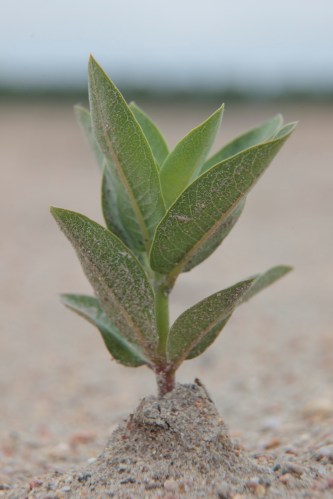
A milkweed sprouts from the prairie that volunteers helped seed last winter.