
Photo of the Week – September 10, 2015

A few weeks ago, I took my camera across town for a walk in a small local prairie.  There were numerous flowers blooming, but the stiff sunflowers (Helianthus pauciflorus) were stealing the show.  I shot quite a few photos of them from various angles.

Hover fly on Stiff sunflower (Helianthus pauciflorus) Lincoln Creek Prairie, Aurora, Nebraska.

This little hover fly was enjoying a meal of stiff sunflower pollen.  Lincoln Creek Prairie, Aurora, Nebraska.
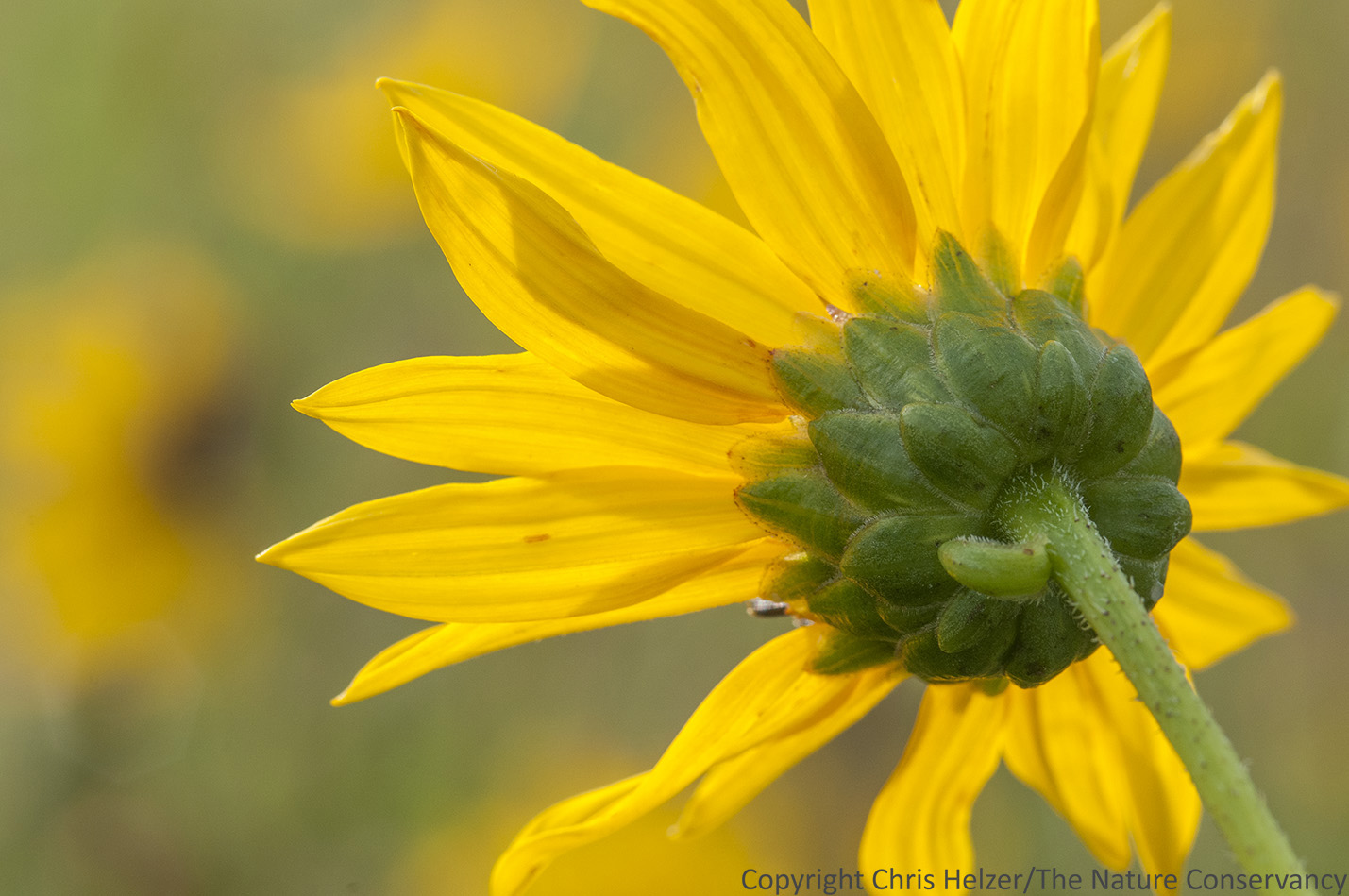
Stiff sunflower (Helianthus pauciflorus) Lincoln Creek Prairie, Aurora, Nebraska.

The sunflower perspective.

I noticed that a few sunflowers seemed to have their “petals” (technically speaking, they are the ray flowers) folded in toward the center of the flower.  I’d seen this quite a few times before, but this time I decided to investigate.  I gently pulled the petals apart and found they’d be held down with what appeared to be silk.  Beneath them, an insect larva was hiding and, presumably, feeding on pollen or other flower parts.

Caterpillar in Stiff sunflower (Helianthus pauciflorus) Lincoln Creek Prairie, Aurora, Nebraska.

A closed-up stiff sunflower.

Caterpillar in Stiff sunflower (Helianthus pauciflorus) Lincoln Creek Prairie, Aurora, Nebraska.

The larva revealed.  Note the remnants of silk and the anthers still sticking to the petal after I pulled everything apart.

Caterpillar in Stiff sunflower (Helianthus pauciflorus) Lincoln Creek Prairie, Aurora, Nebraska.

A close up of the caterpillar (?)

I’m not expert enough with insect larva identification to know for sure, but I’m guessing the larva is a moth larva – I know at least some of those have the ability to make silk.  Some of you reading this will surely know more about them and comment below.  (Thanks for your help.)

A few days later, I ran across some similarly closed up flowers in a different prairie.  When I opened those up, there was another larva inside, but it was much darker in color.  I wonder how many different species have this behavior?

The larva I found was just one of many examples of insects that create safe hiding places for their young to feed in.  Spittle bugs and gall-forming insects are two others that are common in prairies.  Of course, for every great hiding strategy, there is at least one predator that has developed a counter strategy.  I don’t know what eats the petal-tying larvae, but I bet there’s something out there.  I’m pretty sure guys-with-cameras are not the only ones who can find them.  Fortunately, for the larva I found, I wasn’t hungry at the time.


Double flowered sunflowers

When you look at a sunflower, you’re really looking at a composite of tiny flowers, or florets.  The same is true for asters, daisies, and other members of the composite family of plants.  The colorful “petals” of a sunflower are actually a series of tiny florets, called ray flowers, and the seed-producing dark center is made up of lots of disk flowers.  Together, they join together and function as one large flower that attracts pollinators and produces seed.

Stiff sunflower.  The Nature Conservancy's Platte River Prairies, Nebraska.

This sunflower has two kinds of flowers – ray flowers that look like yellow petals, and small disk flowers in the center.

This is how sunflowers are “supposed” to look.  However, you will occasionally find a sunflower that looks more like a chysanthemum, with yellow ray flowers across most or all of the face of the flower head.  Botanically speaking, this is called “double flowering”.  Horticulturists find and breed double flowering varieties of sunflowers and other composites, and you can find them at many nurseries and other plant stores.

Maximilian sunflower.  TNC Bluestem Prairie, Minnesota.

A double flowered Maximilian sunflower (Helianthus maximiliani) at The Nature Conservancy’s Bluestem Prairie in Minnesota.  Most of the disk flowers have been replaced by ray flowers.

When we were in Minnesota a few weeks ago, we saw a fair number of double flowered Maximilian sunflowers at The Nature Conservancy’s Bluestem Prairie.  I don’t remember seeing so many examples in one prairie before, but maybe I just haven’t paid close attention.  The abundance of them made me curious to learn more, so I did a quick internet search when we got back to Nebraska, and emailed a few botanist friends for more information.  The best information I found was related to a 2012 PLos Genetics journal article in which scientists described their discovery of the particular mutation that causes double flowering to occur.  You can read descriptions of the research here and here.

Maximilian sunflower.  TNC Bluestem Prairie, Minnesota.

Extra “petals” can be awfully pretty.

You might think of genetic mutation as something bad, but mutations are actually very common and mostly benign (and don’t affect form or function).  Now and then, a mutation can cause serious problems for an organism, but other times it can generate variations in a DNA sequence that turn out to be advantageous.  Double flowering seems to be somewhere in the middle.  On one hand, producing fewer disk flowers means the plant has fewer opportunities for pollination and seed production.  On the other hand, extra ray flowers could make a plant more attractive to insect pollinators and increase visitation.  In the case of the Maximilian sunflowers at Bluestem Prairie, the mutation doesn’t seem too disastrous, at least based on the number of plants we saw that have the trait.

I’m glad – it sure is pretty.