
He was engaging and informative – feeding our tour group piece after piece of the fascinating history of the people and landscape of the Wildcat Hills Landscape. The first guest speaker on the 2014 Nebraska Natural Legacy Conference Field Trip to the Loess Hills was really fantastic. But as I was listening to him, I was wandering around the outside of the group with my eyes (as they often are) scanning the ground, looking for something small and interesting.
…And that’s how I found this darkling beetle. It was plodding steadily along through sparse vegetation with no apparent concern that it was readily visible to any predator passing by. Before I knew it, I was lying flat on my belly with my camera, photographing this intriguing little creature (while still listening, of course, to the captivating speaker…).
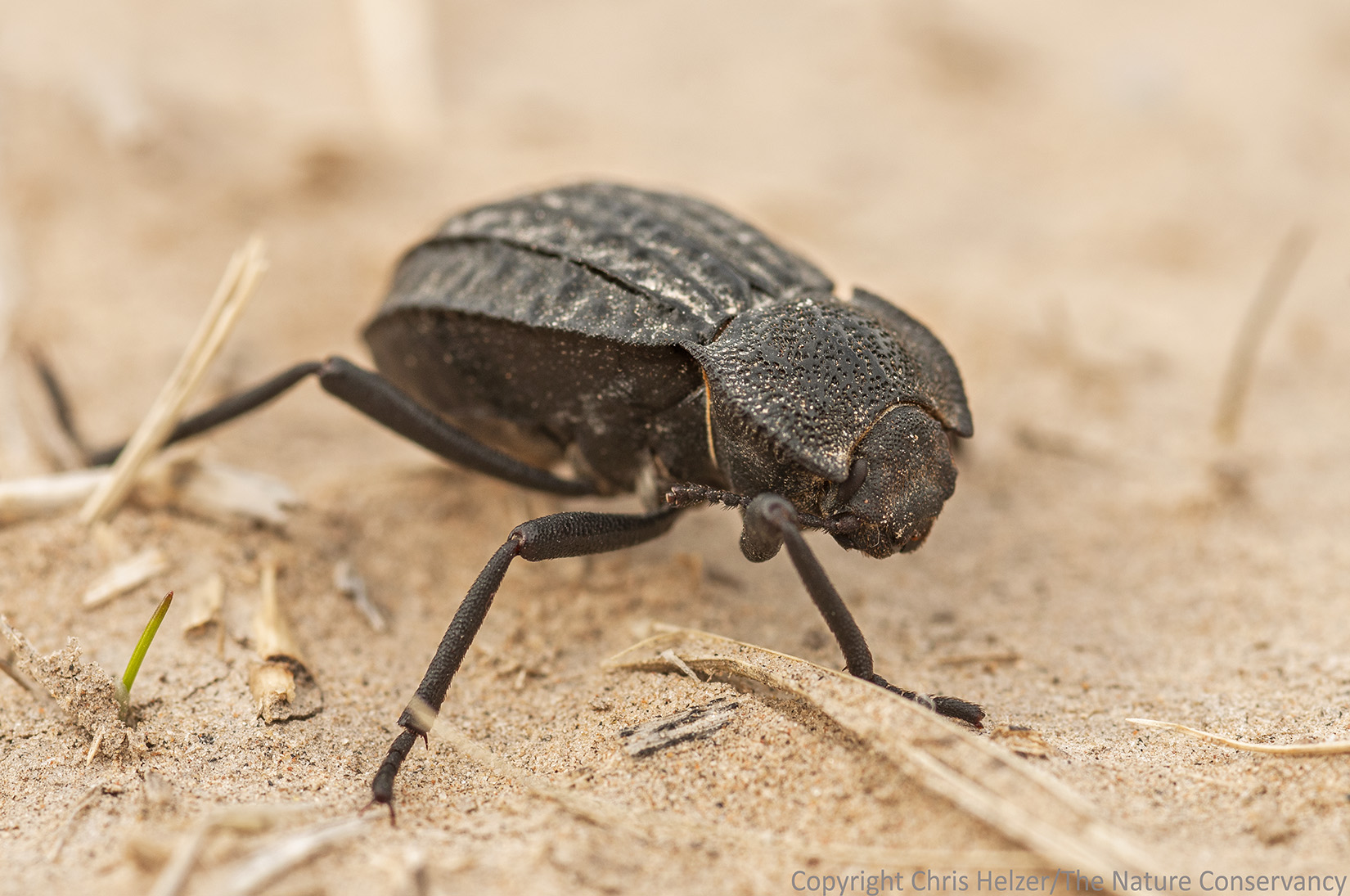
Darkling beetle
Thanks to James Trager and Ted MacRae, I can tell you that not only is this a darkling beetle, it is one of about 263 described species of asidine darkling beetles in North America (Coleoptera: Tenebrionidae: Asidini). I did some reading about asidine darkling beetles and came away with many more questions than answers – which happens every time I research any creature… My biggest question was this: how do these beetles avoid getting eaten by every predator they encounter?
The beetles in the Asidini tribe are flightless, and supposedly rely on camouflage as a major defense strategy. I don’t know about you, but this one doesn’t look to me as if it’s particularly well camouflaged, except maybe at night. The other defense ascribed to asidine darkling beetles is that they resemble another group of darkling beetles that has a chemical defense strategy involving a nasty smelling substance that blisters the skin of humans (and probably other predators).
Mimicry is fine and good, but depends upon potential predators being familiar with the dangerous creature you resemble. That seems like a long shot, given the number of predators running around – how many have had experience with nasty-smell-emitting darkling beetles? Regardless, the slow flightless beetle I photographed seemed either supremely confident or blissfully ignorant as it trucked along, fully exposed to the world. It sure didn’t look like it could outrun a hungry bird or other large predator, and it wasn’t making any obvious effort stay under cover as it moved around in the middle of the day. Seriously, how the heck is this species still around?
Look, what do I know? Maybe potential predators are well aware of the existence of the stinky blistering-chemical-emitting critters these asidine darkling beetles look like. Maybe that awareness doesn’t come from from personal experience but instead is embedded deep in the DNA of those predators. Doubtful? Think about all the people you know who are deathly afraid of spiders or snakes, even though they’ve had no personal negative experience with them.
One way or another, there seem to be plenty of asidine darkling beetles lumbering through the world, and they’ve apparently been doing it for thousands of years. They must be doing something right. Good for them.
I wish them luck.



 The Prairie Ecologist