A Day in the Bluffs

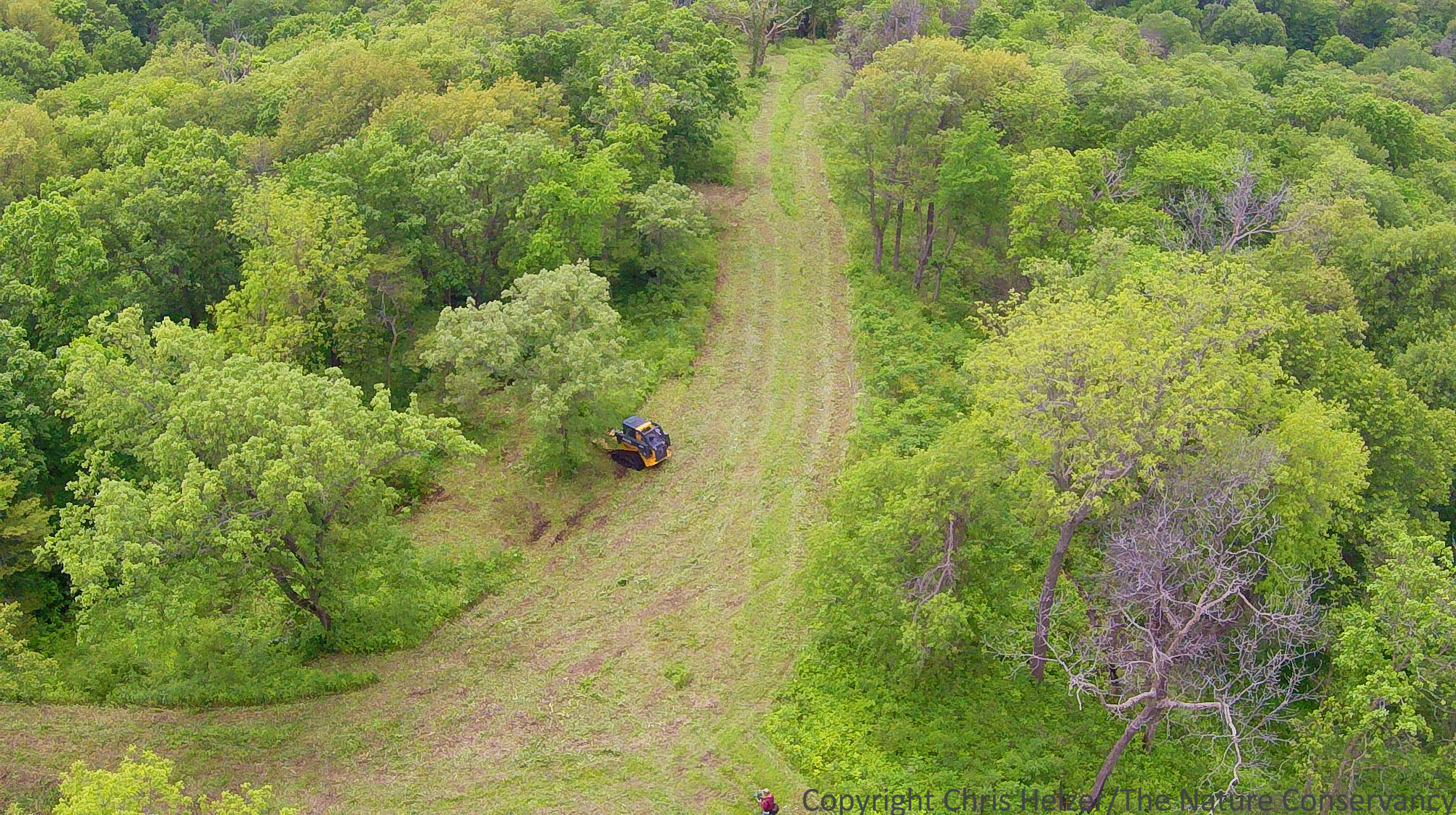
We spent a long day at our Rulo Bluffs property last week.  The site is at the very southeast corner of Nebraska, and includes about 450 acres of mostly oak/hickory woodland with prairie and savanna habitat on steep ridge tops.  I’ve written before about our work to burn and thin the woodlands to open up the understory layer as a way to encourage higher plant diversity and better wildlife habitat.  Last week, Nelson, our land manager, spent the entire day in a rubber-tracked skidsteer, shredding brush along ridges because we didn’t manage to get a fire  done last fall or this spring.  I got a few overhead photos of his work with our drone.

Nelso Winkel shredding brush with a skidsteer at The Nature Conservancy's Rulo Bluffs Preserve, Nebraska.  Using fire, thinning, and shredding, we are trying to allow more light to hit the ground in the woodland, which enhances oak tree regeneration, increases plant diversity, and improves habitat quality for many wildlife species.

Nelso Winkel shredding brush with a skidsteer at The Nature Conservancy’s Rulo Bluffs Preserve, Nebraska. Using fire, thinning, and shredding, we are trying to allow more light to hit the ground in the woodland, which enhances oak tree regeneration, increases plant diversity, and improves habitat quality for many wildlife species.

This photo shows a ridge where we've been working for more at least 15 years to beat back brush with fire and mechanical treatments.  Nelson didn't have to shred this area this year because the brush is finally starting to give way to more herbaceous plants.

This photo shows a ridge where we’ve been working for more at least 15 years to beat back brush with fire and mechanical treatments. Nelson didn’t have to shred this area this year because the brush is finally starting to give way to more herbaceous plants.

The second image above, taken with our drone, was interesting because it and others from the day showed a surprising number of large dead trees scattered across the property.  We knew we were reducing the number of smaller diameter trees with our thinning and fire work, and that a few bigger trees were also dying, but couldn’t see the real scope of that without being in the air.  (Couldn’t see the forest for the trees…)  While we’re not trying to kill off a large number of big trees, losing some provides space for new oak trees to get started, and provides a number of other benefits – including habitat for the many species that live in standing dead timber.  So, it wasn’t a shock or disappointment to see all the dead trees, it was just an interesting observation we couldn’t have gotten without the ability to get eyes up in the air.

My main job last week was to be on site in case Nelson ran into trouble with the skidsteer.  (That makes it sound like I was there to help fix the skidsteer – nothing could be further from the truth.  Nelson has more mechanical ability in his little finger than I could dream of.  I was just there to go for help in case he rolled the thing down the hill or something.)  While he was doing the real work, I tried to stay productive by pulling garlic mustard, scouting for invasive honeysuckle, and killing small trees with herbicide.  I also managed to find a little time for some photography.  Here are a few of the photos I took.

This is

This is starting to look more like what we want the site to be.  A strong herbaceous (non-woody) plant community, including sedges, grasses, and wildflowers, supports better wildlife diversity and also helps facilitate fire to maintain that open woodland character.


These paw paw trees were top-killed in our 2014 prescribed fire. they are regrowing from the base, but aren’t yet tall enough to suppress growth of other plants beneath them.


A small bur oak is fighting to establish itself on a prairie ridge as older oaks near the end of their lives.  Both in the woodland and savanna portions of the site, this replacement process is critically important.

A small bur oak is fighting to establish itself on a prairie ridge as older oaks near the end of their lives. Both in the woodland and savanna portions of the site, this replacement process is critically important.


These beautiful metallic-looking flies were pretty abundant the day were at the site.  I saw several in the clutches of spiders, but didn't manage to photograph any of those.

These beautiful metallic-looking flies were pretty abundant the day were at the site. I saw several in the clutches of spiders, but didn’t manage to photograph any of those.

A close-up photo of bur oak leaves.

A close-up photo of bur oak leaves.

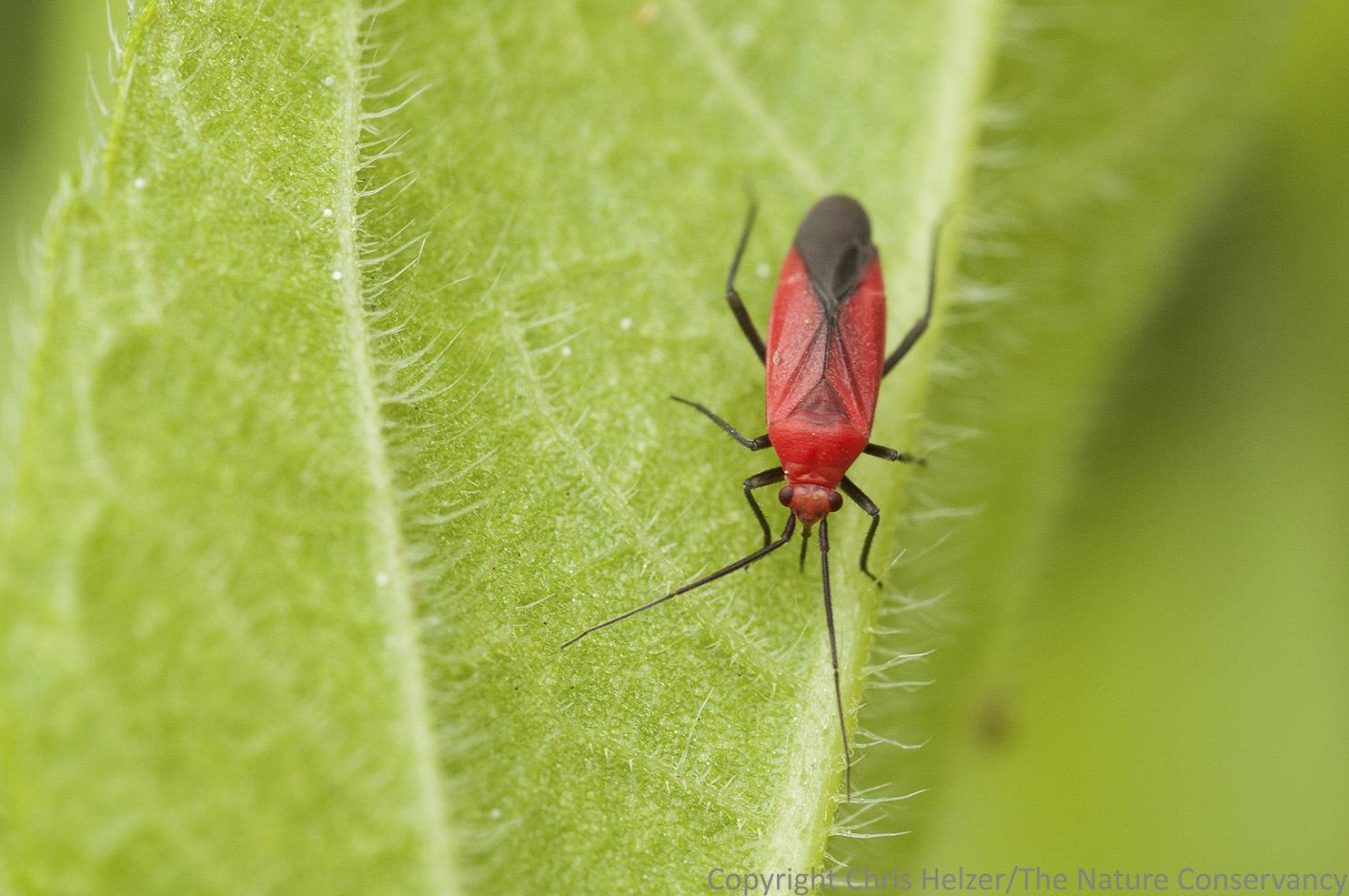
I'm not sure what species of bug (and it is a true bug) this nymph is, but it sure was striking against the green leaves it was feeding on.  I watched it repeatedly stick its long proboscis into this leaf as it moved across it.

I’m not sure what species of bug (and it is a true bug) this nymph is, but it sure was striking against the green leaves it was feeding on. I watched it repeatedly stick its long proboscis into this leaf as it moved across it.

Eastern redbud (Cercis canadensis) is a beautiful tree.  Both its pink flower and leaves are very attractive.  However, it is also one of the species we are trying to reduce the density of in the understory of the Rulo Bluffs woodland.

Eastern redbud (Cercis canadensis) is a beautiful tree. Both its pink flower and leaves are very attractive. However, it is also one of the species we are trying to reduce the density of in the understory of the Rulo Bluffs woodland.

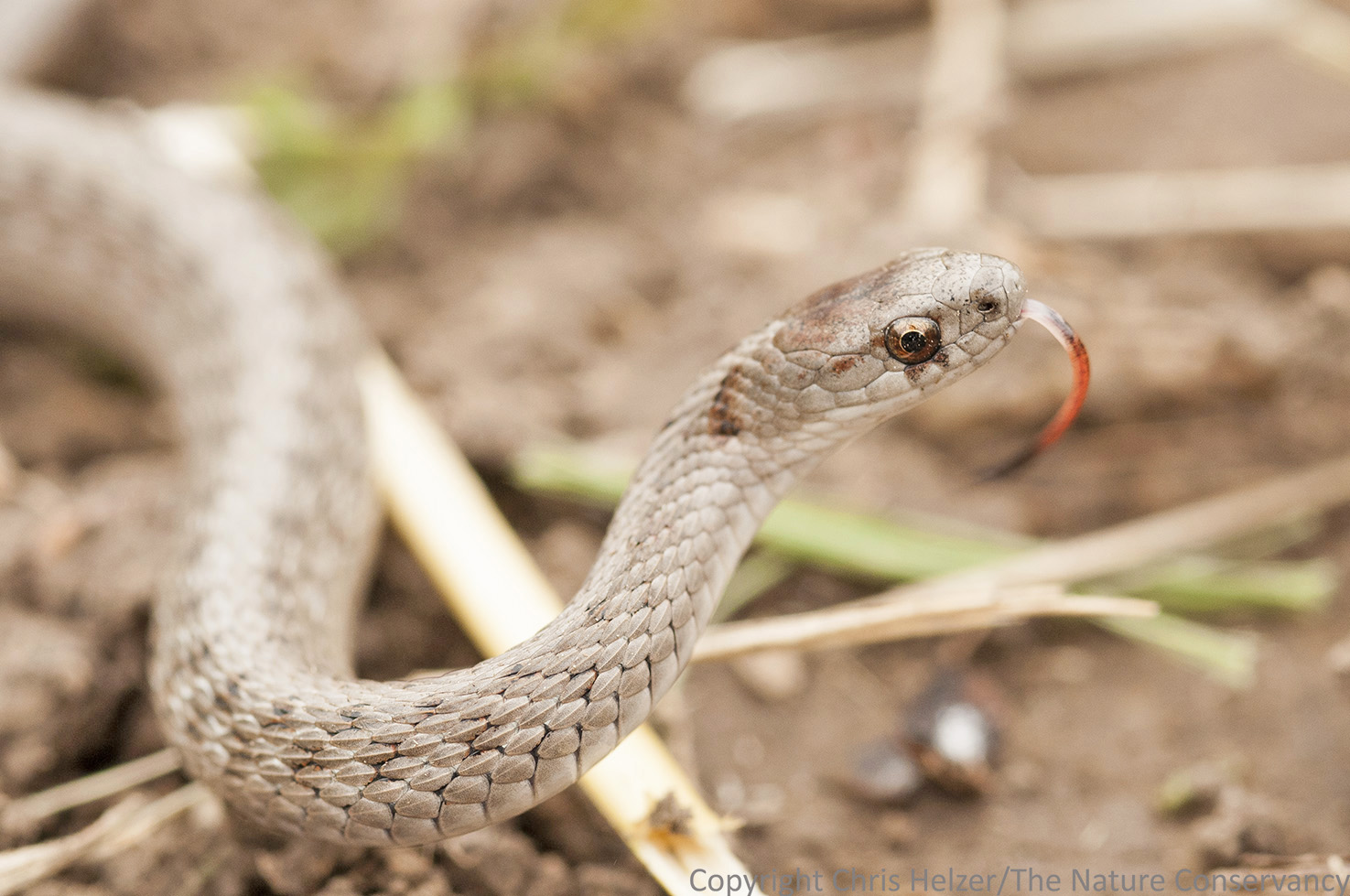
This beautiful little brown snake was about 10 inches long.  I spotted it  as it was making its way through one of the areas Nelson had just shredded.

This beautiful little brown snake was about 10 inches long. I spotted it as it was making its way through one of the areas Nelson had just shredded.

There are a couple species of raspberries, or close relatives, at Rulo Bluffs, but I don't know what species they are.  This one was particularly beautiful the day we were there.

There are a couple species of raspberries, or close relatives, at Rulo Bluffs, but I don’t know what species they are. This one was particularly beautiful the day we were there.

Because of its long distance from our shop and field headquarters, we never feel like we spend enough time working at Rulo Bluffs.  It’s a beautiful site, and one of the best examples of oak woodland remaining in Nebraska.  As with other oak/hickory woodlands, however, it requires active management in order to survive and regenerate.  Without frequent fire, or substitutes such as thinning and shredding, the understory at Rulo Bluffs would become choked with small trees and shrubs, such as ironwood, dogwood, paw paw, and others.  Those woody understory species block light from hitting the ground, prevent the establishment of new oaks, and choke out most grasses, sedges, and wildflowers.  Eventually, if older oaks die without being replaced, these woodlands change into new communities, dominated by trees such as ash, hackberry, and others that don’t create leaf litter that can carry fire.  At that point, restoring the oak/hickory woodland community, which supports a much larger diversity of plant and animal life, is nearly impossible.

…and that is why we keep trying to find time to head down to Rulo Bluffs.  That, and it’s such a beautiful place.

Ruminations on Tree Planting and Prairie Conservation

Trees are great, but trees in and around prairies can negatively impact habitat quality for many grassland plant and animal species and provide points of introduction for invasive species.  Encroachment by trees has become a major threat to prairie conservation in many landscapes.  

A few months ago, I cut across the courthouse lawn on my way home from the office (I was walking – it’s a small town).  On the west side of the courthouse, there are a number of statues and other monuments memorializing veterans of various wars.  In the midst of those, however, is a very different kind of memorial (pictured below).  This plaque-on-concrete memorial got me thinking – yet again – about our relationships with trees, our desire to plant and care for them, and how that affects our former, current, and future relationship with prairie.

We love trees so much, we use them to memorialize important events and people in our lives.  Sometimes, we then create memorials to honor people who plant trees!

We love trees so much, we use them to memorialize important events and people in our lives. Sometimes, we even create memorials to honor the trees and the people who planted them!

I live in Nebraska, home of Arbor Day.  Early European settlers of Nebraska were enthusiastic tree planters for both practical and aesthetic reasons; our legislature even designated us as “The Tree Planters State” back in 1895.  There were good reason for all that tree planting.  It’s certainly nice to have shade around one’s house and yard, and a grove of trees provides a valuable shield from strong winter winds for both homes and livestock.  In addition, early settlers found the open prairie lacked adequate wood for fuel and building materials.  However, despite the numerous practical uses for trees, I think most tree planting was and is done primarily as a way to make the landscape more visually appealing.  People just like trees.

This brings me to my contemplation of tree planting and prairie conservation.  Research has shown that when given a choice, people seem most attracted to the aesthetics of a savanna-like landscape – one with scattered trees and short grass.  That mindset is evident in the way we design our yards and parks.  Not only do we enjoy having trees, we really like to plant them ourselves.  We gain immense satisfaction from the simple act of digging a hole and plopping a seed or small seedling in the ground, knowing that we and future generations will be able to watch that tree grow skyward.  The trees we plant often become almost family members in the way we celebrate their growth and mark time by how big the trees were when such and such happened.

The landscaping around the Hamilton County, Nebraska courthouse (where the above plaque is located) is a great example of the kind of scattered trees/short vegetation landscape humans find aesthetically appealing.

The landscaping around the Hamilton County, Nebraska courthouse (where the above plaque is located) is a great example of the kind of scattered trees/short vegetation landscape humans find aesthetically appealing.

This brings up two issues for those of us working to conserve prairies.  First, we’re starting from a handicapped position when we advocate for prairie conservation because prairies are not what most people visualize when they think of natural beauty.  Given the choice between a treeless grassland and a park-like landscape dotted with trees, most people would choose the wooded park as a site to photograph, hike or picnic, or build a house.  In fact, there are countless examples in which people buy a small patch of prairie for a recreational property and immediately plant numerous trees to make it “look nicer.”  We really haven’t changed much from our European settler predecessors in that regard.

Second, we haven’t yet found a prairie-related analog to tree planting; a simple activity that creates something people can take ownership of, love and nurture.  Planting trees is so easy a child can do it, and with very little investment of time or money, someone can establish a couple trees that become treasured landmarks or memorials – – which further reinforces people’s love of trees and wooded areas.  In contrast, planting prairies is fairly complicated and requires more space.  It also takes a few years for a planting to grow out of its weedy phase and start to look like a prairie.  Prairie planting can certainly be rewarding, but it’s not nearly as simple, accessible, and instantly gratifying as tree planting.

Many people find wide expanses of open prairie impressive, but not alluring.  How do we get people to care about and nurture landscapes and ecosystems they have to work to appreciate?

Many people find wide expanses of open prairie impressive but not alluring. How do we get people to care about and nurture landscapes and ecosystems they have to work to appreciate?

So how can we help people connect with prairies in the same way they connect with trees and wooded landscapes?  I don’t have all the answers, but here are a few ideas.

1) We need to encourage more people to spend time in prairies and make sure they enjoy themselves when they go. It can be a definite challenge to convince someone to take a walk in a prairie.  Even worse, when people do step foot in a prairie, many are unimpressed because they don’t really know what to look for or how to appreciate what they’re seeing.  As a result, they often walk away with an even less favorable opinion than before they came.  “It was just a lot of grass!  And I was pulling ticks off myself all night!”

A good naturalist and interpreter can lead someone on their first prairie excursion and make it a positive and thought-provoking experience.  There is no substitute for the expertise and enthusiasm of a good leader, but there aren’t enough of those people to go around.  Several Nebraska Master Naturalists approached me last year with an idea to create a “Prairie Exploration Guide” – a pamphlet/booklet designed to help newcomers to prairie see the beauty and complexity they might otherwise miss.  The guide is still in the development stage, but I have high hopes that it will be a useful tool when it’s done.

2) Using native prairie plants in landscaping is becoming increasingly popular. The public’s concern over population declines of bees and monarch butterflies is helping to spur the movement, as are issues such as water conservation.  There is no question that getting the public to buy, plant, and appreciate native prairie plants in their backyards is a major step toward building a prairie conservation constituency – and backyard prairie gardens also make real conservation contributions on their own.  Significant obstacles still hinder the movement, especially our cultural norms about what yards and gardens are “supposed” to look like, but I am optimistic about the future.

3) One successful method for engaging people in prairie conservation at our Platte River Prairies has been through seed harvesting. People identify with both the value of seeds and the idea of restoring lost habitats.  Harvesting seed is a tangible way people can contribute toward something important; they can measure that contribution by the amount of seed piling up in their buckets.  Ideally, harvesters come back and help plant the seed they picked, and then visit regularly to watch the prairie planting develop over time.

I hope that helping me harvest and plant seeds at our family prairie will help my kids develop a love for grasslands.

I hope that helping to harvest and plant seeds at our family prairie will help my kids develop a love for grasslands.

Along those lines, one of the most inspired strategies I’ve seen to engage people in prairie restoration was being done by Wayne Pauly in Dane County, Wisconsin.  I went on a tour of some of his prairie restorations back in 2004 and was very impressed with both his plantings and his involvement of volunteers. Most particularly I liked Wayne’s strategy of having volunteers “paint the prairie” with seeds during prairie plantings.  He’d give each volunteer a bucket of seeds of one prairie wildflower species and let them decide how and where to plant those seeds – allowing them to create a pattern or design of their choice (thus the idea of “painting”).  That is a brilliant idea, and one that should not only be fun on planting day, but should also draw those volunteers back in subsequent years to view the results of their work.

Humans have a long and strong relationship with trees, one that is likely embedded within our DNA.  Tree planting is an easy, accessible, and tangible way to contribute something to the natural world.  Unfortunately, tree planting doesn’t do anything to help prairies, and can sometimes be counterproductive if trees are planted in or near open grassland.  If prairie conservation is to succeed, we need to get the public excited about grasslands and combat the perception that prairies would look a lot prettier if they just had some trees growing in them.  More importantly, we need more strategies that actively connect people with prairies and give them the same sense of fulfilment they get from planting trees.  I think we’re getting better, but we have a long way to go.