
Snow-on-the-mountain (Euphorbia marginata) is a showy plant, but not because of its flowers. In fact, the flowers are tiny and very simple. It’s the leaves (and some bracts beneath the flowers) that make the plant outstanding in its field.
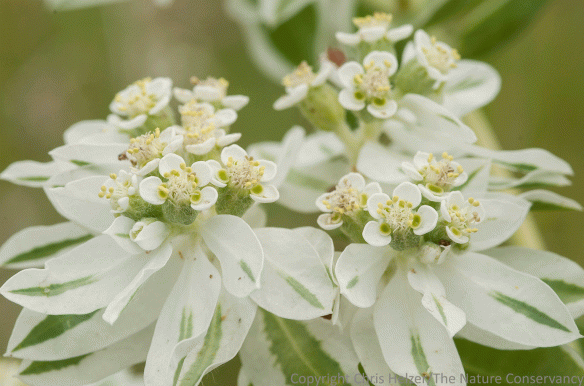
Snow-on-the-mountain (Euphorbia marginata)
Like other relatives in the spurge family, snow-on-the-mountain’s flowers have no petals or sepals. The small round white things that look like petals beneath the anthers are actually bracts, and all the other white parts are leaves. Most of the leaves of snow-on-the-mountain are green, but they become variegated toward the top of the plant. The leaves closest to the flowers are often nearly or completely white.

More snow-on-the-mountain, showing the rounded white bracts beneath the flowers, and the variegated green and white leaves below those.
The weird flower structures and variegated leaves are not the only unique features of snow-on-the-mountain. Some of you with biology backgrounds know that plants are often divided by their photosynthesis strategy. There are C4 plants (often casually referred to as “warm-season” plants) which are most efficient at photosynthesis during hot temperatures and drought conditions, and there are C3 plants (“cool-season” plants) which are more efficient during other kinds of conditions. A few of you might even know that there is a third photosynthetic pathway called CAM, which is particularly effective in very arid conditions. As it happens, snow-on-the-mountain and other Euphorbs actually use all three photosynthetic pathways – the only genus of plants for which that is true (as far as I know). There, now you all have something to talk about at your next family gathering.
Snow-on-the-mountain is often maligned as a weed that needs to be controlled via herbicide or mowing. In truth, while it is closely related to leafy spurge (Euphorbia esula), snow-on-the-mountain is an annual plant that is opportunistic but not invasive. Cattle don’t like the taste of it, so it is often left ungrazed when everything else around it is nipped off near the ground. Snow-on-the mountain can thrive in overgrazed pastures and other places where the vigor of dominant grasses is suppressed, but it competes poorly against those grasses when they’re allowed to grow again.
I appreciate periodically seeing snow-on-the-mountain in prairies because I know that if it was able to germinate and grow, other plants (including less “weedy” perennials) probably got the same opportunity. Except around water tanks or other places where repeated cattle impacts or other factors keep grasses suppressed, snow-on-the-mountain doesn’t hang around very long.
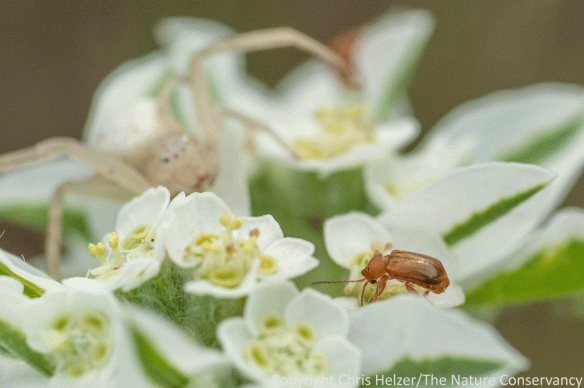
A small beetle feeds on snow-on-the-mountain pollen, seemingly unaware of the camouflaged danger lurking nearby (crab spider).
As if the weird flowers, variegated leaves, and triple threat photosynthesis strategy weren’t enough to make you love this unique and beautiful plant, here’s one more cool fact. Snow-on-the-mountain and other spurges produce white milky latex in their leaves and stems just like milkweed plants and rubber trees. The latex isn’t sap, it’s made by a completely separate production system and doesn’t travel through the plant. It’s a defense mechanism that is bad tasting and irritating to the skin of many animals (including humans with latex allergies).
Snow-on-the-mountain is a gorgeous native wildflower. It used to be more commonly planted as an ornamental because of its beauty, but also because it is relatively free of pests and diseases (due in part to its toxic latex). Unfortunately, because cattle don’t like to eat it and it can be abundant (and very conspicuous) in overgrazed areas of pastures, it has gotten an undeserved reputation as a nasty weed. Snow-on-the-mountain doesn’t want to take over the world. It just likes to grow in places where nothing else is growing anyway, and it gives way politely when the neighbors start getting pushy.
Does that sound like an invasive plant to you? It sounds to me like a plant that needs a friend. Let’s be friends with snow-on-the-mountain. What do you say?


 The Prairie Ecologist