
A Week in the Sandhills

I’m in the Nebraska Sandhills all this week, doing field work.  Being in the middle of 12 million acres of intact native prairie has its advantages, but there’s not much time or internet connectivity for blog posting. I’m hoping I can get a few photos posted here pretty quickly before I lose my connection again.

Yucca is common throughout much of the Sandhills. Many of the plants are in full bloom right now, accompanied by the yucca moths that pollinate them.
Yucca is common throughout much of the Sandhills. Many of the plants are in full bloom right now, accompanied by the yucca moths that pollinate them.

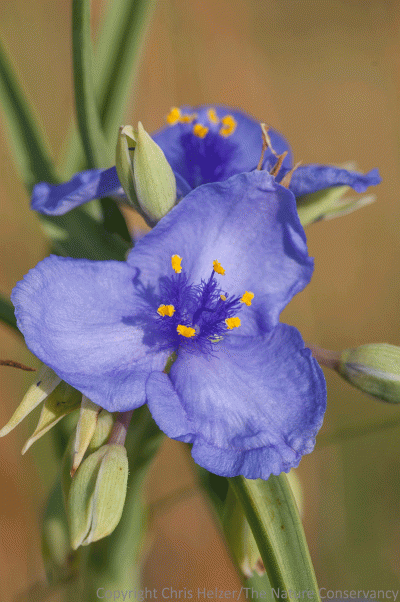
Spiderwort (Tradescantia occidentalis) is also in full bloom right now.

Spiderwort (Tradescantia occidentalis) is also in full bloom right now.  It is one of my favorite flowers.
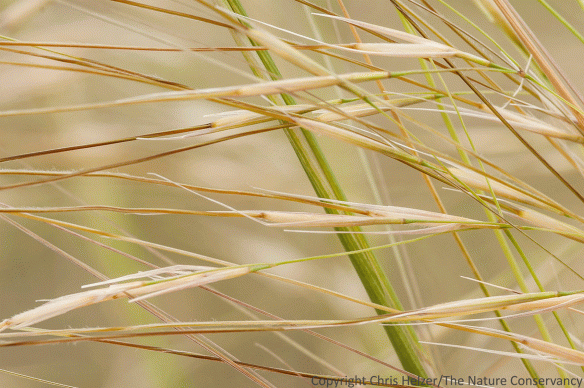
Needle-and-thread grass (Hesperostipa comata) is producing seeds, which look very much - and can act very much - like sharp spears.  Trying to figure out why this grass is blooming abundantly in some pastures and not others has been a fun mind puzzle for me this week.

Needle-and-thread grass (Hesperostipa comata) is producing seeds, which look very much – and can act very much – like sharp spears. Trying to figure out why this grass is blooming abundantly in some pastures and not others has been a fun mind puzzle for me this week.

Wetlands are all over many parts of the Sandhills.  Groundwater levels are high and often exposed between the vegetated sand dunes.  The wetlands are loaded with everything from frogs and salamanders to trumpeter swans and grebes.

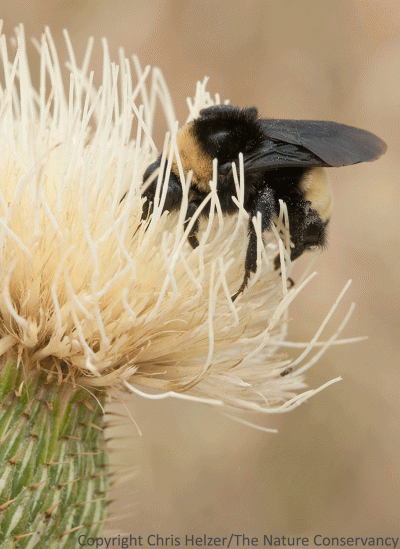
Platte thistle (Cirsium canescens) is a great native thistle with a cream-colored flower.  It is loaded with pollinators right now.
bum

This bumblebee was one of many bees I’ve seen enjoying Platte thistle.

Wetlands are all over many parts of the Sandhills. Groundwater levels are high and often exposed between the vegetated sand dunes. The wetlands are loaded with everything from frogs and salamanders to trumpeter swans and grebes.

Wetlands are all over many parts of the Sandhills. Groundwater levels are high and often exposed between the vegetated sand dunes. The wetlands are loaded with everything from frogs and salamanders to trumpeter swans and grebes.

Lizards are common, especially in areas of bare sand.  They scurry to cover as we approach, but this prairie lizard (Sceloporus sp.) posed long enough for a photo.

Lizards are common, especially in areas of bare sand. They scurry to cover as we approach, but this prairie lizard (Sceloporus sp.) posed long enough for a photo.


This entry was posted in Prairie Animals, Prairie Insects, Prairie Natural History, Prairie Photography, Prairie Plants and tagged , , by Chris Helzer. Bookmark the permalink.
Unknown's avatar

About Chris Helzer

Chris Helzer is Director of Science and Stewardship for The Nature Conservancy in Nebraska, where he conducts research and supervises the Conservancy’s preserve stewardship program. He also helps develop, test, and share prairie management and restoration strategies. Chris is also dedicated to raising awareness about the value of prairies through his photography, writing and presentations. He is the author of The Prairie Ecologist blog, and two books: The Ecology and Management of Prairies and Hidden Prairie: Photographing Life in One Square Meter. He is also a frequent contributor to NEBRASKAland magazine and other publications. Chris and his family live in Aurora, Nebraska.

2 thoughts on “A Week in the Sandhills

  1. Glad you were able to get this post in. What a wonderful place to spend the week. Back when I had a garden spiderworts were included. Besides the wonderful flowers, the plant itself makes an interesting addition.

  2. Nice, I am heading out there in 2 days myself. Always enjoy being in the sandhills. Ever find any white spiderwort? I don’t know how rare it is, but I only come across 2 plants when I spent a whole summer out there.

PLEASE COMMENT ON THIS POST!

This site uses Akismet to reduce spam. Learn how your comment data is processed.