Sand Wasps

I was introduced to sand wasps (Bembix sp) by Mike Arduser when he came to visit the Platte River Prairies back in 2012.  As we stood together in a sand prairie, a bee-like creature was zipping around us with incredible speed.  Mike explained that it was a sand wasp, and that it wasn’t interested in us, but rather was looking for flies that might be hanging around us.  Since that day, I’ve paid much more attention to sand wasps and have seen them all over the place in sandy places.

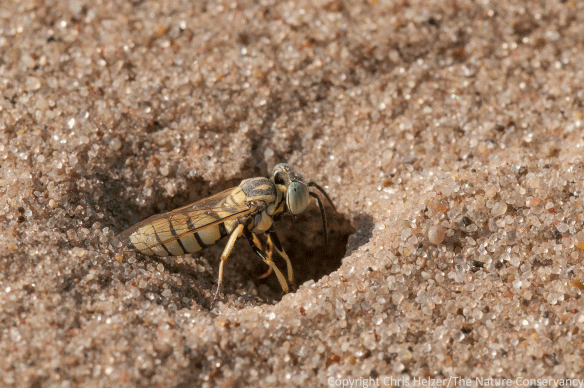
Sand wasp (Bembix americana spinolae) burrowing in sand in a blowout. The Nature Conservancy's Niobrara Valley Preserve.

Sand wasp (Bembix americana spinolae) burrowing in sand in a blowout. The Nature Conservancy’s Niobrara Valley Preserve.  This wasp was about 1/2 inch long.

While we were exploring a big sand blowout last week at the Niobrara Valley Preserve, there were lots of sand wasps buzzing around, and we found some of their nest burrows.  I took a little time to sit near a couple nests and photograph the females as they worked to excavate them.  The wind appeared to be blowing just as much sand back into the holes as the bees were digging out…

Here's the same wasp as above as it digs sand out of its burrow.

Here’s the same wasp as above as it digs sand out of its burrow.

The video below shows both the blowing sand and the valiant effort of the wasp to excavate its burrow despite the wind.  If the video doesn’t appear correctly, try clicking on the title of this post to view it through an internet browser.

Mike tells me these sand wasps and their relatives catch and paralyze flies for their young.  They lay eggs in their burrows and provide the flies as food for the larvae.  Females, of course, do all the work to create the burrows, catch the flies and lay the eggs.  The males are just around for mating purposes.  While the wasp larvae eat flies, both the adult males and females feed on nectar and pollen.

Here are a few more images of the sand wasps we saw last week, along with the blowout they were living in.

A big blowout where wind keeps sand moving and open.

A big blowout where wind keeps sand moving and open.

The sand wasp shown earlier takes off and twists its body to zip away.
The sand wasp shown earlier takes off and twists its body to zip away.

This was a little smaller wasp from a different species that was nesting in a different part of the blowout from the first wasp.

This was a smaller wasp from a different Bembix species that was nesting in the same blowout as the first wasp.

...and that wasp was also digging its burrow.

…and that wasp was also digging its burrow.

As often happens with invertebrates, once I’ve been introduced to a creature, I start seeing it everywhere.  Even better, I’ve yet to meet an invertebrate that doesn’t have a fascinating background story.  It’s an awesome world we live in, and we share it with some pretty great neighbors.

Thanks, as always, to Mike Arduser for his help with identification and ecology.

Voting Results: Prairie and Bee? or Bee in Prairie?

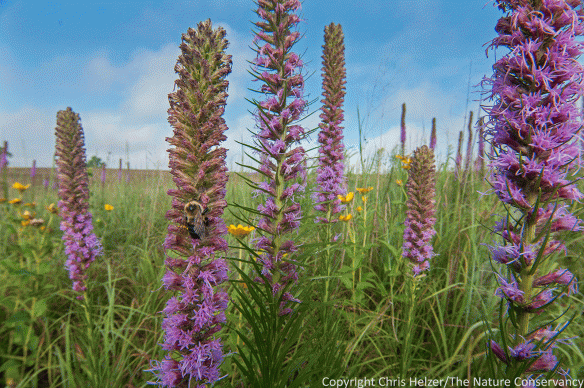
Back on August 4, I posted a selection of similar images and asked for help selecting the best of four compositions.  As has been the case in the past, there was no clear consensus, but there was a winner.  That winner was PHOTO NUMBER FOUR.

Bee on blazing star #4. (Vertical - just to complicate things)

This was the most popular choice from the voting.  (Though not by a landslide.)

Photo number four got 25 votes, followed by photo number one with 22 votes.  Photos number two (7 votes) and three (3 votes) lagged far behind.  However, it was interesting that all four compositions got votes, and even numbers two and three had very passionate supporters.

Bumblebee on blazing star. Photo #1.

This one (photo number one) finished a close second to photo number four.

For many people, the choice came down to whether or not the image was a photo of a prairie landscape with a bee in it (#1) or a photo of a bee in a prairie landscape (#4).  Some people liked the “surprise” of seeing the bee upon looking closely at a prairie.  Others enjoyed the more exposed bee in the vertical photo.

For what it’s worth, the photos were presented in the order I took them in the field.  I personally like number one best, but mainly because it best represents the feel I was trying to capture when I first saw the flowers and then discovered the bee.  I do like number four too, and remember making the decision to drop a little lower with my camera so the bee would be more visible against the sky.  …Of course, I like number two and number three too…

So, thanks for your help.  This is why photographers usually take many photos of the same subject, experimenting with various compositions.  It’s hard to know what you (or others) will like best later on.  This is also why I’ve never enjoyed photo contests.  It’s relatively easy to separate images that are technically good from those that aren’t, but the process is very subjective from there.  In some ways, a big selection of photos is much like an ecosystem – you can argue that one species/photo is more important than another, but it’s really the abundance and diversity that makes both a photo contest and ecosystem work!