
Earlier today, I posted my simple but effective guide to identifying insects and spiders. I hope you are finding it helpful.
Perceptive reader John Blakeman pointed out that a similar format would be helpful for identifying sedges (Carex sp). He’s absolutely right, of course, and it just happens that I have also developed that particular guide. I was going to release it at a later date, but I can see that the demand is high and I don’t want to hold people back.
As with other sedge keys you may be familiar with, this key works best if the sedge is in fruit. What if it’s not? You just have to wait until it is. This is not the fault of me or my key, it’s just the way nature works. Sedges refuse to be identified when they are not in fruit. They’re sorry if that’s inconvenient for you.
Without further ado, here is my simple identification guide for sedges.
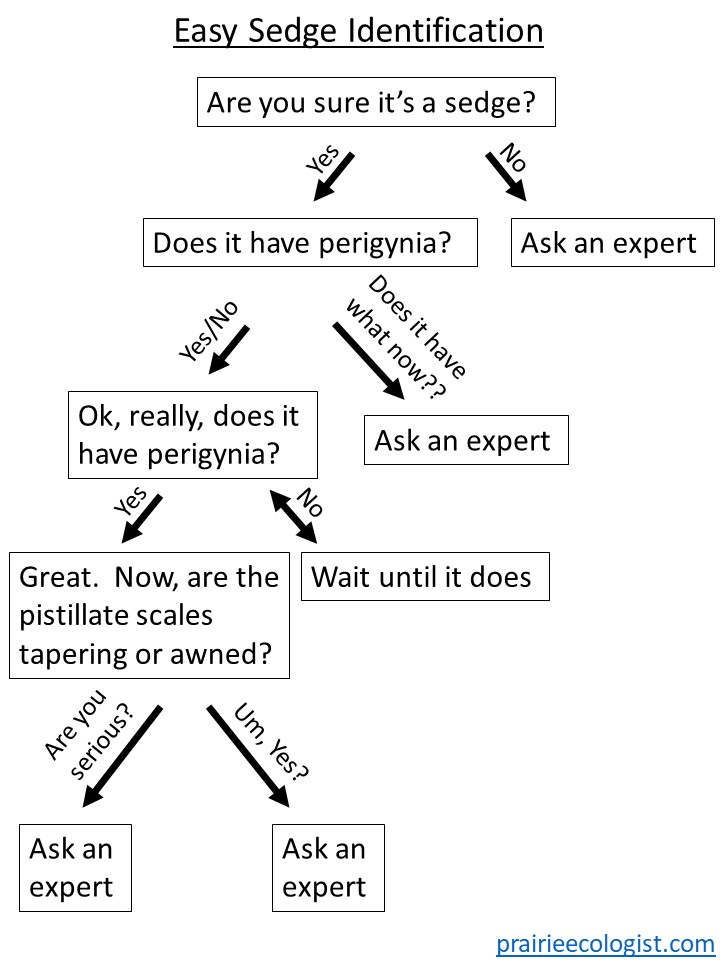
 The Prairie Ecologist
This seems very comprehensive.
thanks for making identification SO Easy!
I sight id sedges all the time without fruit. Although, it depends upon the sedge. Having them in my garden helps.
Brilliant!
The best part of these two posts is that they’ve been a great, simple, and understandable introduction to the very concept of dichotomous keys!
Never before have I encountered a sedge key that gave me the answer for every single sedge I encounter! Awesome!
I first saw the title and thought that was surely an oxymoron.
Brilliant! :-)
😂😂😂
Ha! Perfect!!
😂😂😂