Hubbard Fellowship Blog – Kate’s Rocky Path to Prairie Ecology

This post is by Hubbard Fellow Kate Nootenboom. Applications are open right now for the Hubbard Fellowship, so please forward this link to any recent college grads who might be interested. In the meantime, please enjoy this really nice post by Kate. (Oh, and PLEASE fill out the brief survey of blog readers here. Thanks!)

My biggest secret as a Hubbard Fellow is that I’ve never taken an ecology class.

I barely took biology in college; one intro course as a freshman where we studied, you know, mitosis. Not exactly the hard-hitting plant community stuff. So now I nod politely when ecologists around me drop phrases like “trophic cascade” or “secondary successional community” and try to remember to google it later.

Imposter syndrome aside, I don’t regret my academic path here. On the contrary, I love what I studied, and can draw countless links between the forces that drew me to geology and the forces that drew me here, to Nebraska, guest-writing on a blog with ecology in the title.

For one thing, geology allowed me to learn and work outside more than any other major. The ethos of the geo department hinges on getting students out, on teaching us to recognize a sandstone by the way it rolls in our fingers, or to understand a fault by tracing its signature, with boots or with eyes, across a landscape. I get the same sense of immersive wonder in the prairie, where Chris teaches us to recognize a forb by the way the stem rolls in our fingers, or to understand the impact of a controlled burn by tracing the signature of its perimeter.
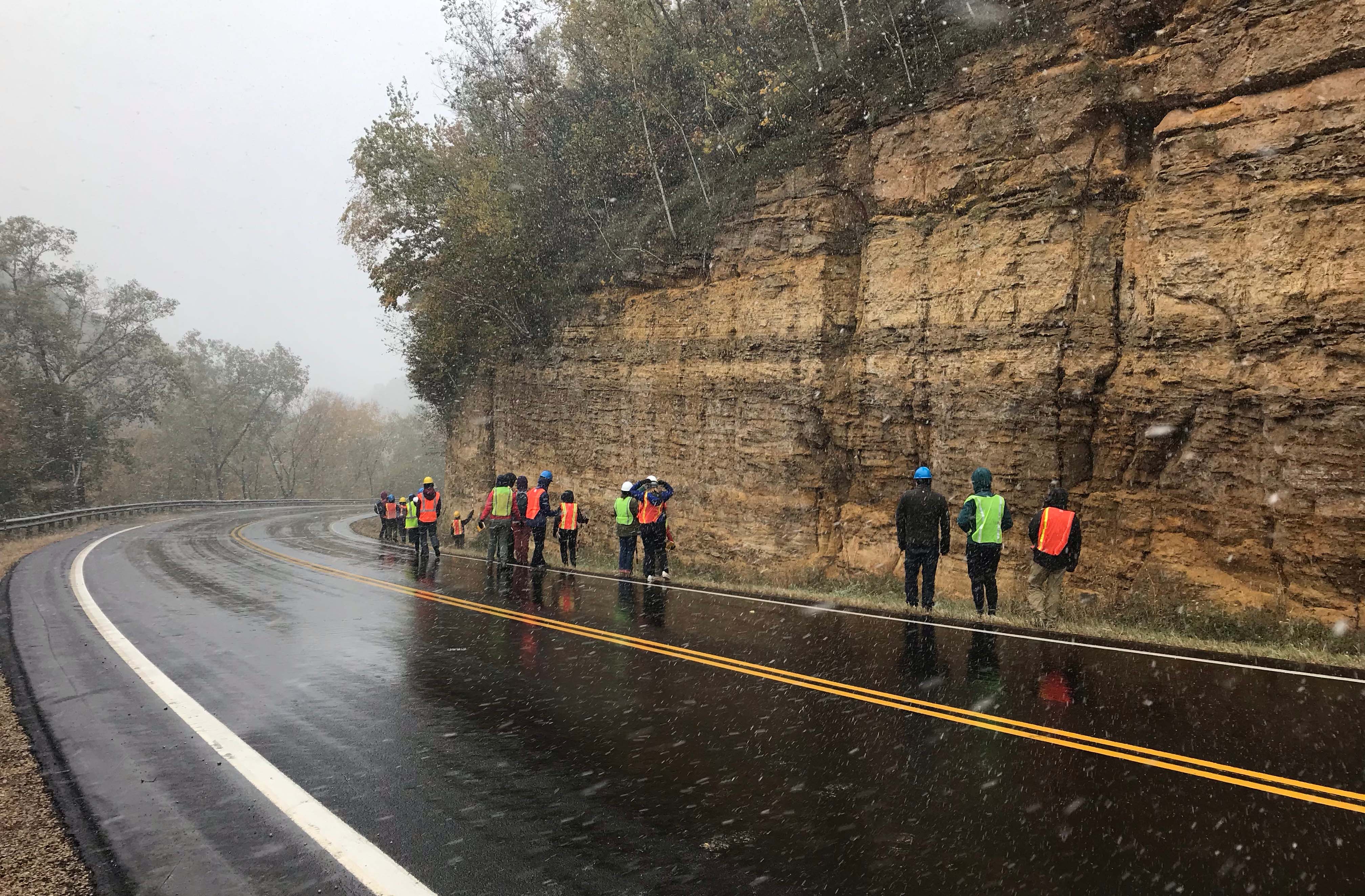
Intrepid young geologists learn the feel of a sandstone on a Minnesota November day. Photo by Kate Nootenboom.

To be sure, there are some obvious overlaps between geology and prairie ecology. The Prairie Ecologist himself has documented how ancient branches of the Platte express themselves now as braided prairie, popping out during drought when alluvial soils dictate vegetation response. There is even a unique ecosystem that is named solely for the type of soil in which it grows: serpentine grassland, brought to you exclusively by soils derived from metamorphic serpentinite.

(Before I go any further, let me acknowledge that there are many more overlaps! A brief shoutout to the wetland restoration specialists who hunt for iron-stained clues in the soil beneath corn fields, and the good people at Konza Prairie in Kansas who delineate their management units along watershed lines. What an earthly idea!)
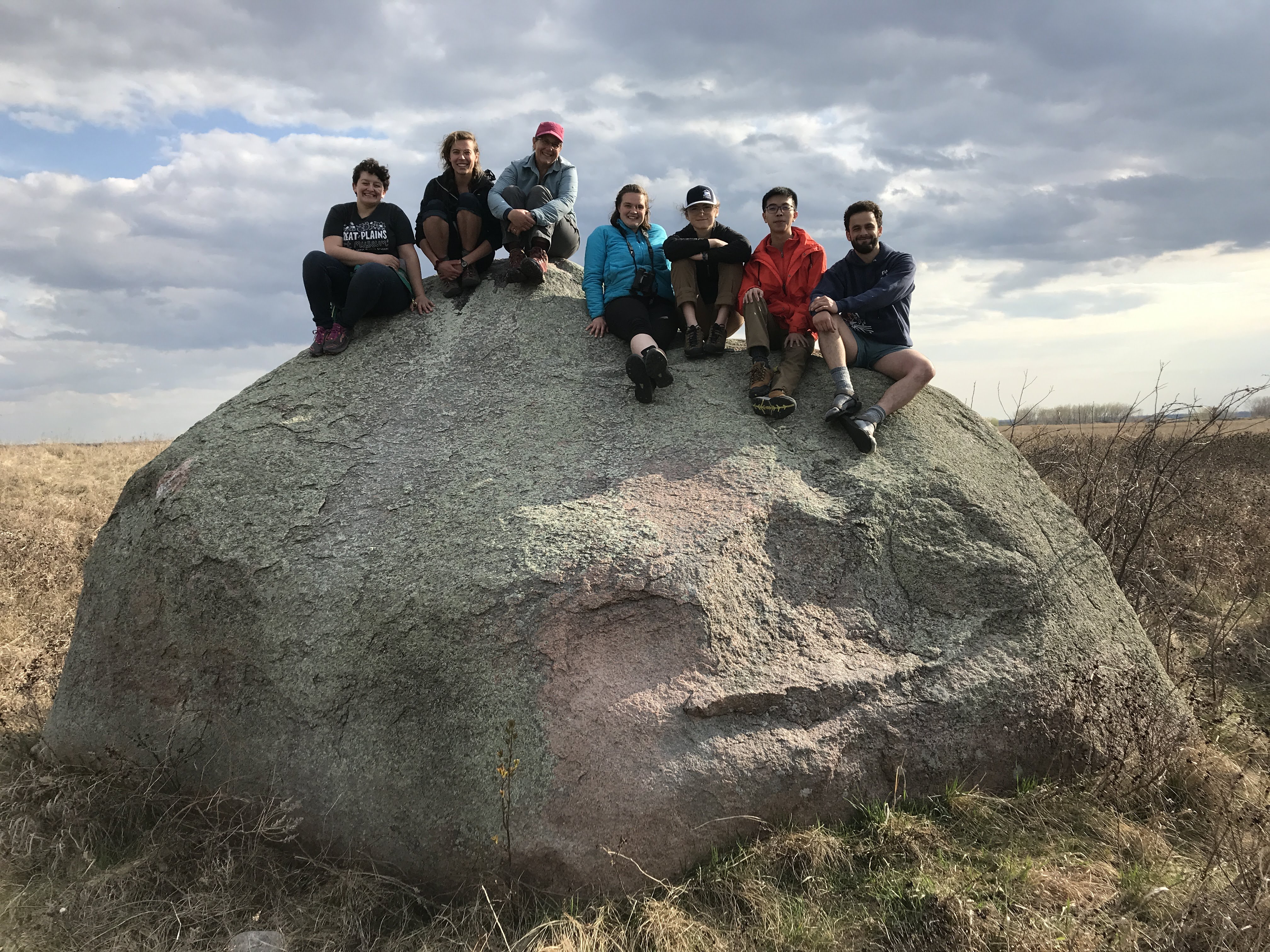
Glacial erratics, or dropstones, are another fascinating link between geology and prairies. These giant boulders were carried great distances by ice sheets until they were, quite literally, dropped where they now stand. This particular boulder has the distinction of being a ‘bison rubbing rock’ in addition to a dropstone: the ground surrounding the rock is noticeably depressed from centuries of bison getting their itches out. (Editor’s note: Two Hubbard Fellows are pictured here – Jasmine Cutter, far left (2014) and Kate Nootenboom, second from left, (2021).)

But the most meaningful connection between geology and prairies, to me at least, are the (ironically) fleeting glimpses that both provide into the fathoms of deep time.  As a geology student, I straddled uncomformities in the rock record, where up to one billion years could pass between adjacent layers and yet, somehow, I could still place a foot on either side. I used to think rocks were unique in their timeful profundity until a walk with Chris this summer through a remnant prairie tract spared, by its hilly nature, from the plow of European colonization. We were waist-high in a patch of switchgrass when Chris remarked, rather casually, “And this clone could be several thousand years old.”

That perennial prairie plants could be recycling genetic material to the tune of thousands of years had not yet occurred to me. Sure, it’s no one billion years, but it still amazes me to stand in a patch of switchgrass in 2021 and know that, sometime in the last ten thousand years, as the last of the ice sheets retreated northward and the Platte River tumbled out of the Rocky Mountains and ribboned its way through shifting dunes of windblown sand and silt, someone else could have stood on this very spot – and been standing in switchgrass, too.  
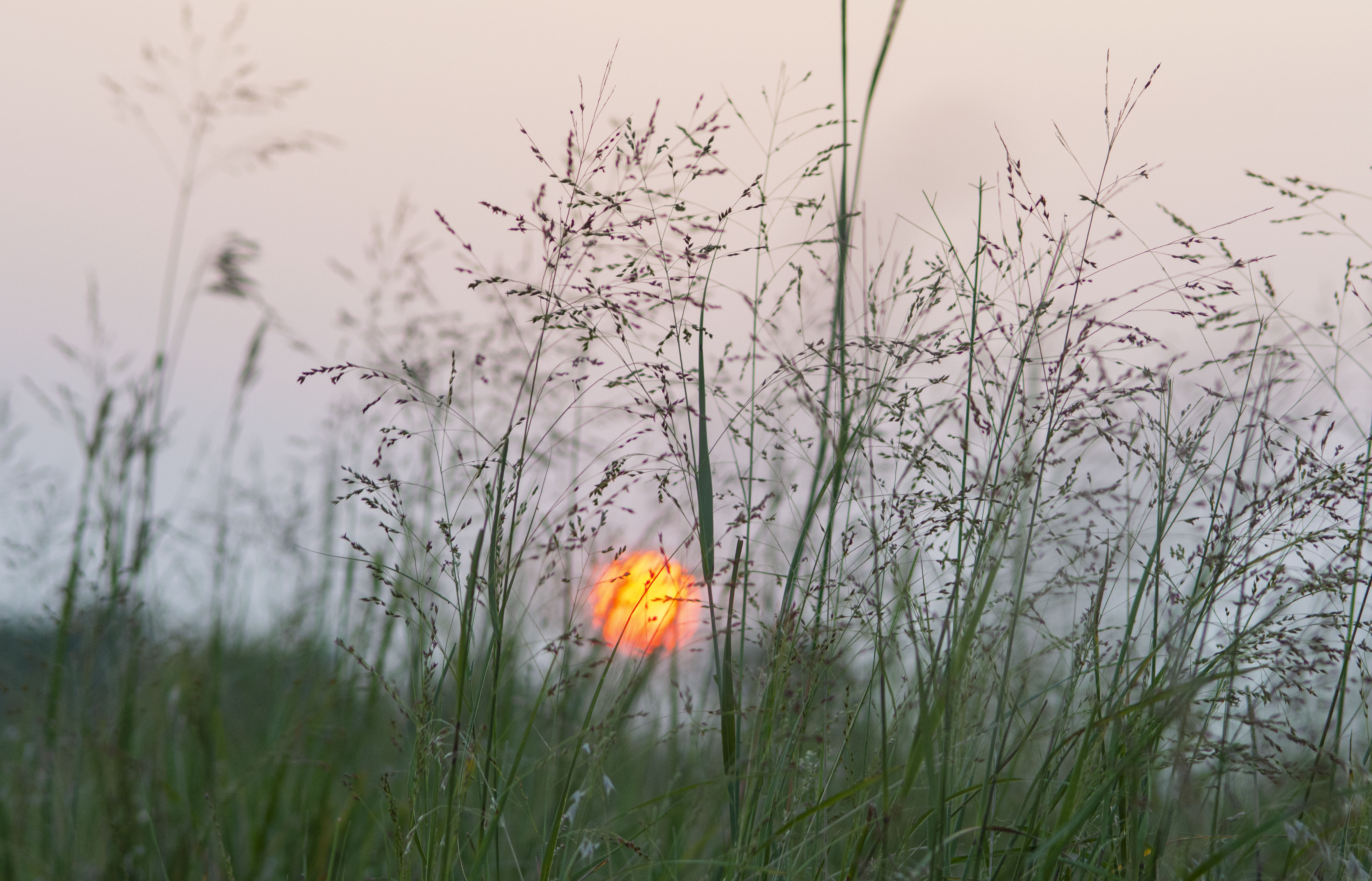
Switchgrass at Platte River Prairies preserve. Photo by Kate Nootenboom.

All this is to say, it makes sense, at least to me, that an interest in geology would complement an interest in prairies; in their history, presence, and continued wellbeing. Even so, applying for the fellowship a year ago required a measure of courage to convince myself that my academic background qualified under the umbrella: “Or Related Fields”.

Applications for the upcoming Hubbard Fellowship close on Friday this week, and I’m excited to hear stories of the many different paths that carry people to prairies. This program thrives because it brings new eyes to Nebraska’s landscapes every year. Maybe those eyes are well-accustomed to grasslands, or more familiar with skyscrapers.  Maybe they are eyes that have read countless ecology papers, or ones that have read none at all.

This last part goes out to any potential applicants who may be procrastinating on cover letters out of an uncertainty over their qualifications. Apply anyway. Ecologist clothing may fit better than you think.
Photos of the Week – September 23, 2021

Thanks to everyone who has filled out the reader survey so far. If you haven’t, please consider taking a few minutes to do it at this link. Based on data collected so far, most people are able to finish it in between 5 and 7 minutes.

In addition, the application period for our Hubbard Fellowship ends next Friday (October 1). If you know of any recent college graduates who would be interested in spending a year with The Nature Conservancy here in Nebraska, please forward this link to them. Thanks!

Now, to photos.

Yesterday, I had a relatively unscheduled day and figured I’d work on some computer-based projects I’ve been putting off. The weather has been good for seed harvesting, and this is the time of year when all the ‘big stuff’ is ready, so I’ve fallen behind on a few indoor projects. So, Thursday was for indoor projects.

Instead, I woke up early, looked outside, and decided to run across town to catch the sunrise at Lincoln Creek Prairie. A light breeze made things a little tricky, but I still managed to get enough photos to fill up much of the rest of the day working through them. I’ll catch up on that other work another day, I guess.

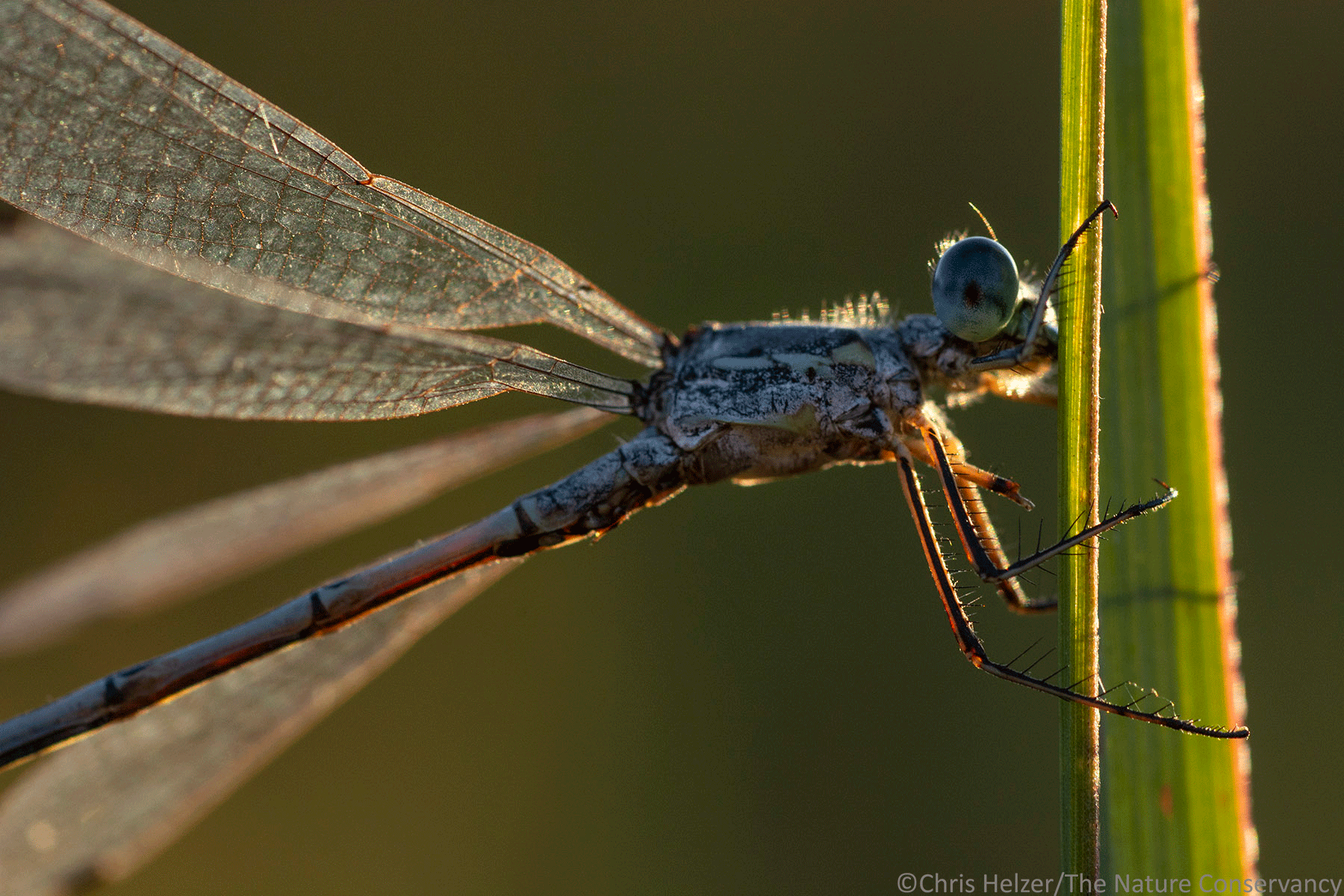
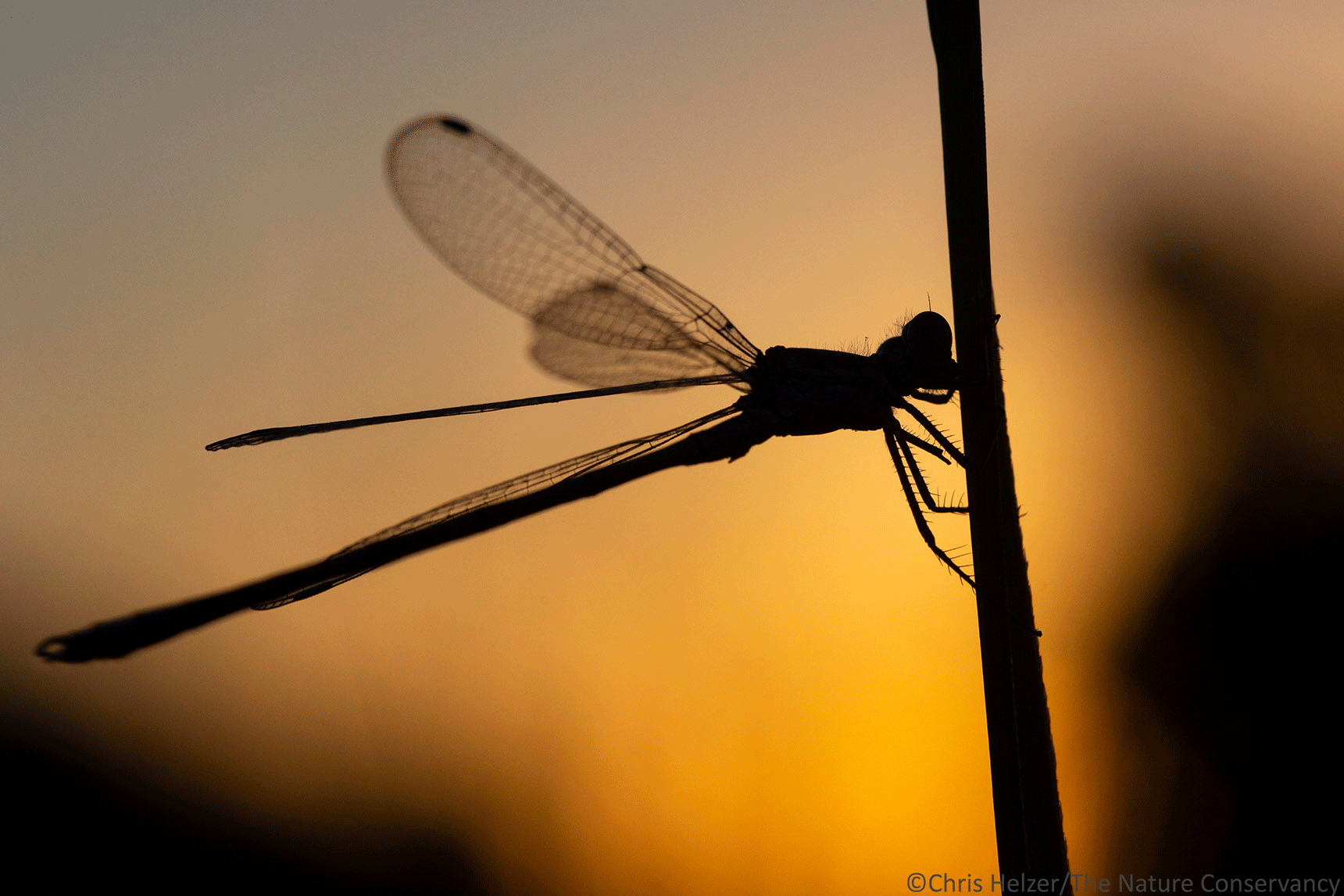
I found this (cold) damselfly before the sun came up, so I photographed it and then marked the spot so I could find it again later. Nikon 105mm macro lens. ISO 500, f/14, 1/800 sec.

After a lot of hazy days this summer, yesterday’s sun came up startlingly bright and unfiltered. I appreciated how quickly it warmed me up (it was about 46 degrees F when I arrived) but I didn’t have much time between pre-sunrise dull light and WHOA THIS IS REALLY BRIGHT light. I’m not complaining – it was a really nice morning, and I feel like I need to take advantage of every opportunity I get between now and the hard freeze that will spell the end of the flower and insect season. (Not counting the few invertebrates that are always around during the winter.)

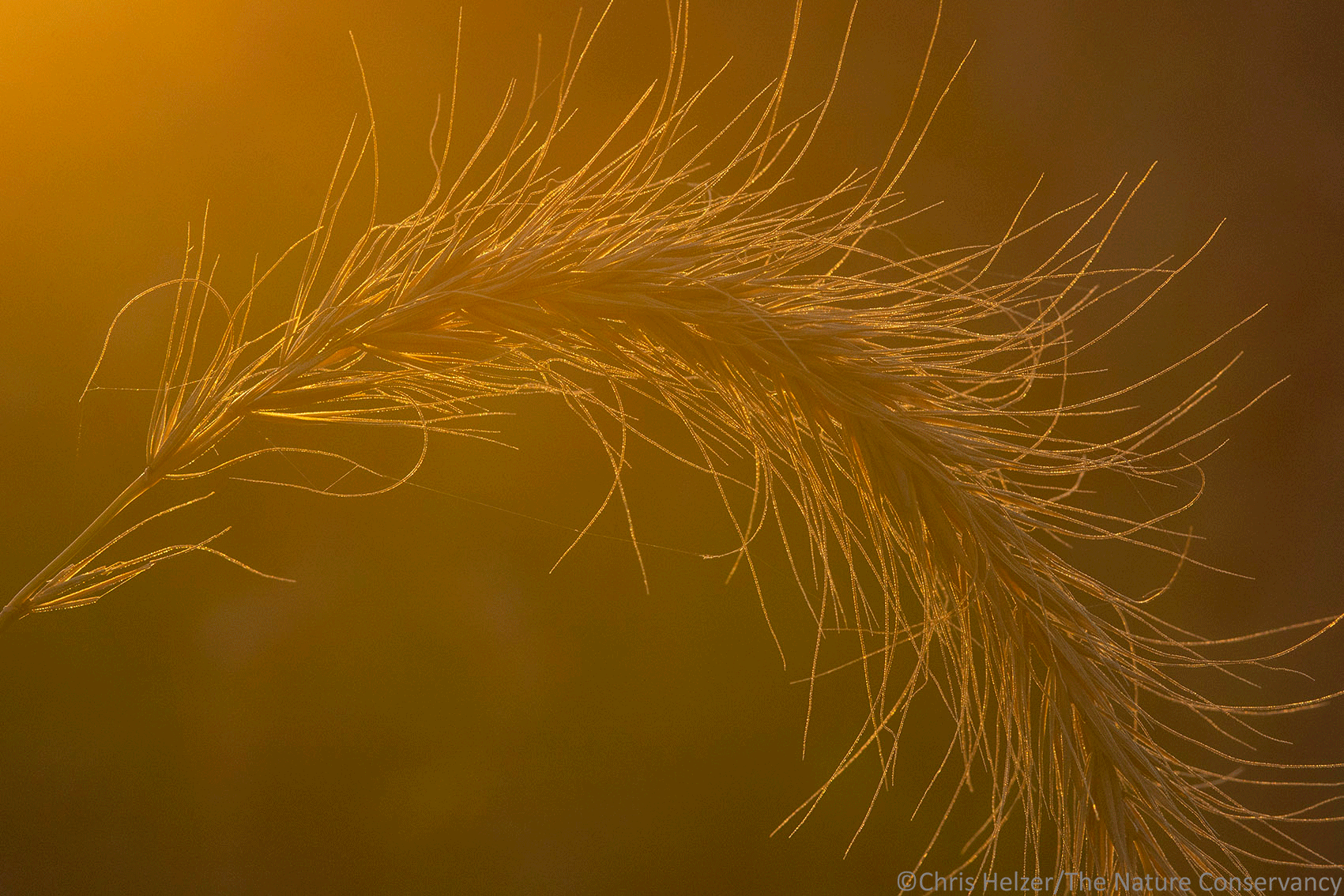
Canada wildrye with the golden sun behind it. Nikon 105mm macro lens. ISO 500, f/11, 1/320 sec.
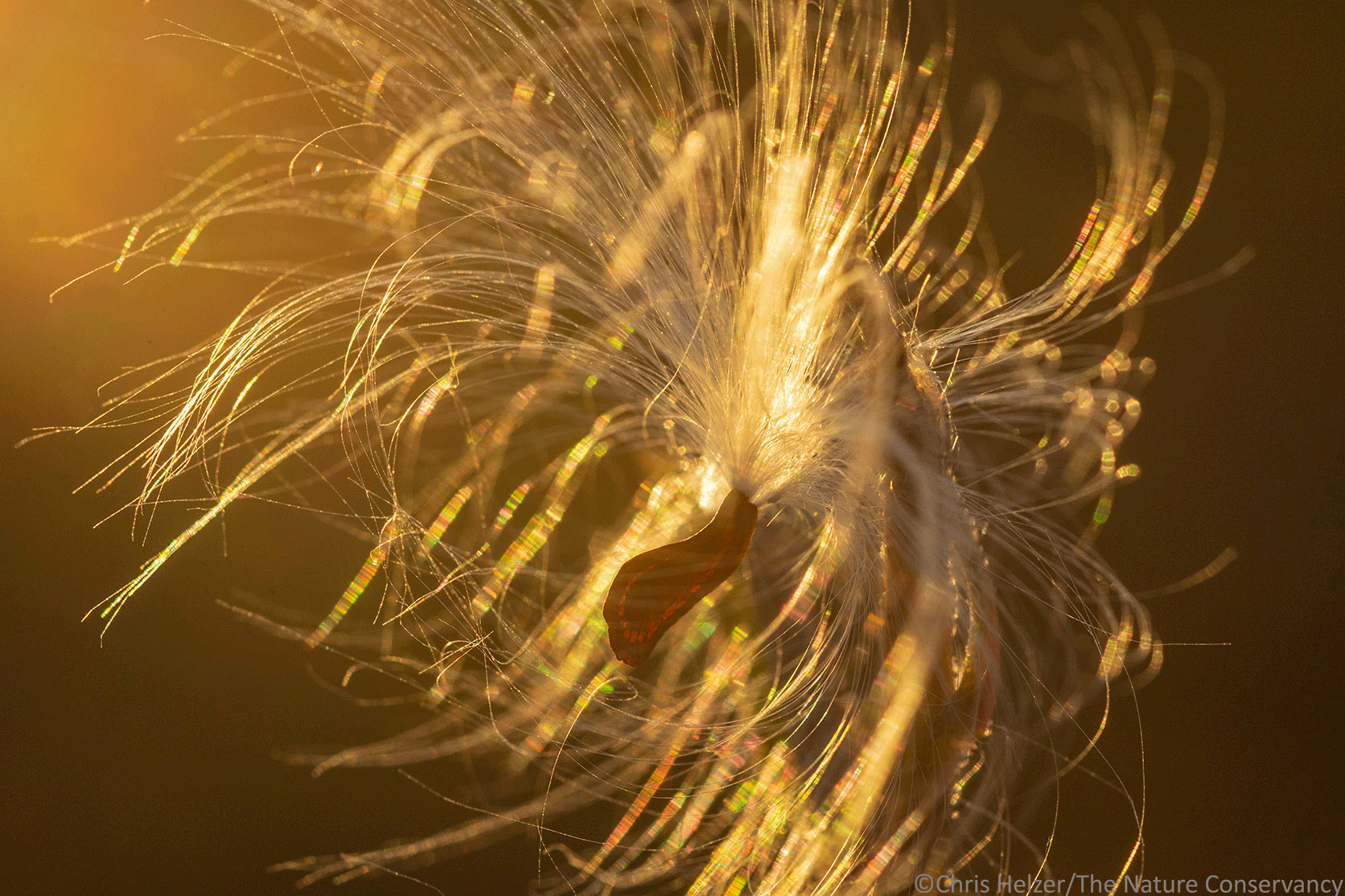
There were milkweed seeds clinging to pods and stuck to other plants all over the prairie. Nikon 105mm macro lens. ISO 500, f/11, 1/500 sec.

I spent quite a bit of time photographing milkweed seeds, which I feel obligated to do each fall. It’s pretty hard to pass them by when they’re hanging delicately and glowing in the morning light. I’m only including one image here, but I came home with lots of other good ones, which I’ll probably use in a future post.

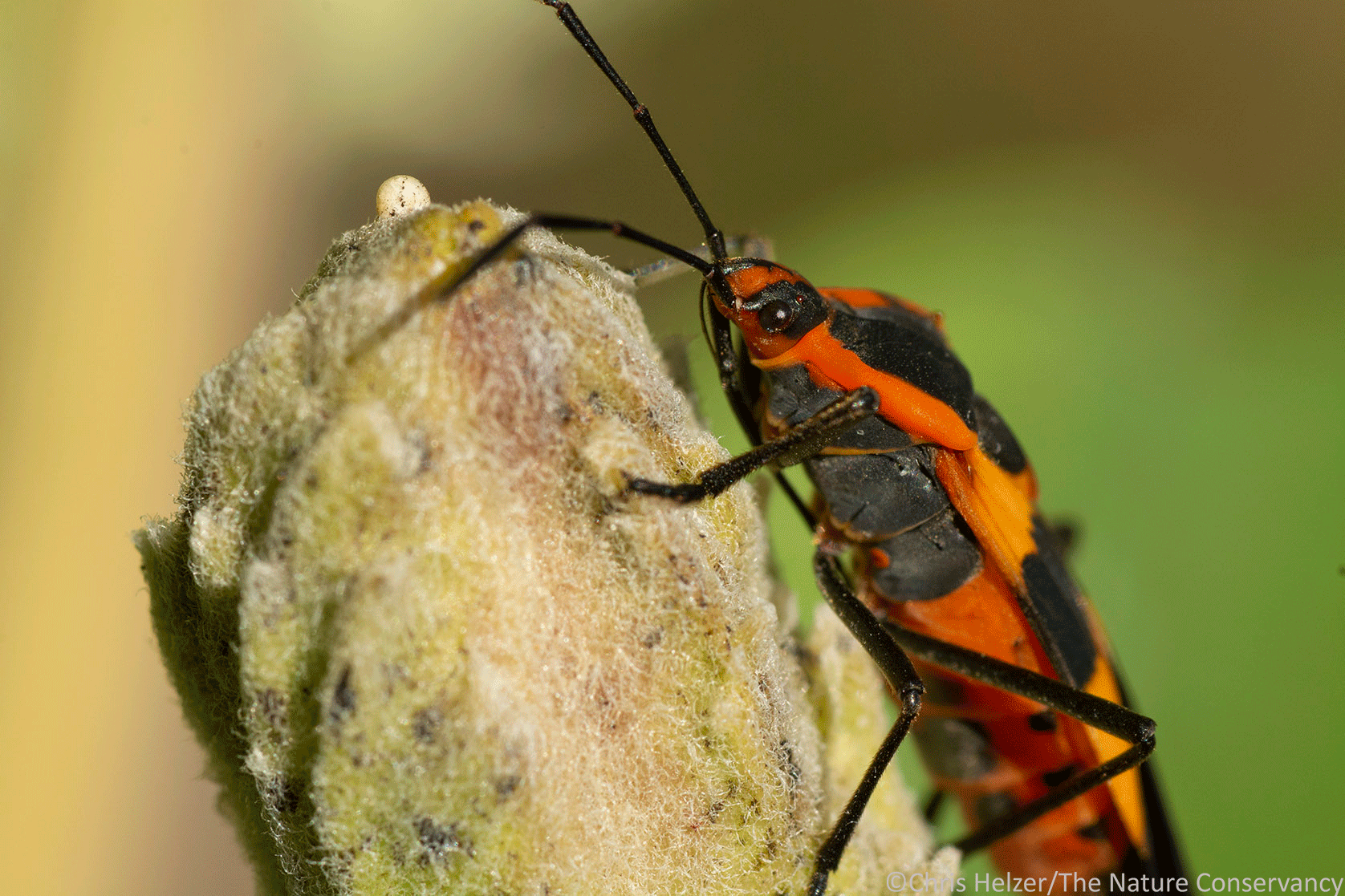
I’ve been a little disappointed in the number of migratory dragonflies I’ve been able to see and photograph this fall, but I did see one green darner flying around today. It didn’t feel like sitting for me. I did, though, manage to spend a lot of time with the single damselfly I spotted. My last photo of the day was of a large milkweed bug, which – surprising as it seems – is a migratory species. I’m not sure if the one I saw had begun its migration or not. It didn’t care to expound upon that subject as I crowded close to it.

Here’s the same damselfly I’d seen before sunrise, now with real sunlight. Nikon 105mm macro lens. ISO 500, f/13, 1/160 sec.
Since the damselfly was cold and not interested in flying, I was able to photograph it from multiple angles and lighting situations. Nikon 105mm macro lens. ISO 500, f/16, 1/80 sec.
Another of the (many) photographs I took of this poor damselfly. Nikon 105mm macro lens. ISO 500, f/13, 1/400 sec.
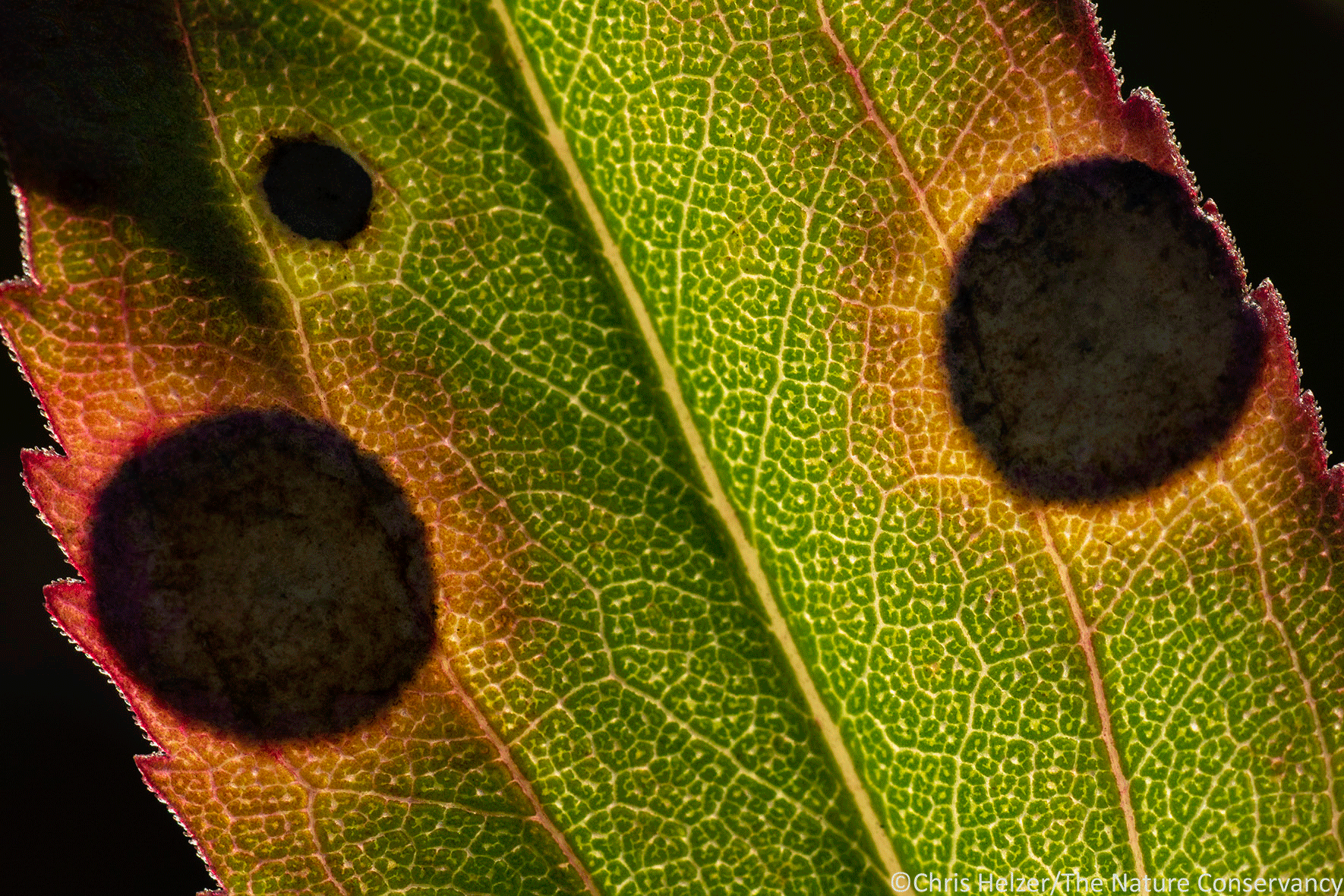
Goldenrod midges must have had a good year in this prairie, based on the number of galls I found on leaves. Nikon 105mm macro lens. ISO 500, f/18, 1/200 sec.
With the strong light behind the leaves, setting the camera so they weren’t too bright meant everything in the background went black – a nice effect in this case. Nikon 105mm macro lens. ISO 500, f/16, 1/250 sec.
This large milkweed bug was by itself on a milkweed pod. I’m still flabbergasted that this species makes long-distance migrations and wish I knew more about their travels. Nikon 105mm macro lens. ISO 500, f/16 1/320 sec.

Thanks again to everyone who has taken the time to fill out the survey. I appreciate all the kind words included in the responses that have come in so far. It means more than I can say. However, I hope you’ll also be honest in your critiques and suggestions so I can improve as needed. Have a great weekend!

Here’s the survey link one more time. Pretty please?