
Here’s part two of a deluge of September images from my square meter photography project at Lincoln Creek Prairie. As with Part 1, these images all came from the period of September 8-25, 2024.
The real joy of this project comes not from the species count, but from all the stories that occur at my plot. Some of those are natural history stories I get to observe. Others are related more to me as the observer, and the process of exploring, experiencing, and enjoying the beauty and diversity of life at a small scale.
Blah, blah, blah. Here we go:
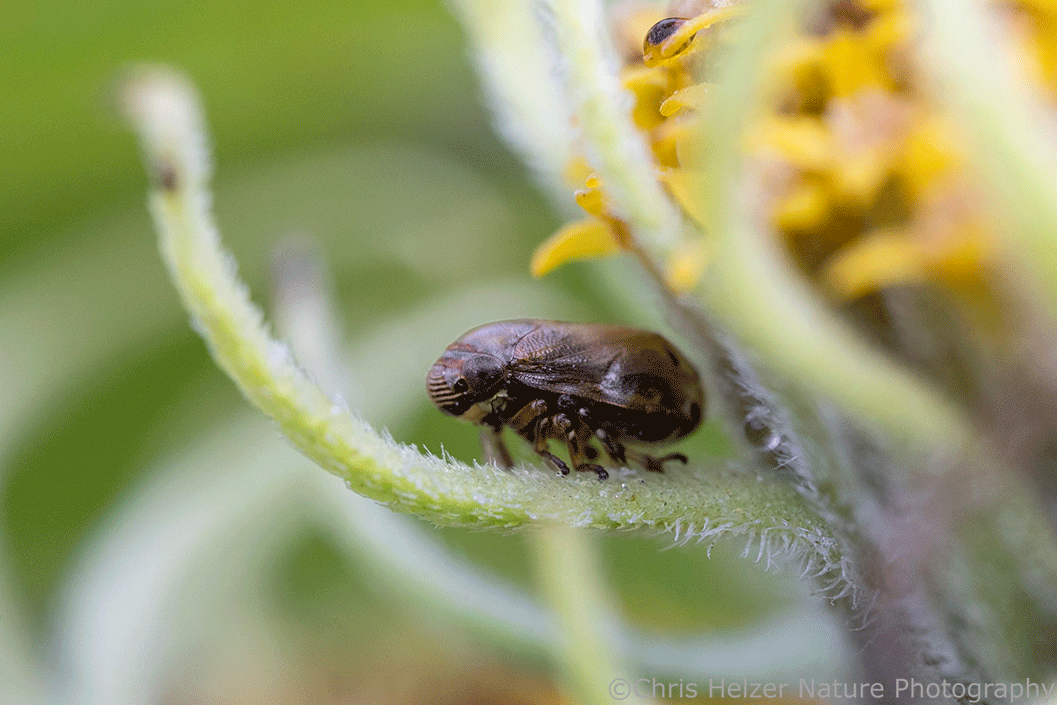
The insect shown below is an adult spittle bug. Specifically, it is the sunflower spittlebug (Clastoptera xanthocephala). I didn’t know that when I took the photo. Bugguide.net experts identified it for me. Now that I know that, of course, I can be pretty confident that it is the species that created the spittle bug bubble clusters I saw on two different Maximilian sunflower plants within my plot.
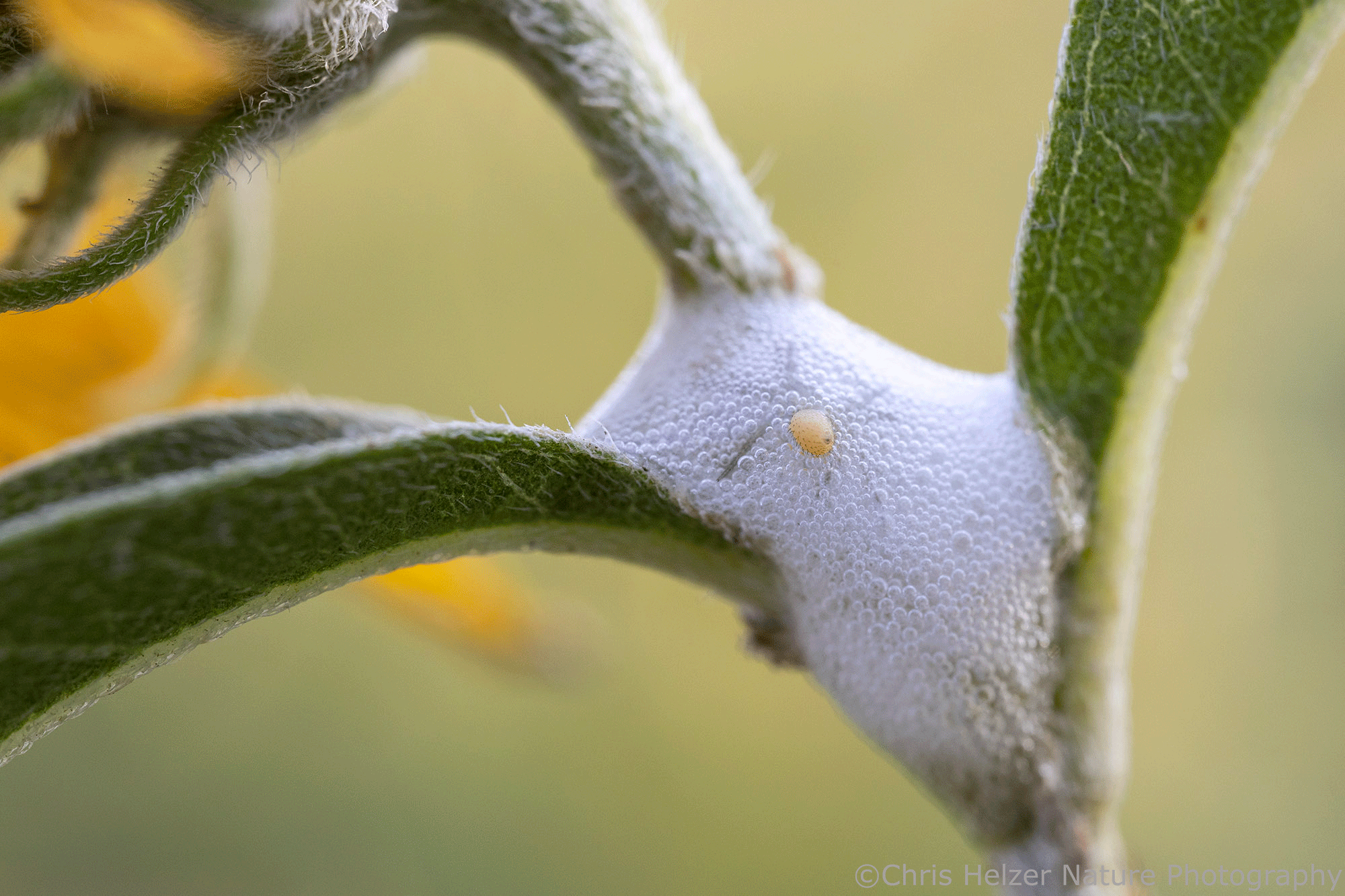
Here’s a photo (below) of one of the two larval habitats of spittle bugs I found this month. I showed the same cluster of bubbles in an earlier post, in which you could see two larvae within the froth. This time, if you look closely, you can see a circular object in the middle of the bubbles. I assumed when I took the photo that it was another spittle bug larva. That seems like a reasonable assumption, right?
When I got home, I looked at the image more closely and it didn’t look quite right for a spittle bug larva. I drove back over to Lincoln Creek and took some more photos, using a higher magnification. Then, I extracted the object to see what it was. In the photo below, you can see some legs. That’s because the object turned out to be a tiny spiderling. I’m pretty sure it was a lynx spider baby, a topic that I’ll return to later in this post.
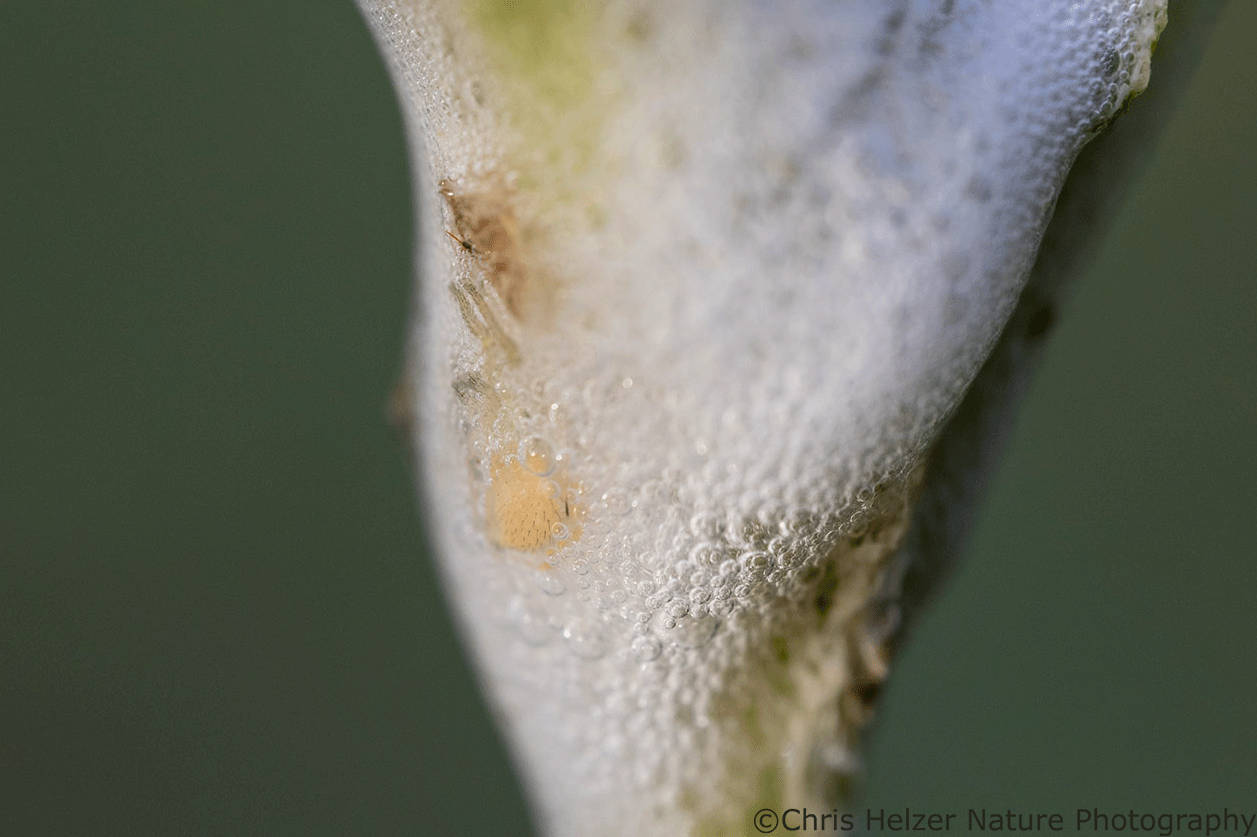
Did the spider crawl into the spittle on purpose? Was it pursuing the larvae? Whether on purpose or not, did it get caught in the bubbles and die? Or was it already dead from other causes and got dropped (or fell) into the bubbles?
I don’t know, but some online searching reveals that it’s not an isolated case. Dead invertebrates have been found in spittle bug masses before. I couldn’t tell, though, whether there’s any consensus about what’s going on. Is it just the mass of bubbles doing their job to protect the larvae? Why would a predator crawl into something that will kill it? Is it surprised to find itself stuck? Does it suffocate as it would if sprayed with soapy water? So many questions. I’d love to hear if others have seen something like this.
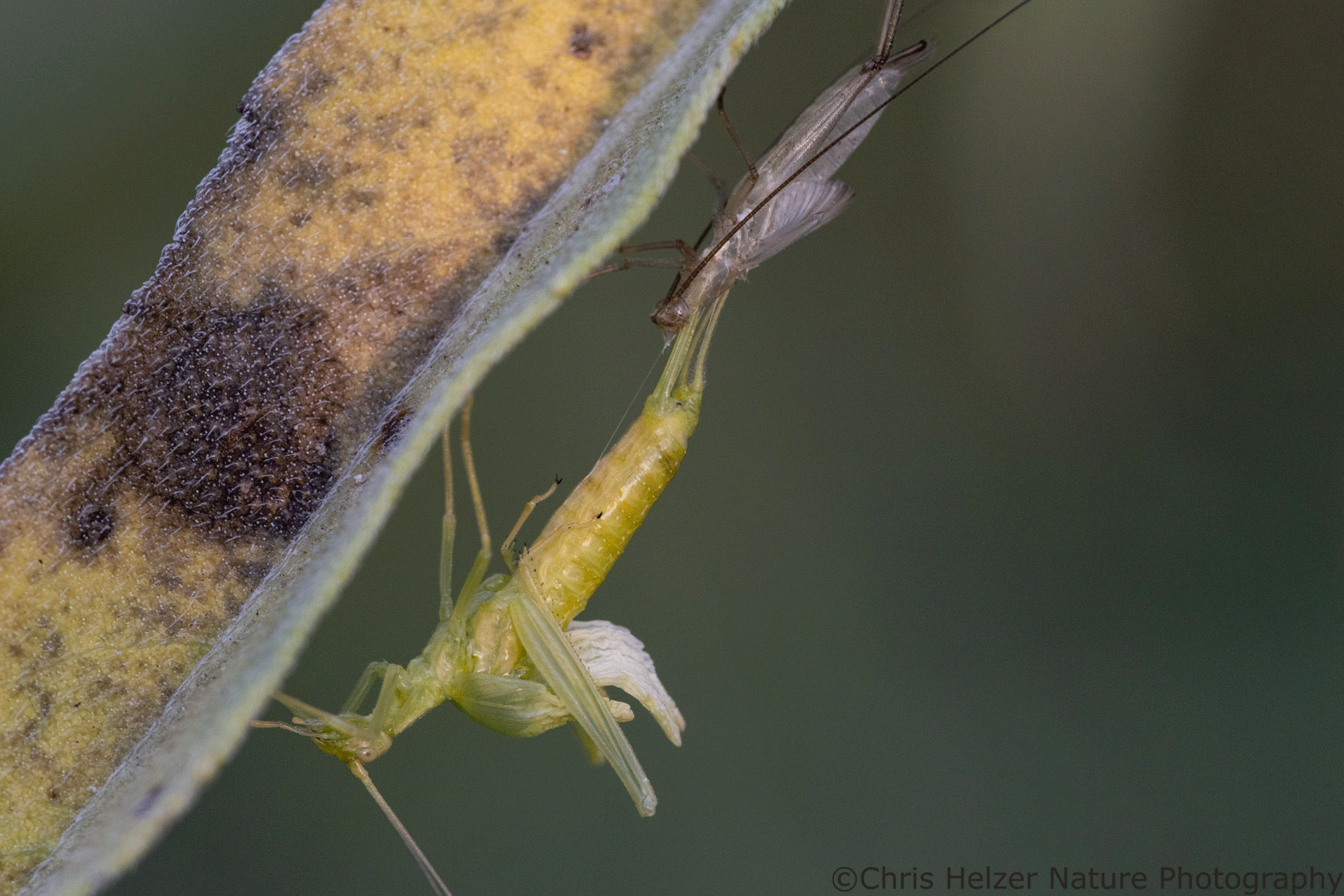
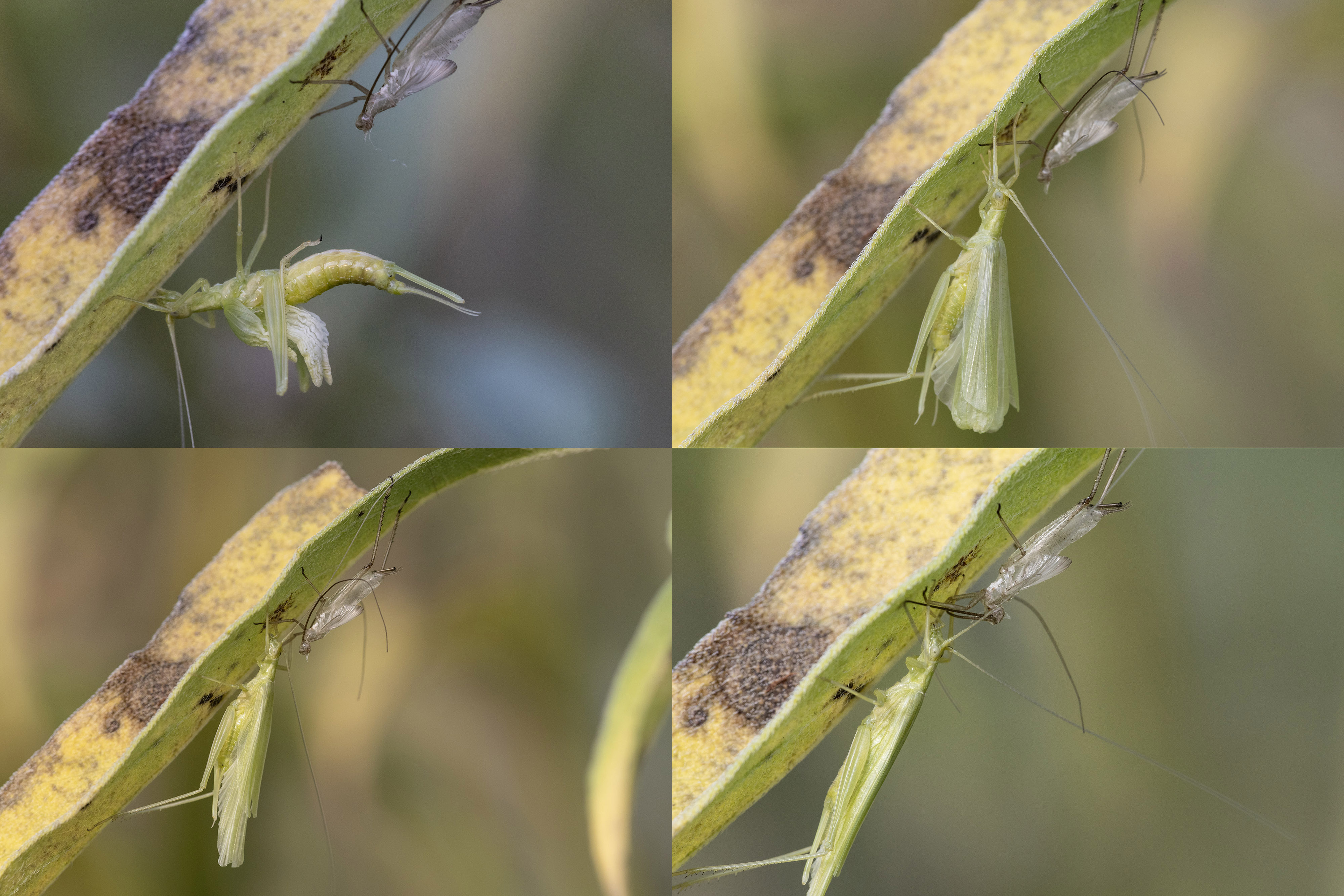
On September 15, I arrived at the plot to find a tree cricket pulling the last bit of its body out of its old exoskeleton. It was apparently completing its final molt into full adulthood. I’ve included the first photo I took of it, along with a series of others from the next hour and fifteen minutes or so. I’ve seen this kind of a thing many times, but I’m always amazed at how scrunched up the insects are before molting, and how well they expand and elongate after emerging.
I’ve seen at least 15 species of spiders in the plot this year. Most of those came early in the summer. Lately, it’s slowed quite a bit, though I still see lynx spiders fairly regularly. Given that spider diversity, I was surprised that my first jumping spider observation came pretty late in the year (September 14). The two photos below were taken the second time I saw the jumping spider (maybe the same individual – who knows!), which was on September 18.
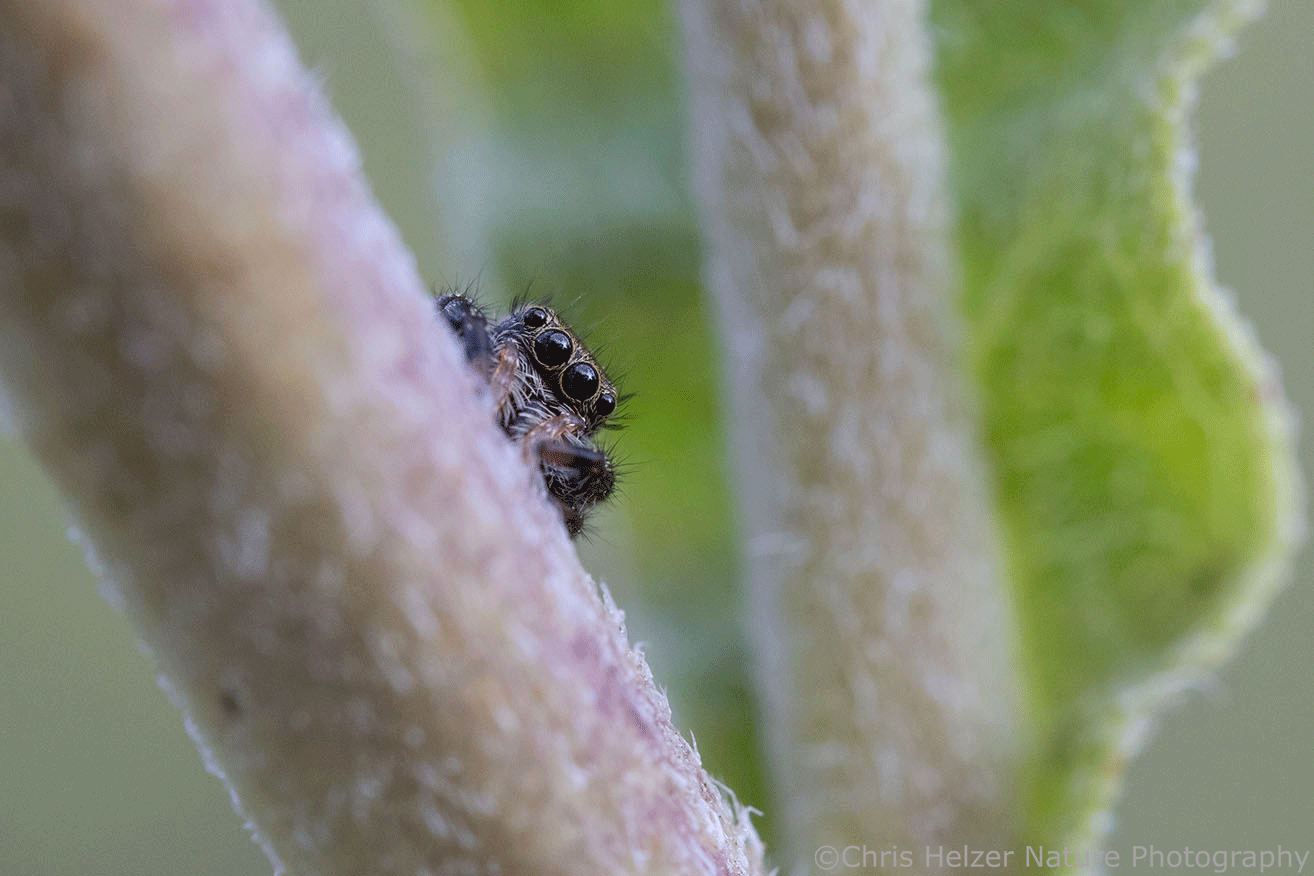
I got some decent, but not great photos when I first saw it on September 14, so I was excited to get a second chance a few days later. A few seconds after I took the above photo, the spider went to the other side of the sunflower stem for a short period. When it re-emerged, it had a little bug (Hemipteran) in its clutches. It moved around a little over the next few minutes while it fed. I, of course, followed it, trying to get photos. I saw the spider once more, three days later, but not since.

Lynx spiders have been the most abundant and consistently seen spider in the plot all year. That’s great for me – they’re one of my absolute favorites. I love their spiky-haired legs and the fact that they often sit still for photos if I’m careful about my approach.
I’ve seen both female and male lynx spiders this year, though most of what I’ve seen have been females. I’m sure I’ve seen many different females, but it’s fun to wonder how many times I’ve seen the same one over and over.
This month, I’m pretty sure I got to watch the same female over multiple visits because she was defending her egg sac. I first noticed the egg sac on September 18. It was only about 6 inches off the ground, but it was (fortunately) right on the edge of my plot where I could contort my body and get my camera into position for photos.

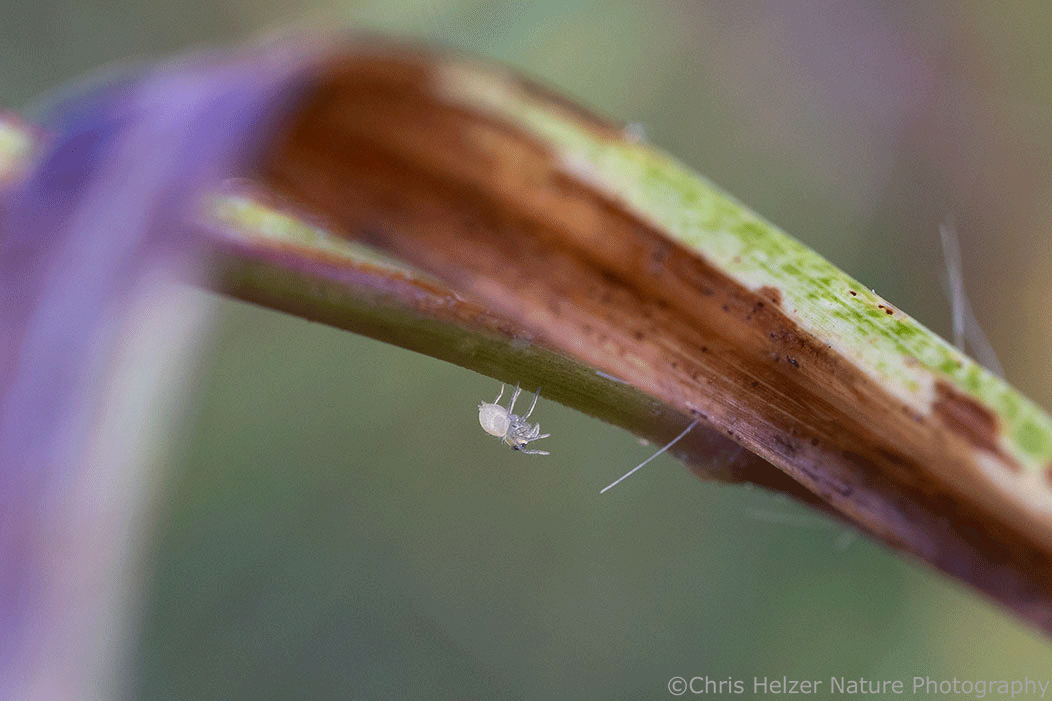
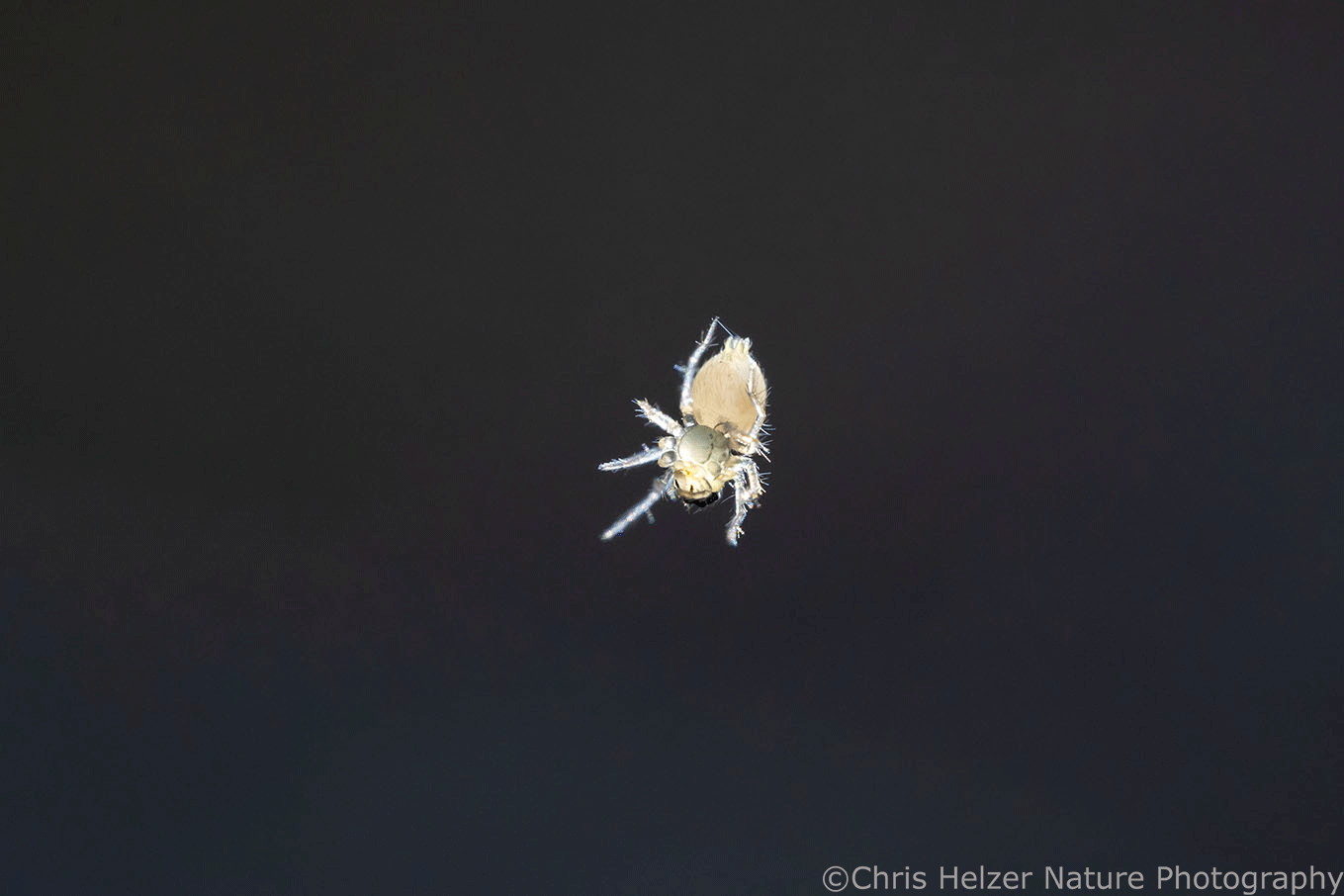
Three days later, on the 21st, it looked like the sac was opened up and I started seeing some little spiderlings around. Interestingly, the spiderling I found in the spittle bug mass was there on September 15, so I’m guessing it came from a different litter.

Obviously, I don’t know for sure that the little spiderlings I saw within a few feet of the egg sac had hatched from that particular sac. It seems likely, though, doesn’t it? Here are a few photos of tiny spiderlings from that week. For context, these spiderlings were about 3 millimeters in length.


Small milkweed bugs (Lygaeus kalmii) have been hanging around for about a month or so. As I understand it, they (and their offspring) feed primarily on the seeds of milkweed plants, using their long mouthpart. In fact, they can insert that straw-like mouth appendage through a milkweed pod and into the seeds within. Now that the butterfly milkweed pods in my plot are opening, access is even easier.
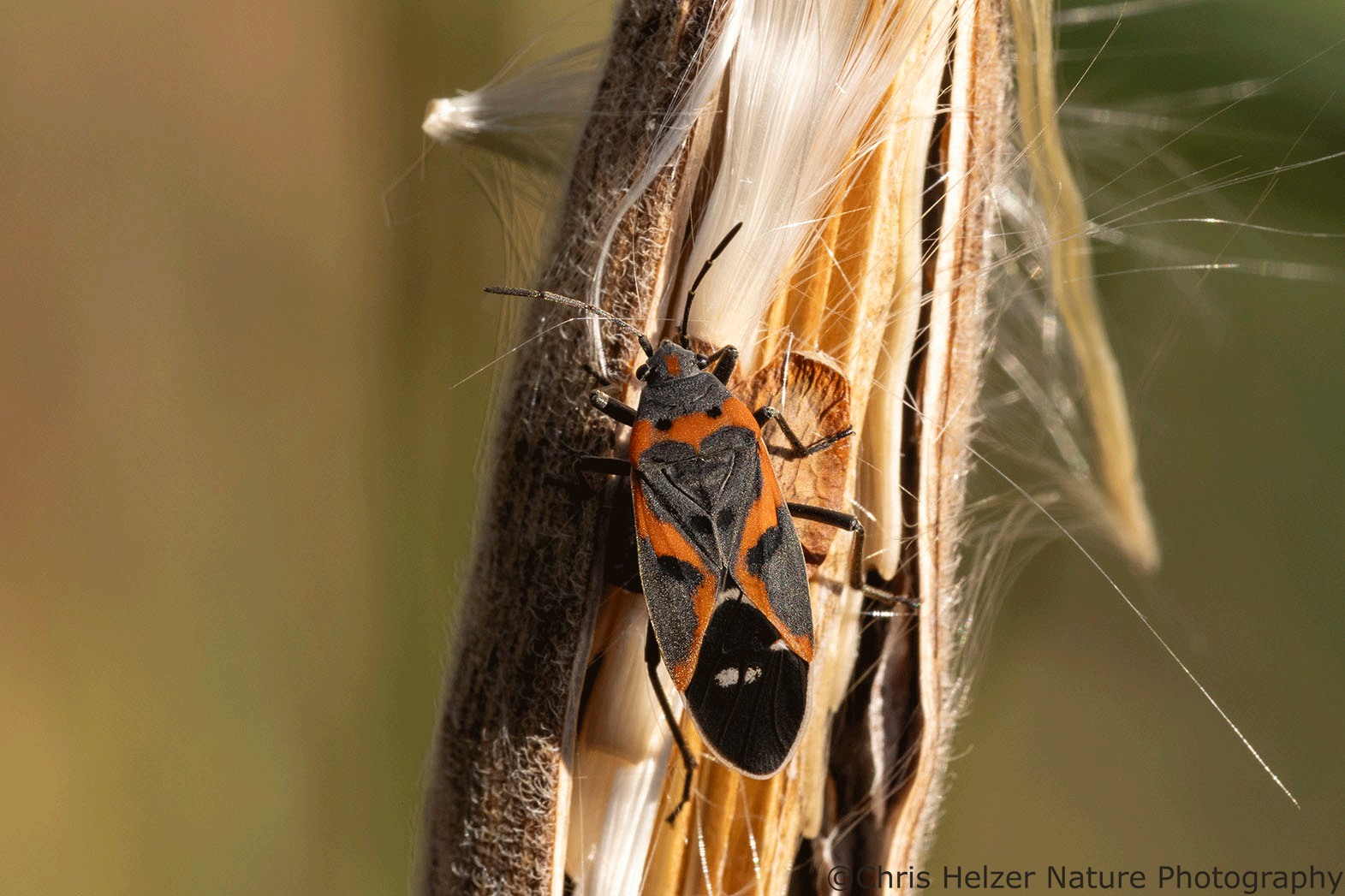
I was confused one morning, though, when I found a small milkweed bug that appeared to be feeding on sunflower seeds (below). I double and triple checked to be sure it wasn’t the very similar-looking Lygaeus turcicus, which feeds on the seeds of oxeye, aka fabulous oxeye (or, if you insist, “false sunflower”). It wasn’t. I’m confident it was a small milkweed bug feeding on sunflower seeds that were about 2 feet away from butterfly milkweed seeds.

Why was it eating the “wrong” food?
I have no idea. Why do I like to dip my french fries in a strawberry shake and eat them? It’s not good for me but I do it anyway. I suppose bugs should get the same leeway.
Another consistent visitor to the plot has been the spotted cucumber beetle. This is a native species that has taken very happily to huge fields of corn across North America and also likes to eat several popular garden vegetables. Because of that, it’s been labeled a pest, which seems unfair. In fact, you might recognize it from its other common name – the “southern corn rootworm”.
I think it’s a charming little beetle that, at least in my plot, fed mostly on the pollen of Maximilian sunflower, and maybe some of the pitcher sage flowers. In a previous post, I explained why I think we should stop using the terms ‘beneficial and pest insects’. Feel free to join me in this effort.

A few days before I took the above photo, I found the same, or a similar, cucumber beetle on a pitcher sage plant before sunrise. I photographed it in silhouette and then stuck with it over the next few minutes as the sun breached the horizon. The three photos below show the results of the changing light during that short period (and some changes to the angle I shot the beetle from).
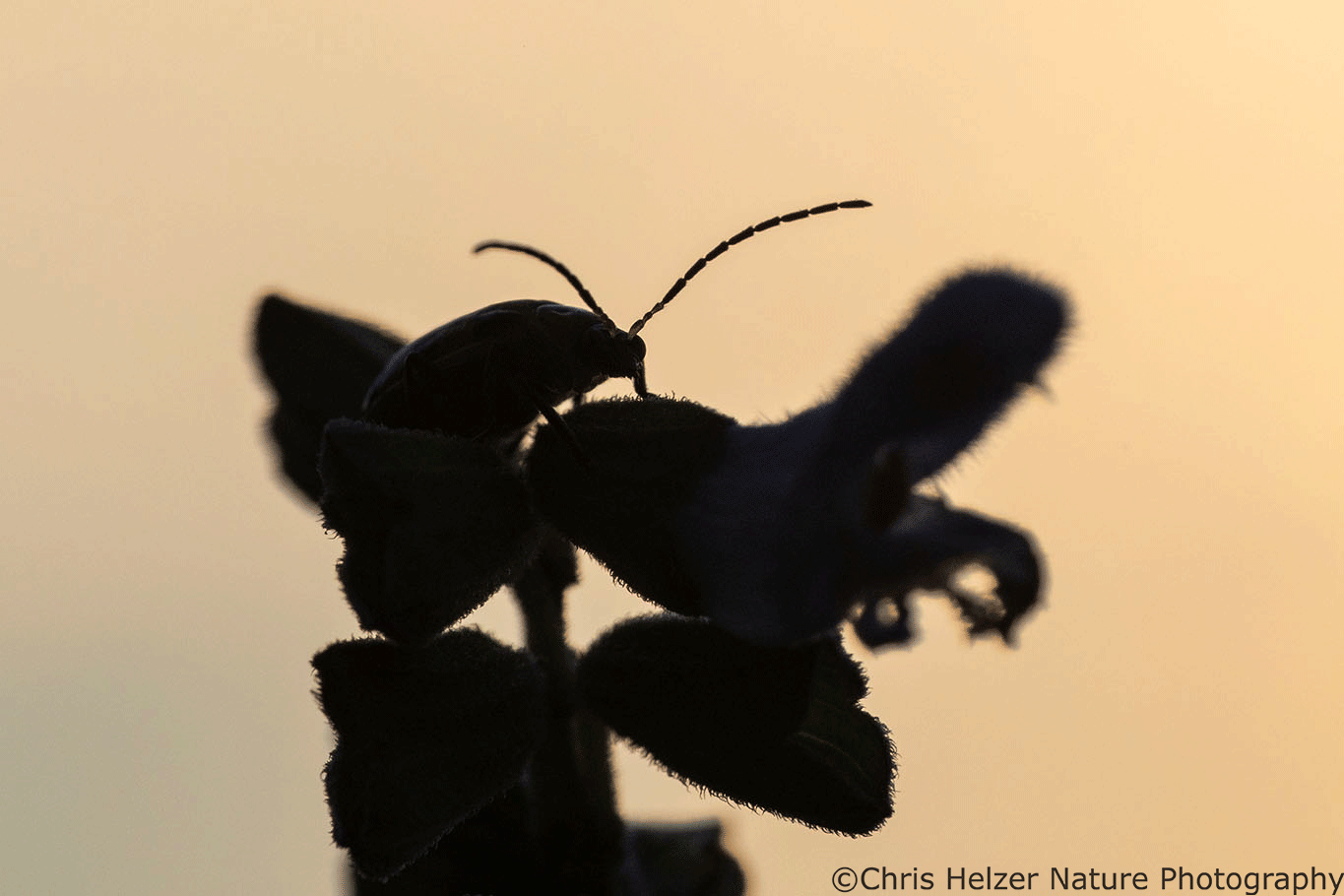
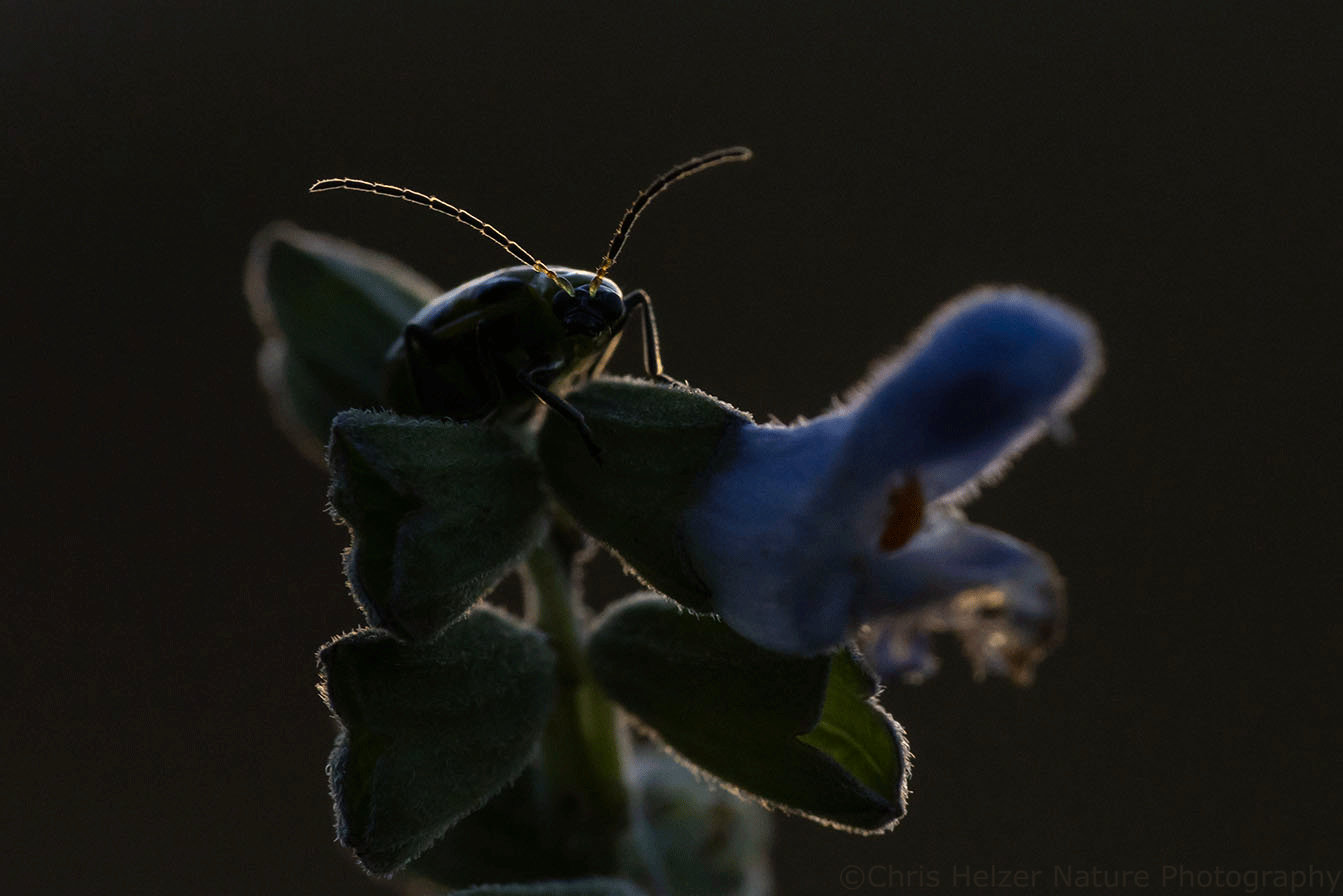

This is one of the luxuries of late September photography in my plot. With lower temperatures and fewer flowers, I don’t see as many invertebrates moving around. That gives me time to stay with the ones I do see for more time without worrying about missing something else. It also allows me to explore more artistic choices.
That time to focus came into play recently with a katydid. I saw my first katydid nymph back in late May, but then didn’t see another until late September, for some reason. Then, within a week, I saw two different species. They are both meadow katydids: the straight-lanced meadow katydid and the seemingly-contradictorily named woodland meadow katydid.
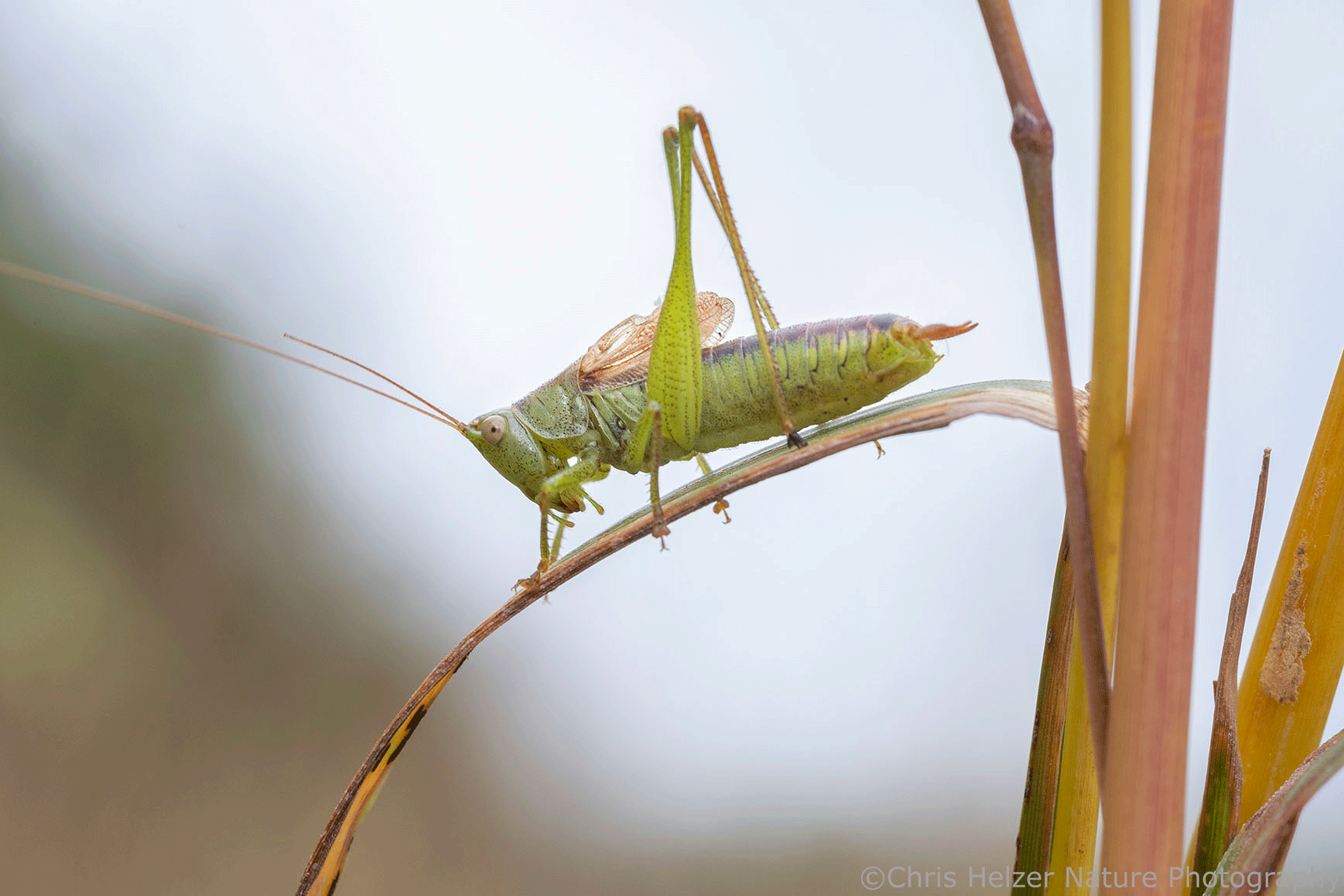

On the morning of September 25, I arrived to find a woodland meadow katydid perched on a nicely-curled leaf of big bluestem. I know it wasn’t the same individual I’d seen a couple days before. How? Because the first one (above) was a female with a long ovipositor and the second was a male. Very helpful!
I photographed it with a colorful background. Pretty, huh?
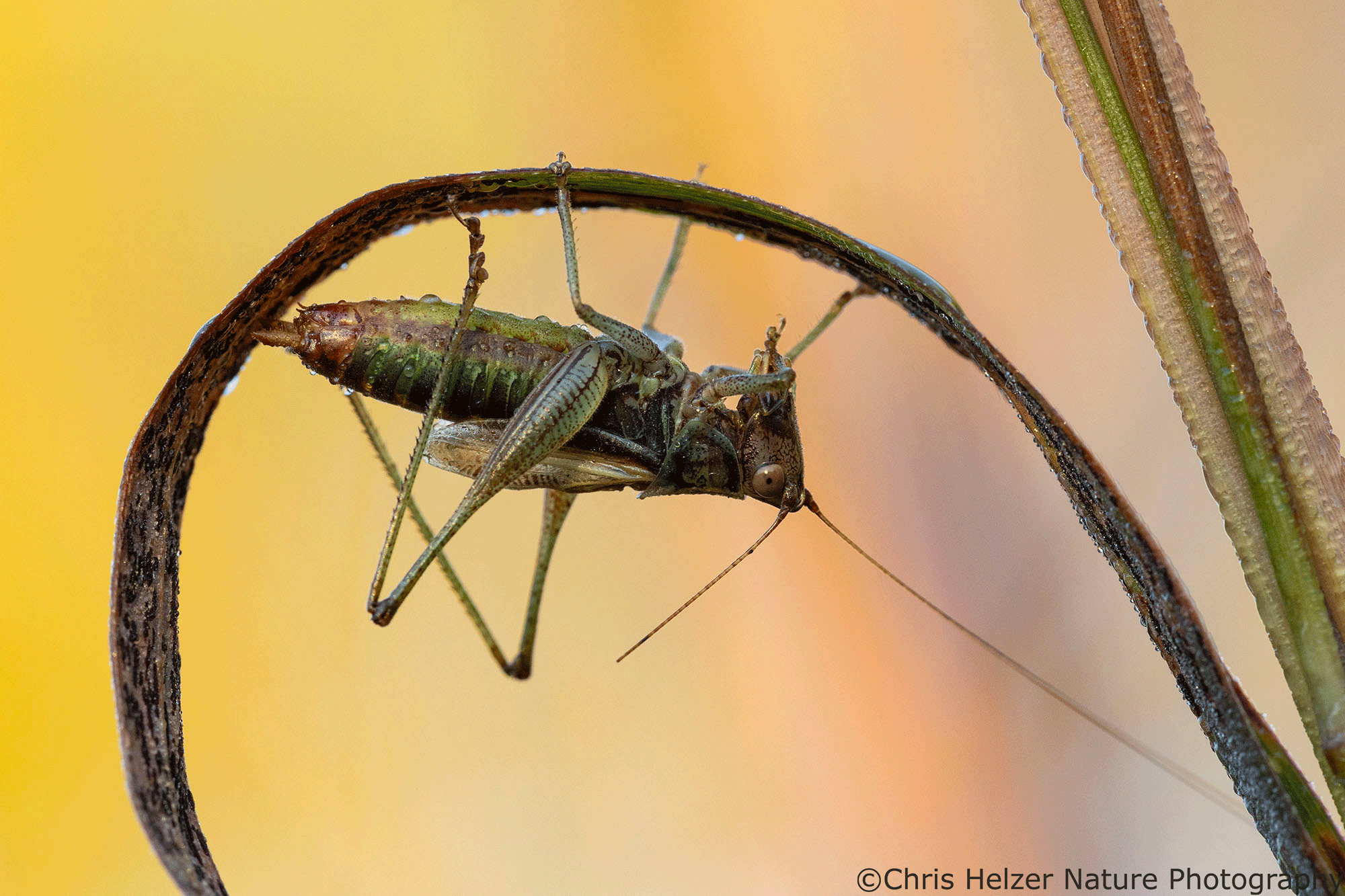
I tried a couple different compositions. Then, I scanned the rest of the plot to see if there was anything else of note. Seeing nothing more interesting than the katydid, I came back and photographed it for a while longer. It started moving around, warming in the sun. I stayed with it and photographed it in different positions.

I did eventually find a few other things to photograph, but I kept coming back to the katydid. I really liked the way it was framed within (or on top of) that curled leaf. As a result, I ended up with a big variety of similar, but different shots of the same individual (below).

So, there you go. Those are some of the stories from the last few weeks at my square meter plot at Lincoln Creek Prairie. Stay tuned for more action, including a slug I’ve seen a couple times, more milkweed seeds, and who knows what else!
 The Prairie Ecologist
Love your photos. Your word choices sometimes make me giggle. I’ve seen a litter of puppies, but never a litter of spiders! Keep up the good work!
Great photos! Love the spiderlings! And the cucumber beetle silhouette. Heck, they’re all good!
This is very special. Enjoy reading and the photographs. Entertaining.