

One of my favorite wildflowers is the spectacular shell-leaf penstemon (Penstemon grandiflorus). It’s one of the showiest of the opportunistic wildflowers in our prairies. Shell-leaf penstemon thrives under heavy grazing, in sandy and/or low-productivity soils, or other places where most other plants struggle. Every year, as the month of May progresses, I watch closely for the first blooms so I can get out and photograph them.
Which is why it really ticks me off that an unknown entity chops a bunch of them down every year. I don’t know who’s doing it, I don’t know why they’re doing it, and it’s incredibly frustrating. I’m sorry to lose the flowers, but my biggest resentment is that I can’t explain what’s happening.
What’s particularly confusing is that whomever cuts the top of these plants off with their teeth doesn’t appear to then eat anything it removes. The tops of the plants are just left lying around.
It’s almost as if someone is annoyed by the excessive height of the plants and has a compulsion to hack them down and keep them short. Or maybe they just hate beautiful flowers. But if that’s the case, there are plenty of other gorgeous wildflowers in the prairie they could attack and I’ve never seen this “cut and leave it lie” behavior with any other plant species in our prairies.
Having said that, I guess prairie dogs do chop plants down around their towns, but we don’t have prairie dogs at the Platte River Prairies. Unless they’re really, really sneaky prairie dogs. I’m not dismissing any possibilities right now, but that one feels pretty far-fetched.

My top candidates are black-tailed jackrabbits, but thirteen-lined ground squirrels are high on that list, too. It also feels like the kind of thing a cranky, vindictive white-tailed deer might do, but the sharp angled cut feels more like rabbit or rodent. Google says pocket gophers can reduce the size of penstemon populations, but they’re underground foragers, so they don’t seem likely.
To be clear, I don’t begrudge any animal its search for food. By all means, eat all the plants you want to eat! In fact, it makes me feel good to know that our prairies and stewardship work are providing sustenance for wildlife.
But this looks like wanton destruction, not foraging. Apart from disliking the height or beauty of the plant, the only other explanation I can come up with is that something wants access to the liquid inside the stem. Are rabbits cutting the tops off the plants and then sipping xylem and/or phloem out of the stems like a kid with a soda straw?
Now that I’ve got that visual in my head, if that’s what’s going on, what I’m most mad about is that I’ve not gotten to watch it happen. It sounds adorable.
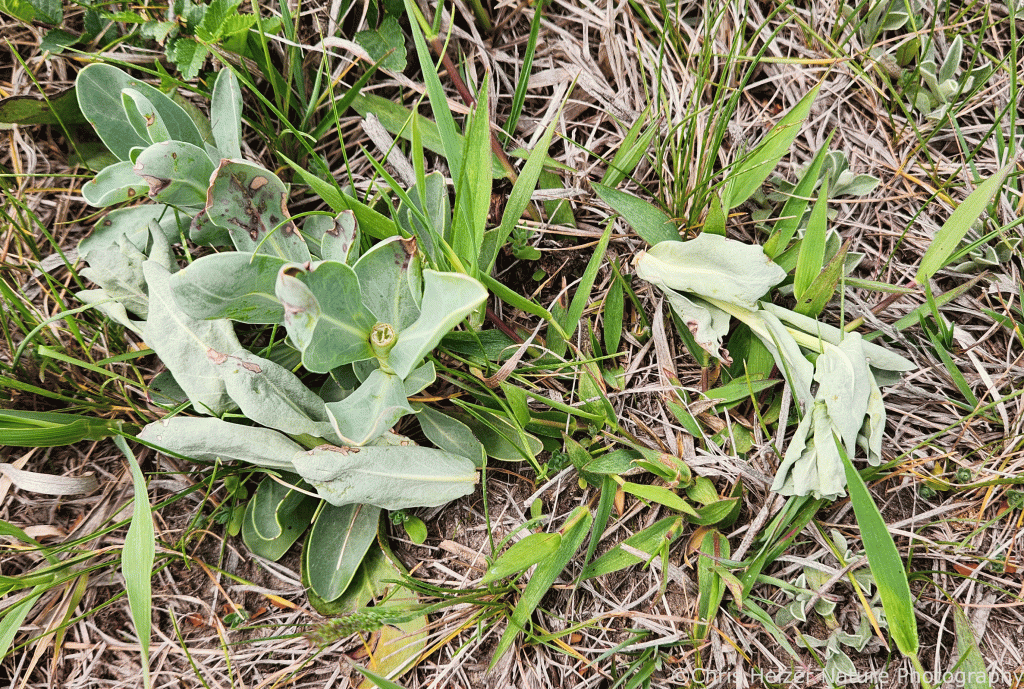
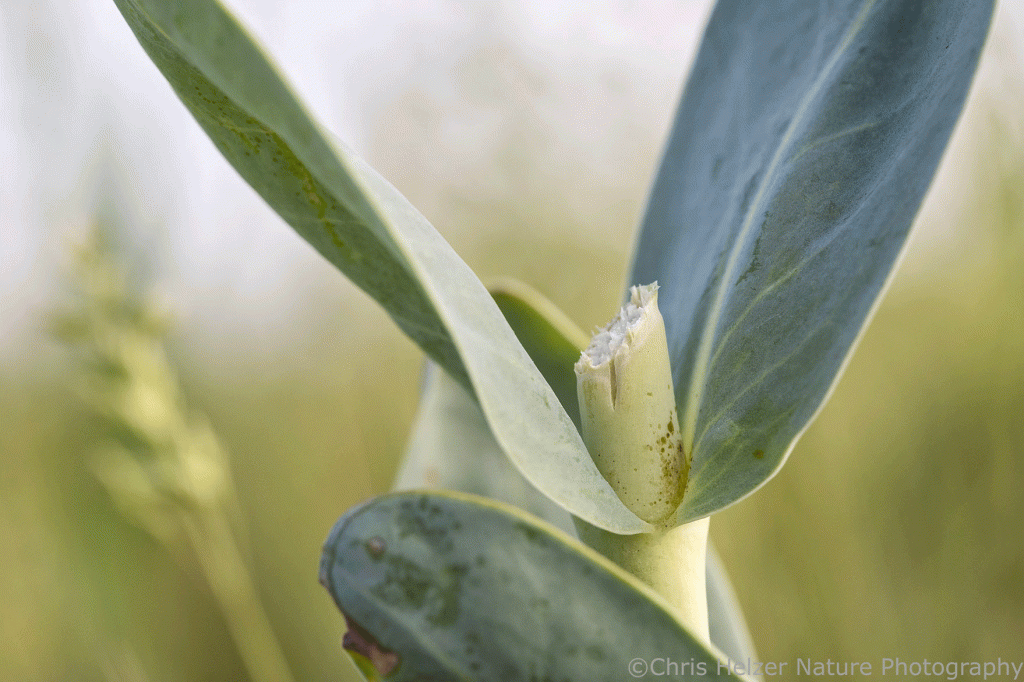
I’m hoping those of you who read this will have some helpful information for me. Have you seen this near you? Have you seen it with other plants besides shell-leaf penstemon? Any idea who would do it, or why? Do you have friends who might know? Acquaintances?
I don’t want to pressure you, but honestly, if we can’t use this blog’s reach and influence to solve a simple mystery like this, why am I wasting my time with it? I could do other things with my life. For example, I could…
Hm. Ok, I retract that threat.
But still, someone out there has to have an explanation, right? I’ve been seeing this phenomenon for years, so it’s not an isolated incident. I’m also pretty sure it’s not just one ill-tempered individual jackrabbit with a bad attitude about penstemon. As far as I know, jackrabbits don’t usually live longer than five years and I’ve been watching this for more than a decade.
Thanks in advance for your help. Any reporting will be appreciated. If you’ve seen something similar, tell me both where you saw it and any relevant details – plant species, topography, soil type, local rodent/lagomorph species, most popular local sports team, etc. We don’t know what will constitute key information, so the more the better. If you yourself don’t have anything to report, please pass this post on to others who might know something. Let’s figure this out!
 The Prairie Ecologist
I’ve had rabbits cut down my flats of comm
Chris, Trail cam? Who knows, you might catch a first …. your first ever river otter sighting (vegetarian if course).
Guess who 🙃
How about setting up a wildlife cam to catch the critter(s) in the act?
I’ve seen it, but I have no idea as to the culprit(s).
i love the mystery… hope you can figure it out some spring! someone in my yard chomped the tops off a couple crocus blooms and left the top half of the blooms sitting there… i was thinking could be a turkey? do you have chompy ground birds at your prairie? or maybe a possum? (i had poops from both in the vicinity, plus a fox but i’m guessing the fox isn’t chewing on flowers) who knows.
I was hiking a Douglas County Colorado Open Space today and saw the same thing with a Senecio – the flowering stems were bitten off and neatly laying on the ground. The only obvious culprit appeared to be nearby prairie dogs but in the past I’ve seen squirrels snap off the flowers of black tulips in my home garden and leave them lying untouched next to the erect stems. In that case, I figured the squirrel was critical of my color choice!
Happens to my echinacea angustifolia, Agastache Foeniculum, eupatorium purpurea, and liatris ligulistylis. Likely culprits are squirrels, chipmunk, or rabbits. No answer yet
Rabbits, squirrels, or chipmunks are doing the same thing to my echinacea angustifolia, eupatorium Purpurea, liatris ligulistylis, and Agastache Foeniculum.
I do not know the culprit, but the damage reminds me of cicadas breaking the twigs on trees prior to laying their eggs in the break.
Hey Chris. Baby rabbits do this to all sorts of plants in my yard. My hypothesis is they are learning which plants are eatable. Don’t know which sports teams they like though.
Chris, Have you tried the plant yourself? You can get some insight into what flavor profile it has and then extrapolate to what other prairie animals prefer – thereby narrowing the possible suspects.
I have had something similar happen with wood rats- the fuzzy little rats will chop flowering vegetation off at a few inches high and leave the stems to dry, then collect them later (once dry) and make a little hay stash, I presume for winter. Had one hitch a ride to my house after I went camping and it harvested petunias, and various grasses- let them dry then stacked them neatly in piles all over in my shed. Didn’t know what was chopping all my flowers off until I left my handy Cam going all night on the ground to catch the culprit.
My sister-in-law in Omaha has seen cottontail rabbits do this to her flowerbed Echinacea angustifolia for years. She puts cages around them now to protect them.
Chris, now that you brought up this topic, I will be watching our penstemon population. I have been hoping for a beautiful spread of blooms. In fact there seem to be more plants than last year but we also have ground squirrels. So now I’m nervous!
Great talking to you on the phone. Our conversations are always informative and interesting. we look forward to seeing you later this summer.
Judy
Oh no! Sorry for your loss! Really. These are my favorite flowers. I hope it doesn’t happen here.
This calls for a trail cam! Mine is at our vernal pool looking for salamanders!
What percentage of them are being bitten off? I suspect a rabbit, but is there any insect that is weakening the stem below the flowers and the wind is blowing them over? Any wilted stems?
I asked to ChatGPT and it didn’t know. lol
The blog does not appear to be accepting my commentOh no! Sorry for your loss! Really. These are my favorite flowers. I hope it doesn’t happen here. This calls for a tra
Would like to post an image, but don’t have URL.
I love how biologists say “someone is doing this” and I think a hiker or a naughty kid has come by picking flowers. “Someone” to a biologist means anyone who live in the prairie as opposed to anyone who visits!
Look for scat nearby to get a lineup of your suspects, my thought is rabbits.
Thanks for sharing, this is fascinating! Hopefully all those nipped Penstemon will use that damage to branch out and continue growing! Can you provide updates on any interprets habits that occur after this carnage??
Great work!
Samm Medeiros she/they Habitat and Conservation Manager Pollinator Partnership Canada
PO Box 73619
Wychwood PO
Toronto, ON M6C 4A7 e: samantha@pollinator.org Samantha@pollinator.org w: pollinatorpartnership.ca o: 647.558.9304 [image: https://pollinatorpartnership.ca/en/%5D https://pollinatorpartnership.ca/en/ https://pollinatorpartnership.ca/en/bfg-canada Writing from Nogojiwanong/Peterborough, ON, traditional territory and homes of the Michi-saagig Nishnaabeg and Chippewa Nations. These lands are associated with the Williams Treaty of 1923 and Rice Lake Treaty #20 of 1818.
I’m a few days late, but maybe ask Backyard Farmer. Email them at byf@unl.edu.
If the break area looks like larvae exits here are a few possibilities but I think these generally affect crown and seeds. Some mention stem.
https://www.fs.usda.gov/rm/pubs_other/rmrs_2012_hammon_r002.pdf