
Conservation success relies upon people feeling connected to nature. As a result, conservation groups spend a lot of time trying to show the public how much their health and prosperity depend upon natural services and processes (clean air and water, storm surge protection, pollination, etc.). They also try to find easy ways for people to interact with nature where they live. The latter can be particularly difficult, especially as we become a more and more urban society. Programs that promote and install trees, pollinator gardens, rain gardens and other tidbits of nature within our concrete jungles can all help bring nature to people. However, I think we’re missing an easy answer that could very well be staring at you right now: the friendly neighborhood boxelder bug.

I photographed this boxelder bug on my sidewalk last week, just a few feet from where my wife first spotted it crawling on a blooming daffodil. It was in a sheltered area on the sunny side of our house; probably warming up on a pleasant spring day. Boxelder bugs keep their long straw-like mouth parts tucked beneath them except when they poke them into plants and seeds to feed.
Chances are, if you’re in the United States, and you look carefully through whatever building you’re in right now, you’ll find at least one boxelder bug hanging around. If it’s a sunny day, you might be able to go outside and find some warming themselves on the south side of that same building. Boxelder bugs make themselves easily available to us, but we have largely failed to take them up on their obvious offer of friendship.
Boxelder bugs are harmless. They don’t bite people and they don’t cause any significant injury to plants, including the boxelder, maple, and ash trees they like to feed on. Boxelder bugs are sometimes characterized as nuisances because they can accumulate in large numbers, especially on the sunny outside walls of buildings, or even indoors, near windows or other warm places. And yes, large numbers of insects can create large amounts of insect poop, and that can sometimes cause some discoloration of walls or curtains. Fair enough, but most of us put up with a lot more from kids, dogs, and/or cats without calling in exterminators.

Boxelder bugs are often seen on trees, especially maple, boxelder, and ash, where they feed on the seeds – but don’t appear to cause any problems for these trees or any other plants they feed on. They like to overwinter in piles of plant material (landscaping mulch, compost piles, etc.) or make their ways through tiny cracks and crevices into warm buildings.
Most often, boxelder bugs get noticed during the winter when a few of them warm up enough to come wandering out of their hiding places into the living spaces of humans. This is a perfect example of how these bugs can be ambassadors for nature. They are quite literally little representatives of nature that present themselves to us, in a completely nonthreatening way, right in our homes. If we can spread the word about the harmlessness of boxelder bugs, maybe we can turn these surprise appearances into positive interactions. If we can point them toward information about the fascinating lives of boxelder bugs and other creatures, we might even start a cascade of exploration.
You’re skeptical? Well, people are already taking an interest in boxelder bugs without our encouragement. How do I know? Back in February 2013, I wrote a short blog post about how glad I was to find boxelder bugs in my house because I was looking for something to photograph during the middle of the winter. Though the post was mostly about new camera gear, I also threw in a few natural history facts about boxelder bugs, as is my wont.
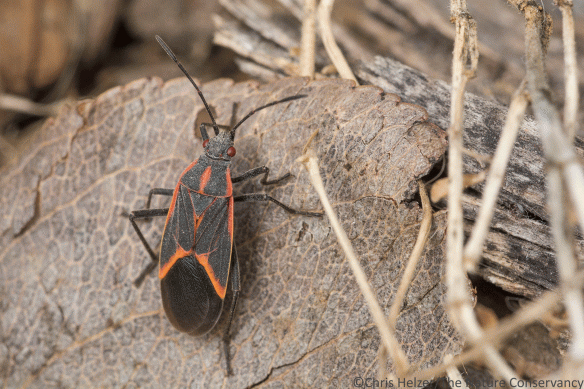
The boxelder bug (Boisea trivitatta) is a true bug, and has the characteristic triangle shape on its back, straw-like mouth, and incomplete wing coverings (among other things). The “trivitatta” portion of its name refers to the three stripes behind its head. The are categorized as “scentless plant bugs” but can release a bad tasting (and smelly) compound when attacked in order to fend off predators. They don’t use that defense against humans, however, or at least I’ve not experienced that with the hundreds I’ve picked up to examine over the years.
Five years later, that post on boxelder bugs continues to attract a surprising number of readers. In fact, during the last couple of years, the post has been viewed between 1000 and 5000 times every month! It has become, by far, the most viewed post I’ve ever written, surpassing many posts I’d have predicted to have more lasting interest and value. It has been viewed five times as frequently as “What’s the Best Time to Burn?” and almost ten times as often as “The Conservation Value of Backyard Prairies”. I was just looking for an excuse to try out a new flash system for my camera and ended up writing the most popular thing I’ve ever written. It’s an odd world, to be sure.
People seem to stumble onto my boxelder bug post because they are looking for information on the little insects that have shown up in their houses, and a fair number of those people appear to be looking for something beyond just how to kill them. The comments section is full of people thanking me for providing positive information on boxelder bugs and telling me about how they are making friends with the boxelder bug(s) in their home. This is energy that needs to be harnessed and used for good!
If people become comfortable with boxelder bugs, they might also become comfortable with other invertebrates around them, including ants, millipedes, and even (gasp) spiders. Looking at these little creatures with interest and empathy, instead of fear or disgust, might lead them to look around for other animals to learn about. Once they’ve gotten a pretty good inventory of what they can find in their homes and neighborhoods, they might start to wander further, and to expand upon their species of interest. Before you know it, they’ll be amateur naturalists and conservation supporters.
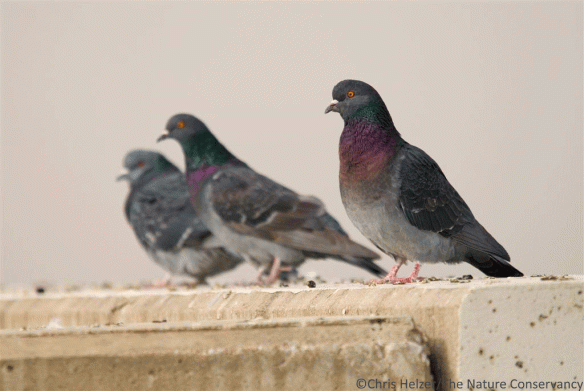
Pigeons are another example of an animal living among us that is easy to observe and has plenty of fascinating stories to learn about. Don’t believe me? Do a Google search for “pigeon trivia”.
Boxelder bugs aren’t the only potential accessible ambassador for nature. They happen to be handy (and cute) but there are plenty of other animals hanging around too, including both invertebrates and larger animals. We naturalists tend to be snobbish about species like pigeons and house sparrows, but imagine what could happen if a young kid started following one of those birds around to see where it lives? That curiosity, once satisfied, would very likely lead them to look around for other species to learn about.
If we’re going to build a constituency for nature in an urban world, it makes sense to focus more on urban and suburban nature. Boxelder bugs, pigeons, and many other animals are right there, waiting to be noticed and learned about. It’s important to show people what nature looks like out in the great wide open spaces, but we should probably spend more time talking about the nature living right outside, or even inside, our homes.

Who could look deeply into the four red eyes of a boxelder bug and not come away deeply moved? (Did you notice the two smaller eyes behind the bigger ones? I’m telling you – there’s a lot more to these little critters than you might think at first.)




 The Prairie Ecologist