Hubbard Fellowship Blog – Alex’s Work Pants

This post was written by Alex Brechbill, one of our Hubbard Fellows this year.  Alex has a great aptitude and personality for environmental law and policy work, but not to the detriment of his outdoor work ethic – as you’ll see here.  Also – Stay tuned for an announcement very soon about the application period for the next round of our Fellowship.

After graduating college with a degree in political science, I was convinced I was going to dive headfirst into a cubicle. There was something very exciting about it. I would have my own desk, the ability to throw on a sweater because the A/C is just a bit too chilly, and maybe, if I’m lucky, two monitors on my computer. This image was so idyllic because most of my work experience includes me being knee-high in mud (and probably not mud, if we are being honest), saturated in sweat, and consistently covered in perma-dirt, no matter how fancy I get with my laundry.

I was convinced I would have that dream cubicle. I wanted to, and still want to, pursue environmental law in some capacity: paralegal, administrative assistant, research, etc. Despite having plenty of outdoors jobs, I’ve had my fair share of indoor positions, slowly building a collection of slacks, khakis, corduroys, and dress pants for the day that I finally get my name on a desk. However, that collection will have to keep gathering dust, because my favorite pants are my workpants.

They are khaki canvas Dickies, with the classic red patch on the right butt cheek. They are size 32×32, but depending on the day, they would ideally be about two inches snugger and two inches longer. I’ve had them for four years. They were originally intended for my dad, but I intercepted them as they were my size.

Are these pants freshly laundered or have I worked in them for three weeks? You can never really tell by just looking at them.

Workpants are the physical manifestation of how much it takes to keep ecosystems in their desired condition. Without a little elbow grease, most of our prairies would be thickets of Siberian elm, a sea of musk thistles, or thatch dense enough you’d have to Bear Grylls your way out. Growing up, I marveled at how beautiful landscapes could regulate themselves without any intervention. However, there is a lot of behind-the-scenes work. It takes folks out in the field every day of the week, not just when it is convenient, but when it’s raining, windy, hot, cold, summer, or winter. It is by no means glamorous work, but it’s rewarding, beautifully messy work. My pants have borne the brunt of that labor, from mud to paint. Every spot, snag, hole, wrinkle, or stain has a story.

In the last seven months, I have conducted a very scientific study regarding the reasons I have washed my workpants. Although the research is ongoing, I have some results that I think are notable for this audience. One might ask, “are most scientific studies done in colored pencil and marker?” The answer is that although it may seem archaic, I assure you it is still very scientific.
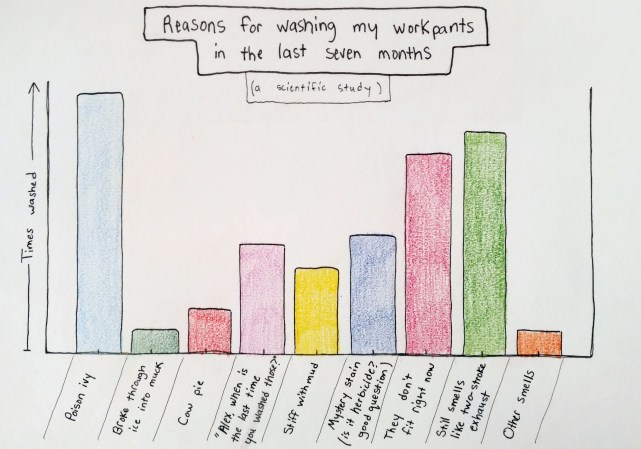
Life-long scientific research. Still trying to get it published in Workpants Quarterly.

Some of the preliminary findings are that there has been a lot of poison ivy this year and that I’ve done a lot of chainsaw work, as shown by the lingering smell of two-stroke exhaust. After looking at the raw data and punching some numbers, I found that there is a clear correlation between my pants not fitting and how long I have been chainsawing. On occasion, after I take off my chaps, one may think that I’m wearing a second pair of chaps underneath my chaps, however, that is merely the outline of my sweat from where the chaps were once occupying.

This is the Achilles’ heel of any good pair of pants, the classic backpocket wallet hole. I prefer the hole in my backpocket to be somewhere in between “that’ll be fine” and “I think I lost my wallet in the prairie.

Once upon a time, these pants used to be more of an orange-khaki color, as shown by the color under the cuff. Over the years they’ve been sunbleached and built up a good patina. They get better with time, like a fine wine.

Permadirt and blue stains. Really it’s a match made in heaven.

Although it made a small appearance in the above data, breaking through the ice was one of my favorite experiences. In February, I and the other field staff were preparing for crane season, and one of the objectives was to remove cattails to make a clear view of the roosting cranes on the river. The river was still frozen at this time, but I was still wary of the thickness of ice. From the bank of the river, I removed all the cattails that I could reach. However, there were still cattails out further that were blocking the view of the river from the blind. Thinking of the cranes, I braved the ice. As I reached the outer edge of the cattails, I knew my goose was cooked. I plunged two feet down into the brisk water and got stuck in the muck, the murky water flowing into my boots. Within an instant, the stale winter air became rank with pungent, marinating muck that had not been disturbed for months. The damage was done, my Muck Boots were filled with literal muck, and I wasn’t going anywhere. To my demise, I finished the job, removing the cattails. To exit the icy water, I laid the weedwhacker on ice near the bank and beached-whaled myself out of the mucky water. Like I said, it’s not glamorous work, but it’s rewarding. The science is still ongoing, but if you’d like to contribute to my (very scientific) research, I’d be curious if you have any good stories about your trusty workpants!
Quality Time

I was at the Niobrara Valley Preserve for two different events last week.  The first was a fantastic two day meeting/tour with university scientists that defined the likely focus of our primary research effort over the next several years.  The second was much more impactful – I spent two days with my 17 year old son.  We didn’t have much of an agenda for the two days, other than to kayak the Niobrara River on day two.  Apart from that, we were free to wander the prairie, splash in the river, or just hang out anywhere and anytime we felt like it.  It was pretty glorious.

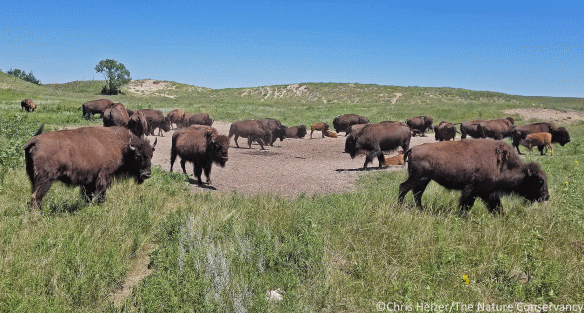
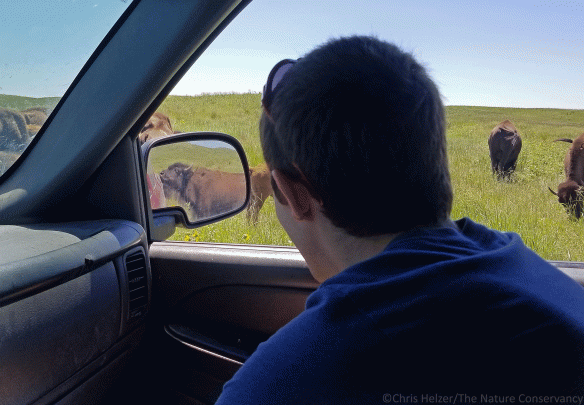
As we were driving into the Niobrara Valley Preserve, we spotted a small group of bison from the road and drove over to take a look.  They were hanging around a low area that was clearly a well-used dusting area.

We parked close by, sat quietly, and just watched them.  After a while, the bison got pretty comfortable with our presence, with several coming over to lick the mineral deposits (I assume) off the side of the truck.

John is the only one of our kids who hasn’t floated the Niobrara River, so that clearly needed to be remedied.  More importantly, I was really looking forward to spending some quality time with my son before he enters his senior year of high school and prepares to go off to college.  John and I have similar senses of humor, though he’s usually a little quicker off the mark than I am.  He’s also brilliant at math and engineering, knowledgeable and opinionated about current events, passionate about soccer, and has matured over the last few years into an independent and responsible human being.  I’m incredibly proud of him.  (Also, he will probably read this, so I’m saying only nice things about him.)

When we drove up to the small group of bison at the beginning of our visit to the Niobrara Valley Preserve, I was worrying about how to keep John engaged and happy during our two days.  He’s a kid who is comfortable in the outdoors, but not necessarily someone who seeks out or finds inner peace when surrounded by nature.  When I first asked him if he wanted to spend a couple days at NVP with me, he said, “sure, as long as we can DO things.”  No pressure, Dad…

After about ten minutes of bison watching, with just a little quiet conversation about what they were doing and why, we lapsed into a long silence.  Concerned that he was bored, I asked John if he wanted to move on to something else.  “No,” he replied, “I like bison.  We can stay for a while longer.”  About twenty minutes later, the bison started wandering off over the next hill, and we drove off in the opposite direction toward a prairie dog town.

After watching the bison, we decided to go check out a small prairie dog town along the south end of the bison pasture.

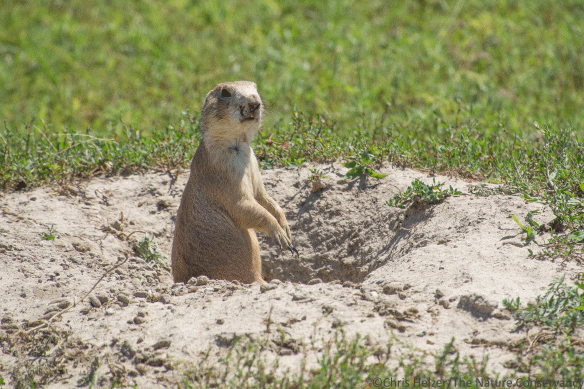
My typical experience with prairie dog towns is that I get to see lots of prairie dogs from a distance, but they disappear into their holes well before I get into easy visual range.  One of the few exceptions to that came a couple years ago when I visited this same prairie dog town with my daughter.  As we drove into the town last week, I assumed the worst, and my expectations were confirmed by the first twenty or so dogs we saw – each of which squeaked and dove into their burrows as we approached.

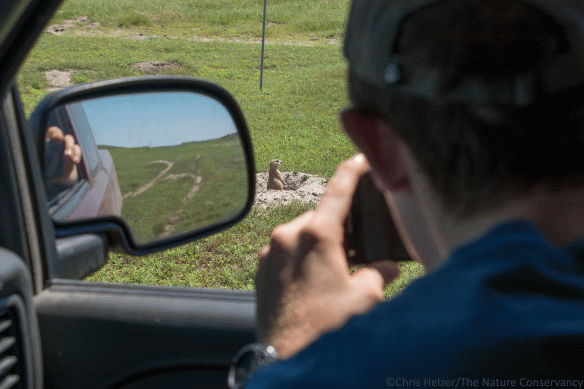
The twenty-first prairie dog, however, hesitated, and as we inched a little closer, stayed alert but aboveground, along with one of its pups.  We slide quietly to a stop and watched them for a little bit.  After a few minutes, I moved the truck up even closer so John could get some better photos with his phone, and while the pup got nervous and left, the mother stuck around.  While we sat there, we also spotted a burrowing owl and a fledgling horned lark.

Most prairie dogs dove for cover long before we got close, but this one stayed aboveground long enough for us to get a good look at it.

Usually, when I’m at the Niobrara Valley Preserve, I try to maximize every minute of my time.  It’s over four hours away from my home, so it’s an effort to get there, and I always feel pressured to get as much done as I can during each trip.  As a result, I rarely have time to just relax and take whatever comes.  After John and I finished watching bison and prairie dogs, and it was clear that John was enjoying the laid back trip, I began to relax and sink into the bliss of some agenda-less time with my kid.  We decided to go see if we could find a small creek to explore.

We found the spot where this little creek flowed right out of the sand and started on its way through a wooded draw and down to the Niobrara River.

On the way to find the creek, we ran across a bigger group of bison and decided to launch the drone and get some footage for my slowly-growing video library.  John is a fan of the drone, but we only flew it for a little while before we moved on.  After all, this wasn’t a work trip.  We eventually stopped along the edge of the bluffs above the river and walked down into a draw that looked like a good place to find a stream.  Sure enough, we started to hear flowing water as we descended, and we found a cold clear creek and walked upstream until we saw where it was seeping right out of the ground.

Later that evening, we met up with a couple other friends who happened to be at NVP at the same time, and the four of us splashed around in the river for a while before playing cards and going to bed.  It was a good first day, but the main reason John had come was to kayak the river, and we needed to get up (fairly) early the next day to beat the crowd to the water.

Finally – the part of the trip John was really waiting for.

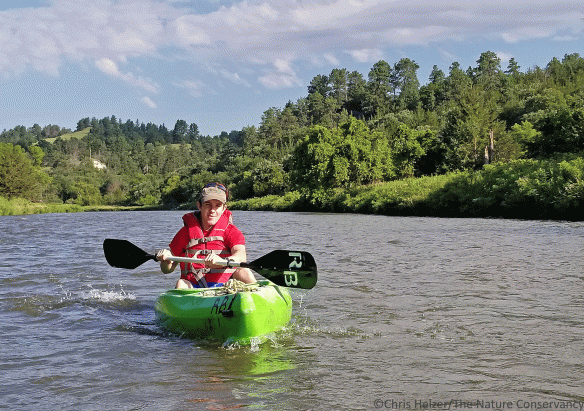
The next morning, we got to Rock Barn Outfitters and got a ride upriver to our drop off point, where we slid the kayaks into the water.  It was a Friday, and I was a little concerned that we might have to weave through early weekend tubers sharing the river with us, but while the scattered campgrounds along the river were full of people, we spent five hours on the water without seeing any tubers, canoers, or other kayakers.  It was perfect.

I made John stop and walk up to see Stairstep Falls, one of many waterfalls on the north side of the river (on land owned and managed by The Nature Conservancy).

We floated about 14 miles in five hours, stopping a few times to hike, swim, or eat lunch.  During the entire trip, the Niobrara Valley Preserve was to our right, helping to give John a feel for the immense size of the 56,000 acre property.  In fact, we only saw about half of the Preserve’s river frontage that day.  As we slipped quietly downriver, we also saw quite a few bald eagles, along with great blue herons, spotted sandpipers, dragonflies, frogs, and other animals.

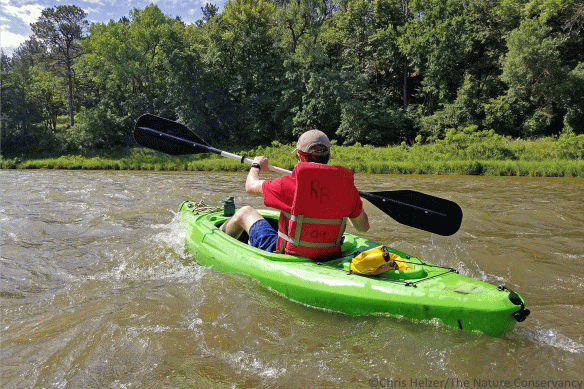
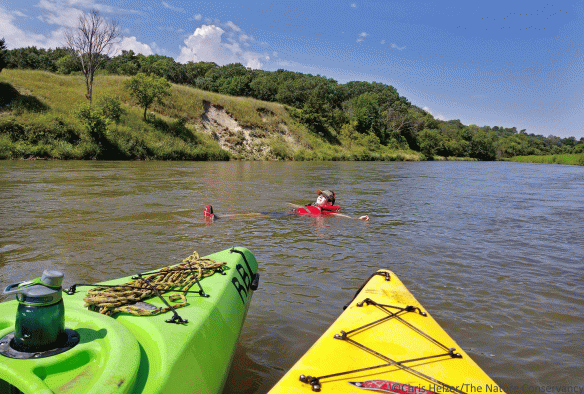
It wasn’t all quiet and contemplative nature watching, though.  There were also a few kayak races, which included quite a bit of pushing, shoving, and splashing.  In addition, John was really hoping to paddle through some rapids, and while I tried to temper his expectations, the river was running pretty high and we did manage to find a fair number of (mild) whitewater stretches.  We also found a nice, quiet, and relatively deep stretch of river where he hopped into the water and just floated/swam downstream while I held onto his kayak for him.  I think we checked all his boxes for the day.

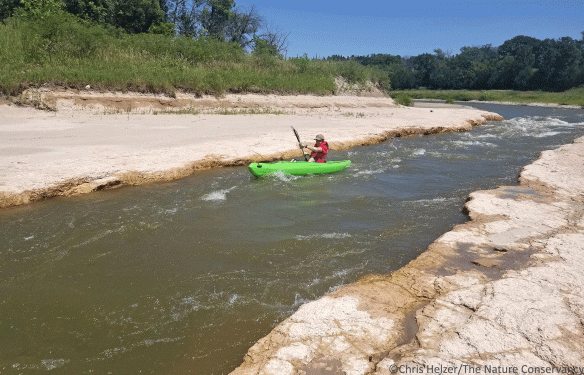
This was one of many short stretches of mild whitewater.  Most were rough enough to splash a little water into the kayaks, but not really enough to do much else.

Toward the end of the trip, we went through the Egelhoff rapids, where the entire river squeezes tightly into a very narrow run.  We got out and scouted it ahead of time, and then decided it was safe enough to paddle through.  I went first and then got out to watch John come through.

This might have been the best part of the day – we just floated slowly through a deep and gentle stretch of river, with John cooling off and relaxing in the water while I babysat the kayaks and tried not to float too far ahead.

We had a pretty quiet ride home after we got off the river.  John, as usual, slept through most of it.  I was pretty tired too, but also grateful for the opportunity to share one of my favorite places with one of my favorite people. Hopefully, John will remember the trip fondly as he goes off to become an engineer.  And hopefully, he’ll come back and float the river with me again sometime.

If you’re interested in visiting the Niobrara River Valley, here’s a good website that describes the National Scenic River and some of the choices available.  While you’re there, you can stop and hike the public trail at the Niobrara Valley Preserve.  We don’t (yet) offer public tours of the bison herd or prairie dog town, but the hiking trail (just south of the river bridge on the road between Johnstown and Norden) provides some great overlooks of the river, and a chance to wander through many of the different ecosystems found in the valley.