Bison, Bingo, and Other Bits and Bobs

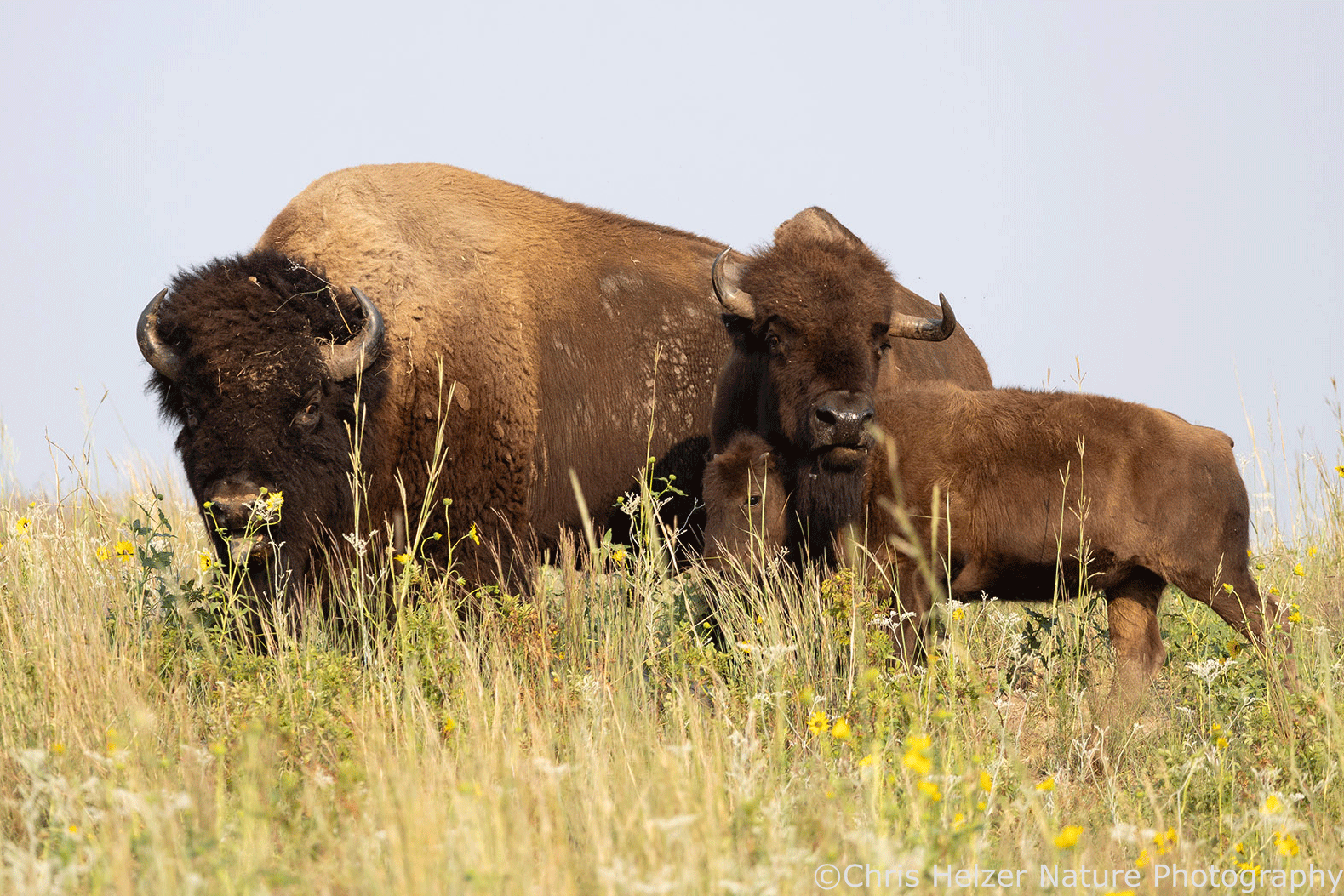
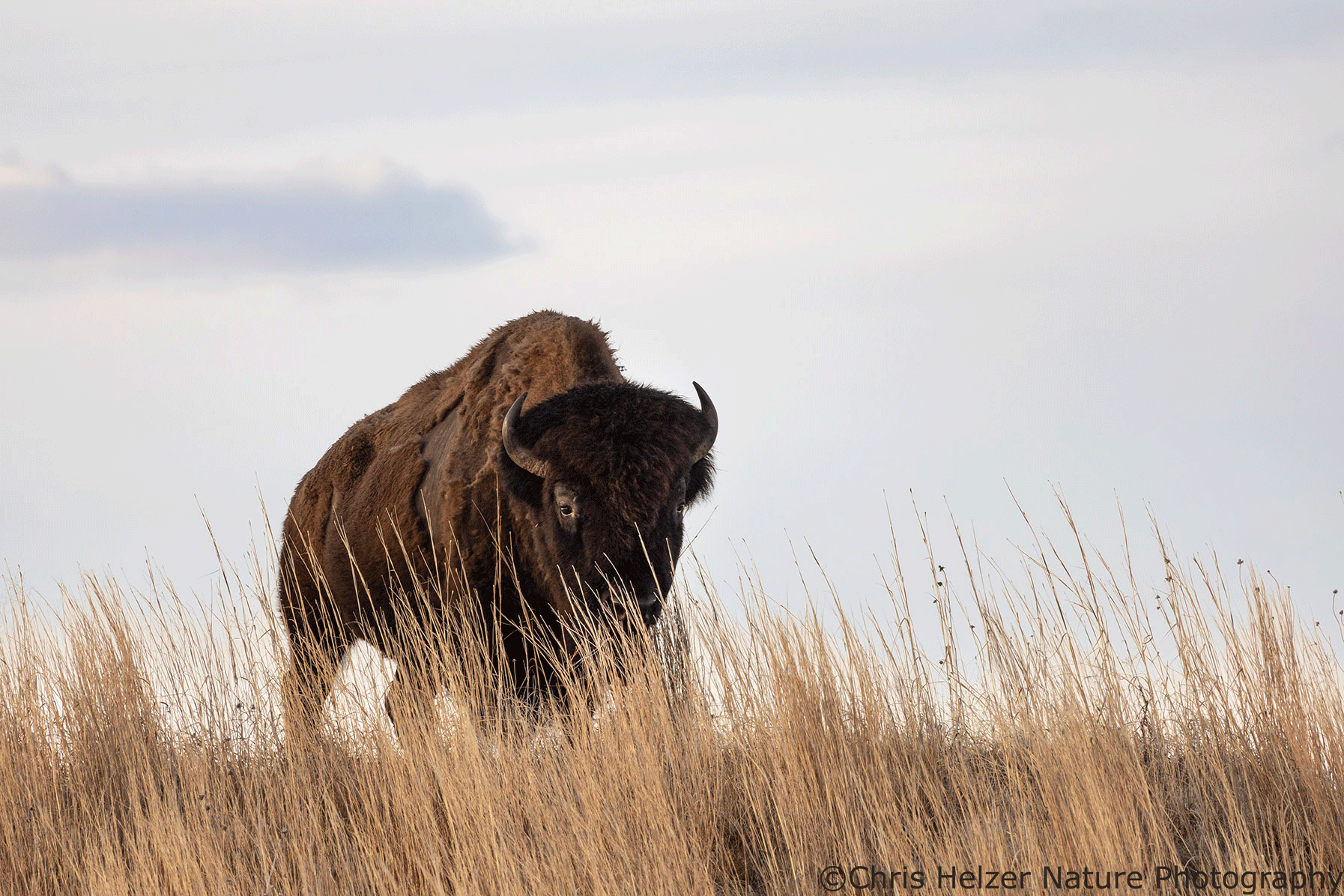
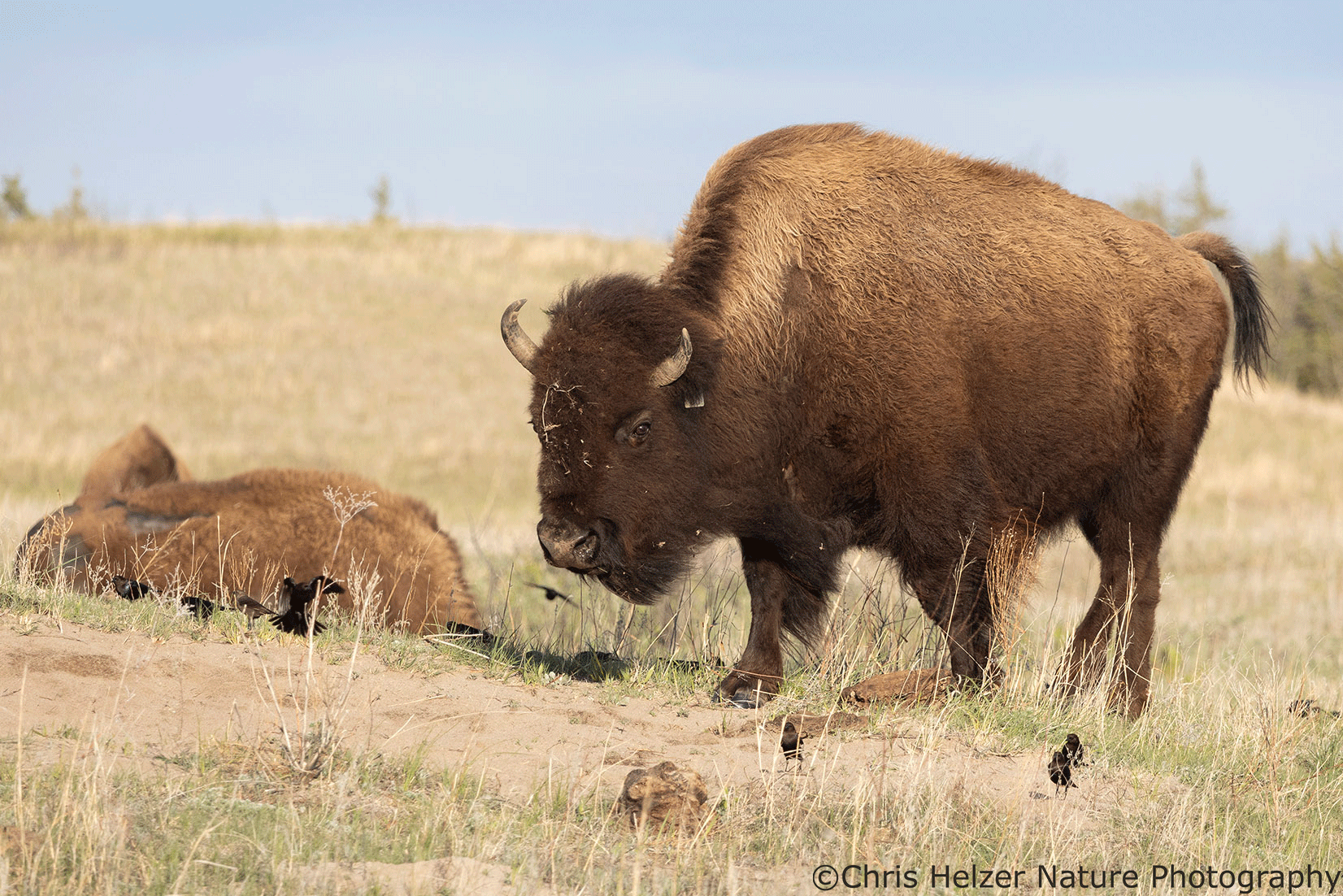
A bison bull at the Niobrara Valley Preserve this week

Today, I want to share a bunch of announcements, a wonderful surprise I received last night, some photos from this week’s trip to the Niobrara Valley Preserve, and some spring/summer prairie bingo cards. Thanks for your patience with this omnibus post.

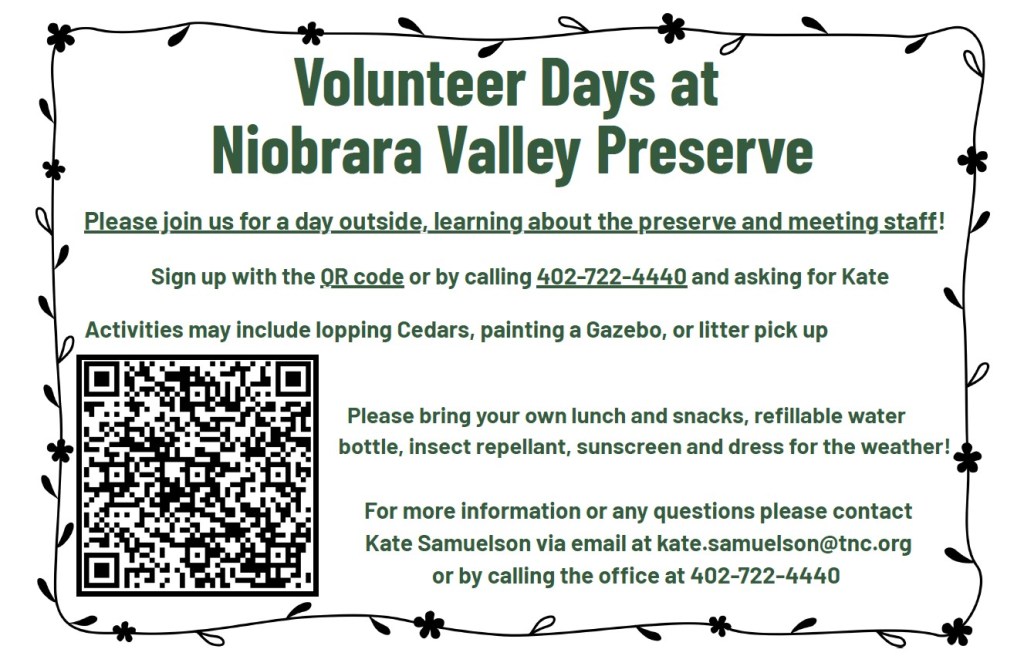
I’ll start with an invitation to volunteer at The Nature Conservancy’s Platte River Prairies or Niobrara Valley Preserve. If you’ve always wanted to come visit one of these sites and also enjoy contributing to conservation efforts, here’s your chance! (If you just want to come visit and NOT work, you’re also welcome to do that, and both sites have public hiking trails just waiting for you.)

At the Platte River Prairies, we host volunteer workdays twice a month throughout most of the year. You can find more information on those workdays here. At the Niobrara Valley Preserve, Kate Samuelson, our outreach coordinator is going to start hosting volunteer days this summer. She created a flyer (below) with the information you need to know. Possible NVP volunteer days include June 6th and 10th and July 18th and 29th. At both sites, we may be able to provide overnight housing for people traveling from far away.

In addition to volunteering and hiking our public trails, another opportunity to visit and learn will come on July 11, 2026, which is the date of our next public field day at the Platte River Prairies. I’ll share more information later, but please save the date if you’re interested. It’ll be a terrific opportunity to meet our staff, explore both restored and remnant (unplowed) prairies, and learn prairie ecology, research, and land stewardship.

We will also be hosting four habitat workshops this summer, aimed at land owners and land managers. At those workshops, we share what we’ve been learning about fire, grazing, restoration, and other stewardship practices, as well as a good dose of plant identification practice. If you’re interested in attending one of these free workshops, please contact Kate for more information (see her contact info in the above flyer for the NVP volunteer days). Habitat workshop days will be June 9 and August 18 at the Platte River Prairies and May 19 and August 11 at the Niobrara Valley Preserve.

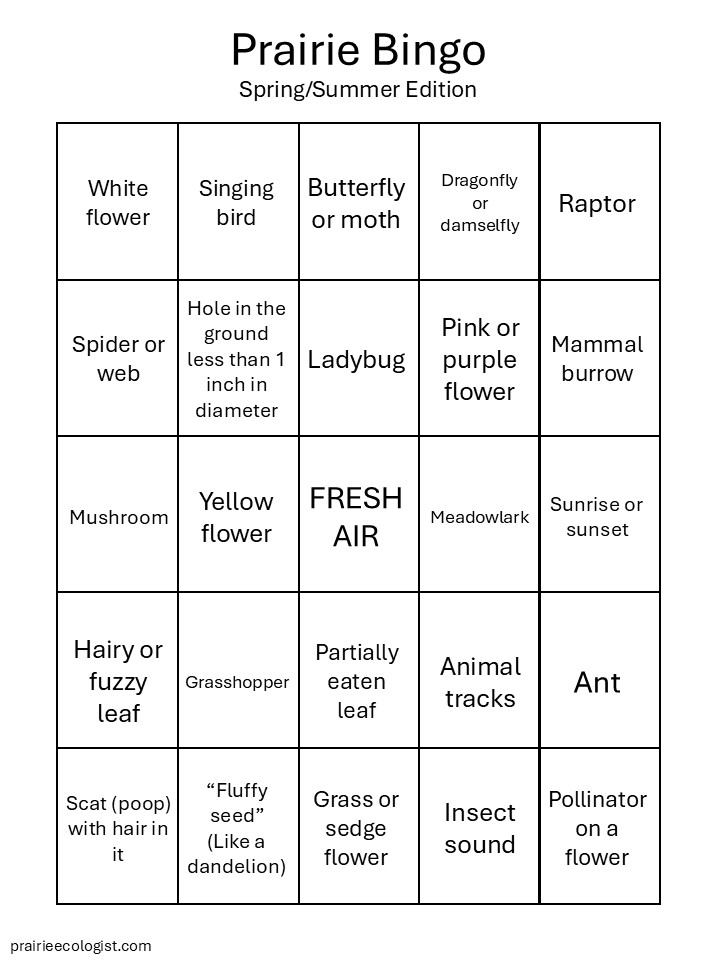
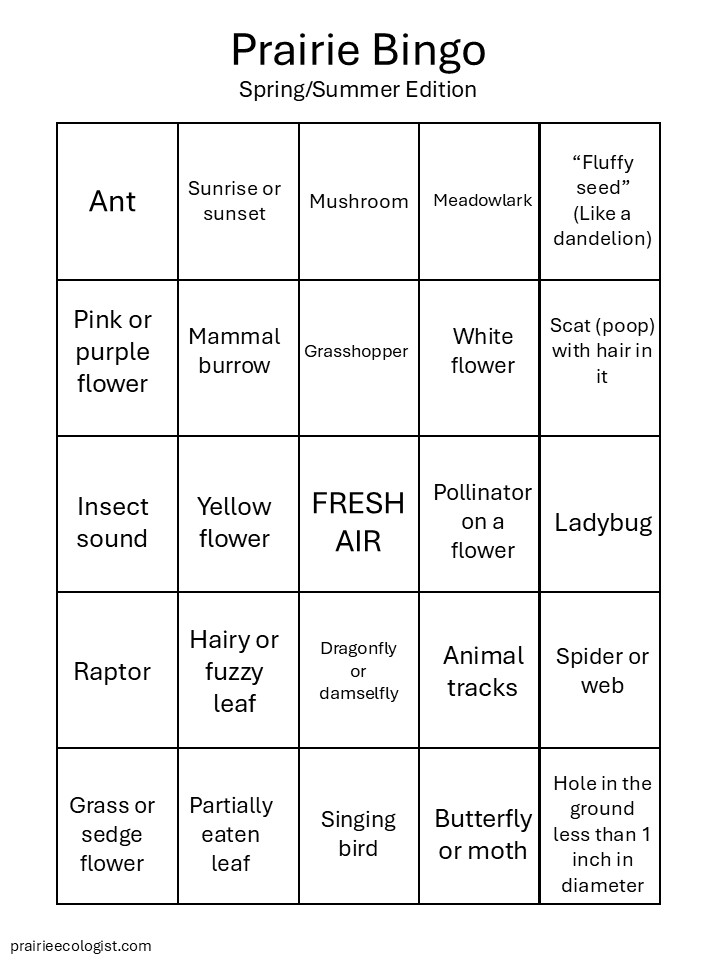
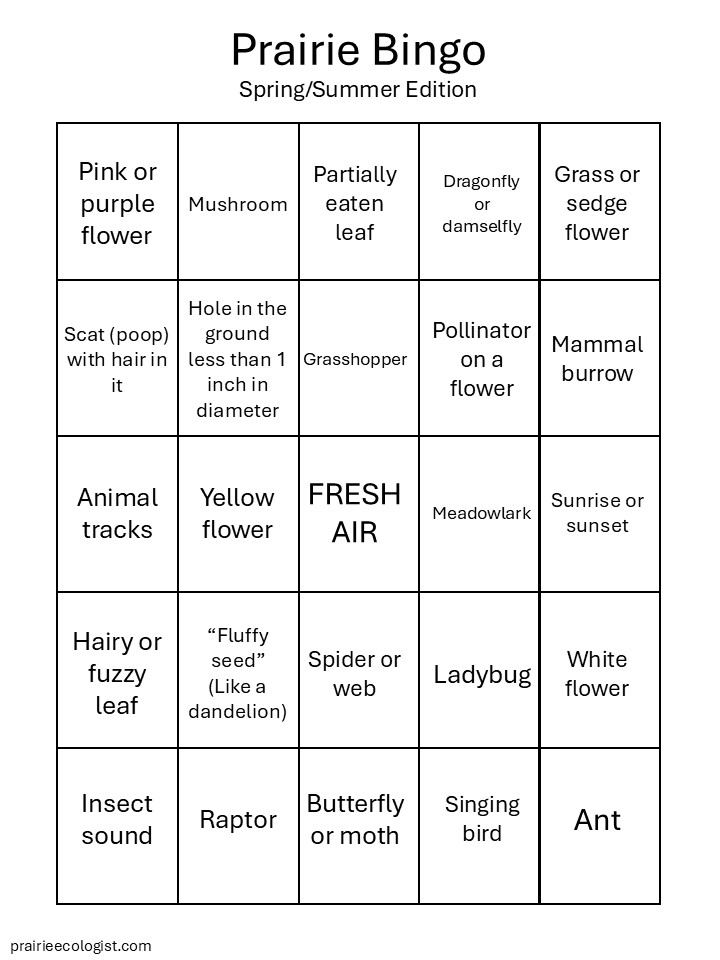
If you’re looking for something to entice you out on a hike in the prairie, either at one of our sites or in any other prairie, I’ve created some bingo cards for the spring and summer seasons. I had a surprising number of people thank me for the last batch I made, so I hope these will be similarly helpful. There are three bingo cards at the end of this post, each with the same items to find, but in different locations on the card, in case you have multiple people and it’s helpful to non-identical cards. Look, don’t let me tell you how to have a good time in prairies – I’m just giving you options!

Lastly, before I just dump a bunch of recent photos on you, here’s the terrific surprise I received last night. Many of you will know about Wild Green Memes For Ecological Fiends. If you’re on social media and you’re not aware of that group, I’m not sure why you’re on social media. Wild Green Media also has other platforms, including their Wild Green Streams podcast, on which I appeared last year.

Well, anyway, Rhett Barker, founder of the Wild Green Memes for Ecological Fiends, executive director of Wild Green Future, and the person who interviewed me on their podcast, sent me an email last night. Apparently, after hearing about my square meter photography project, he was inspired to try his own (12-hour) version. The resulting 10-minute YouTube video is fantastic and I wanted to share it here. If the video link below doesn’t open for you, please click on the title of this post above to open it online and that will make the link active.

Ok, on to photos… Here is a batch of images from the Niobrara Valley Preserve this week:

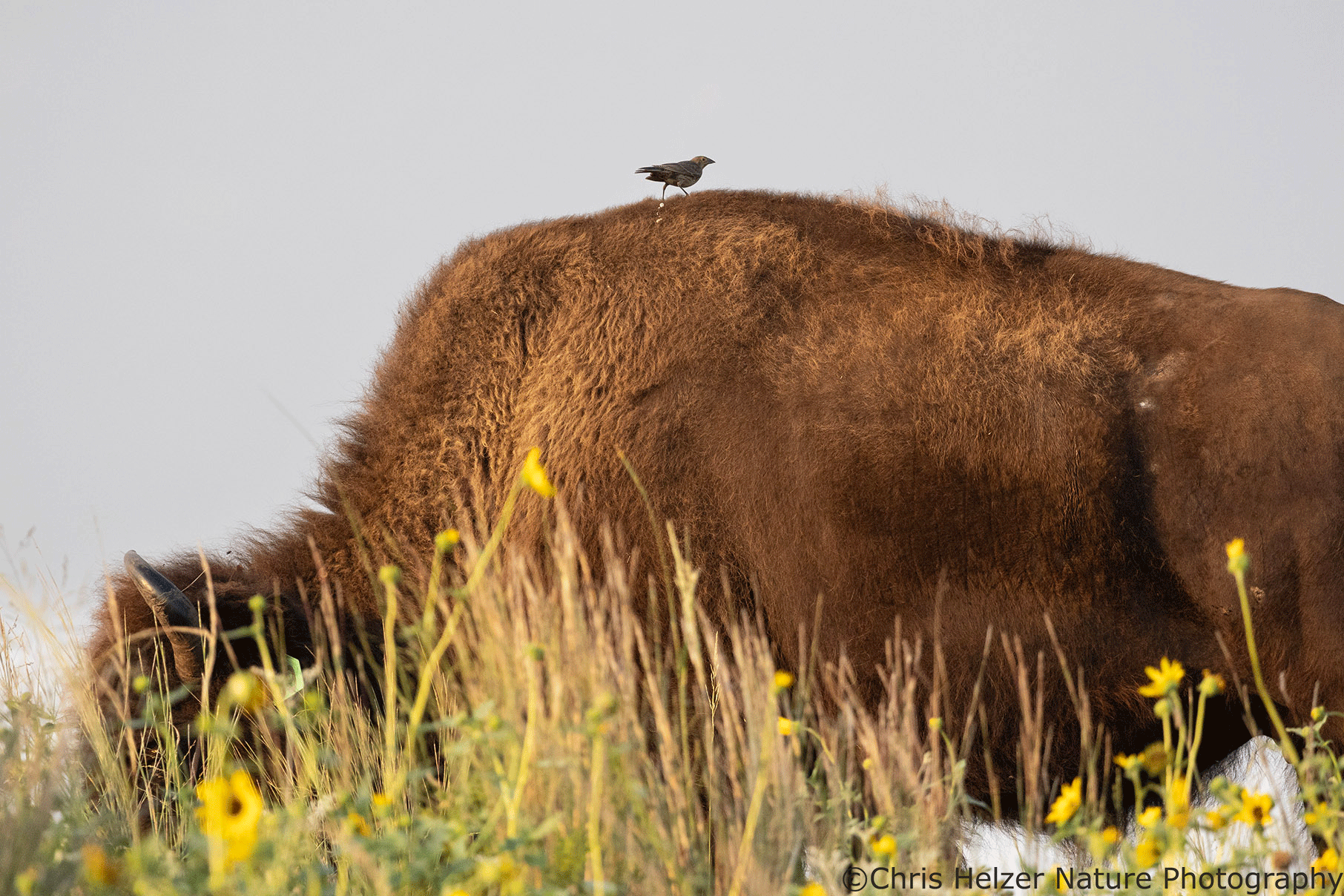
Bison and cowbirds in Sandhills prairie
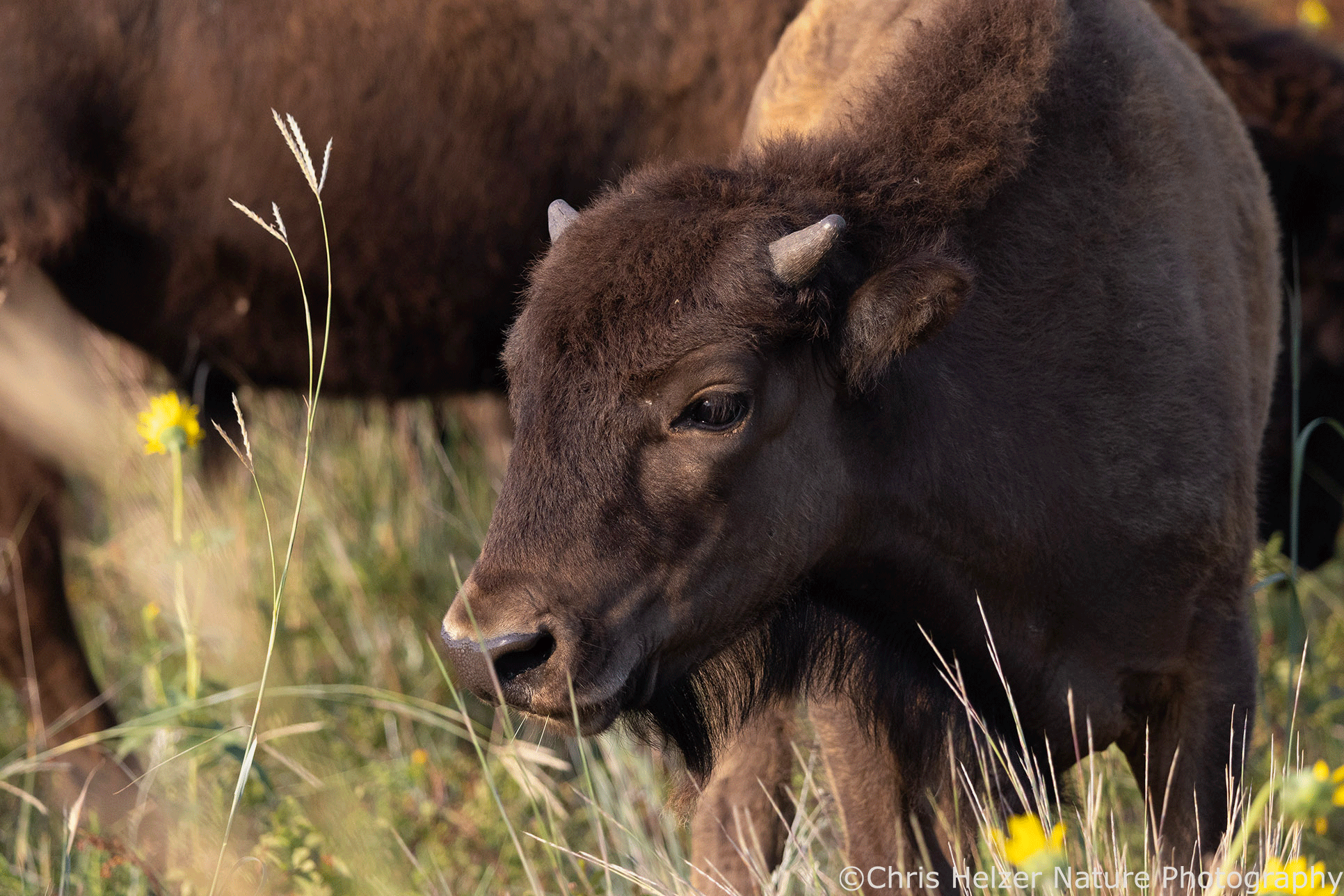
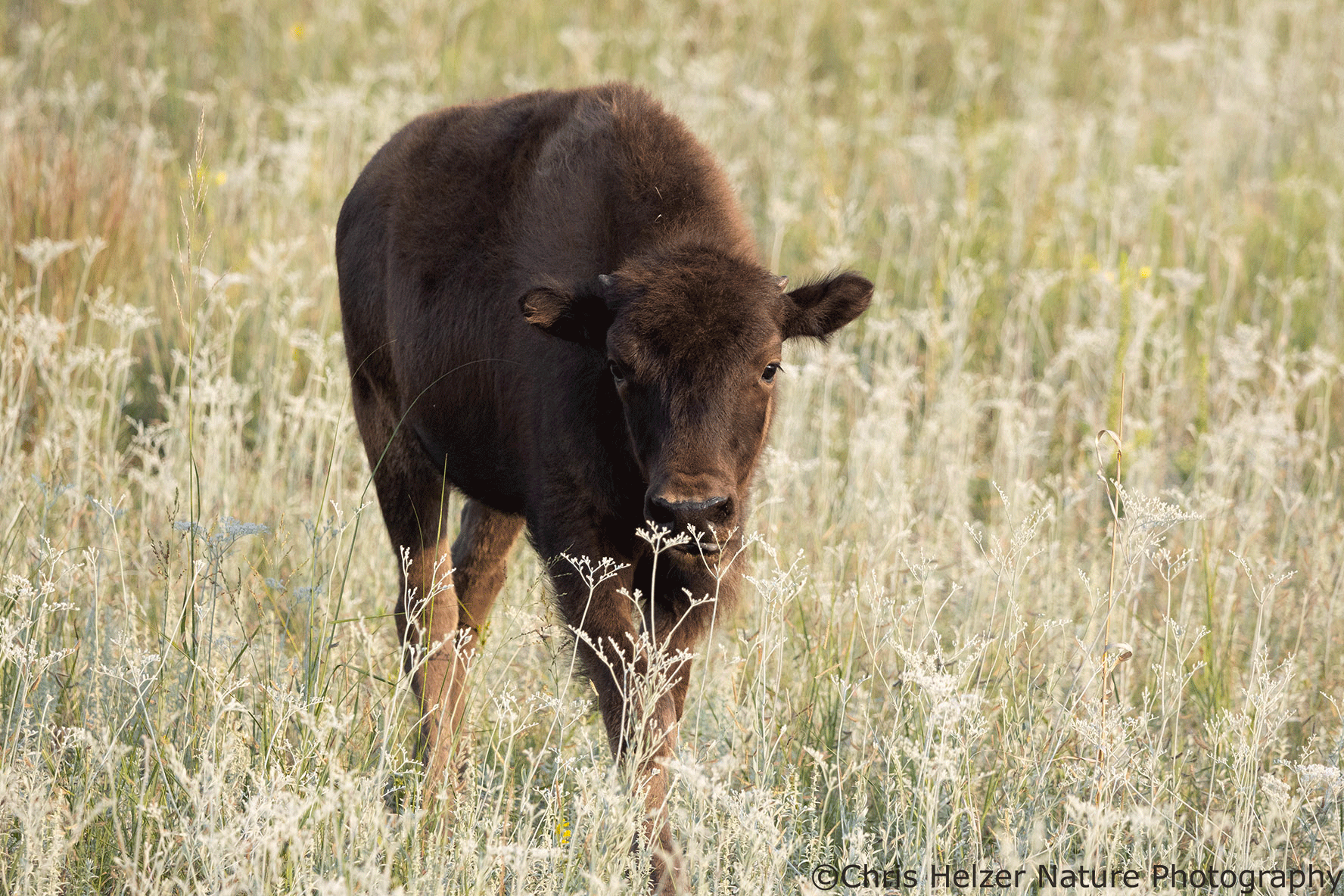
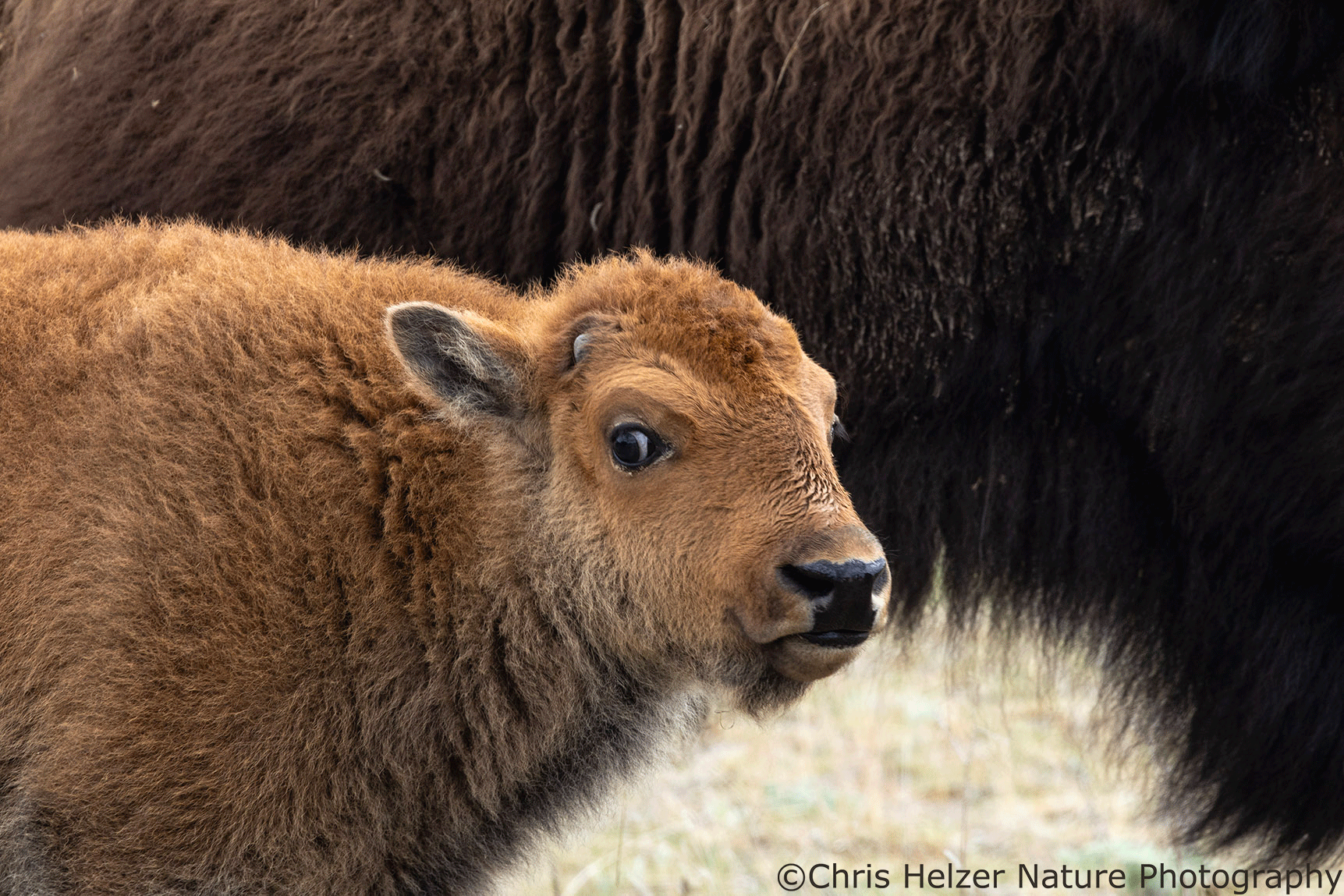
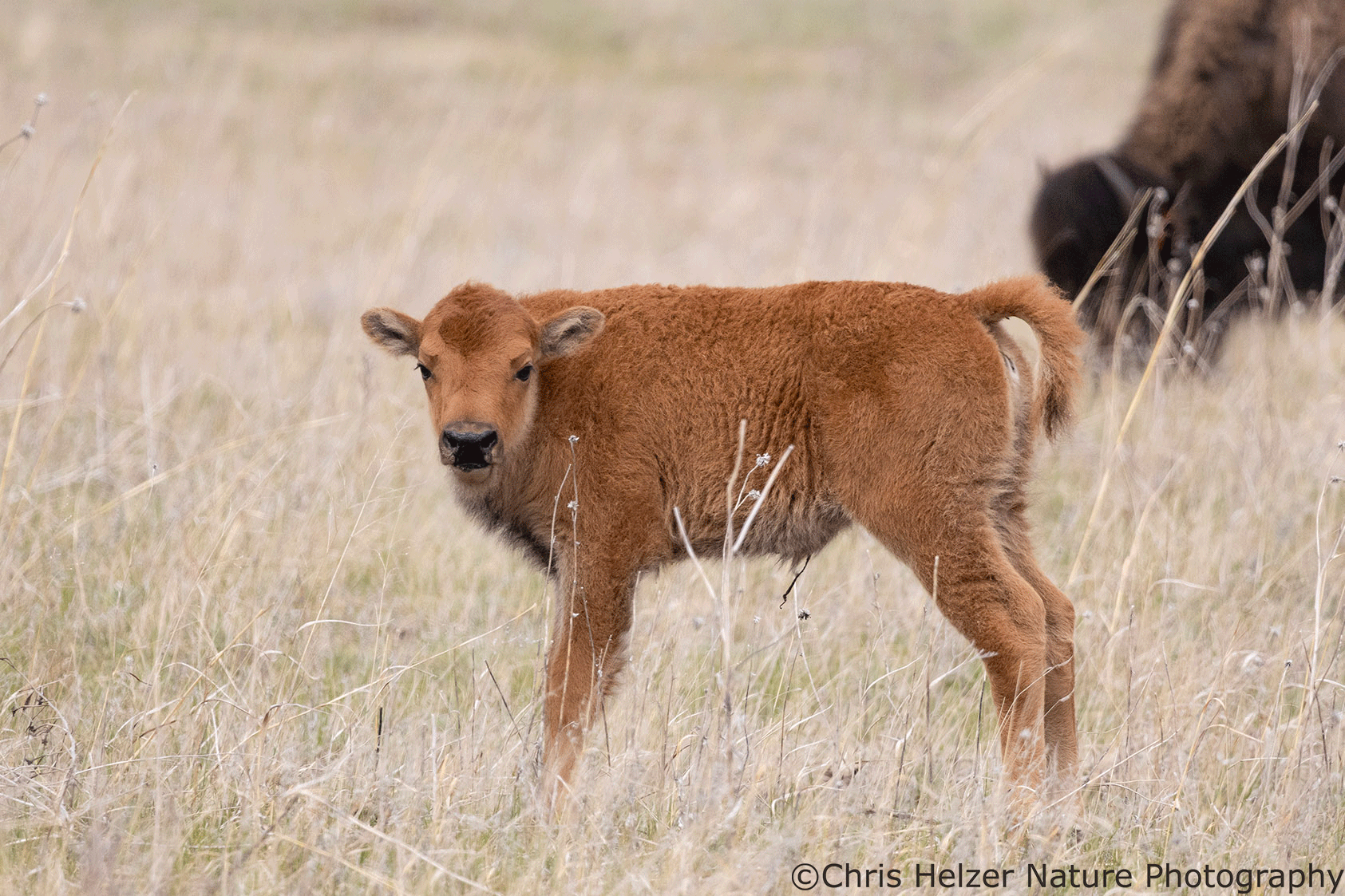
A young bison calf giving me the sideeye
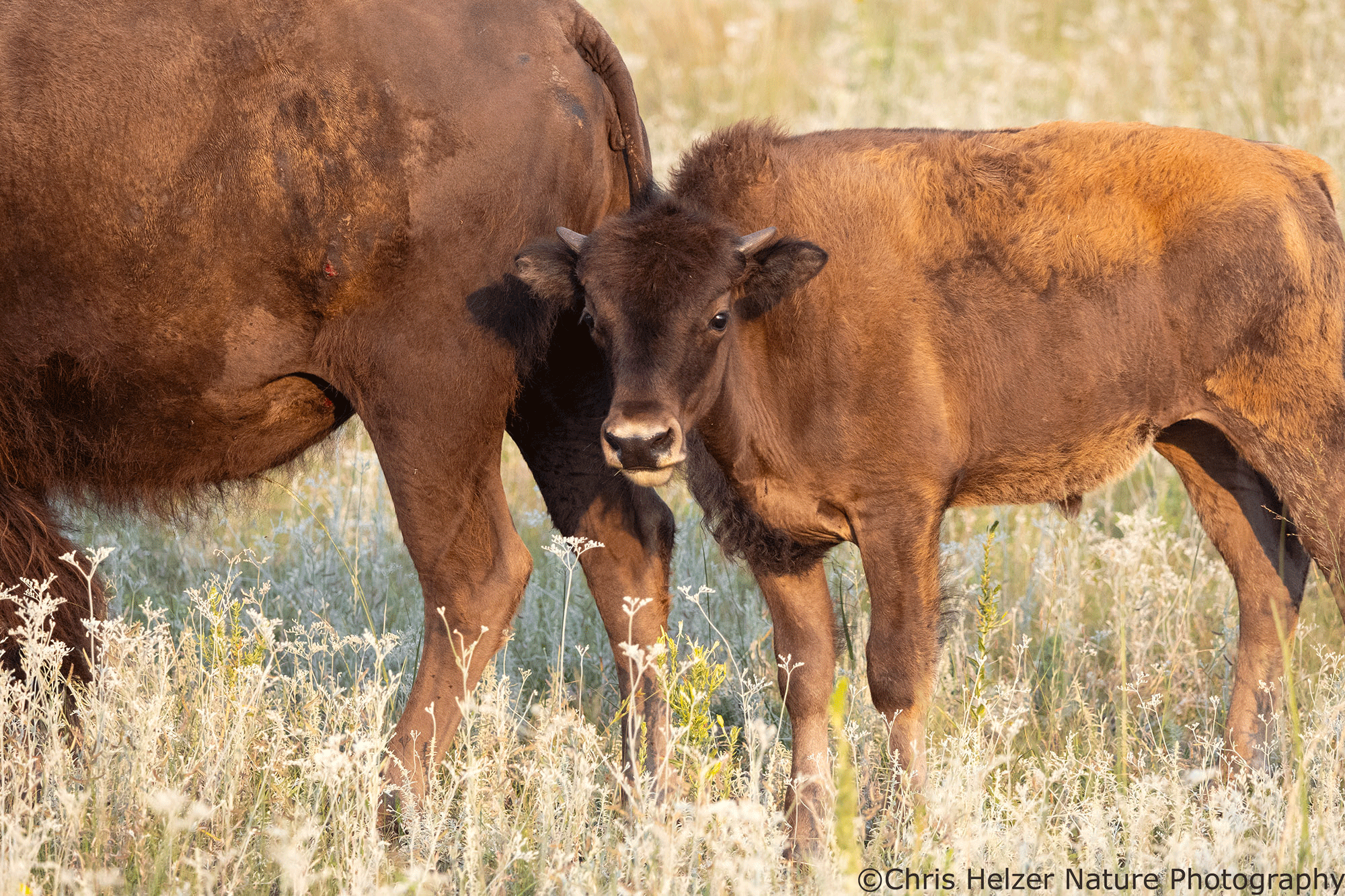
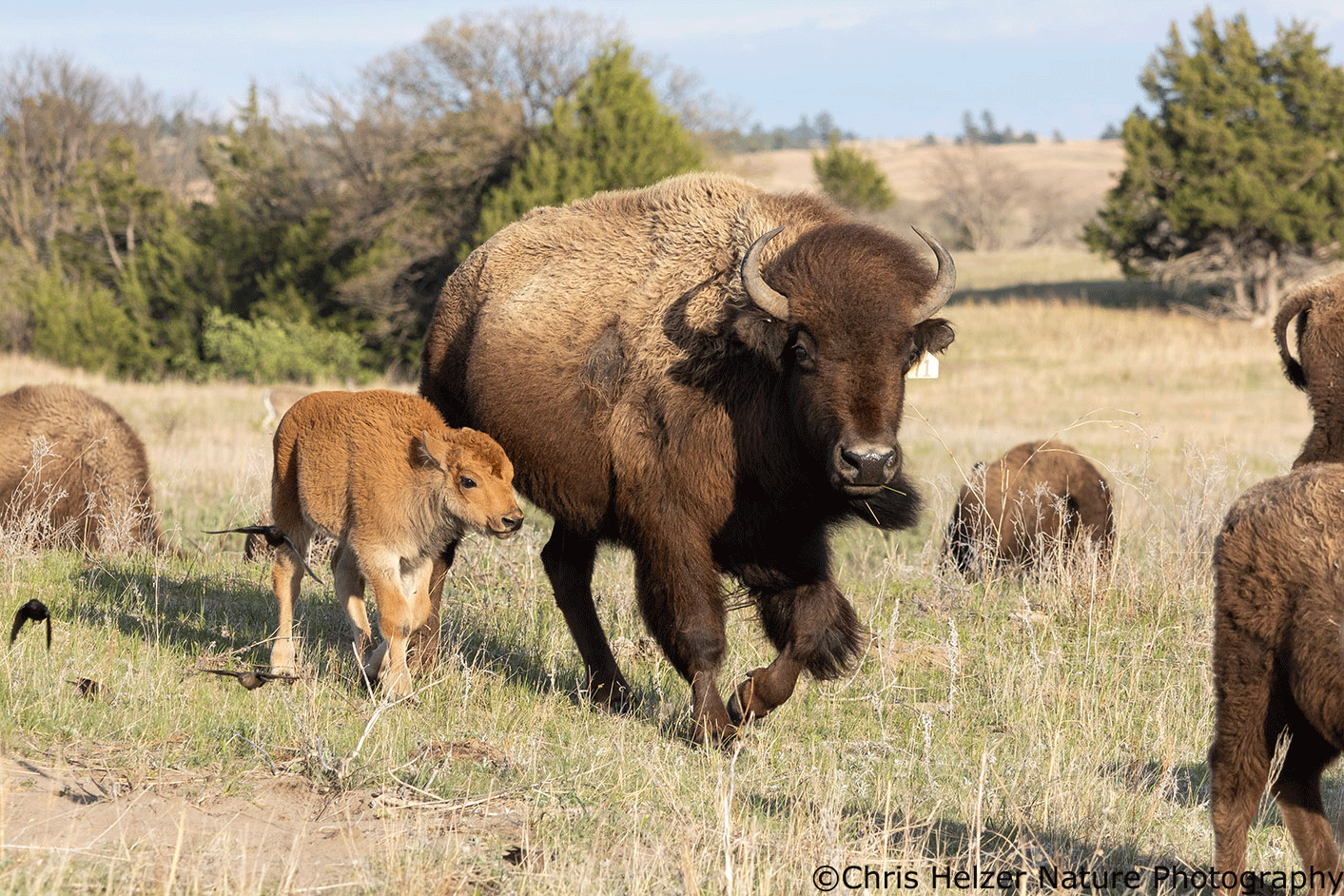
Mom and calf
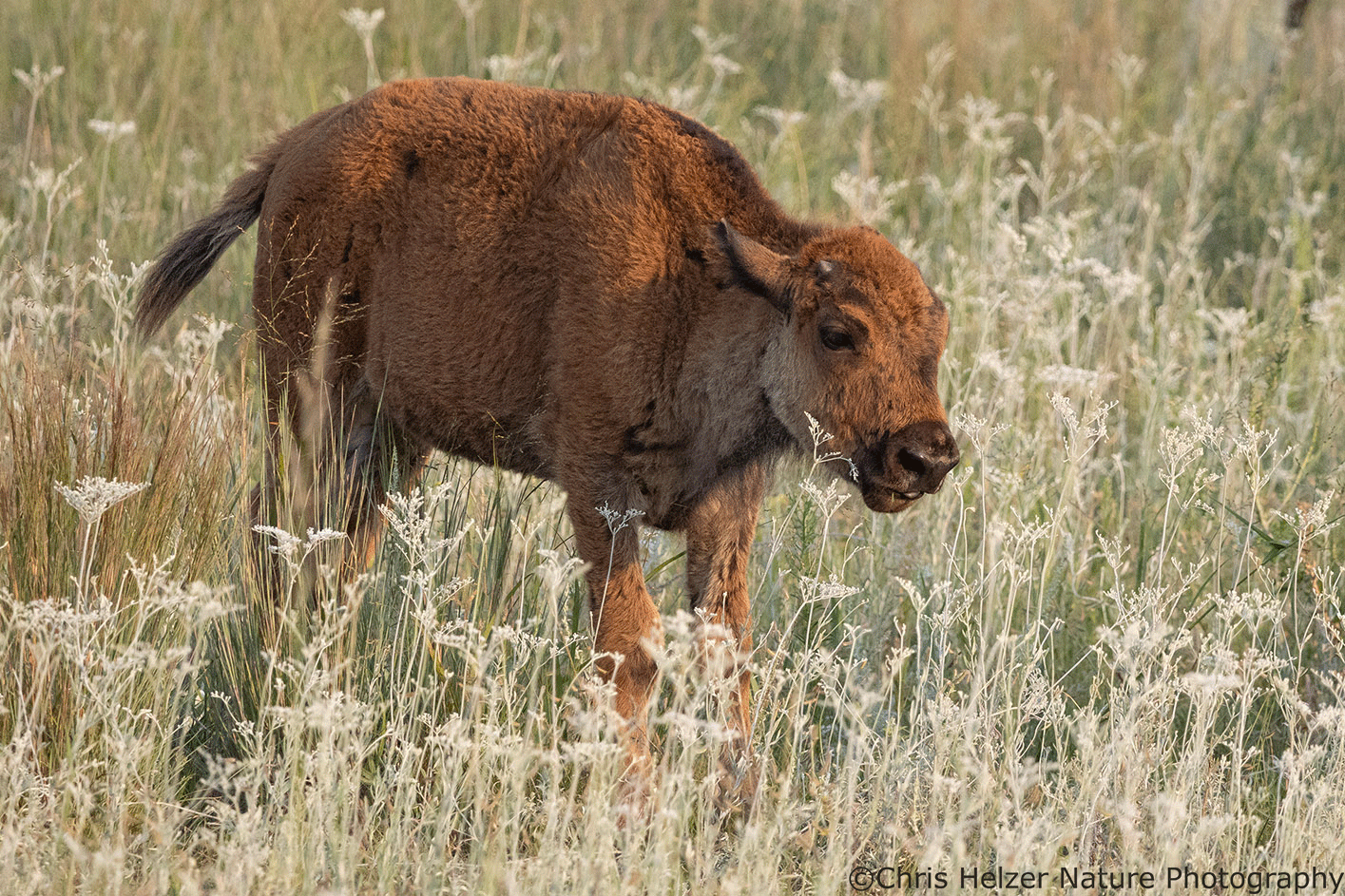
A calf young enough you can still see the remnant of its umbilical cord
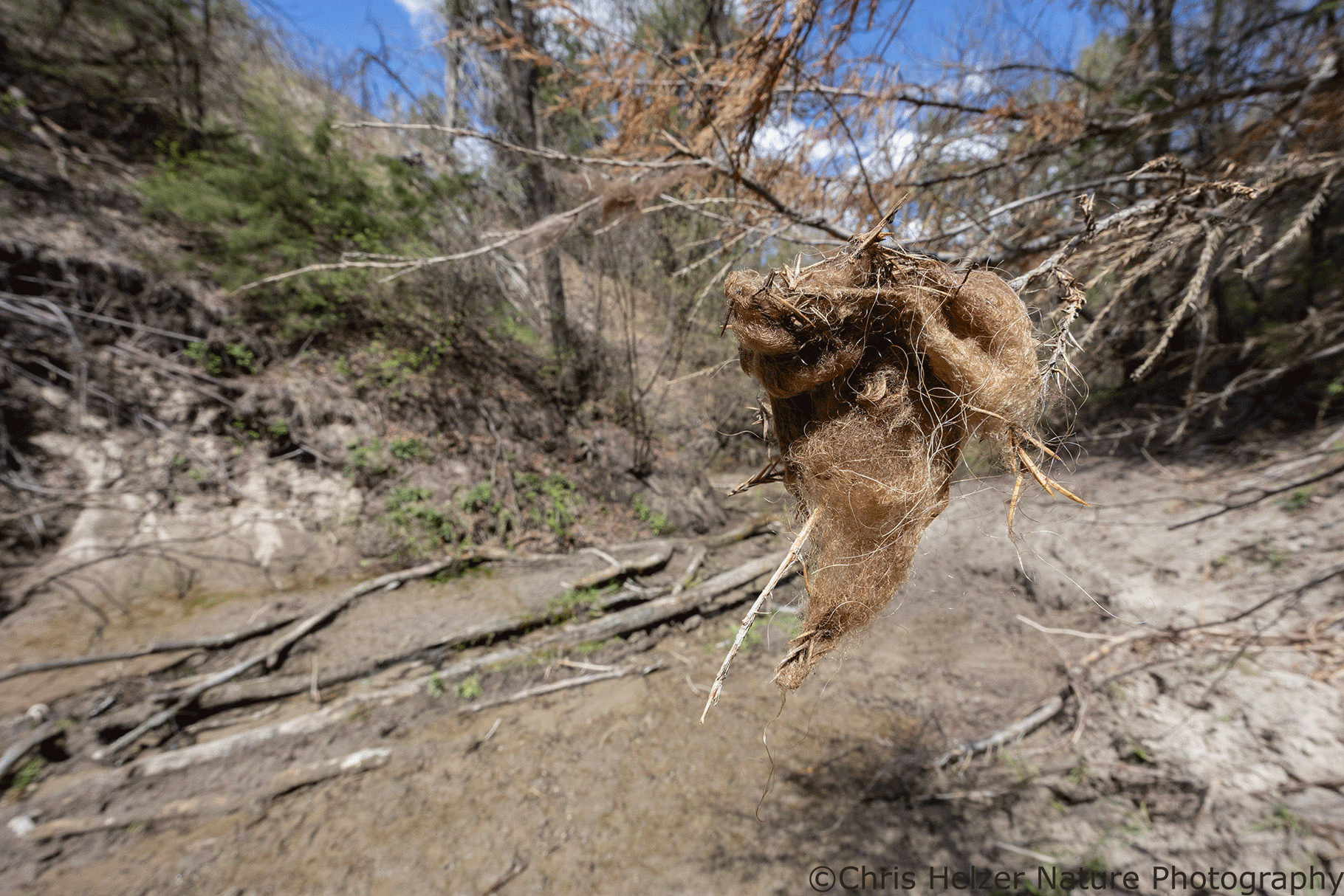
Bison fur along one of the many creeks the animals visit for water (along with other water sources we provide for them)
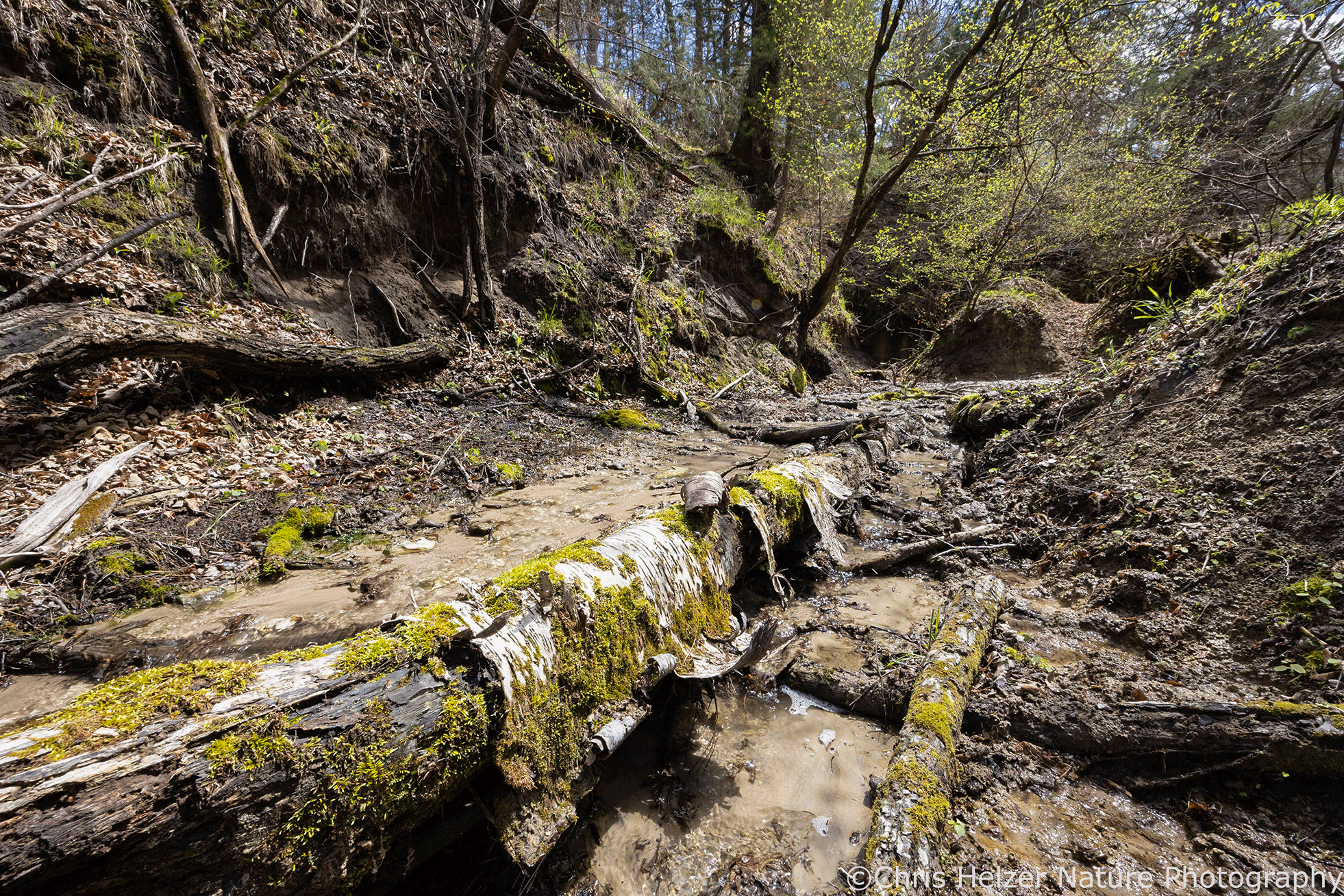
A paper birch log along a spring-fed stream
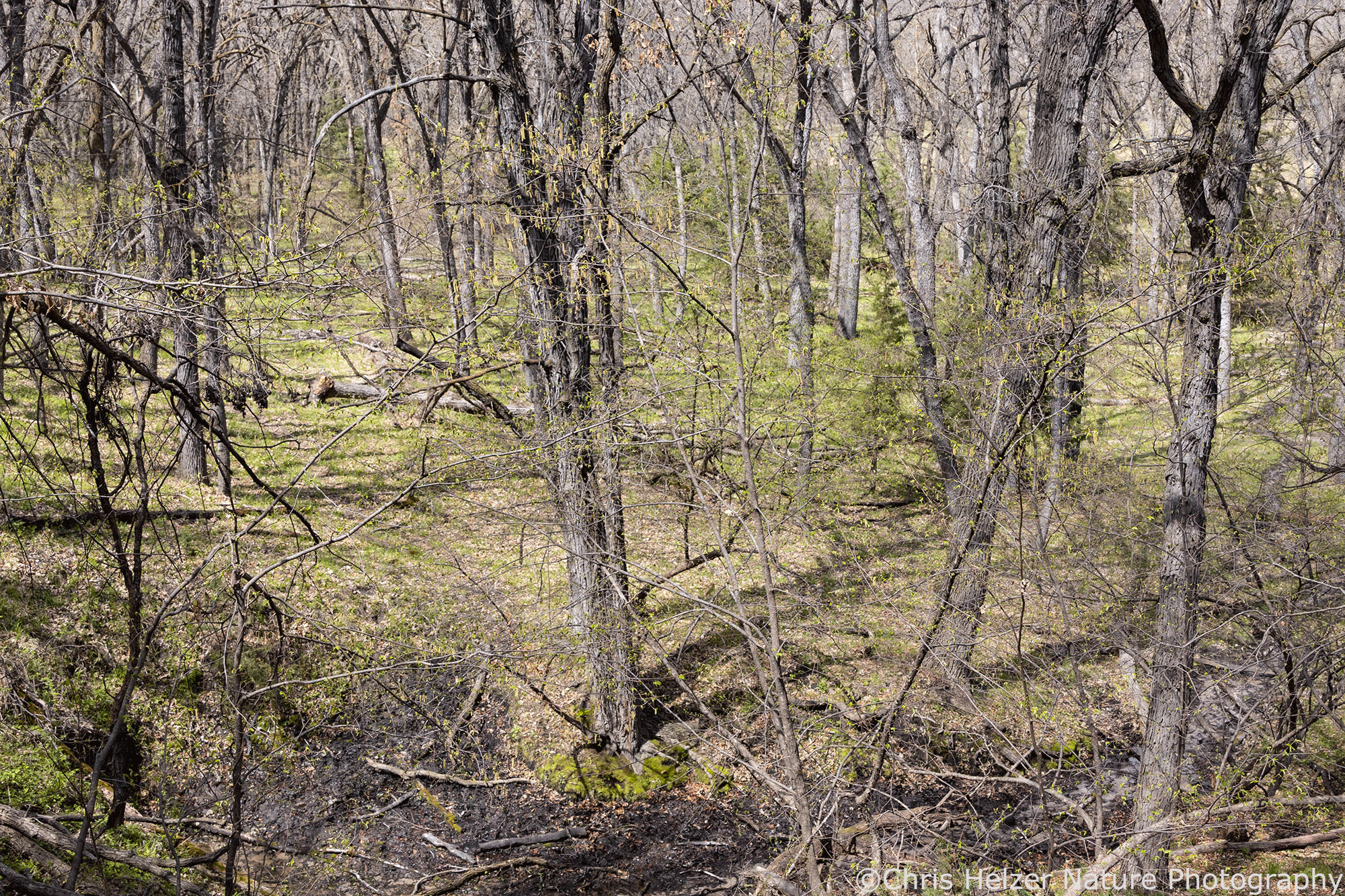
A riparian oak woodland recently cleared of (most) eastern red cedar trees to improve habitat conditions
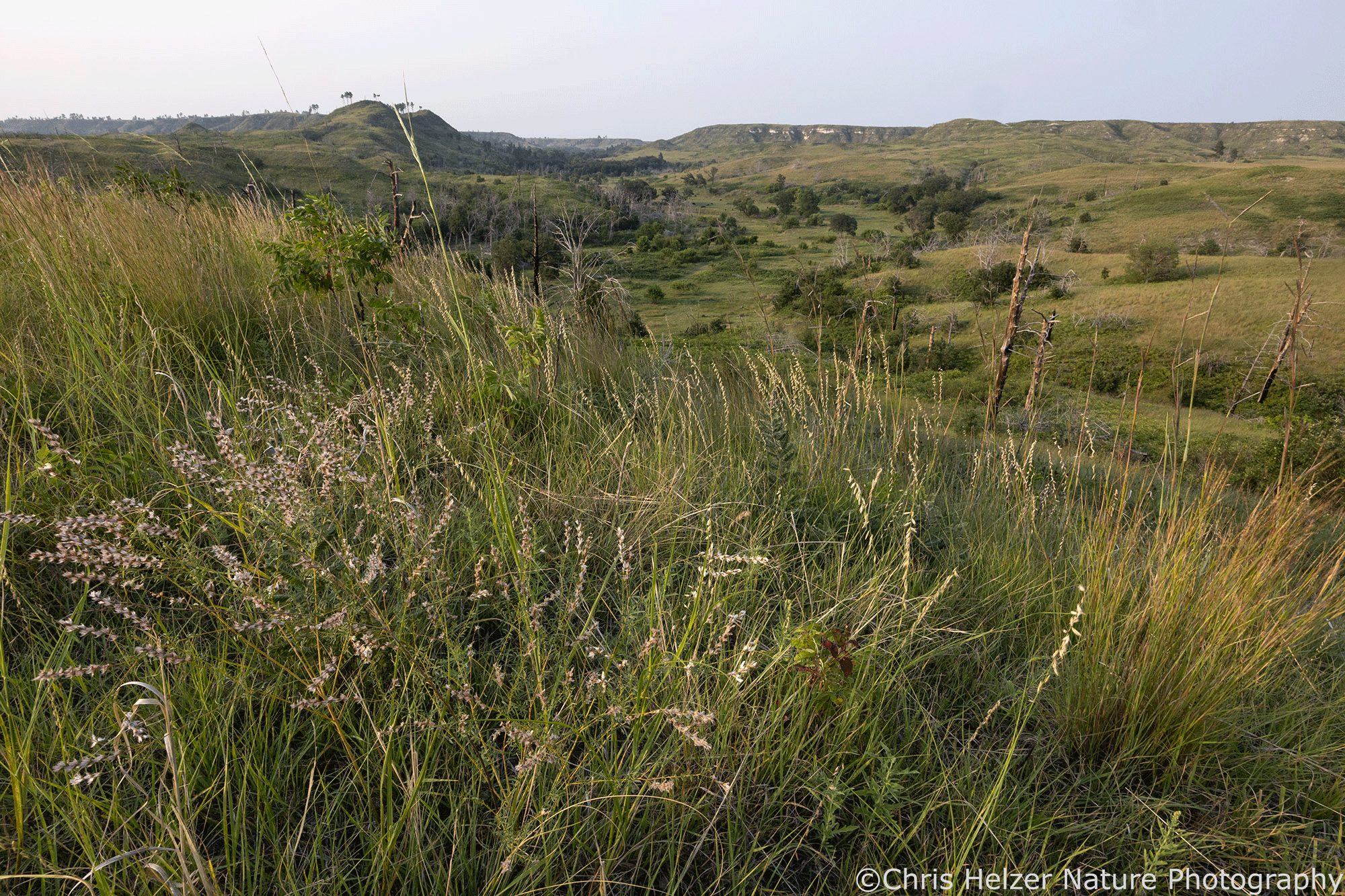
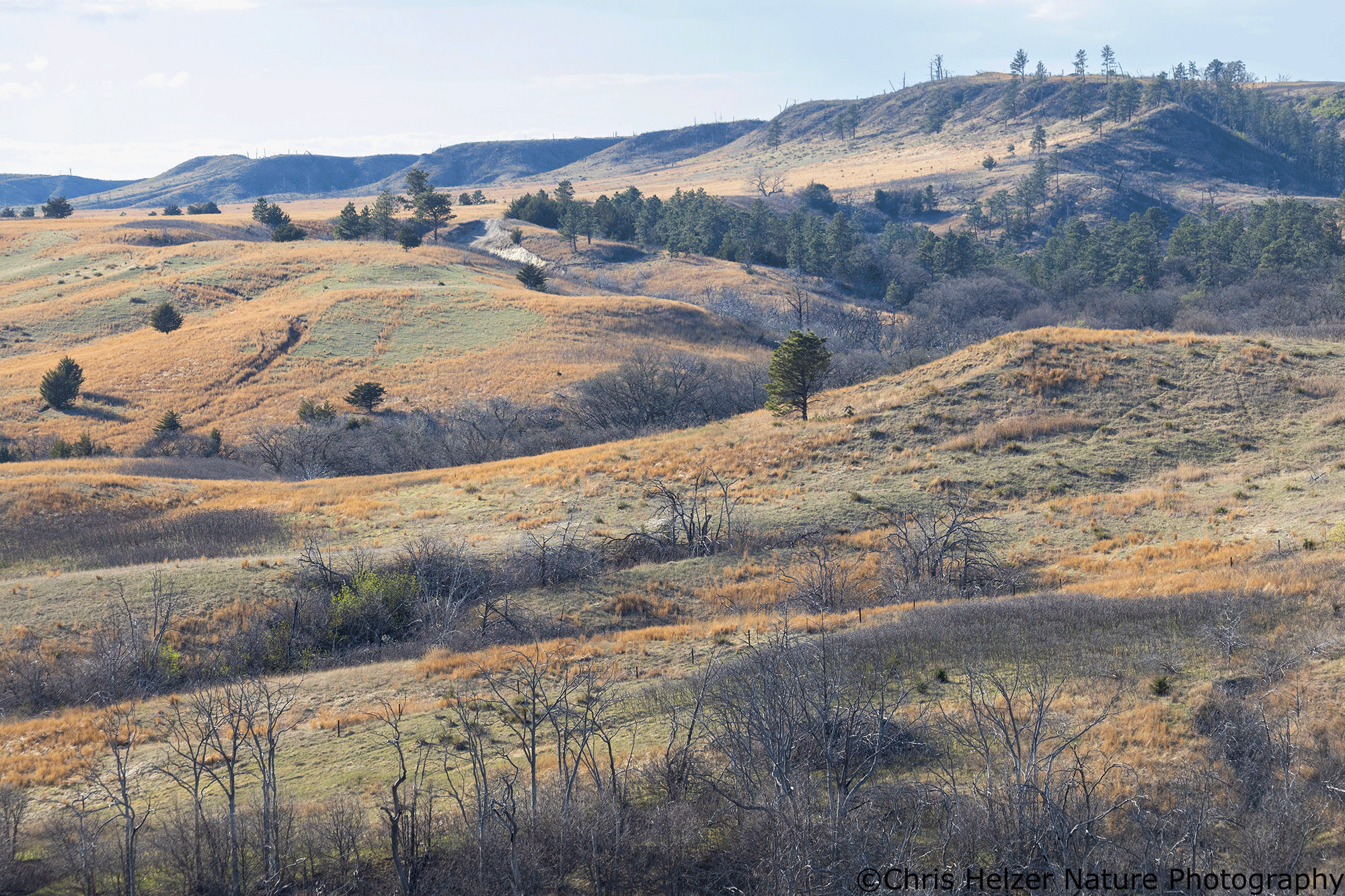
Grasslands on the north side of the Niobrara River – Dakota mixed-grass prairie
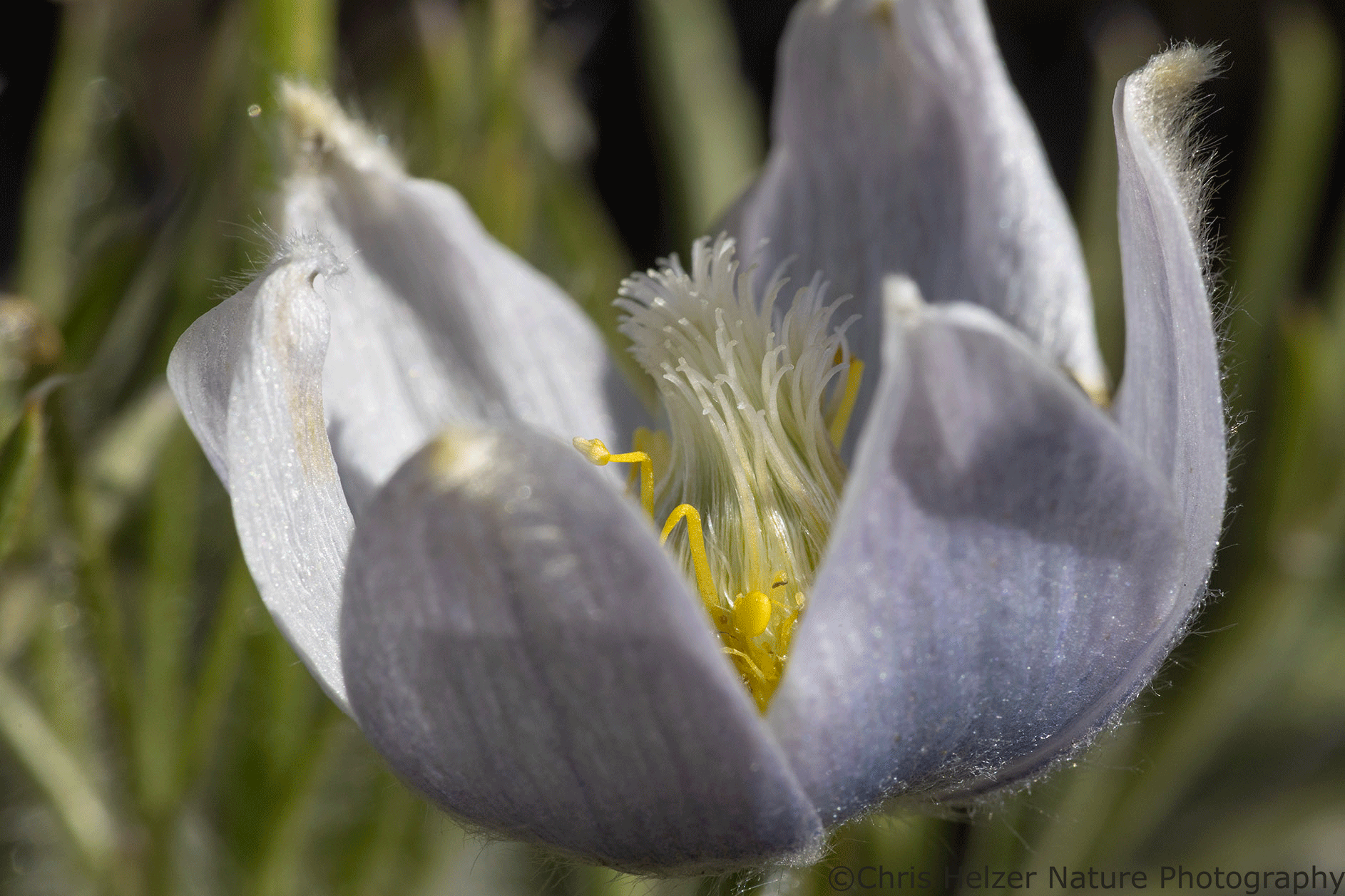
The last pasque flower (Pulsatilla patens) I saw in bloom on the north side of the river.
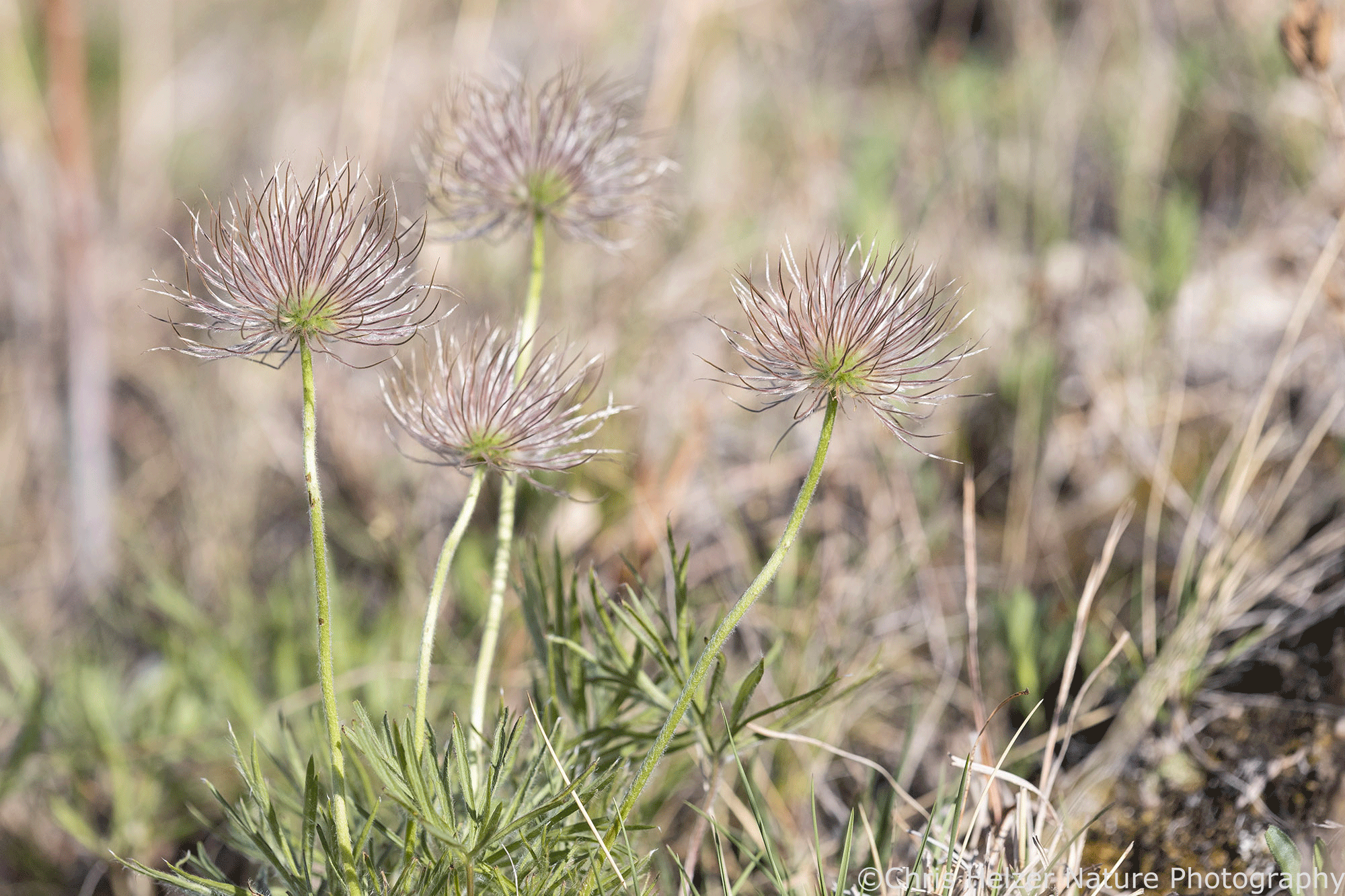
Most pasque flowers have produced fruits/seeds now.
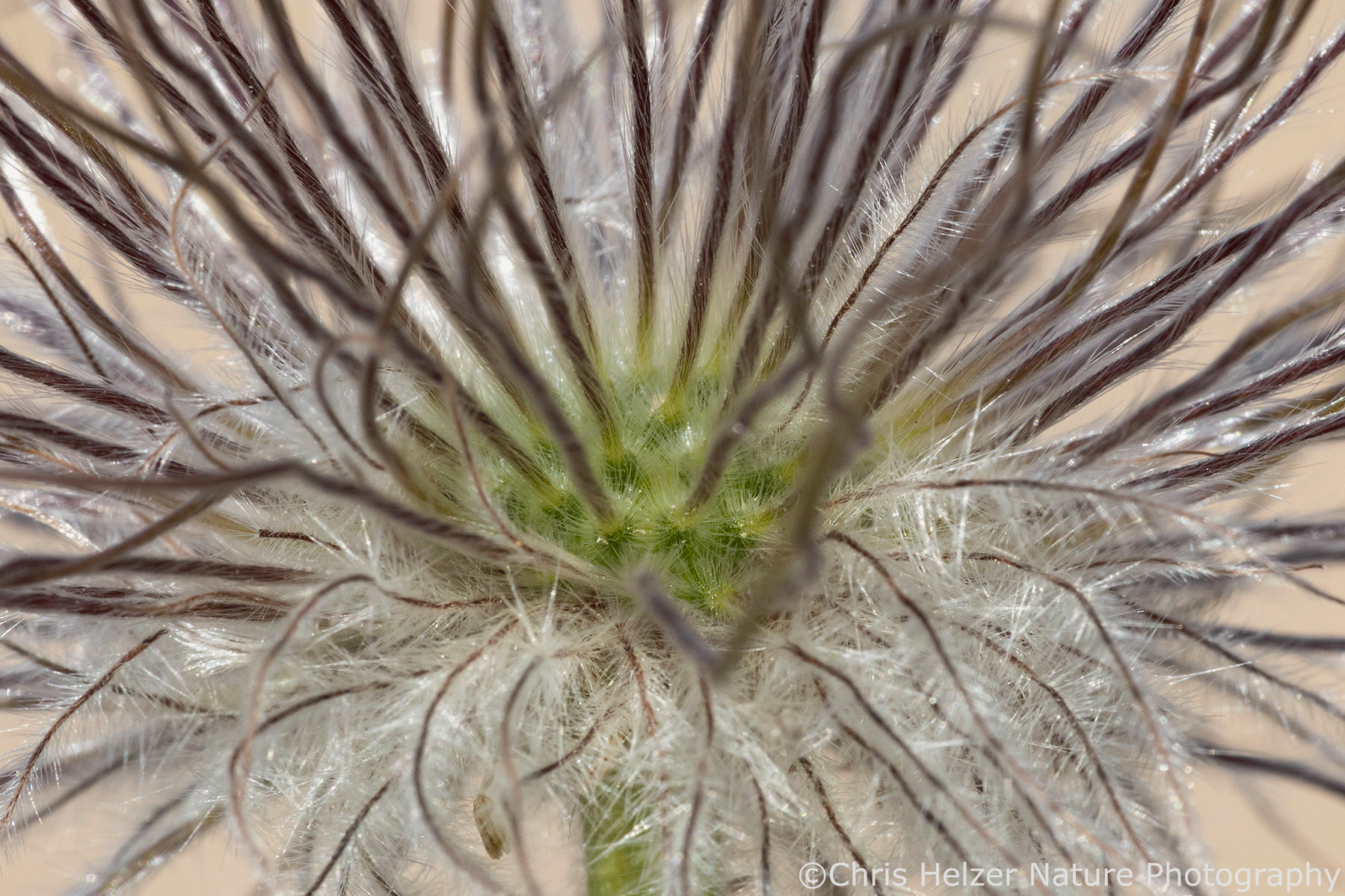
A close-up of a pasque flower seed head
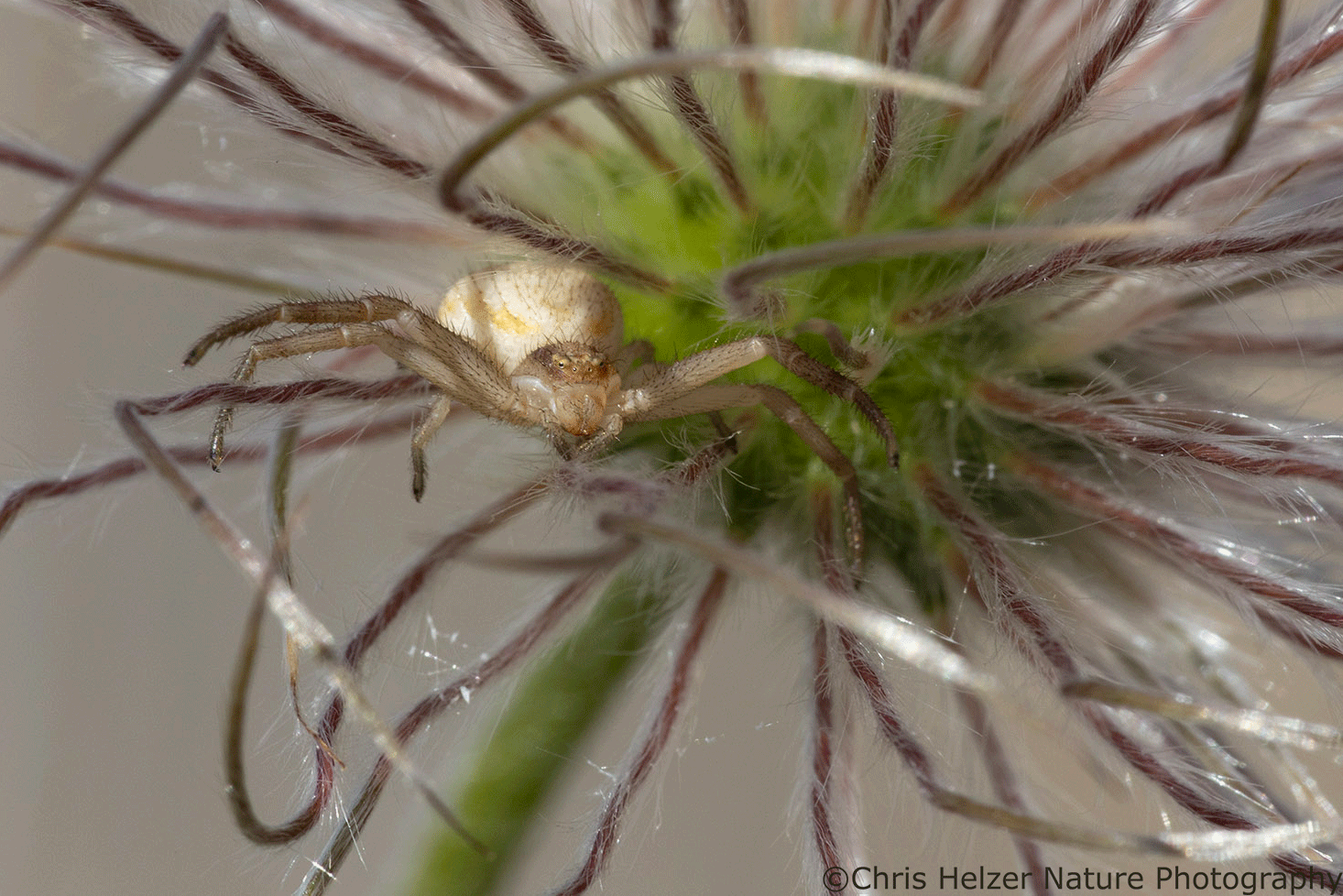
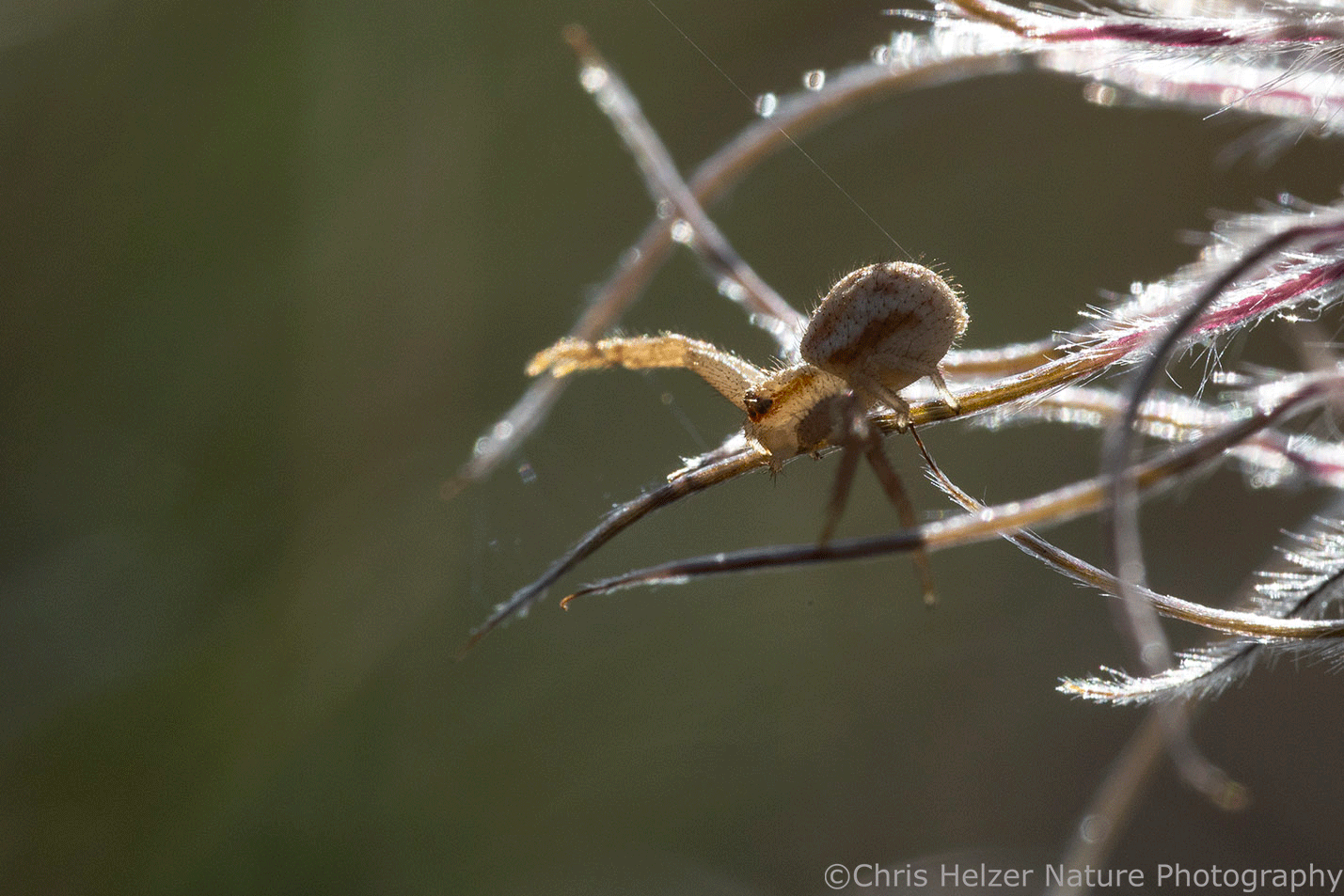
One of many crab spiders hanging out in pasque flower seed heads
A different spider on a different pasque flower
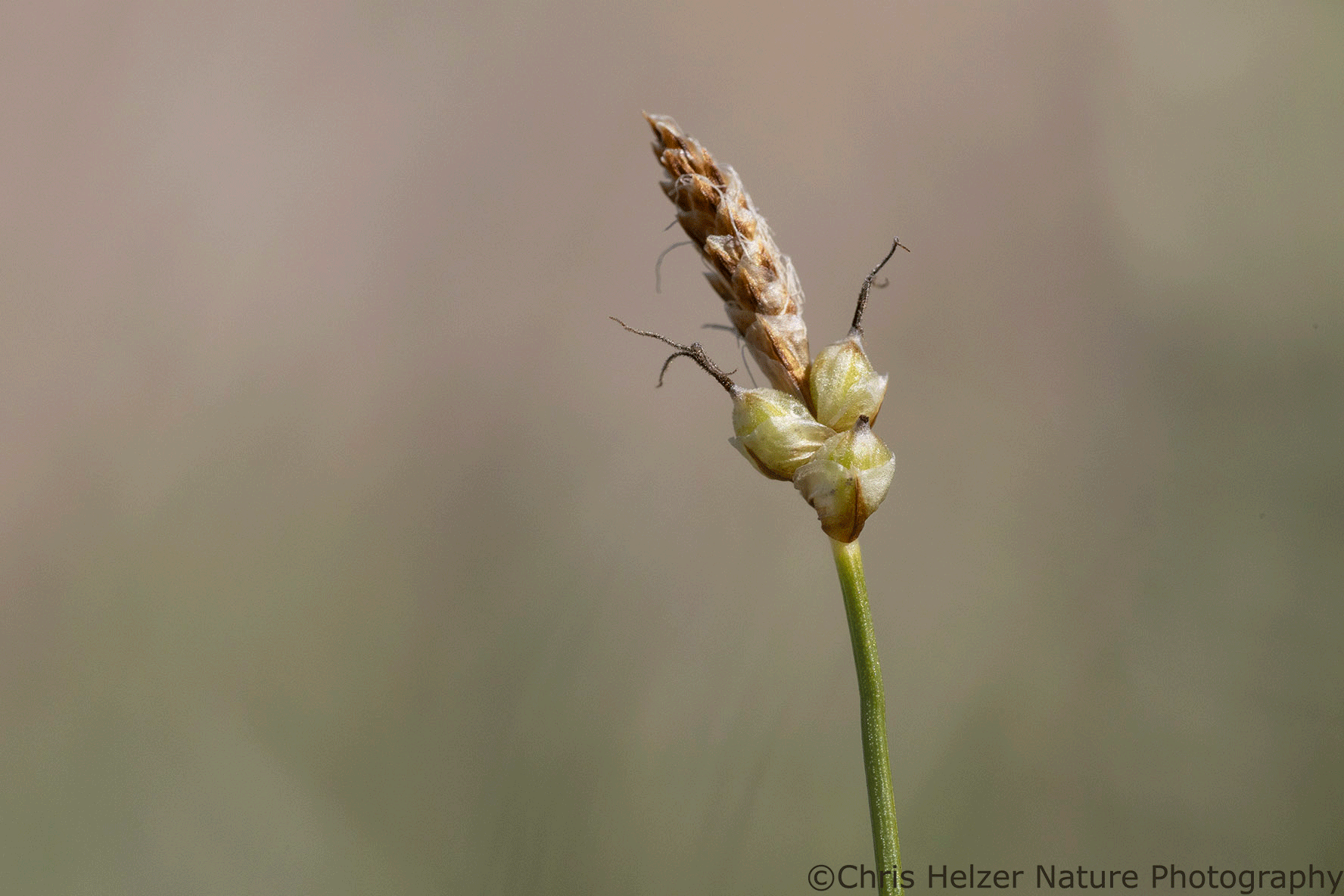
Sun sedge (Carex inops) with fruits. This sedge is one of the most abundant plants at the Niobrara Valley Preserve.
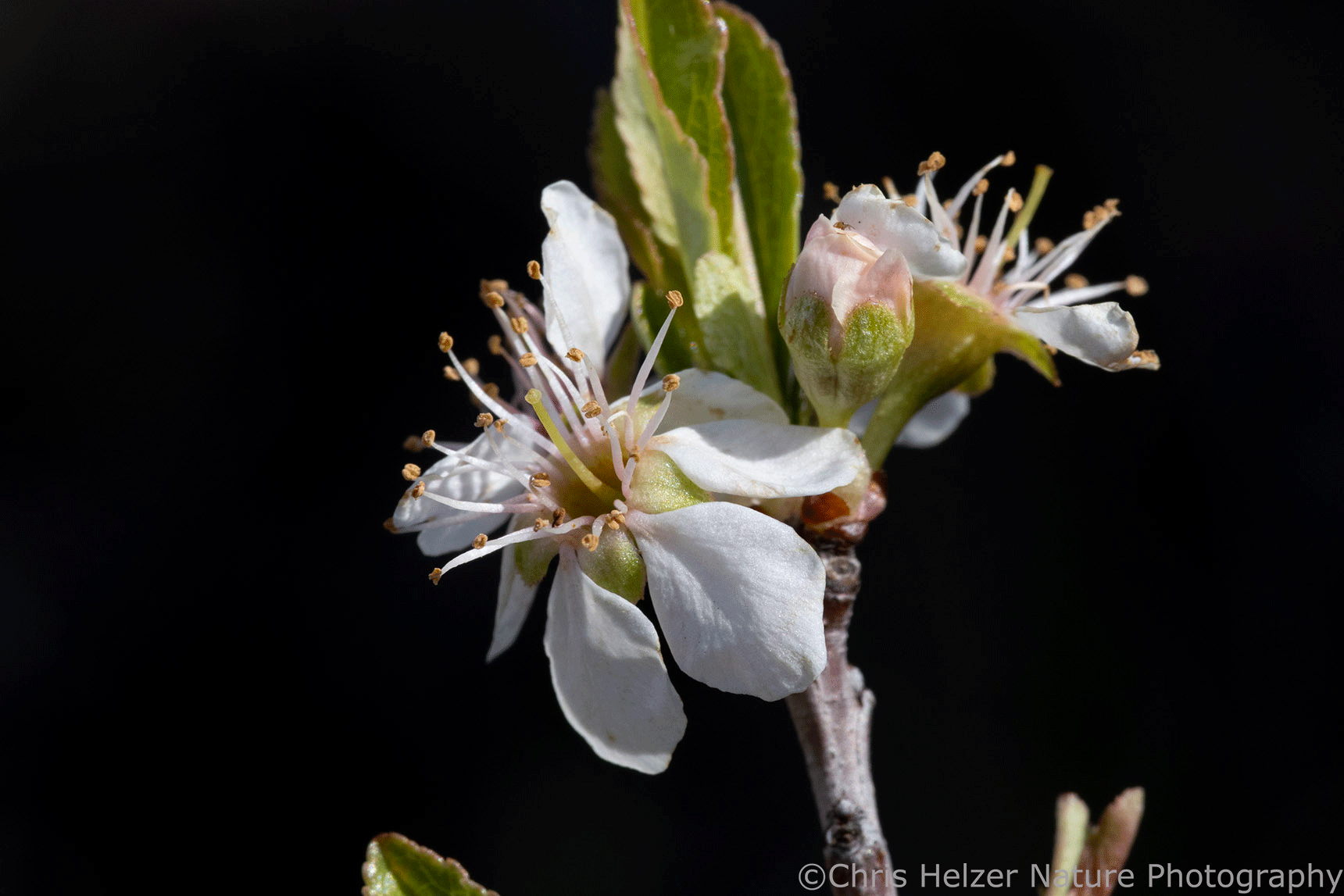
Sand cherry (Prunus pumila)
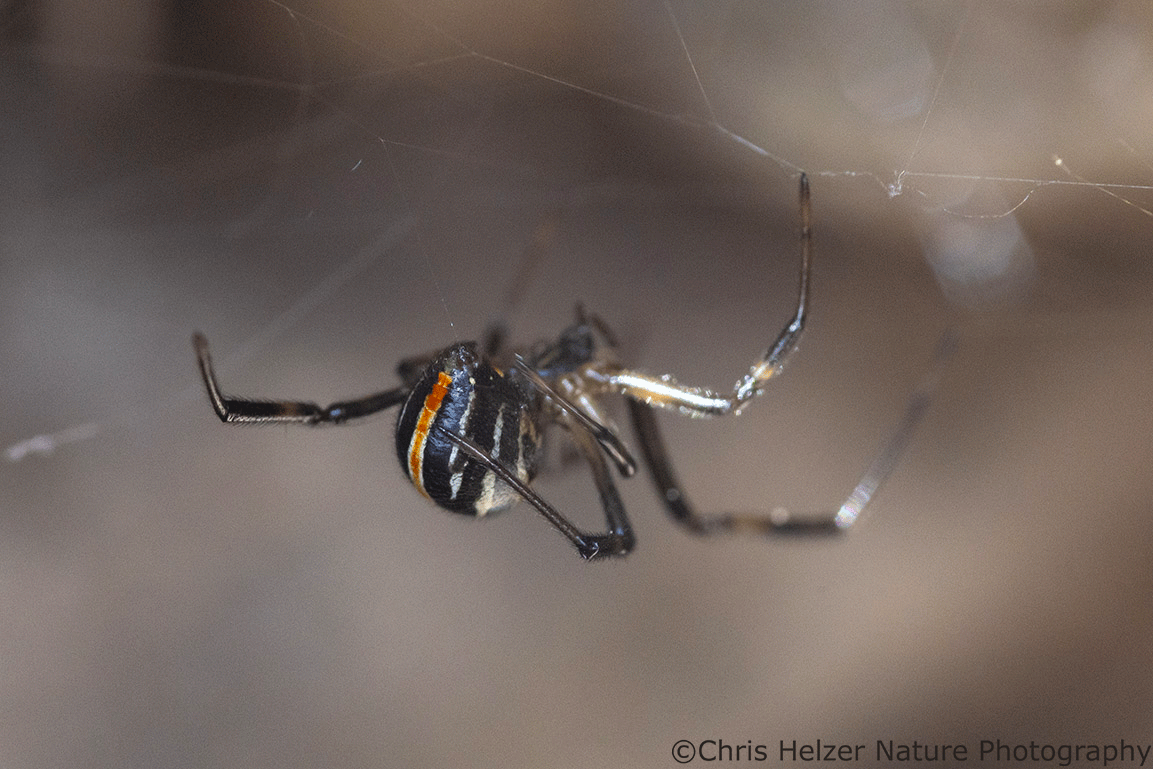
A juvenile female black widow spider on her web in an abandoned prairie dog burrow.
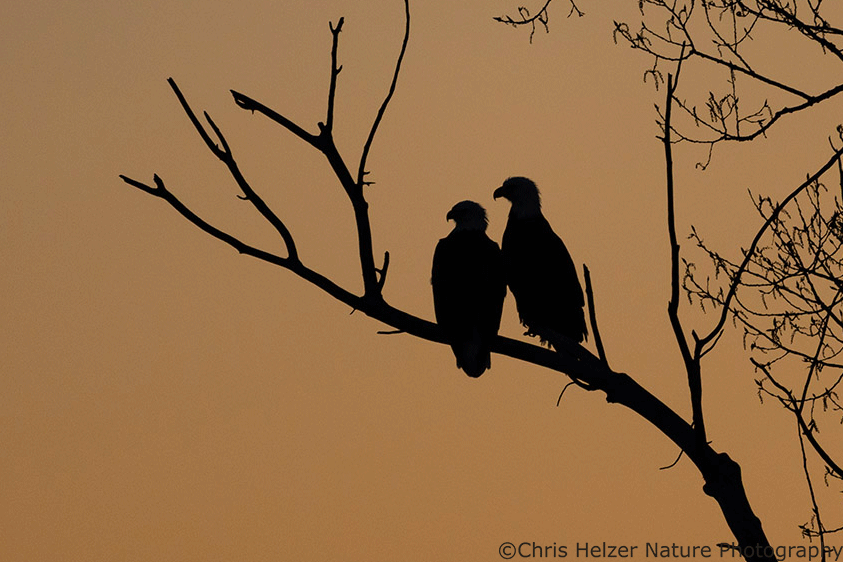
A pair of bald eagles sitting together at sunrise

Finally, as promised, here are some bingo cards you can print out or otherwise utilize to add a little extra fun to your prairie explorations this summer. Each card has the same squares/items, but in different orders/locations. Enjoy!

Perspectives of the Prairie: Amanda Hefner

Hi everyone.  The following blog post is written by 2024 Hubbard Fellow Claire Morrical.  Claire put together a fantastic series of interviews with people working in conservation here in Nebraska and we thought you’d enjoy reading and listening to their stories. 

This project – Perspectives of the Prairie – uses interviews and maps to share the perspectives and stories of people, from ecologists to volunteers, on the prairie. You can check out the full project HERE.

This post also contains audio clips. You can find the text from this blog post with audio transcripts HERE. If you’re reading this post in your email and the audio clips don’t work, click on the title of the post to open it online.


Amanda spent her 20’s at Niobrara Valley Preserve and was strongly shaped by the preserve and its communities. Amanda and I chatted as she baked a loaf of beer bread. She shared how the 2012 wildfire brought her to NVP, her experience telling the story of two long-time employees at the preserve and discussed the importance of community to herself and the Niobrara River Valley. Today Amanda works with at Rowe Sanctuary with the Audubon Society.

Interview: December 14th, 2024

Part 1: Meet Amanda

Location: Crew Quarters at Niobrara Valley Preserve

This is Amanda Hefner, baking bread in the kitchen of the Niobrara Valley Preserve crew quarters.

A year ago, Amanda would have been at the Niobrara Valley Preserve as an employee. Today, she’s a visitor and a volunteer. Visiting a recent burn, providing her fellow volunteer (who is painting stories from preserve) with moral support, and chatting with me about her time at Niobrara Valley Preserve.


Part 2: In the Aftermath of Wildfires

Location: The North Ridge at Niobrara Valley Preserve

The catalyst for Amanda’s arrival at Niobrara Valley Preserve was the 2012 wildfire (listen to Neil Dankert’s perspective of the wildfire in “Neil Dankert 3: Fire on the ridgetop“). The fire was one of several major wildfires across Nebraska that year, and burned a total of 74,000 acres, including part of NVP.

Notes for Context: Although native to Nebraska, eastern red cedars can be a little … overzealous. If left un-managed, they can grow into dense woodlands, choking out grassland species and other native trees and shrubs. We often rely on regular fires, which can kill small enough cedars, as a tool to manage eastern red cedars. Learn more HERE.

  • Regeneration: recovery of an ecosystem or a population within an ecosystem
A photo of Niobrara Valley Preserve from the north ridge after the burn (photo: Chris Helzer)

You can learn more about 2012 fire and the prescribed fire in 2023 HERE.

There is a consequence to every choice that a land manager makes, in addition to the consequences of events out of their control. For every fire, there are questions like “how intense is too intense, or not intense enough?” “Will this create opportunities for species we want to encourage or species we want to deter?” Oftentimes, every problem that is addressed means another problem has to be accepted as it is or as a result.


Part 3: Telling the Story of a Friendship

Location: The East Bison Pasture at Niobrara Valley Preserve

For as long as Amanda has been there, the people on the Preserve and the community in the Sandhills have been a key part of Amanda’s life. The significance of their experiences drew Amanda to storytelling early on.

Notes for Context: Mike Forsberg and Mike Farrell tells stories of ecology and history on the Platte River through their Platte Basin Timelapse Project, a collection of stories, films, and photography.

Amanda and Doug at Niobrara Valley Preserve (photo: Chris Helzer)

Amanda doesn’t tell all of Doug and Rich’s wild stories, but you can get a sense of their friendship through Amanda’s video, linked HERE.

It’s easy to see the community that Amanda has amassed around her, and the ways in which it ties her to the valley. Earlier that year, Amanda had organized a kayaking trip down the Niobrara River. Our outfitter was Scott Egelhof, Richard’s brother, and an old friend of Amanda’s. It was a joy to watch Scott and Amanda catch up and banter, as Scott lamented her departure from the Nebraska Sandhills.

Amanda reflects on how relationships like these shaped her.

Richard Egelhoff at an NVP bison roundup (photo: Chris Helzer)

Part 4: No Dam on the Niobrara River

Location: The intended dam location on the Niobrara River

Amanda and I also talked about the history of the Niobrara River Valley, and the importance of the river to its ecology, the community, and herself.

Notes for Context: Be careful not to confuse the Niobrara Valley with the Niobrara Valley Preserve. The river valley extends beyond the boundaries of our preserve, and is part of a quilt of preserves, parks, and ranches along the Niobrara River, with the diverse array of ecosystems that Amanda shares with us.

The distance that Amanda describes, from the preserve headquarters to Smith Falls measures to about 18 miles of riverfront.

Amanda shared a lot of different ecosystems with us. Let’s take a moment to learn about them:

(While the Niobrara dam was never built, the surveys done in preparation for the dam include a wealth of information. Brandon shares this in “Brandon Cobb 5: Cultural surveys with Stacy Laravie“)

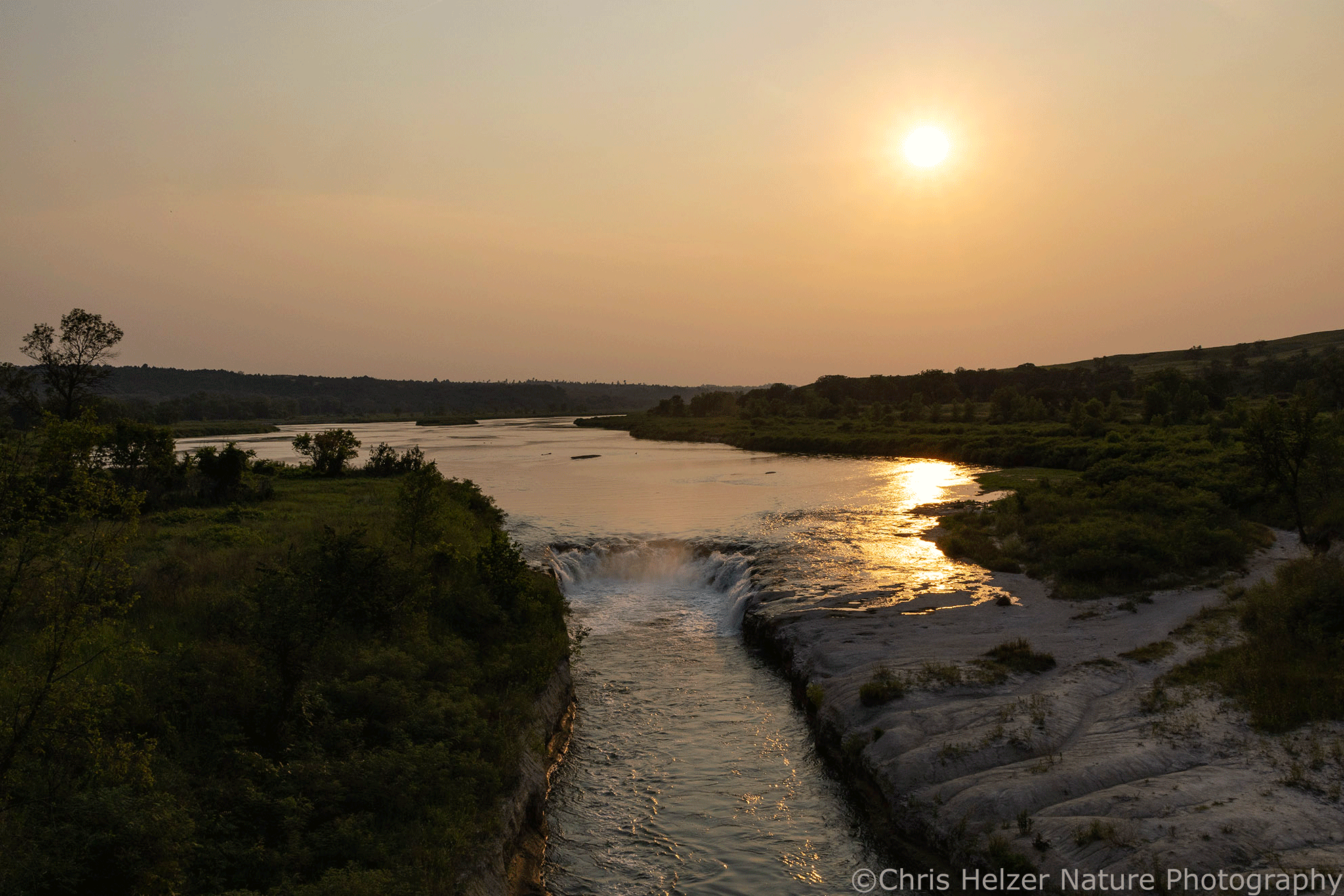
The Niobrara River at sunrise (photo: Chris Helzer)

Amanda is open about her deep love for the Sandhills and the Niobrara River Valley. It’s something that emanates off of her, when she describes the landscape, when she tells stories of other employees and friends.

She values this love and this openness and relies on it in her outreach work, to form meaningful connections with others.


Part 5: Giving Back Buffalo

Location: The West Bison Pasture Corral at Niobrara Valley Preserve

The bread is done and cooling on the counter.

Amanda with her loaf of beer bread

Amanda relays one more story about connections in conservation, through bison returns with the Intertribal Buffalo Council.

Notes for context:

Bison round up at The Nature Conservancy’s Niobrara Valley Preserve (photo: Chris Helzer)