
Hubbard Fellowship Blog – Mummy Wasp!

The following post was written by Evan Barrientos, of our two Hubbard Fellows for this year.  Evan is a talented writer and photographer, and while you’ll get the chance to see some of his work here during the next year, I also encourage you to check out his personal blog.

How many naturalists does it take to spot a parasitoid? In this case, two. While we were harvesting seeds in a wet prairie, Chris spotted this caterpillar. He noted that it seemed to be mimicking horsetail (Equisteum sp.), a very common wetland plant, for camouflage. That was a really interesting idea, but it turns out be far from the truth, and you’ll soon see why.

06242015_nebraska_9233_combined

At first it seemed that this caterpillar was mimicking horsetail (Equisteum sp.), but can you spot the real culprit of this caterpillar’s odd appearance?

Upon a closer look, I noticed that the caterpillar was honeycombed with holes. This  caterpillar wasn’t using camouflage; it had been parasitized! Did you know that there are forty to fifty thousand species of wasps so small that they are almost invisible to the naked eye? They are called Braconid wasps, and they have a fascinating life cycle. Nearly all Braconids lay their eggs on or inside another insect (called a host), which are often caterpillars. After the eggs hatch, the wasp larvae eat the host’s insides, pupate (turn into adults) inside the body, and chew their way out as full grown wasps! Insects that do this are called parasitoids. While I was taking photos of the dead caterpillar, Chris made an even better observation: there was one last wasp still emerging from it!!!

06242015_nebraska_9432

A Braconid wasp emerges from its caterpillar host. Keep reading to learn exactly what species they are.

It was awesome to witness and document a Brachonid wasp in action, but I wanted to go further: I wanted to know what species these two insects were. As a naturalist, I love learning about tiny and obscure organisms like this wasp. It just blows my mind that so much information exists about such unappreciated species if you can only identify them. When you learn a species’s name, it goes from a speck to an encyclopedia. So I posted this photo to Bugguide.net and an incredible entomologist (insect scientist) suggested that this might be a Stigmata Mummy Wasp (Aleiodes stigmator) feeding on a Cattail Caterpillar (Simyra insularis). I did a little more research and found this publication on Aleiodes wasps. I learned that as Aleiodes larva go about eating their host, they line the caterpillar’s insides with a light silk. Eventually, the caterpillar dies and shrivels up, which is why the wasps are called “mummy wasps.” Aleiodes larvae chew a hole through their host and secrete a substance that glues it in place while they finish eating and pupating. Eventually, they chew their way out of the host and emerge as adult wasps.  If this all sounds gross to you, at least consider that mummy wasps and countless other Brachonids are important pest predators. Mummy wasps help keep gypsy moth and tent caterpillars in check, and several species of parasitoid wasps are sold to protect crops ranging from corn to tomatoes.

It turns out that each Aleiodes species makes a unique mummy. I went through the pictures in the publication I was reading and found one mummy that closely resembled my specimen (described as “appearing as though pelted evenly by shotgun pellets”). Sure enough, the guide listed the wasp as Aleiodes stigmator and the caterpillar as Simyra insularis! From there I learned that A. stigmator is the oldest known Aleiodes in North America and was discovered by the first American entomologist, Thomas Say, in 1824. Say thought the wasps’ exit holes looked like stigmata in the hands and feet of Christ, and so named the species “stigmator.” Despite having been discovered long ago, this species has never been carefully studied and many basic facts about it are still unknown.

06242015_nebraska_9392

When you look at the holes in this caterpillar, do you think of the stigmata on the hands and feet of Christ? I sure didn’t, but the entomologist who discovered this wasp somehow did.

I don’t know what’s more amazing, wasps that eat their way out of caterpillars or people who can identify them from a single photo.  It never ceases to astound me how every living speck of an organism has such an interesting story behind it. This process of stumbling upon mysteries and discovering their secrets is a large part of what drives me to spend so much time exploring nature. There’s just so much coolness out there!
Hubbard Fellowship Blog – Up and Down the River

This post is written by Kim Tri, one of our two Hubbard Fellows for this year.  Kim is an excellent artist, as well as an ecologist, writer, and land steward.  You can look forward to seeing more of her writing and artworks soon.

Sometimes, I have to remind myself that it’s in the name: Platte River Prairies, the collection of lands that we conserve.  They are strung out and fragmented, but the Platte is what unifies them.

f

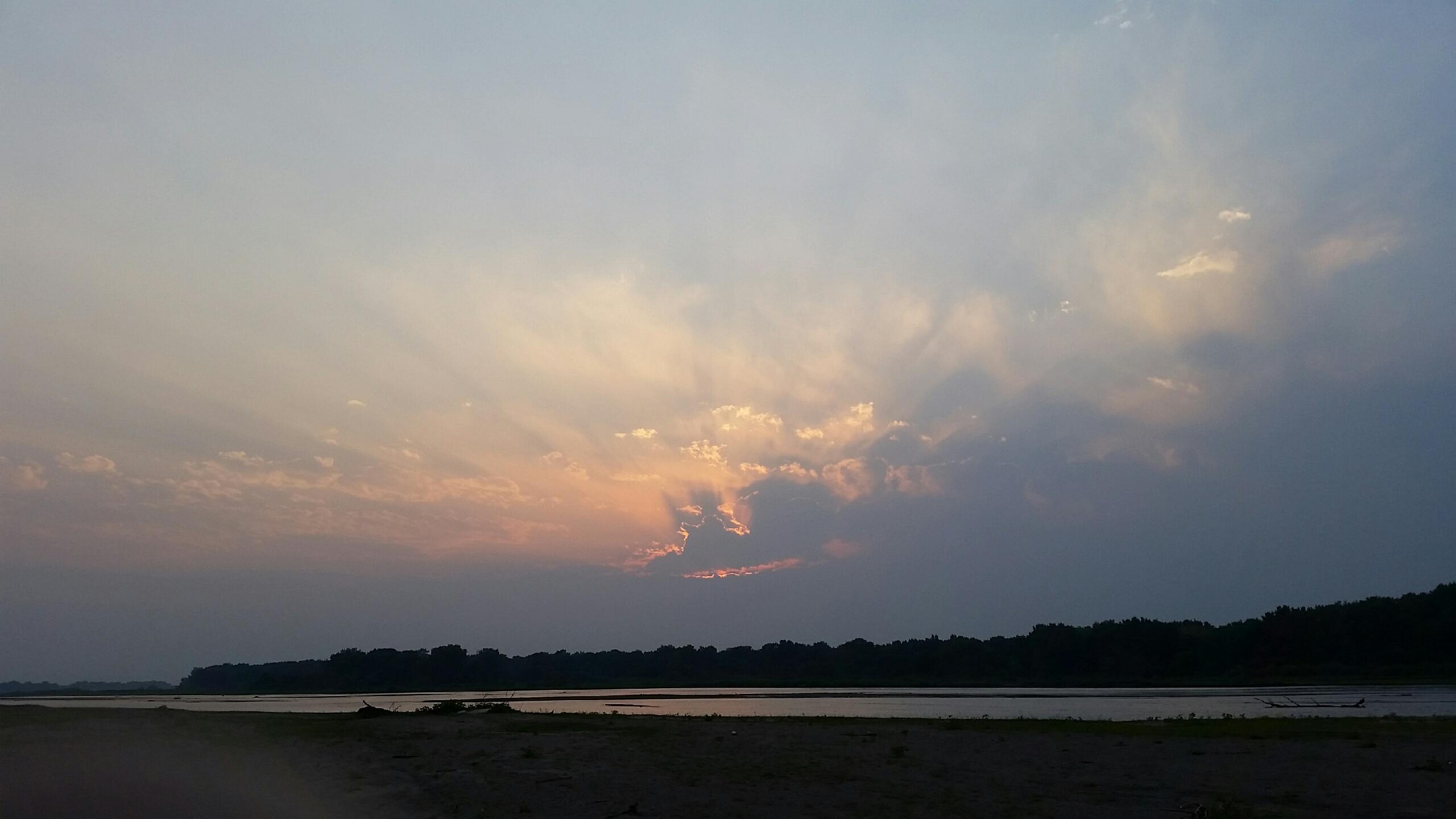
The Platte River at sunset.  Photo by Pat Lundahl

It can be hard to see it sometimes.  The river, altered as it is, follows its own sinuous course, dictated by geology, varying flow rates, and other natural vagaries.  However, the roads we travel to reach our properties along the river follow man-made lines.  Though the river laid down their sandy grades long ago, the roads were built on section lines and survey coordinates, east-west, north-south.  (The exceptions in this area are Interstate 80 and the Lincoln highway, which roughly follow the river and the 19th century Mormon Trail.)  Trying to follow the Platte along the county roads from one property to another involves a confusing handful of miles of zig-and-zag.  These miles take long enough to travel on an ATV that it is easy to lose track of the river and the relative position of different tracts of land in this maze of right angles.

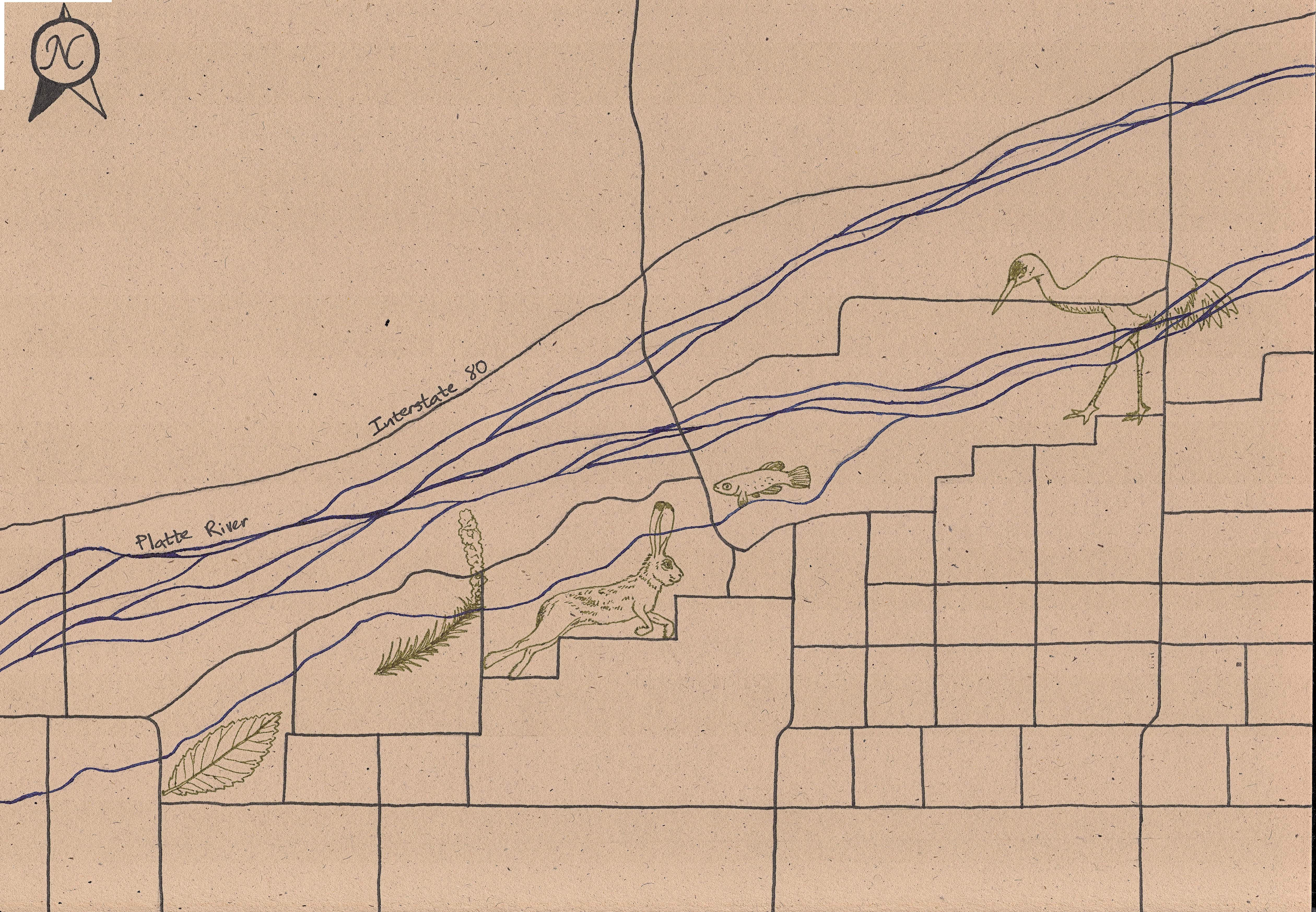
So, to keep myself straight, I build a mental map of the different disconnected pieces of land, re-centered along the river which ties them all together.  It’s not very precise—there are no exact boundary lines and the distances are all approximate, but it helps me visualize the big picture.

g

My mental map of the Platte River Prairies on paper. It covers roughly 14 miles west to east, with the river represented in blue, the roads in black, and collections of our properties in green symbols, which represent unique aspects of these properties. From left to right, the symbols are: Siberian elm leaf (invasive), tall gayfeather, black-tailed jackrabbit, plains topminnow, and sandhill crane. Map by Kim Tri.

Allow me to explain the map briefly.  I chose to represent our properties, or collections of them, with symbols highlighting unique character aspects of the land tracts, rather than exact boundary lines, which aren’t really a part of my mental map.  I’ll explain them from west to east.

Sometimes I think of the Bombeck property as Siberia, because it is way out there and has our worst Siberian elm (a non-native tree) invasion, which I’ve represented with a Siberian elm leaf.  To the east of that is the Miller/Uridil complex, which is represented by a tall gayfeather, since one of the Uridil prairies has an abundance of gayfeather flowers.  The black-tailed jackrabbit to the east of that covers the Derr and Suck properties, since that is almost exclusively where I see jackrabbits when they aren’t dashing across the road between cornfields.  The plains topminnow on the right represents or Sandpit wetland restoration, a restored stream channel that serves as habitat for native (and non-native) fish.  The last symbol to the east is a Sandhill crane, representing the Studnicka and Caveny properties, located next to the Crane Trust, and where we view cranes on their migration stopover on the Platte.

This map gives me a perspective that helps me make sense of the everyday, the right and left turns chasing the treeline that marks the river.  It helps me to see that while our properties may have edges defined by man, the boundaries within which we work are defined by a natural watershed.  And though our lands may not all be connected by land, they are still connected by the Platte.  The water that flows through the Kelly tract—two hours to the west—also flows past the Rulo property along the Missouri river, below the confluence of the two great rivers.

Photo by Pat Lundahl.

Great blue heron and shorebird tracks along a sandbar.  Photo by Pat Lundahl.

The Platte provides the focus of life here.  It feeds the groundwater which fills our wetlands, spawning frogs and toads, watering the sedges and rushes.  It draws much of the wildlife to its banks.  A walk along the river last weekend yielded the tracks of raccoon, deer, bobcat, and otter mixed in with those of the shorebirds.  Here and there were dotted the massive prints of a great blue heron.  In the spring, the sandhill cranes will blot them all out.  We are working to preserve all of this, as well as the tallgrass prairie which the river feeds, and which we walk every day.