
Hubbard Fellowship Blog – Alex’s Bittersweet Relationship With Trees

This post was written by Alex Brechbill, one of our Hubbard Conservation Fellows.  Alex hails from right here in Aurora, Nebraska.  He has worked both in the policy arena and deep in the wilderness, and so brings a broad perspective to his thinking about conservation.  You’ll hear much more from him during the coming year.

I must come clean before diving into this article: I love trees. Trees are one of my favorite things in the world. From the towering conifers of the Pacific Northwest to the vast overwhelming deciduous canopy in the Shenandoah Valley. So long as I have two boots on my feet and passion in my heart, I will always love trees. Out of all trees, I especially love (brace yourself, fellow prairie-folk) the eastern redcedar.
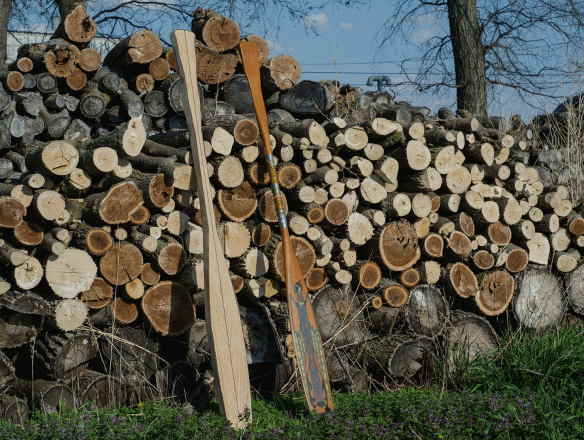
Rough profile of my new Siberian elm canoe paddle, adjacent to the retired Western redcedar paddle. Photo by Alex Brechbill

I love cedars, largely because of the time I spent up North, in Minnesota, on the water. The first canoeing paddle I carved was from a slab of western redcedar. I cut the profile with a bandsaw and spoke-shaved the shaft, throat, and blade, leaving the finesse of the handle to fine grit sandpaper. Walking into the woodshop, the pungent aroma of cedar fills the air. As someone who enjoys woodworking, there are few things as visually appealing as the aesthetic of a golden, polished cedar-strip canoe. At times I’m a little embarrassed at how much time I spend ogling canoes on the Internet. From the bow to the stern, they are charming and iconic. While camping, I spent hours sitting by the warmth of glowing hot firepit, from freshly split cedar. Even on a soaking wet, bitter-cold day, cedar will burn well. There is a reason that the cedar was known as the tree of life.

Redcedar invokes all five senses; from smelling it to feeling the warmth of a fire. However, seeing thickets of trees, cedar or otherwise, on the prairie is jarring. A majority of the land stewardship time I have spent so far in the fellowship has been dedicated to removing woody invasive plants: Eastern redcedar, Siberian elm, mulberry, and several others. Cutting down trees is bittersweet. I have an immense respect for trees as organisms, and each time I cut one down I have to remember why I am cutting it down: we will lose our prairies if we don’t do anything about encroaching woodlands.

Encroaching trees limit the ability of some plants to establish themselves, and they will choke other plants out. Trees decrease the amount of forage that can be produced on a prairie for grazing. I could go on, but the bottom line is that trees can be harmful to prairies. On the other hand, there are certainly places for them. Along stream banks, as shade trees, and in shelterbelts, trees can be very helpful for people and livestock. I love both trees and prairies, but not when they form a Venn-diagram.
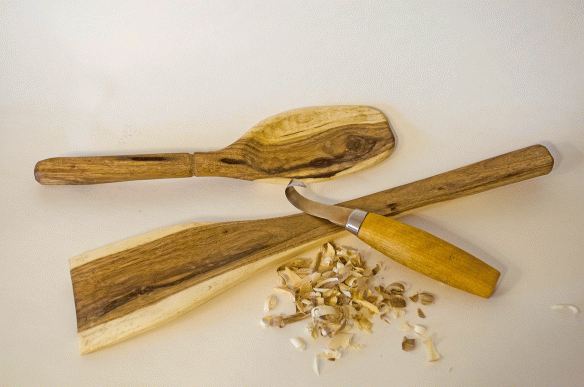
Black walnut spatula and serving spoon next to a pile of woodchips and a hooked knife. Photo by Alex Brechbill

Not only do we improve the quality of our prairies by removing invasive trees, we can also glean valuable products from their wood. Firewood is the first product that comes to mind. Sitting next to my fireplace on a cool night is one of my favorite ways to end the day, relaxing in the dry heat of the seasoned firewood. Milling logs into dimensional lumber is another great way to utilize problem trees. Sawing dimensional lumber is like breaking open a geode, the rugged exterior concealing a center of splendor. The freshly exposed grain of the wood is captivating, and it’s easy to get lost in the curvilinear waves flowing through the heartwood and sapwood. Currently, I am carving a flatwater canoeing paddle out of a milled slab of Siberian elm, another problem tree that we spend hours removing. I spend my evenings whittling black walnut, with its gorgeous dark heartwood, and cottonwood, which cuts like butter under the bevel of freshly honed edge.

A redcedar slab that is destined to be an end table. Photo by Alex Brechbill

For utility and beauty, trees give us a lot, whether they are the subject of a photo or some shade for a picnic. Unfortunately, as much as they give us, they can take a lot away from us, and if that means taking away our prairies, I better sharpen my saw and get back to work.

Hubbard Fellowship Post – Mixed-Up Flickers

This post is written by Olivia Schouten, one of our Hubbard Conservation Fellows.  Olivia hails from Pella, Iowa, and has strong experience in prairie ecology.  Look for more posts from her, as well as our other Fellow, Alex Brechbill, in coming months.

One of my favorite things about the change from winter to spring is the return of migratory birds. While the rest of spring has been reluctant to arrive, I am still reminded of the inevitable change in season as more and more birds arrive in the area. What started with sandhill cranes back in February just continues as killdeer, turkey vultures, and swallows, among others, seem to appear overnight when a favorable wind blows from the south.

Among the new arrivals are northern flickers, a woodpecker that despite its name, tends to feed on the ground. This migratory bird arrived here on the Platte River quite suddenly over Easter weekend, and they’ve been everywhere ever since! While common across North America, if you’ve spent any time travelling and recognize this bird, you may have noticed something interesting: birds in the eastern half of the continent are not the same color as those in the west.

In fact, there are two color variants of northern flickers. Eastern birds are called yellow-shafted flickers, and those in the west are red-shafted. The ‘yellow/red-shafted’ designation refers to the unusual coloration on the shafts of the wing and tail feathers of this bird. Where most birds’ feathers either have white, brown, or black shafts, northern flickers’ are bright yellow or salmon-red, depending on the variant. The undersides of these feathers also display the same color, resulting in bright flashes of color when the birds fly, turning a somewhat drab bird into something spectacular.

There are some other differences between the eastern and western variants. Yellow-shafted birds have a red crescent on the nape of their neck, and while all males have a ‘mustache’ patch of feathers extending down their cheek, it is black in yellow-shafted males, and red in red-shafted males. These differences are so clear, that for many years the two variants were considered different species.

This red-shafted flicker displays the red mustache sported by the males of this species.  Photo by Chris Helzer

In contrast, yellow-shafted northern flickers have a red crescent at the nape of their neck, and the male’s mustache is black. All flickers have a bold black crescent across their chest. Photo by Olivia Schouten

Though overall drab in appearance, northern flickers flash bright yellow or red when in flight. This yellow-shafted male followed around the female at the left of the photo for several minutes. Notice the female is missing the mustache of the males. Photo by Olivia Schouten

However, what complicated that classification was the presence of hybrids of the two variants in a large zone stretching from Texas to Alaska, cutting right through the heart of the Great Plains, including central Nebraska. These hybrids, called intergrades, display combinations of facial traits found in the red- and yellow-shafted variants. In my home state of Iowa all you will see are yellow-shafted flickers. However, here in Nebraska I see flickers with their wings flashing everything from yellow to dark salmon red, and all colors in between.

Though I couldn’t get a clear picture of this bird in flight, it is still clear that the wings of this bird grade from yellow to orange. While the facial markings of this flicker suggest it is a yellow-shafted variant, the coloration of the wings point to it being an intergrade, the result of the hybridization of a yellow-shafted and red-shafted variant. Photo by Olivia Schouten

Now considered one species, northern flickers are just one example of a common trend seen among North American birds. If you flip through a bird field guide and study the range maps, you will often find pairs of similar species where one occurs in the east, and one in the west, with the transition between the two occurring right down the middle of the continent. Eastern screech-owls and western screech-owls, ruby-throated hummingbirds and black-chinned hummingbirds, eastern and western wood-pewees, eastern and western meadowlarks, vireos, bluebirds, warblers, and on and on and on, you can’t escape the pattern. For many, it’s as if there was an invisible wall through Oklahoma, Nebraska, South Dakota, and upward keeping these species from spreading any further.

Clearly, something is going on in the middle of the continent when it comes to birds, and this hybridization sometimes makes it difficult for ornithologists to determine where species begin and end, or whether they should even be considered different species at all. One of the leading hypotheses is that climactic changes during past ice ages created unsuitable habitat in the center of the continent that separated previously connected populations. Time allowed for the divergence of these now separate populations, and when they reconnected as the ice retreated, enough differences had accumulated that they were no longer the same species.

Of course, this divergence was carried to varying degrees of completion depending on the bird. While some of these species pairs, like flickers, hybridize quite readily, and in fact never quite diverged enough to be different species at all, others, such as meadowlarks, while nearly identical in appearance, developed different enough songs that their separation was maintained.

So pay attention to the flickers around you here in Nebraska and elsewhere along the hybrid zone, and see if you have can spot the different variants!

Though I’m not entirely sure what is happening in this photo, I believe the male flicker here was displaying its tail to the female in some sort of courtship behavior. Whatever it was doing, it made for a nice demonstration of the brightly colored feathers tucked away by this otherwise unassuming bird. Photo by Olivia Schouten