Photo of the Week – May 26, 2017

Shell leaf penstemon (Penstemon grandiflorus) is one of the showier wildflowers in the Platte River Prairies during late May and early June.  It is most often found in dry soils and where the surrounding plants aren’t overly competitive.  We often see populations increase after droughts and grazing events and then decrease again as grasses recover their vigor in subsequent years.

Shell leaf penstemon has big showy flowers that are just the right size for bumblebees, but are used by other pollinators as well.

For years now, I’ve been periodically coming across patches of shell leaf penstemon plants that have been decapitated by a rabbit or something.  That wouldn’t be surprising except that the top of the plant is usually just lying next to the plant uneaten!  There is a single angular slice in the flowering stem, usually well below the bottom-most flower, and the entire flowering stem just (apparently) falls to the side.  I’m at a loss to explain this.  I don’t know if an animal is doing this to lick the juices out of the stem for some reason?  I honestly can’t think of any other good reason for what I’m finding – not that juice licking is a very good reason…  I’d love to hear from someone who knows the answer to this.

Yesterday, Nelson (our land manager) and I were touring a colleague from Wisconsin around one of our prairies and found a patch of decapitated penstemon.  As we were discussing the mystery, Nelson grabbed one of the stems and saw what he thought might be a black stem-boring insect.  As we peeled apart the stem to see it, it turned out to be a small black wasp or bee that Nelson had apparently squished when he picked up the stem.  Before I could get a very good look, the wind blew the deceased insect off the stem and down into the grass at our feet.  I didn’t worry too much about it, but as we continued to peel open the stem, I wished I’d tried to recover the insect.

Here is the detached flowering stem Nelson picked up.

The penstemon stem was stuffed full of flies.  Flies of all shapes and colors.  There were more than 20 of them, separated intermittently by wads of dried plant material.  Based on what we found, I guessed the insect we saw, and then lost, must have been a wasp and that it was laying eggs in the stem and provisioning them with flies.  I took the stem home to photograph it and then sent the photos to my friend Mike Arduser, who knows everything about bees, and an awful lot about wasps and other insects as well.

Here is a close-up photo showing the diversity and abundance of the flies jammed into the stem. I looked, but didn’t see the eggs that must have been there.

Mike said the insect was very likely a wasp in the genus Ectemnius that usually uses flies as the food source for its larvae.  They frequently excavate the pith out of twigs and other stems.  Based on the behavior of other wasps, I assume the flies were paralyzed, not dead, and that there was an egg laid with them, but I didn’t actually see any eggs.  According to Mike, Ectemnius wasps have a kind of “cuboidal” shaped head and the various species are between 6 and 14 mm in size.

I’m very certain the wasp wasn’t responsible for cutting the flowering stem off the penstemon, but it was pretty interesting to see something taking advantage of the destruction.  I didn’t see any other stems with similar nests in them, but I’ll sure keep an eye out for that in the future…

Now if I can just figure out who or what is decapitating our penstemon plants, I’ll be satisfied.  Until the next mystery comes along.

PLANT GAME RESULTS:

On the whole, you did pretty well on the plant game this week.  I tricked most of you on the first one, but the majority of you guessed correctly on the second and third questions.

On the first question, 161 people voted (as of this afternoon) and almost 50% chose Candy Lovegrass as the fake name, which is wrong – it’s a real plant.  Look it up if you like.  The actual fake name in that list was Clark’s Blisterpod, which came in 3rd at 22%.

More people (212) were bold enough to guess on the second question, and 50% of you were correct that Bully Pulpit was the fake plant.  However, about 1/3 of you guessed Beefsteak Plant, which sounds fake but is real – and invasive in at least some places/situations.

On the third question, 172 people voted, and 47% correctly identified Slipper Cherba as a fake plant name.  Autumnal Water Starwort and Beaked Ditchgrass were second and third in the voting with 25% and 21%, respectively.  I really thought more people would go for Beaked Ditchgrass, but what do I know?

Thanks for playing my goofy game.  The hardest part of putting it together is coming up with names that are weirder than the real ones…
How Small Is Too Small?

What’s the minimum effective size of a prairie?

For example, can a prairie be the size of a kitchen table?  Let’s say someone converted a landscape full of prairie to an immense gravel parking lot, leaving only a round kitchen table-sized parcel of vegetation in the middle.  Is that tiny isolated parcel a prairie?

The question might seem silly, but the question became a useful little thought experiment for me.

That little parcel certainly wouldn’t be big enough to meet the needs of most prairie animals.  Birds, small mammals, snakes, and even smaller creatures like grasshoppers and bees would be unable to find enough food to survive within that small area.  The loss of those animals would affect many of the ecological services and functions that make prairies work.  Those services include pollination, nutrient cycling, herbivory and more.

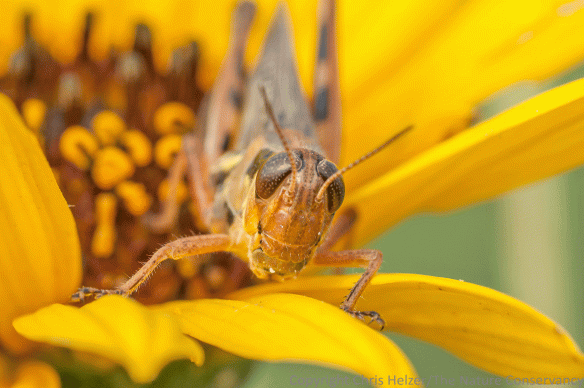
Even small creatures like grasshoppers would have a hard time surviving in a patch of plants the size of a kitchen table.

Some tiny herbivorous invertebrates might be able to survive in that little parcel of vegetation, but probably not enough of them to support most predators that feed on them.  The lack of predation would allow those invertebrate populations to grow much larger than they otherwise would, leading to significant damage, or even mortality, to the plants they feed on.  Once their food is gone, the invertebrates would starve and die as well.

Plants that manage to survive invertebrate attacks and an absence of pollinators in our little parcel would still face major challenges.  In the long-term, they would probably suffer from a huge genetic bottleneck because they don’t have other individuals of their species to cross breed with.  In the meantime, it would take a lot of intensive and thoughtful management to keep them alive.

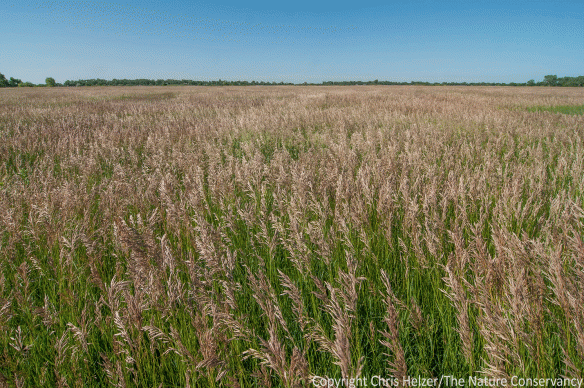
Smooth brome and other invaders can quickly dominate small prairie patches without constant vigilance and suppression.

Invasive species management would be a huge problem because it wouldn’t take long for an aggressive invader to quickly dominate that small area.  Quick action would be needed to remove invasive plants as they arrive.  Fire or mowing would also be needed to prevent a smothering thatch from accumulating as plants grow and die back each year.  Unfortunately, every fire would kill most invertebrates aboveground at the time and destroy their food sources.  We could try to burn only a portion of the parcel and save some of the insects, but with such small populations, we’d still probably lose most species eventually.  Mowing and raking might be an alternative, but we’d still end up removing either the invertebrates or their food sources.

Ok, so we’d just have to live without most prairie animals, but we’d still have plants.  Or at least a few of them.  Some of those plants would be more competitive than others, especially in an animal-less environment, so it would take a lot of effort to keep them from pushing the less competitive plants out.  And, of course, we’re assuming the mysterious belowground processes that allow plants to survive would still function in our tiny parcel – microbial relationships that allow plants to access and process water and nutrients, for example.  If those are sufficiently intact, we’d have some plants.

Would that be a prairie?

I’m pretty sure no one would argue that a kitchen table-sized area containing few plants is a prairie.  Even in the first moments after the parking lot was created, I would argue the remaining patch of vegetation had ceased to be a prairie, even though it still contained a reasonable diversity of plants and animals. It wasn’t really a prairie anymore, just a doomed fragment of its former self.

If we can agree that a kitchen tabled-size patch of land is too small, how big would we have to make that patch before we’d be willing to call it a prairie?  What species and/or ecological processes should we use as criteria?

Can we agree a prairie needs to be big enough to support a healthy pollinator community?  Does it need to be able to sustain viable populations of small mammals, snakes, leafhoppers, spiders, and other little creatures?  Is it a prairie if it doesn’t have a full complement of grassland bird species?  Does that requisite bird community include larger birds such prairie chickens or other grouse species?  What about at least moderately-sized predators such as badgers and coyotes (or even bigger ones) or large ruminants like bison or elk?  Which of those components are we willing to live without, and more importantly, which can a prairie live without and still sustain itself as an ecological system?  A prairie without badgers, coyotes or bison is functionally different than one with those animals, but is it a non-prairie or just a different kind of prairie?

Bison herds need very large prairies, but we don’t know as much about the amount of land needed to sustain populations of bees, leafhoppers, jumping mice, or even genetically viable plant populations.

Even if we reach consensus on the key components of a prairie, we’re still hamstrung by our lack of information about how big a prairie needs to be to support each of them.  We have decent data on the prairie size requirements for many grassland bird species, but beyond birds, we’re mostly just guessing.  If we want the full complement of species, including bison and other large ruminants, we’re going to need thousands of acres, but how many thousands?

More importantly, what does this mean for the many remaining patches of prairie vegetation too small to support whatever we decide are the key components of a prairie?  It certainly doesn’t make them worthless, but it might be important to make sure we’re viewing them realistically.  What are the likely ramifications of the missing components?  The absence of prairie chickens or upland sandpipers might be disappointing, but might not have the ripple effect that the absence of pollinators or coyotes might have.  Can we identify and compensate for the absence of key prairie components by managing differently or more intensively?  If not, how do we adjust our vision of the future for that prairie parcel, and how does that adjusted vision affect how much management effort we invest?  (You can read more about the challenges of managing small prairies here.)

For many of today’s small prairie patches, the only chance of preserving their species and ecological functions is to make those small patches larger and/or more connected to others.  Restoring adjacent land back to high-diversity prairie vegetation allows formerly landlocked populations to expand and interact with others, and creates enough habitat for larger animals to survive.  Identifying potential restoration opportunities might be the highest priority conservation strategy for those of us working with small prairies.

Reasonable plant diversity and the presence of larval host plants like this prairie violet have so far allowed our family prairie to support a population of regal fritillary butterflies, but the small size and isolated nature of our prairie means if the butterflies have a bad year, they could easily disappear and never return.

Our family prairie is a little over 100 acres in size, is managed with large ruminants (cattle), and has regal fritillary butterflies, coyotes, badgers, upland sandpipers, and even an occasional prairie chicken.  However, I’m certainly not comfortable that our 100 acre island within a sea of cropland will to sustain a prairie ecosystem indefinitely.  This thought experiment has forced me to think more seriously about prospects for increasing the size of our prairie and building connectivity to other grasslands.  I hope it’s useful to others as well.