
Frozen Bugs (and Beetles)

My family and I spent some time exploring the frozen pond/wetland at our prairie during the holiday break.  We even got a couple days of great ice skating weather.

My three kids had a great time ice skating on the pond over the holidays.

My kids had a great time ice skating on the pond over the holidays.

While we were on the ice, we found some great patterns (see earlier post), but we also found quite a few frozen insects.  In particular, there seemed to be two species of insects – one bug and one beetle – encased in ice.  The bug was a species of Corixidae, or water boatman.  Its name comes from the fact that two of its legs are extra long and sport hairs that make the legs look and function like the oars on a boat.  Water boatmen suck the juices from algae and plants through their long straw-like beak and are common inhabitants of just about any freshwater body around here.  They are also frequently seen in the ice when those water bodies freeze up in the winter.  Apparently, water boatmen can survive freezing and just start swimming again when the ice thaws.  A pretty neat trick for an aquatic bug that lives in a temperate climate.
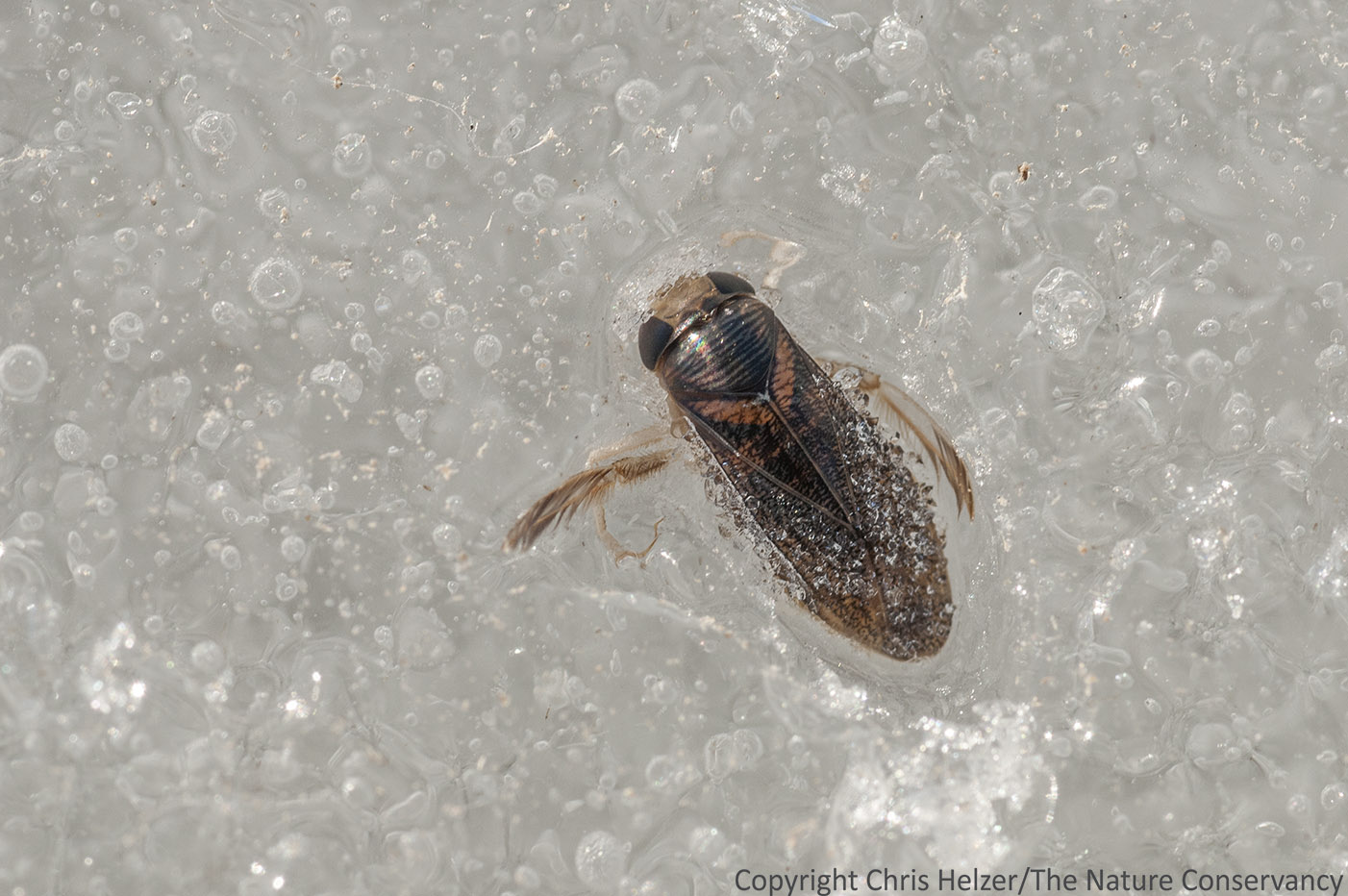
A frozen water boatman

A frozen water boatman

.

Another one

Another one

We had a two day period over the holidays during which the temperature briefly climbed up to about 60 degrees (Fahrenheit).  The warmth didn’t last long enough to spell an end to our ice skating, but did melt some of ice along the edges of the pond.  Apparently, the warm temperatures also encouraged a number of individuals of one particular beetle species to go exploring.  Unfortunately, it appears quite a few of those beetles wandered out onto the ice and didn’t make it back.  We didn’t see any of them on the ice before the warm spell, but found lots of them afterward.
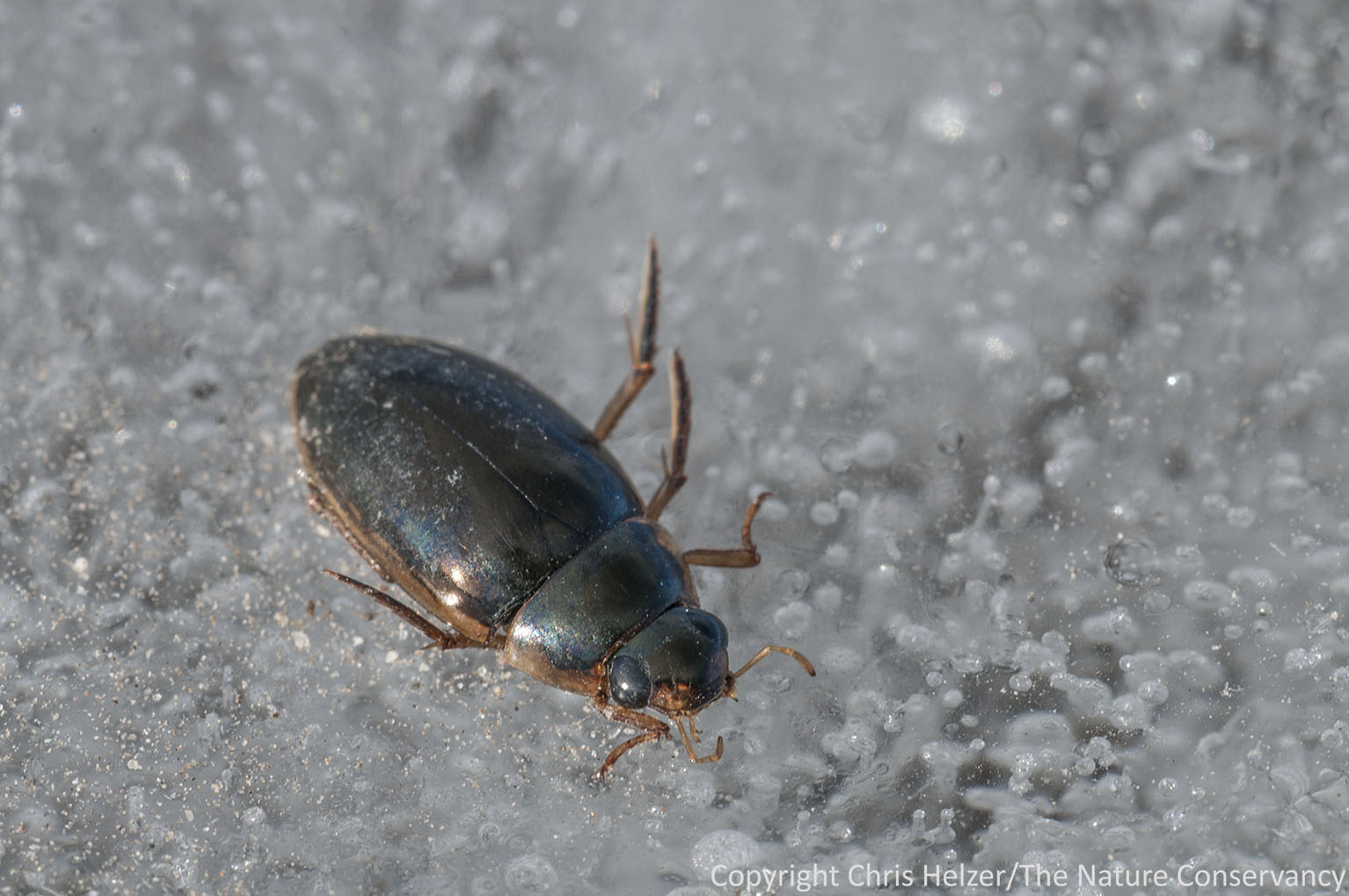
Here's one of the beetles that froze after (apparently) getting caught out on the ice after a warm day.  I'm hoping one of my entomologically-inclined friends can help me out with identification and/or natural history info?

Here’s one of the beetles that froze after (apparently) getting caught out on the ice after a warm day. I’m hoping one of my entomologically-inclined friends can help me out with identification and/or natural history info?

.

This beetle apparently got flipped over before freezing.

This beetle apparently got flipped over before freezing.

I was curious to know whether those frozen beetles could do the same thaw-out-and-re-energize trick as the water boatmen, so I broke off a chunk of ice containing a frozen beetle and brought it home to thaw it.  The beetle has been thawed out for more than a week now, and hasn’t moved, so I’m pretty sure it’s dead…  The next question is: where were those beetles staying during the very cold weather earlier this winter, and how did they prevent themselves from freezing to death then?

Always more questions…

For more information on how water boatmen and other creatures weather the winter, see this earlier post from 2011.

A Prairie Ecologist Holiday Reading List

If you’re like me, this period just before and after the New Year provides a good opportunity to enjoy some quality reading time.  Maybe you’ve already got a stack of books or list or blog posts you’re waiting to read.  If not, maybe I can help.

Here is a selection of some of my favorite blog posts from The Prairie Ecologist dating back to 2010.  If you’ve only recently found this blog, some of the older posts may be brand new to you.  If you’ve been here since the beginning, maybe these will stoke some old ideas or just be fun to read again.

For your convenience, I’ve split these into five categories: Species profiles, conservation science, prairie management, prairie restoration, and humor/photography.  If you have a favorite post that didn’t make the list, you can add it by leaving a comment below with the name or link to the post.

Species Profiles

1. One of the most viewed posts I’ve ever written was about the mutualistic relationship between the yucca plant and the yucca moth.  It is a fascinating story of interdependence in nature.

The relationship between the yucca moth and yucca plant is one of the most fascinating in nature.

The relationship between the yucca moth and yucca plant is one of the most fascinating in nature.

2.  The camouflaged inchworm is my favorite insect.  How could you not love an inchworm that camouflages itself with bits of the flowers it eats?

3. Knowing how many crazy things have to happen to pollinate milkweed flowers makes you wonder how it ever happens at all.

4. The sora is a bird that has quite a reputation for being able to hide in wetlands.  I found out one big reason it might be so good at that.

5. The lower portions of thistle flowers seem to be death traps for many insects, even while the upper portions provide a bonanza of nectar and pollen.

Conservation Science

1. Resilience is a word that gets a lot of play these days – in multiple settings.  Ecologically speaking, though, resilience may be the key to survival for ecosystems such as prairies.  Read about what defines ecological resilience and how it applies to grasslands.

2. Invasive plants are a major challenge for prairie ecologists.  We can’t stop them all, so we have to prioritize.  One big step in that process is coming to terms with the idea that not all exotic plants are invasive.

3. Conservationists are always looking for indicator species that can help us decide how our conservation work is going.  Unfortunately, I think we rely much too heavily on birds as indicators because they are really not that useful in that role – at least in prairies.

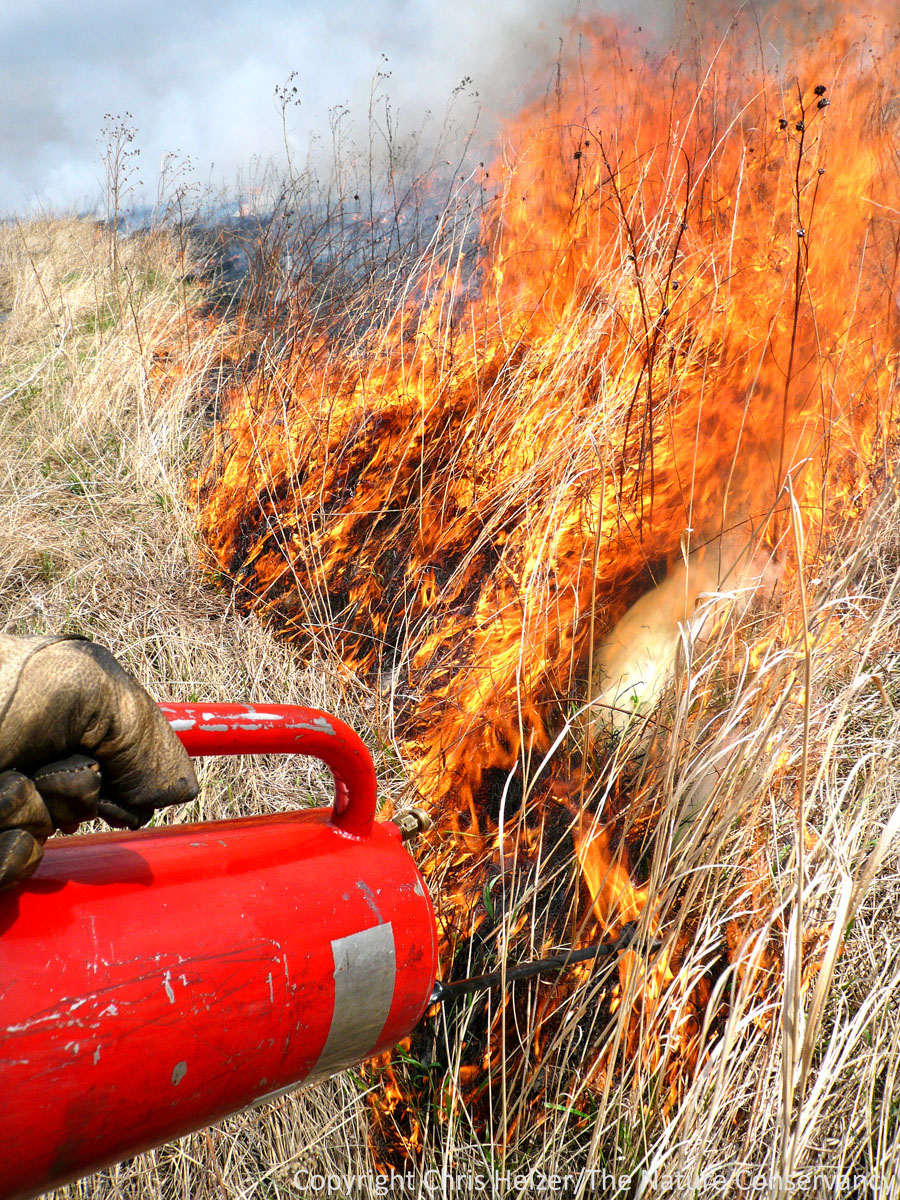
4. Prescribed fire is a very important tool for prairie conservation (as well as the conservation of many other ecosystems).  However, with all the smoke created by prairie fires, are we causing more problems than we’re solving – especially related to global warming?  When you look at the facts, the answer seems to be no.

Prescribed fire is an important prairie management tool and shouldn't be blamed for contributing to climate change.

Prescribed fire is an important prairie management tool and shouldn’t be blamed for contributing to climate change.

Prairie Management

1. Keeping prairies healthy and diverse relies on diverse management that maintains habitat and growing conditions for as many species as possible.  Unfortunately, our human nature tends to work against us sometimes, including a tendency to manage for what I call “Calendar Prairies.” 

2. Many management strategies that work well in large prairies just aren’t feasible in smaller ones.  How should we manage those small prairies?

3. Here is some fascinating evidence of the interconnectedness of prairies and impacts from management treatments that link fire, cattle, mice, and prairie clover.

Prairie Restoration

1. Too many people think of prairie restoration as recreating something that used to exist – like restoring an historic building to help preserve the past.  There is certainly value in that, but we also have the opportunity to create prairie in a way that rebuilds the ecological function of grassland landscapes.

2. Prior to writing the above essay, I laid out a more specific set of ideas about how prairie restoration can help us rebuild fragmented landscapes.

Humor/Photography

1. Many of my attempts to photograph wildlife turn out to be relatively humorous adventures.  My attempt to photograph prairie dogs not far from my house, for example, turned out to be kind of a fiasco.  A second attempt at a different location resulted in better photographs, but was also good fodder for some laughs.

2. A porcupine sitting in a short tree in beautiful evening light seems like a prime opportunity for some great photographs.  But only if the porcupine is cooperative

3. In one post, I shared some information about one of my favorite techniques for photographing small creatures in my backyard.  It requires one very important piece of equipment: a wheelbarrow.  It’s a good thing my neighbors can’t see me (I hope!).

4. We have lots of river otter use in our Platte River Prairies.  Guess how many I’ve seen?