Ambush in the Prairie

Like crocodiles in African water holes, crab spiders sit patiently on prairie flowers, waiting for prey they know will eventually come.  For crab spiders, that prey is most often an unwary pollinator looking for nectar.

A crab spider with a recently caught orange sulphur butterfly. The Nature Conservancy's Platte River Prairies.

Crab spiders are not built for speed and they have poor eyesight – even for a spider.  However, they’re well built for ambush.  Both sets of front legs are extra long, and the spider snaps them shut to catch any insect that happens to come within reach.  In addition to those legs – and a good dose of patience – some species of crab spiders can also change their color to better camouflage themselves.  They’re not quite on the level of chameleons, but over a day or so, those species can change from white to yellow – or vice versa – to match the color of the flower they’re on.

Read more about crab spiders in my NEBRASKAland magazine article here: CrabSpider-July2009 and about spiders in general in another article here:Spiders-AugSept2010.
An Inchworm in Disguise

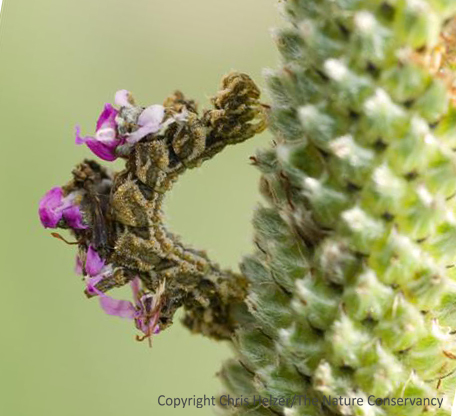
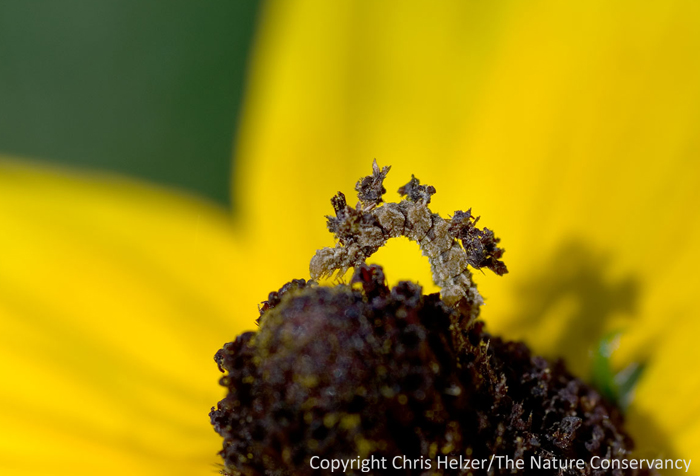
This has to be my favorite prairie insect, although there are a lot of close runners-up.  This photo is of a camouflaged looper – an inchworm that disguises itself by gluing bits of flowers to its back.  It grows up to be a cute little green moth.

A camouflaged looper caterpillar on a black-eyed susan flower. The inchworm has camouflaged itself by attaching pieces of the flower to itself.

This one (above) was on a black-eyed susan flower in one of my backyard prairie gardens.  The only reason I saw it was that it was walking across one of the flower petals.  It looked like a bit of mung, but I stopped to look more closely and figured out what it was.  It’s only the second time I’ve seen one – the last one was on purple prairie clover, and the photos I took of that one (below) showed up in a lot of places, including NEBRASKAland magazine.

Camouflaged looper on purple prairie clover.

As far as I’m aware, the decorator crab is the only other invertebrate that attaches pieces of its environment to itself for camouflage – though some others, like caddisfly larvae construct protective cases that incorporate pebbles etc.  Not only does the looper create its own camouflage, it also refreshes it by replacing withered pieces with fresh over time.  When the caterpillar starts feeding on a different species of flower, it replaces its whole costume to match.  If you’re interested, there’s a short and interesting research paper from the late 1970’s by Miklos Treiber describing this process.

See some excellent photos of both the larva and adult stage by M.J. Hatfield here.

See my 2008 NEBRASKAland magazine article on this subject. Looper-April2008