People often seem surprised to learn that I’m an introvert – probably because in large groups, I feel pretty comfortable being the center of attention and talking to an interested audience. However, when I’m just one of many people in a large gathering, I naturally retreat to the edges of the group where I don’t feel hemmed in by humanity. As a result, during presentations out in the field, I tend to wander and explore while staying within earshot of what’s being said. I’m not trying to be rude, I’m just keeping my escape routes open…
Accordingly, two of the three mysteries I wanted to share today were things I found while skulking in the background during a tour last Friday at the Valentine National Wildlife Refuge. The first was a trailing wild bean plant (Strophostyles sp) with a series of intriguing holes in the leaves. I showed a couple other people, but none of us knew what might have made the holes. I’m guessing invertebrate, of course, but I don’t have any idea beyond that. It looks to me like something was rasping away at the surface of the leaf until it punched all the way through and then repeated the process in a new spot. Anyone recognize this?

Interesting holes in trailing wild bean leaves…
The second mystery relates to some piles of wild rose hip remains scattered around on the ground. We were standing in the middle of a good patch of wild rose and talking about how plants in recently burned areas (at least this year) seemed to have lots of large fruits. As I wandered around with my eyes scanning the ground, I spotted several places where some animal had apparently dismantled rose hips, leaving the skin (rind? husk?) and seeds strewn about on the ground.

Rose hip remains.
At first, I was wondering why an animal would go through the trouble to open up the fruit and then not eat the seeds or skin since there’s not much more to the fruit than that. Upon a closer look, though, it appears many of the seeds had been split in two, which makes me wonder if something was eating the center of the seeds and then spitting them out – almost like a ballplayer at a baseball game. I’m guessing this is a small mammal, but don’t remember seeing piles quite like this before. Help?

A closer look a the rose seeds, which seem to be split in half and hollowed out?
The final mystery was not something I discovered, but instead came from a question someone asked me. I feel bad, but I honestly don’t remember who it was who asked – I’d give them credit if I did because it was a great question. The question was, “Why don’t we see big flushes of annual sunflowers in the same place two years in a row, even when there is still plenty of bare ground?” We’d been talking about the hypothesis that plains sunflower (Helianthus petiolaris) germinates really well when there is abundant bare soil – such as after a fire or drought. However, the question asker rightly pointed out that it doesn’t seem like the same phenomenon repeats itself in the same location in the following year, even if those bare soil conditions still appear to be present.
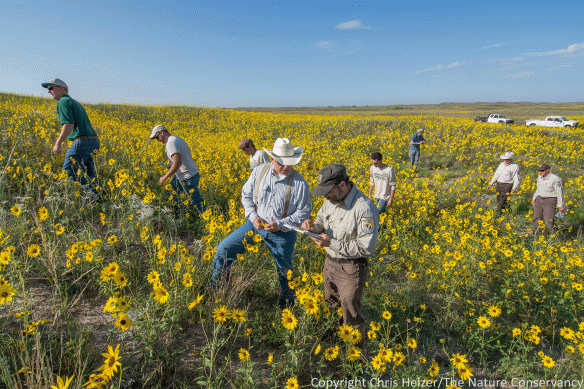
Populations of plains sunflower, like the one our group explored in this burned patch of Sandhills prairie, don’t seem to flourish two years in a row, even when bare ground persists. There must be something else driving that population boom and/or restricting a subsequent one.
I don’t have an answer for that sunflower question. Possible explanations could include 1) the majority of the available seed bank germinated the first year and seeds from that crop need a year or more to become stratified or otherwise prepared to germinate; 2) sunflowers produce chemicals that inhibit their own growth the next year (seems doubtful); 3) an insect, microbe, or other organism builds up large populations during population booms of sunflowers and then either eats or infects seeds/plants of the next generation, preventing them from establishing. There are probably lots of other possibilities. Anyone have the answer?
I’ve said it many times, and it’s always true – finding these kinds of mysteries is what helps keep me interested and excited about prairie ecology. It’s fun to figure out the solution to the mysteries, but then I have to find more mysteries. Fortunately, there doesn’t seem to be any shortage of them!