Photo of the Week – August 21, 2015

How could you look at this spider and not think it’s cute?

Jumping spider. Helzer yard. Aurora, Nebraska.

This beautiful jumping spider was in my background last weekend.  I cajoled it onto a piece of cypress mulch and took its portrait.  The crazy green color in the background is the underside of a maple leaf I put beneath the wood chip.  Doesn’t it look like a cute little teddy bear?  (Or an Ewok?)

Unfortunately, many people will look at this photo and recoil.  I’ve gotten so used to handling and admiring spiders and other invertebrates that I forget most of the human population is much less comfortable with them.  I wish I could help; spiders (and other “creepy” invertebrates) are incredibly important, but it’s hard to have a conservation discussion about them when the person you’re talking to is covering their face in disgust and fear.

I get that many people have a very strong visceral reaction to spiders (and/or snakes), and I’m not trying to minimize or mock that.  In fact, I can relate.  My own initial reaction to seeing a snake in the wild is usually to take a quick step backward.  However, I’ve spent enough time getting comfortable with snakes that after that first backward step, my next move is usually to try to catch them to get a better look.  Experience helped me conquer my discomfort and turn it into admiration.  I think the same would help most people deal with snakes, spiders and others, but getting the majority of the public that kind of direct exposure and experience seems unlikely.

Here’s a compromise.  We don’t need everyone in the world to love spiders and snakes to the point where they try to cuddle every one they find.  Instead, it’d be great if people could just understand that spiders and snakes are critically important components of complex ecological systems rather than nasty creatures to stomp on or chop with shovels.

I don’t expect anyone to transform from spider hater to spider cuddler just because I say spiders are cute and ecologically valuable.  However, maybe I can nudge the ball in the right direction by pointing out some mythology about the danger of spiders.  Let’s start with this:  Almost no one reading this blog post will ever encounter a spider that will pose any danger to their health.  Seriously.  The vast majority of spiders can’t even bite you – their little fangs can’t penetrate your skin.  With very few exceptions reported “spider bites” turn out to be something else.  SPIDERS DON’T WANT TO HURT YOU.  I’ve handled countless spiders of many many varieties and have never had one act aggressively toward me, let alone try to bite me.

I’m not going to tell you there are no dangerous spiders.  There are a few species that can cause you harm, but the chances of running into one of them are pretty slim, especially in Nebraska and most other midwestern U.S states.  Really slim.  And if you do happen to encounter one, they’re not going to jump up and bite you on the throat.  I promise.  Also, they are not going to lay their eggs inside you so that your face (or other body part) swells up until it eventually bursts and thousands of tiny spiders come out.  Not going to happen.  That’s a particularly vivid, but completely false urban legend.

Spiders are just tiny creatures trying to survive in a dangerous world.  Just like you, though possibly cuter – I don’t know, I haven’t met all of you.  Maybe you don’t want to pick spiders up and play with them.  That’s cool.  But  maybe you don’t have to kill every spider you see because you figure it’s either them or you.  It’s not.  They’re just trying to find something to eat and avoid being eaten themselves.  Ignore them.  Or catch them in a cup and take them to a safe place.  Or, if you’re feeling really crazy, pick them up, put them on a wood chip and take pictures of their adorable little faces.

Here are two more links that talk about spider bites and other myths, in case you’re interested:

http://www.burkemuseum.org/spidermyth/

http://arthropodecology.com/2012/02/15/spiders-do-not-bite/

Killer Thistles

Two years ago, I posted some photos of ants and other insects that had died on the sticky lower portion of thistle flowers.  At the time, I speculated about whether or not the sticky bracts below the thistle blossoms were an adaptation to prevent ants from reaching the flowers and “stealing” nectar.  Since ants aren’t fuzzy and don’t dependably go from flower to flower like bees do, they probably don’t provide many (any?) benefits to the flower in return for the nectar they take.

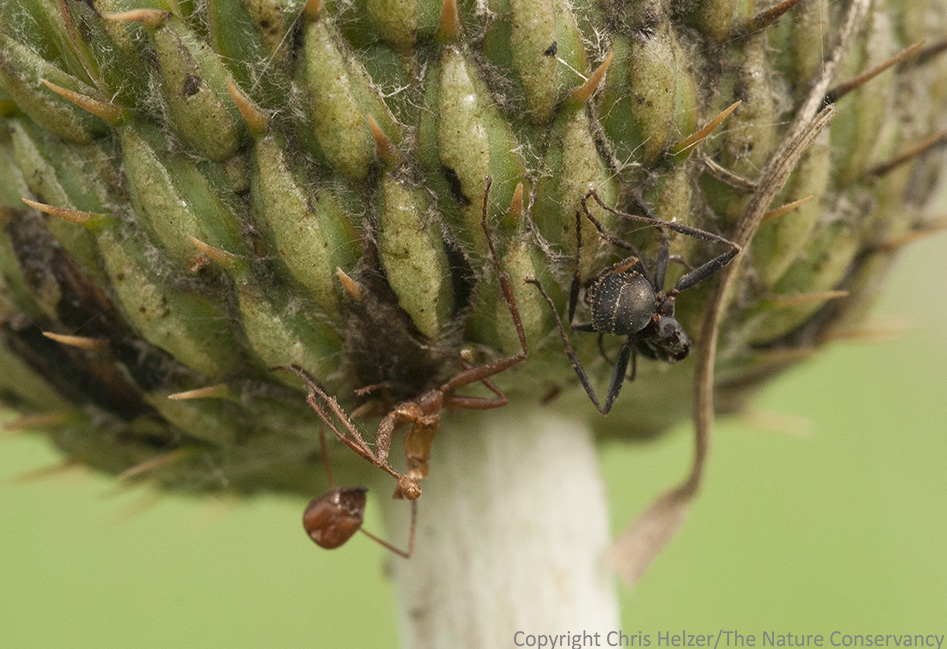
Dead ant stuck to bottom of wavy-leaf thistle flower. Helzer family prairie near Stockham, Nebraska.

Dead ant stuck to bottom of wavy-leaf thistle flower. Helzer family prairie near Stockham, Nebraska.

After that post, a friend sent me a journal article detailing a study (see citation below) in the 1980’s that looked at this same phenomenon, trying to figure out what benefit the thistle might get from having sticky bracts.  They used Liquid Paper to coat the bracts and make them non-sticky and then measured seed predation between coated and non-coated plants.  Overall, their results were fairly inconclusive, though they did see higher seed predation by insects on non-coated flowers in one of their sites.  The mystery remains!

One interesting part of the study was that of the 331 insects they found trapped on the bracts of Flodman’s thistle at Frenchman’s Bluff in Minnesota, 96% were ants.  (Given that result, I’m not sure why they focused on seed predation – I don’t think ants feed much on thistle seeds?)  I have been trying to keep track of what insect species I see stuck to thistle bracts during the last few years, and while ants do make up the majority of dead insects found there, a number of other species show up as well.

Dead ant stuck to bottom of wavy-leaf thistle flower. Helzer family prairie near Stockham, Nebraska.

The ant on the left appears to have completely lost his head over sticky thistles.

All the photos on this page were taken on the same morning last month.  I was walking around our family prairie and looking at the wavy-leaf and Flodman’s thistles (Cirsium undulatum and C. flodmanii) to see what was feeding on them, as well as what insects had become fatally stuck.  As usual, the majority of dead insects were ants, but there were several bees and even a little cicada as well.  More interesting, I also tried to pay attention to insects that seemed to move across the sticky flower bracts without getting stuck.  Crab spiders and stink bugs were two that seemed to have no trouble.  Spiders, at least some of them, have a special coating on their fuzzy feet that help keep them from sticking to their own webs – does that help them not stick to thistle bracts?  Maybe?  What about stink bugs?

Dead bee on bottom of wavy-leaf thistle flower. Helzer family prairie near Stockham, Nebraska.

This bee probably chose a nice sheltered place to spend the night without knowing it’d be the last choice it ever made.

Dead bee on bottom of wavy-leaf thistle flower. Helzer family prairie near Stockham, Nebraska.

This bee had been stuck for a while.

Dead beetle on wavy-leaf thistle flower. Helzer family prairie near Stockham, Nebraska.

This tiny beetle was another victim of the killer thistles.

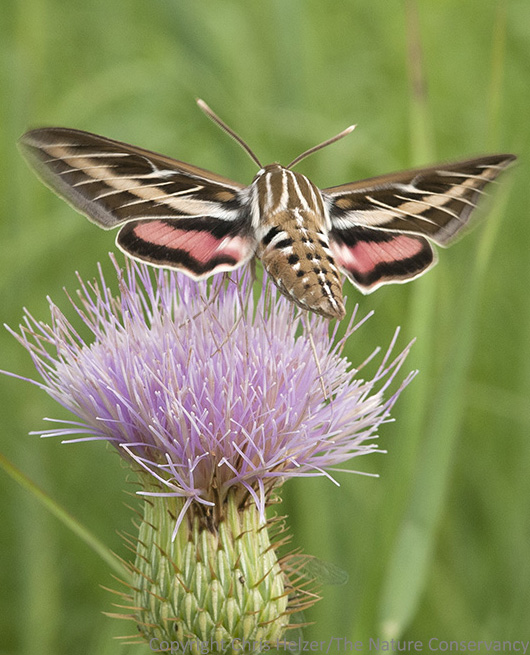
Sphinx moth on wavy-leaf thistle flower. Helzer family prairie near Stockham, Nebraska.

Sphinx moths and many other pollinators feed on the tops of on wavy-leaf thistle flower. It’s the underside that’s dangerous.  If you look closely at the bottom of the thistle flower, you can see a couple wings…

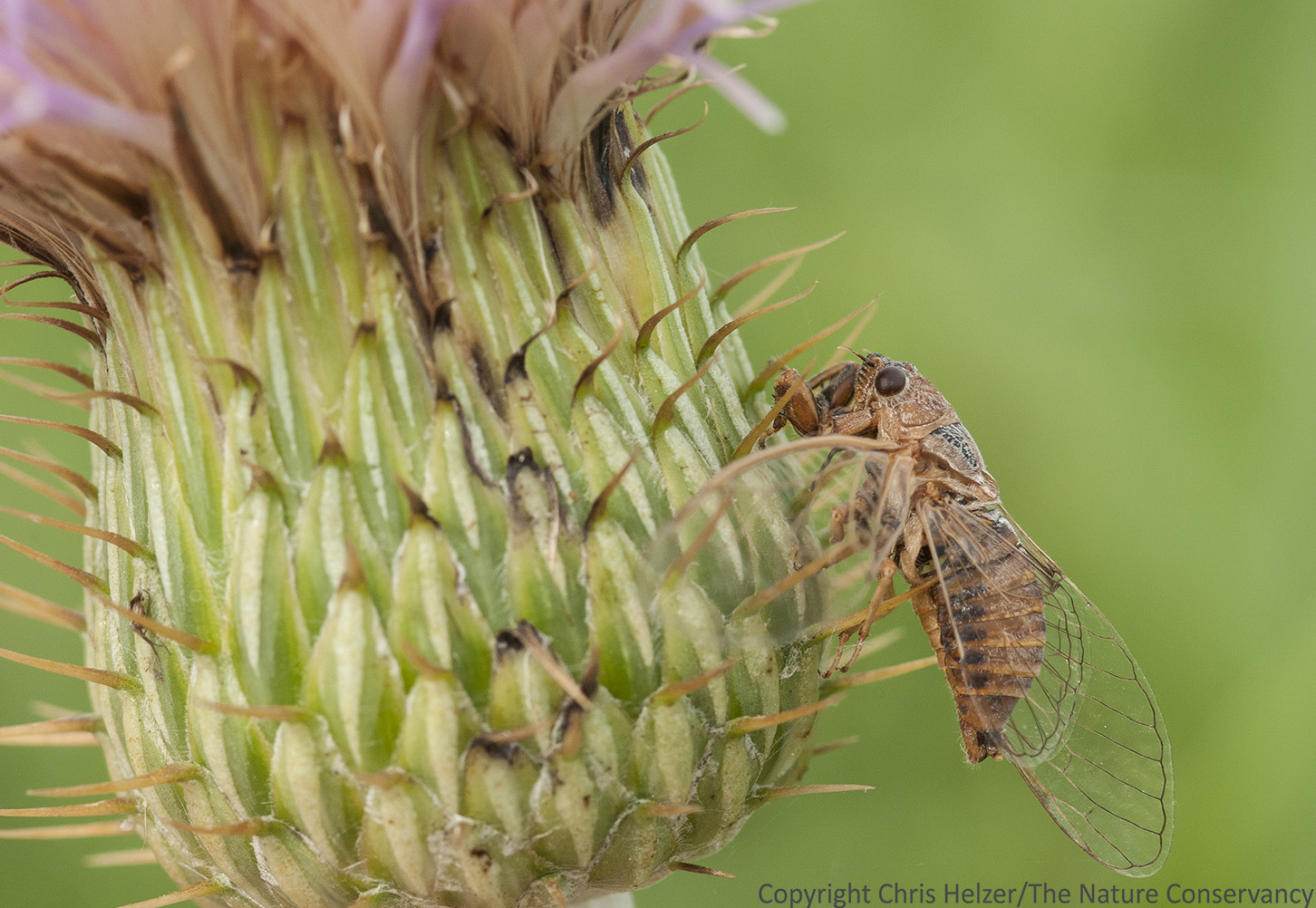
Dead cicada on bottom of wavy-leaf thistle flower. Helzer family prairie near Stockham, Nebraska.

…and those wings belong to this poor dead cicada.

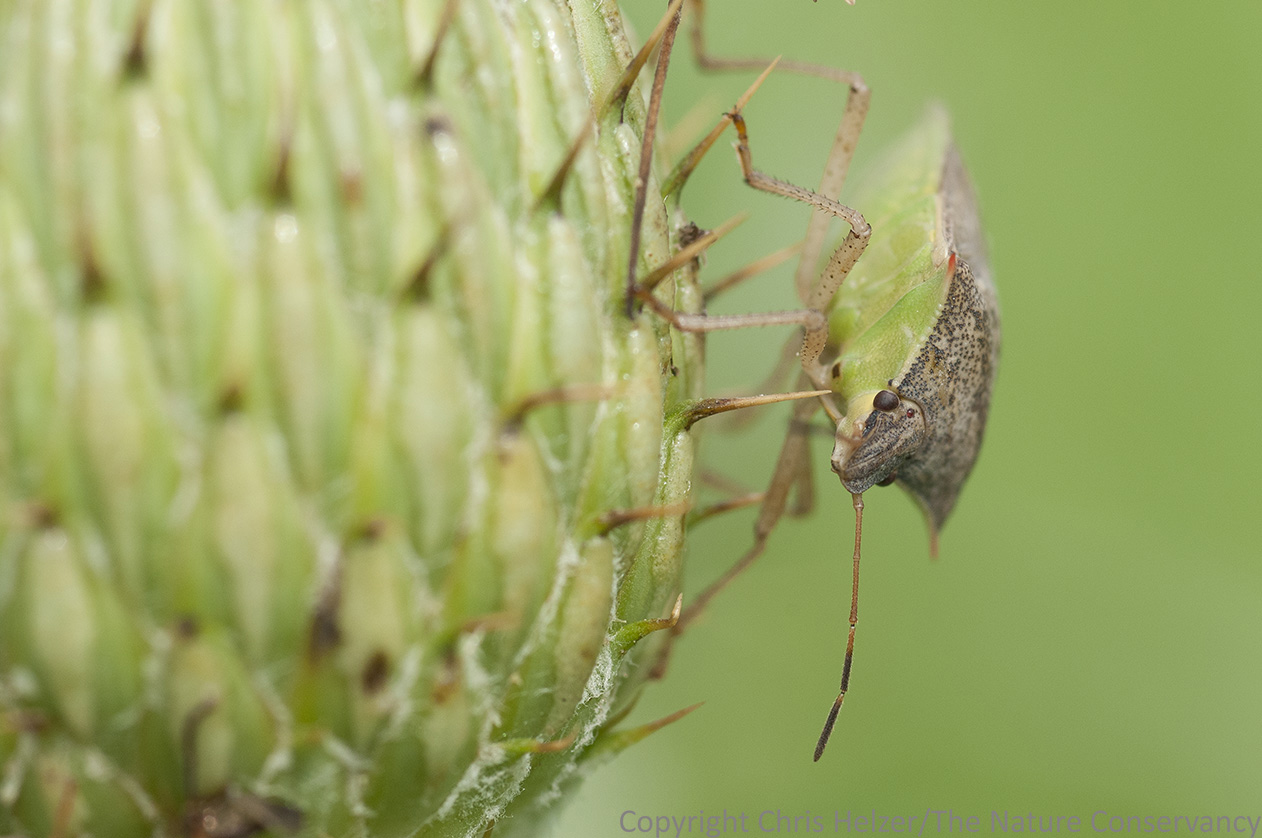
Stink bug on wavy-leaf thistle flower. Helzer family prairie near Stockham, Nebraska.

Stink bugs and crab spiders are among the insects that are apparently unaffected by the sticky thistle bracts.  This stink bug was moving around the flower with no apparent problems.

These are the kinds of mysteries that make walking through prairies fun.  Maybe someday we’ll figure out the secret of thistles’ “bracteal exudate”, but in the meantime, it’s just one of many prairie interactions we can marvel at.

>>>>>>>>>>>>>>>>>>>>>>>>>>>>>>>>>>>>>>>>>>>>>>>>>>>>>>>>>>>>>

Journal Citation:

Bracteal Exudates in Two Cirsium Species as Possible Deterrents to Insect Consumers of SeedsAuthor(s): Mary F. Willson, Pamela K. Anderson and P. A. ThomasSource: American Midland Naturalist, Vol. 110, No. 1 (Jul., 1983), pp. 212-214Published

.