
There are plenty of things to worry about when conducting a prescribed fire. Is the wind going to change? Is the smoke going where it’s supposed to? Will the fire leave sufficient unburned refuges for insects and other animals?
Fortunately, one thing we don’t have to worry about is whether or not the smoke from our fires is contributing to global warming. It’s true that smoke from prairie fires contains carbon, and that carbon is lifted right into the air. However, it’s important to step back and look at the bigger picture.
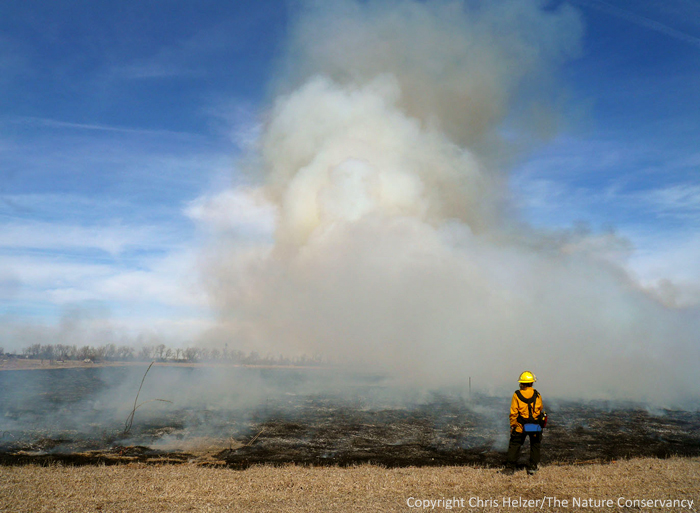
When all is said and done, the smoke from a prairie fire returns much less carbon to the atmosphere than was sequested during the same time period. Even with annual burning, a prairie stores more carbon than it releases.
First, prairies pull more carbon from the ecosystem each year than they release – even if they’re burned annually. Prairie plants take carbon from their environment and store it beneath the ground as soil organic carbon. We’ve long known that prairies build organic soils – that’s why grasslands make such good farmland – but recently that ability has gotten more notice because of its contribution to carbon sequestration efforts.
Second, burning prairies stimulates stronger vegetative growth, which sequesters even more carbon in the soil than if the prairie was unburned. Spring fires warm the soil and allow prairie plants to start their growth earlier, and removes shade that would otherwise slow plant growth. In addition, it appears that fires also stimulate soil bacteria that make more nitrogen available to plants.
Third, the carbon that IS released through smoke is not the fossil carbon that is responsible for steeply climbing carbon dioxide levels in the atmosphere. Smoke from prairie fires contains carbon that was pulled out of the atmosphere within the last few years. Remembering that much of that carbon is sent down in the the soil by prairie plants, whatever is re-released is simply returning carbon that was already in modern day circulation. Today’s increasing atmospheric carbon levels are driven by the release of fossil carbon from millions of years ago. That carbon was stored away in coal and oil deposits until we pulled it out of the ground and released it through combustion.
A nicely succinct (if slightly ornery) synthesis of the reasons prairie fires don’t contribute to global warming was written by Gerould Wilhelm, a widely respected botanist and educator. You can read that in PDF form here. GW carbon paper
So – stop worrying about carbon. Instead, make sure the forecast is still accurate, watch where your smoke is going, and be sure to leave some unburned areas for insects and other animals.
Most importantly, be safe.


