
One of the biggest jobs of a prairie steward is to manage the competition between plants, ensuring that no species becomes too dominant and no species is pushed out of the community. In our prairies, much of our effort is directed toward some of the stronger grass species, including big bluestem, indiangrass, smooth brome, and Kentucky bluegrass. Left unchecked, those grasses (and a few others) can monopolize both light and soil resources and reduce plant diversity. Our management targets those grasses with fire and grazing, often using season-long defoliation by cattle or bison to weaken the competitive ability of those grasses, opening up space and resources for other plants to flourish. Our long-term plant data show that we’ve been able to maintain species richness and a full complement of plant species with this kind of management.
When those major grasses are weakened, one of the most obvious responses is a flush of “weedy” vegetation that quickly takes advantage of the soil and light resources that have become available. Research has shown that growing season defoliation temporarily causes grasses to abandon some of their roots (until defoliation stops and the grasses recover), opening up space for nearby plants to grow larger and more abundant. However, there are still many questions about the actual physical responses of grass roots to defoliation, and gaining a better understanding of that could be really important to prairie managers. Researchers at Kansas State University are actively working on those questions right now. Dr. Jesse Nippert, in particular, has done a lot of work on this subject, including some work on prairie shrubs that I wrote about a few years ago.
Last week, a couple of Jesse’s graduate students, Seton Bachle and Marissa Zaricor, were at our Platte River Prairies, collecting data on roots under grazed and ungrazed conditions. In addition, Seton brought along a nifty tool called an air spade, which uses compressed air to dig into prairie soil with enough force to expel soil particles, but not so much that it tears apart the roots of plants (with the exception of the tiny rootlets at the tips). Seton and I started talking about a year ago about the possibility of getting the air spade up here so we can look for visual evidence of grazing impacts to roots. Marissa and Seton are both doing very in-depth (ha!) measurements of plant root responses, but I also wanted to see what’s those roots really look like. The air spade seemed like a great way to do that.
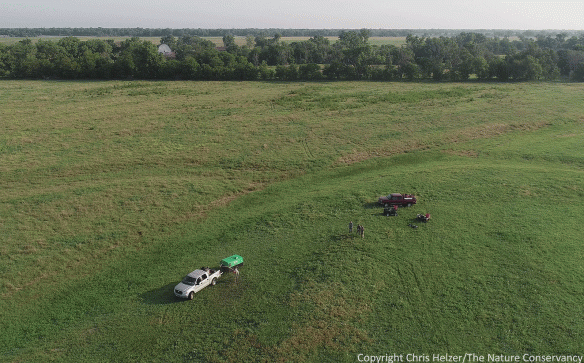
Here is our sampling area, as seen by our drone. The bottom right portion was burned this spring and has been grazed fairly intensively since. The top left portion is unburned and has had very little grazing pressure.
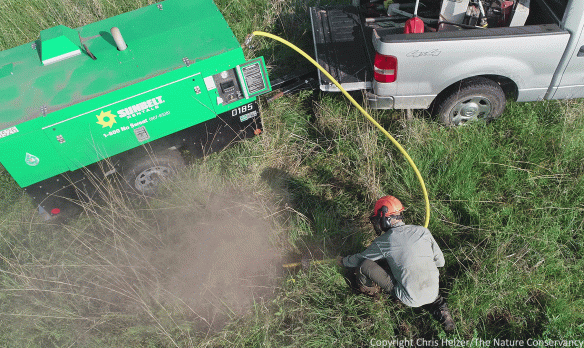
Dust erupts out of the ground as Seton excavates with the air spade.
For this initial trial, we chose a part of the prairie that was burned this spring and was being grazed intensively by cattle as part of our patch-burn grazing management. Abundant rain this year has meant that the cattle aren’t keeping the grasses as short as we’d really like, but we were still able to find some big bluestem plants that have been cropped pretty short. As a comparison, we went across the burn line to part of the prairie that hasn’t had much grazing pressure in recent years and, because it is unburned, hasn’t had much attention from cattle this year either. As a result, we were (ok, Seton was) able to excavate around the roots of big bluestem plants that had been grazed off to just a few inches of leaf height, as well as ungrazed plants with leaves around 12 inches high.
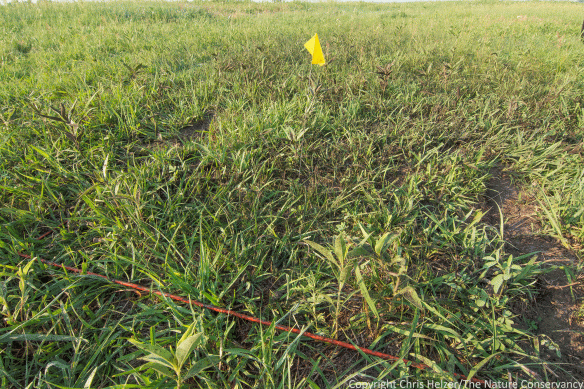
Here is the excavation spot in the burned/grazed patch.
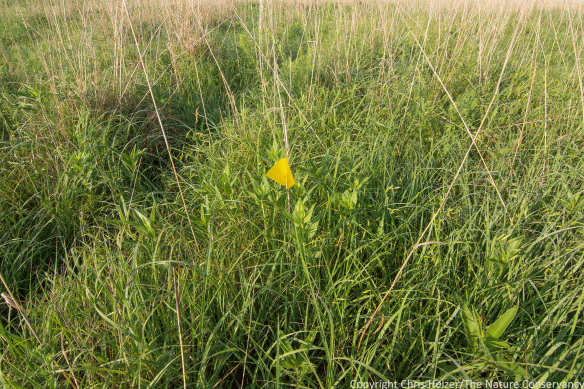
Here is the unburned/ungrazed excavation site.
As Seton started blowing soil away from the roots (and I photographed the process with my camera and our drone), one of the first things that became obvious was the relatively shallow depth of the main root mass. The work of J.E. Weaver and others has shown that prairie plants, including grasses, have some very deep roots. However, more recent work, including that of Jesse Nippert of Kansas State, Dave Wedin at the University of Nebraska, and others, has shown that those grasses don’t appear to actually use those deep roots for much. In fact, grasses tend to concentrate the vast majority of their root masses in the top foot or so of the soil profile, effectively monopolizing most of the moisture and nutrients there. Forbs tend to pull most of their resources from below that, and shrubs work at even greater depths. I’ll write about this more in a future post, but for now, just trust me when I say that this is abundant evidence for this (and many more questions being pursued). Prairie grasses can have deep roots, but it’s the incredible root density at shallow depths that they most rely on, even during drought.
With the air spade, we could pretty easily see that most of the big bluestem roots were in that shallow depth, and only a few extended down below that. However, as Seton pulled out fully-excavated clumps of big bluestem shoots and roots, my initial reaction was one of disappointment. There didn’t seem to be any obvious difference in the density of roots or size of the overall root mass between the grazed and ungrazed plants.
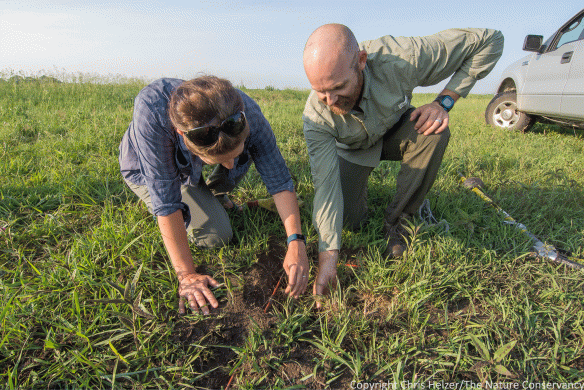
Marissa and Seton examine the roots in the partially excavated grazed site.
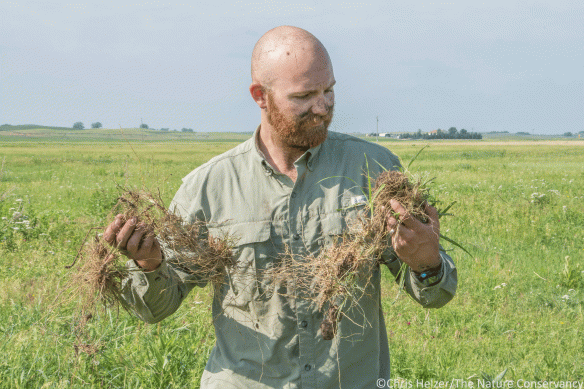
Seton examines some of the roots dug out of the burned/grazed site.
My immediate thought was that because these plants had only been exposed to grazing for about a month, maybe there hadn’t been enough time to see changes in their root masses. In addition, it might be that some of the roots were no longer active, but were still connected to the root mass for now. We’ll be repeating this excavation process later in the season, and might see differences then that aren’t yet obvious. In addition, we’ll look at some roots of grasses that were heavily grazed all of last season and see what those look like. Still, I was a little disappointed not to see a bigger visual difference.
However, when Seton and Marissa looked at the roots, they pointed out something I hadn’t initially seen because I was so focused on root length and density. The diameter of most of the roots of the ungrazed bluestem appeared to be considerably larger than those of the grazed plants. We were working with a small sample size, but among all the plants we dug up, that size difference seemed to be pretty consistent.
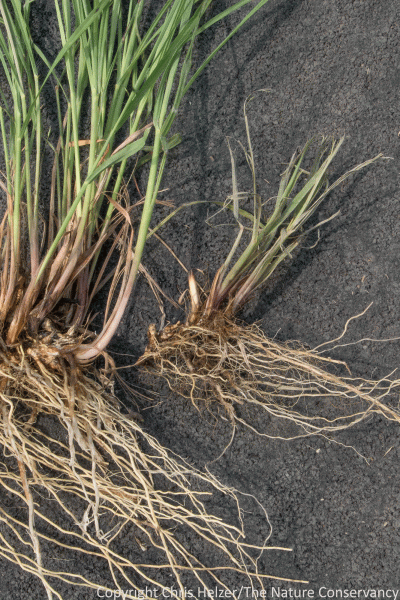
An ungrazed clump of big bluestem on the left and grazed on the right. You can’t see the length of all the roots in this image (they were similar between plants) but the ungrazed roots are noticeably thicker than the roots of the grazed plant.
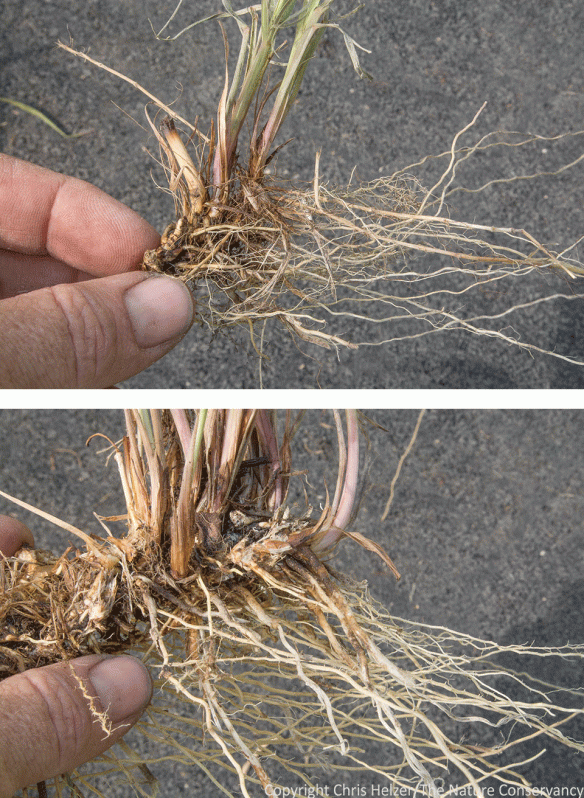
Here’s another look at the difference in root thickness between the grazed plants (top) and ungrazed (bottom).
Marissa explained that thicker roots have more carbohydrates stored in them. Plants that have been defoliated, and are trying to regrow shoots, have to pull carbohydrates from their reserves to do so – pulling them out of their roots and putting them into aboveground growth. Whether those roots kind of deflate as the carbohydrates are pulled from them or stressed plants just create skinnier roots is something Marissa and Seton are hoping to learn from their work. Regardless, carbohydrate storage plays into competitive ability. Grasses rely on their storage capacity to fuel growth and withstand further stress, so differences in root diameter could be part of the answer to why grazed grasses are less competitive. Seton and Marissa plan to examine some cross sections of the roots we dug up to see if they can see more under a microscope than we could by just looking at the roots with our naked eye.
Seton and Marissa’s actual scientific explorations will give us much better answers to questions about grazing impacts on grass roots than simply looking at a few samples, but it was fun to see the actual roots themselves. While the differences between grazed and ungrazed plants weren’t as stark as I’d expected, I’m still looking forward to our next effort later this summer – especially because all I have to do is photograph the results of the hard work Marissa and Seton are doing!
If you’re interested, here is a short 1 minute drone video showing the excavation process. You can also check out Seton’s science website here.
Special thank you to the Nebraska Environmental Trust for funding our drone purchase through a PIE (Public Information and Education) minigrant, administered through the Nebraska Academy of Sciences.


 The Prairie Ecologist