
Sweet Clover: Ugly but Harmless? Or Dangerous Invasive Species?

Why is sweet clover the target of aggressive control by some prairie managers and largely ignored by others?  After talking to a number of people across the Midwest and Great Plains, I think there are a couple of things happening.  First, the usually biennial sweet clover can be very abundant and showy in the years it blooms, but is harder to find in other years.  I think some prairie managers see those big flushes and mistake abundance for aggressiveness.  However, I also think that some soil/precipitation/latitude(?) conditions may lead to real negative impacts from sweet clover on plant diversity.

One of the lessons that’s been strongly reinforced for me this summer is that it can be difficult to extrapolate successful prairie management/restoration strategies from one region to another.  Just during the last several months, I’ve visited prairie managers in Nebraska, Indiana, Missouri, and South Dakota and I’ve seen tremendous variation between (and even within) those states in terms of which species are invasive and which are not.  It’s dangerous to assume that just because a species like sweet clover isn’t causing problems in one prairie, it won’t cause problems in another.  I hope we’ll eventually learn enough to accurately predict when to worry and when not to, but in the meantime, it behooves prairie managers to carefully evaluate species at their own sites.
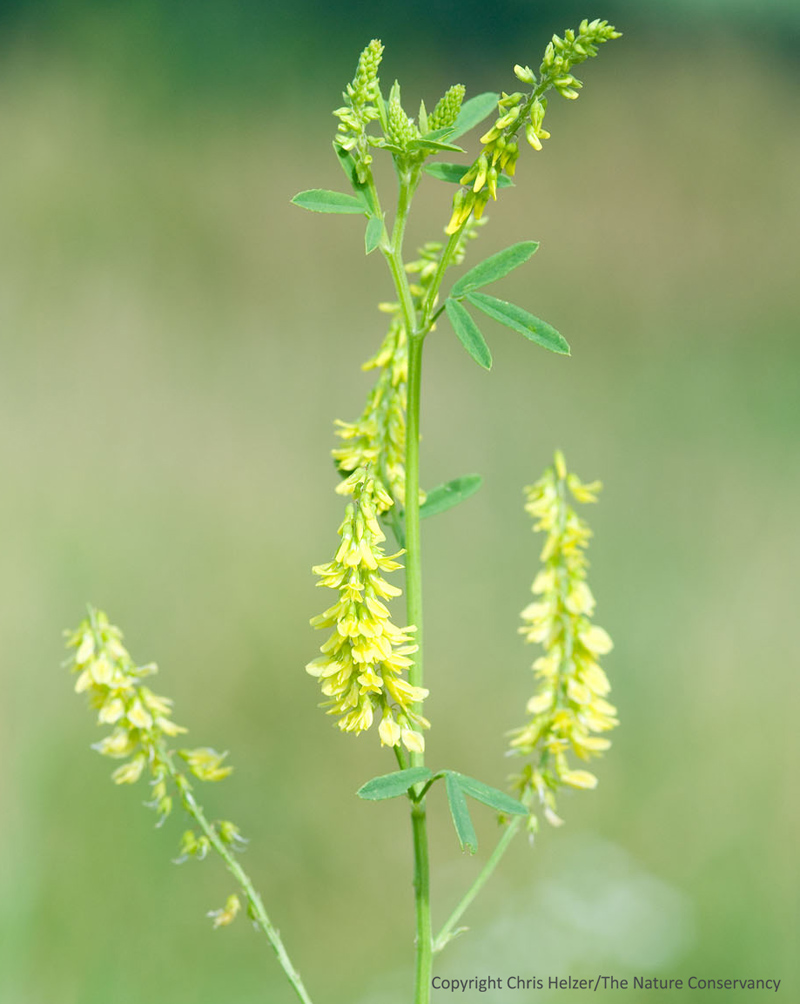
Yellow sweet clover. This exotic species is still planted in some wildlife and ground cover grassland plantings because of its purported wildlife value and cheap seed. However, it appears to be invasive in some places and/or situations.

I’ve been working with prairies along Nebraska’s Platte River for nearly 20 years now, and my observations have led me to conclude that sweet clover is more of a big ugly plant than a true invasive species in those prairies.  Years of data collection on my plant communities support those observations.  That annual monitoring work entails listing the plant species I find in each of about 100 1m2 plots across a prairie.  Those plots are stratified across the prairie so the site is evenly sampled.  Once I have those plotwise species lists, I calculate the floristic quality  (FQI) inside each plot, a calculation that takes into account both the number of species present and the average “conservatism” value of those species.  I can then look at changes in mean floristic quality over time to help me see how the plant community changes over time.  I monitor a few prairies annually, and others on a periodic basis.

Those data show the same thing I’ve seen observationally – sweet clover changes in abundance from year to year (though not as much as it appears visually), but the species doesn’t increase in abundance over the long term and doesn’t appear to negatively impact floristic quality.  Below are graphs from three sites that show both sweet clover frequency (% of plots occupied by sweet clover) and mean floristic quality.  Two of those sites were annually grazed during the data collection period, and the other was only grazed once – toward the end of the sampling period.  Cattle grazing almost certainly helps control sweet clover because it is one of their favorite plants to eat, but I don’t think sweet clover is causing me problems where I don’t graze either.

What my data don’t show is the flush of tall blooming plants that happens every other year or so.  I’m just counting whether at least once sweet clover plant is present in each of my small plots – not how big it is, or whether or not it’s blooming.  Nevertheless, sweet clover frequency changes from year to year but doesn’t appear to correlate at all with changes in mean floristic quality.

Nine of years of annual data from a 1995 prairie restoration seeding. The site has been under patch-burn grazing during each of the nine years of data collection. Sweet clover is never abundant at this site, but has also not increased over time, even through years of drought and heavy grazing. Error bars for floristic quality indicate 95% confidence intervals.

.

Sweet clover was present in between 22% and 42% of 1m plots in this restored crop field, planted in 2002. Though the sweet clover frequency varied from year to year, the mean floristic quality of the plant community increased between 2004 and 2008 before leveling off after that - apparently independent of sweet clover. Sweet clover data from 2008 was eliminated from this graph because I later questioned whether I'd confused black medick and sweet clover in some plots. This site was not grazed except in 2009.

.
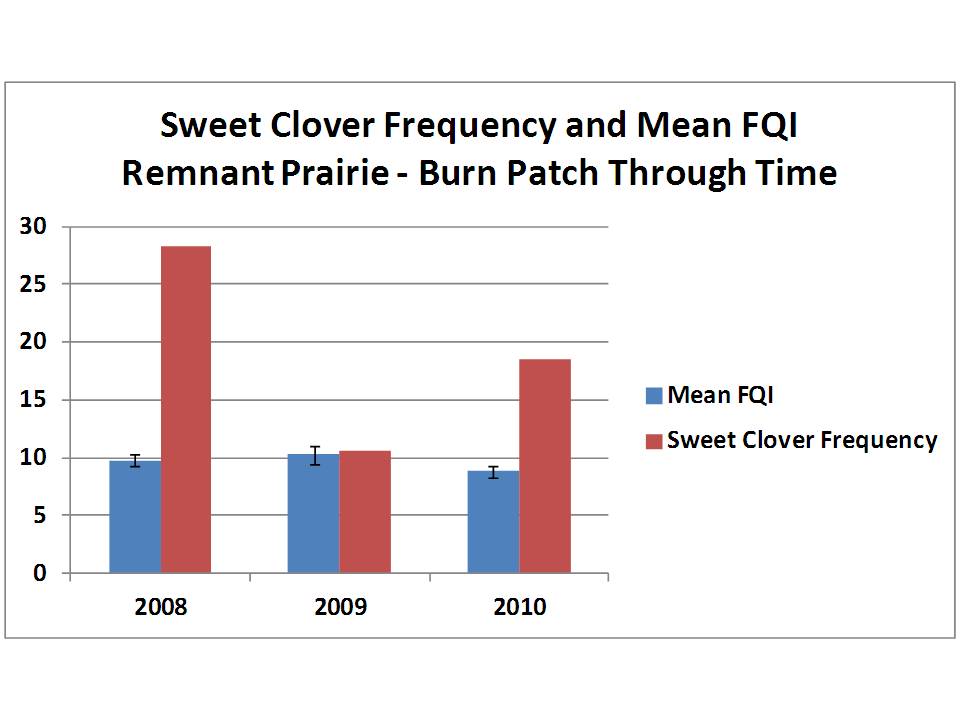
These data are from a remnant mesic prairie under patch-burn grazing. Instead of being stratified across the entire prairie, these data are from a single patch that was burned in 2008, and that same patch was sampled again in 2009 and 2010. It was grazed very hard in 2008. In 2009, no new patch was burned, so it was grazed hard again, but then fenced out in early June. In 2010, the site was not fenced out, but received only light grazing while cattle focused on another portion of the site that was burned. These data are from only about 30 plots per year.

I feel pretty good about ignoring sweet clover and focusing on more invasive species on our prairies.  Both my observations and data support that strategy.  However, as I said earlier, just because the species doesn’t appear to be problematic for me doesn’t mean it isn’t an invasive species in other prairies.  It’d be great if we could compare data similar to what I’m presenting here from a number of sites to see if sweet clover is acting differently in different places.  Without data, it’s hard to know whether or not people are just interpreting the “invasiveness” of sweet clover in different ways.  For now, my answer to the question,  “Is sweet clover really invasive?” is still the same…

Maybe.
Innovation in the Dakotas

It’s always fun to hang out with innovative people, especially when they’re working on the same kinds of challenges I am.  I was invited to spend several days last week at a South Dakota prairie restoration (reconstruction) workshop, organized by and for staff of the U.S. Fish and Wildlife Service.  Tom Koerner, an old friend from when he worked in central Nebraska, asked me to come up and share what we’ve been doing with prairies, and I was glad for the chance to see what’s happening up north.

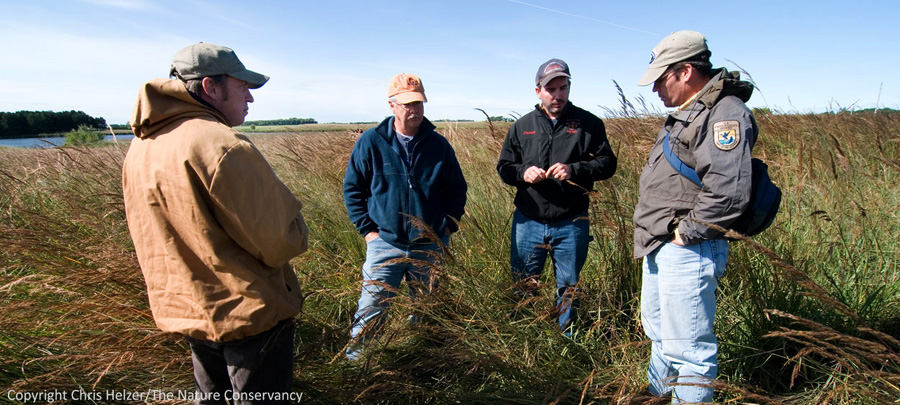
Tom Koerner (right) of the U.S. Fish and Wildlife Service talks with colleagues about prairie restoration near Madison, South Dakota.

The Fish and Wildlife Service refuges in the Dakotas have a long history of restoring and managing wetlands and surrounding uplands as primarily duck habitat.  Recently, a few biologists and managers have begun questioning the relatively narrow focus on ducks, in view of the much broader mission of the agency (“The U.S. Fish and Wildlife Service’s mission is, working with others, to conserve, protect and enhance fish, wildlife, and plants and their habitats for the continuing benefit of the American people.”).  Rather than planting non-native grasses and legumes as duck nesting cover, they say, the Service could be adapting high-diversity restoration techniques used in nearby states to better accomplish their broad mission.  To those of us who have been working with high-diversity prairie/wetland restoration for years, the decision seems like a no-brainer, but there are several significant obstacles standing in the way for the Fish and Wildlife Service.

The first obstacle is really inertia.  The refuge system in the Dakotas has established a strong reputation as a duck production area among the public, and refuge managers have established techniques and strategies that have been consistently used for many years.  It’s difficult to convince someone to change what they’ve been doing over their entire career, especially when you’re asking them to start using a technique they’re unfamiliar with.  To those who haven’t used it, high-diversity restoration sounds expensive and risky – and what if it isn’t good for ducks?

The second obstacle is invasive species.  In much of the Dakotas, and certainly on the sites we visited near Madison, South Dakota, Canada thistle is a pervasive and invasive threat.  Taking land out of crop production and planting perennial vegetation often produces large dense crops of Canada thistle (except when it doesn’t – but there isn’t currently a good way to predict that outcome!).  Because Canada thistle is both aggressive and a state-listed noxious weed, the Service can’t ignore large populations of the species in restored grassland areas, and has to act to control it.  Small patches can be spot-sprayed, but many areas become infested so heavily that they have to be broadcast-sprayed.  This makes planting a diversity of plant species a risky endeavor, because there’s a pretty good chance much of that diversity will have to be sacrificed during Canada thistle control efforts.

The third obstacle is the cost.  The perception is that high-diversity restoration is much more expensive than simply planting several species of exotic grasses and some alfalfa.  There is obviously some truth to that.  Particularly if you’re buying the seed you use, a diverse mixture of native prairie seed can be very expensive.  However, there are several other ways to measure and mitigate costs.  For example, if seed is harvested by agency staff and volunteers, a lot of seed can be obtained pretty cheaply.  It’s amazing how much seed a few people can harvest in just a little bit of time when they’re organized and efficient about doing it.  In addition, the alternative is Dense Nesting Cover (DNC), consisting of exotic grasses and alfalfa, which typically has to be torn up and replanted every 7 years or so when the alfalfa starts to disappear, so over the long term, the costs of that method are higher than it might seem at first.  Combining the Canada thistle threat with the perceived cost, however, makes a pretty strong counter argument to those pushing for high-diversity – and that argument was the main subject of the workshop last week.

Bryan Shultz (left) walks with others through a two-year-old seeding.

Madison, South Dakota was chosen as the location for the workshop because that Wetland Management District has been experimenting with high-diversity restoration for the last several years.  Kyle Kelsey and Bryan Schultz are leading that charge, harvesting seed and experimenting with techniques for establishing it in the face of tight budgets and Canada thistle.  Bryan, like Tom Koerner, has ties to prairie restoration work in Nebraska, having worked at the Boyer Chute National Wildlife Refuge on the Nebraska side of the Missouri River earlier in his career.  (I’m sure these Nebraska ties are just coincidence, but it IS interesting that John Leisner with the South Dakota Game, Fish & Parks, who is helping lead the way for high-diversity within that agency, also started his career in Nebraska…)

To account for Canada thistle and build diverse prairie restorations, Bryan and Kyle are trying a combination of strategies.  First, they are harvesting as much seed as they can – from local sources.  Their diversity is increasing each year, as they find more seed sources (and create their own in newly-restored prairies).  Second, they are dealing with first-year weeds by applying Plateau herbicide in the first spring.  That herbicide application helps suppress Canada thistle, along with some annual weeds such as foxtail.  They also do some mowing of annual weeds when they grow so densely that they block sunlight from hitting the ground.  Finally, if Canada thistle does appear, they control it by spot spraying, if possible, and broadcast spraying only when absolutely necessary. 

Both the Plateau herbicide in the spring and the Milestone herbicide for later thistle control are relatively selective herbicides – though grass and wildflower species that are tolerant of one are not necessarily tolerant of the other.  As we walked around the sites, it appeared to some of us that the Plateau herbicide might not be necessary, judging by some areas that were not sprayed.  The herbicide application appeared to increase the speed with which dominant warm-season grasses established, and knocked out some wildlflower species – both of which run counter to Bryan and Kyle’s objectives.  The weed control provided by the herbicide did alter the weed species composition, but it looked like the unsprayed areas were going to establish equally well (maybe better) compared to the sprayed areas – and might actually have better species diversity in the long run.  Experimentation over time will provide better answers than our brief observations last week.

The Milestone herbicide applications seem to be effective, because the chemical is certainly effective at controlling Canada thistle, and there are quite a number of wildflower species that are tolerant (recover within a year or two) to being sprayed.  Broadcast spraying definitely reduces plant diversity, but that’s only used when absolutely necessary, and spot spraying is used much more often.  That spot spraying helps maintain diversity by only applying chemical to small areas and the selectivity of the herbicide means that even sprayed areas maintain some plant diversity. 

In addition to chemical control, Service staff are working on a research project with Dr. Jack Norland of North Dakota State University to see if they can find ways to increasing seed rates of forb species that might compete strongly with Canada thistle without decreasing overall prairie diversity.  This study is intriguing because, in contrast to a couple similar projects I’m aware of, they’re targeting a single invasive species and are trying to find forb species with similar life strategies to compete with the invader.  They’re only in their second field season, so it’s difficult to say how the project will work out, but I like the way they’re thinking.

Participants of the Fish and Wildlife Service's prairie restoration conference walk through a second-year restored prairie near Madison, SD.

Bryan, Kyle, Tom, and the rest of the Fish and Wildlife Service staff in the Dakotas have a long learning curve ahead of them, but they’re doing great work.  Most importantly, they’re jumping in with both feet and building some experiment/demonstration sites that will help address the questions being asked by themselves and others about the potential for high-diversity seedings to work in the Dakotas.  Some of their young seedings are already looking great, and it’s hard to imagine standing in one of them and thinking that a seeding of exotic grasses and alfalfa would be superior.  On the other hand, success hasn’t been consistent yet (Canada thistle has come in strongly in some seedings) and it’ll be interesting to see how their plant diversity looks over time.  They’re getting tremendous growth of warm-season grasses in first and second year seedings, which is nice in some respects, but may make it difficult to obtain and maintain plant diversity in the long term.  However, as trips around the country constantly remind me, techniques and results that apply to one site often don’t apply elsewhere, so it’s good to try many different things to see what works best locally.

Lots of questions, lots of ideas, and lots of experimentation.  Sounds like prairie restoration to me!