A Conciliatory Gift from the Mammal Community?

Maybe it was because my daughter was with me.  Maybe it was just one brave (or not very bright) individual.  Or maybe the prairie dogs and otters got together and decided to throw me a bone.  Regardless, my daughter and I had a pretty cool experience watching prairie dogs this past weekend.
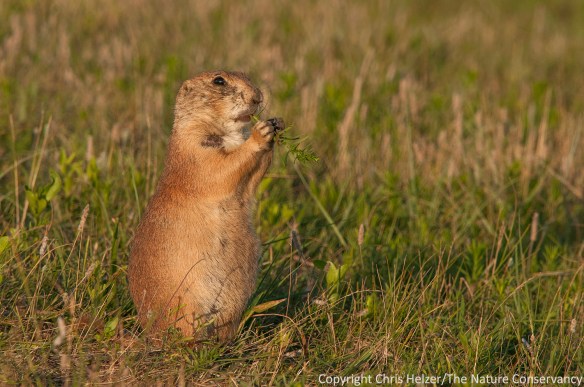
Black-tailed prairie dog. TNC Niobrara Valley Preserve, Nebraska.

Black-tailed prairie dog. TNC Niobrara Valley Preserve, Nebraska.

You might recall earlier posts I’ve written about attempts to photograph prairie dogs and otters.  In fact, I know many of you recall them because you ask me about them when we meet in person.  Let’s just say it hasn’t usually gone well.  (Examples one, two, and three, but see also four.)

Last weekend, however, my daughter and I were enjoying a weekend together at the Niobrara Valley Preserve before she leaves for college.  We canoed the river and explored the prairies, and generally had a great time.  The biggest highlight, though, was when we stopped at the small prairie dog town in the east bison pasture.  As we drove the truck into the edge of the town, I was telling her that we wouldn’t likely get a very good look at any of the dogs, so she should look at them in the distance and enjoy the view of them scurrying into their holes.  Based on much previous experience, I told her, “They never let you get very close.”

I drove slowly, hoping to give Anna a decent, if distant, look at a few prairie dogs before they dove for cover.  The first one we saw followed the expected pattern.  The second one, however, kept looking at us, so I slowed the truck even more, figuring I’d give Anna another few seconds to see the prairie dog that way.  The prairie dog just kept looking at us, so I stopped the truck completely.  Not only did the prairie dog stay aboveground, she(?) had three pups nearby that kept feeding and exploring almost as if we weren’t there.

Black-tailed prairie dog pups. TNC Niobrara Valley Preserve, Nebraska.

Here are two of the three pups hanging around the burrow.  The third was 15 feet away, feeding.

As Anna and I sat there for a few minutes, I pulled out my camera and took a few photos. For some reason, the prairie dogs seemed largely unconcerned about us.  Eventually, I decided to take a big chance and slowly backed the truck around so that we were a little closer and so that the light was a little better for photography.  The prairie dogs just watched us nonchalantly as we moved.

We watched and photographed them for a few more minutes, savoring the chance to be so close.  I tried a little video but couldn’t hold the camera still enough to make it work well.  Very slowly, I opened the truck door, hoping to set up a tripod behind the door and take video through the open window.  I figured this would likely be the last straw for the prairie dogs, but we’d had a good look already, so it was worth a try.  …Still no response from the prairie dogs.

One thing led to another, and about 15 minutes later, I found myself lying prone on the ground, about 10 feet from the mother(?) prairie dog, photographing her while she alternatively foraged and stood on her hind feet looking alert.  (I’m not sure she understood that while in “alert position” she was supposed to be watching for things like ME CREEPING SLOWLY UP ON HER.)  Eventually, I ran out of both battery and memory card space, and retreated to the truck.  As we turned around and drove away to look for the bison herd the prairie dogs in more distant parts of the town barked warnings and ran for their holes.   You know, as prairie dogs always do…
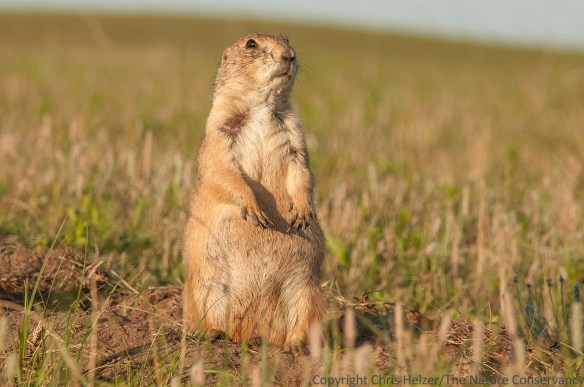
Black-tailed prairie dog. TNC Niobrara Valley Preserve, Nebraska.

She’s sitting in alert position, but I’m not sure what she’s watching for since she didn’t seem to be concerned about the big creature stalking her with a camera.

Black-tailed prairie dog. TNC Niobrara Valley Preserve, Nebraska.

Clearly unconcerned about me, the prairie dog continued to move around and eat.

This short video shows two clips.  If it doesn’t show up correctly, try clicking on the title of this blog post to open it in a web browser.  The first was shot from behind my truck door and shows the mother and pup interacting.  The second was shot later while I was lying on the ground and shows the mom feeding.  Clearly, despite how close I was to the prairie dogs, they weren’t very worried…

I have no idea why this particular prairie dog family was so accommodating, but Anna and I were certainly grateful for the time we spent with it.  I’ll try to head back to the dog town in the future and see if I can find them again.   It shouldn’t be hard if they’re the only ones still aboveground when I drive up to the town.   Alternatively, it’s very possible that a hungry coyote, hawk, or other predator will beat me to it…  While it would be great for photographers and kids if all prairie dogs were easy to get close to, it probably wouldn’t work out well for the species.

Now if I can just find a family of otters…

Anna took this photo of me with her phone. It shows how crazy close the prairie dog let me get. Sure, I was being slow and following the rules of good wildlife stalking, but still...

Anna took this photo of me with her phone. It shows how crazy close the prairie dog let me get. Sure, I was being slow and following the rules of good wildlife stalking, but still…

Photo of the Week – July 1, 2016

I often tell people, “I’m not an insect expert, I’m an insect enthusiast.”  I don’t spend nearly enough time immersed in the vagaries of invertebrate taxonomy and biology to know much more than some interesting trivia about most species.  This week provided a couple great examples of my lack of expertise.

Early in the week, I was at the Niobrara Valley Preserve.  While walking one morning, I noticed a longhorn beetle on a white prairie clover flower.  I felt pretty good about recognizing it as a longhorn beetle, and was even able to remember part of the genus (“Typo something, I think”).  I also noticed a small weevil on the same flower.   “Cool!”

Long

Longhorn beetle (Typocerus confluens or Typocerus octonotatus) and a weevil on white prairie clover (Dalea candida) at The Nature Conservancy’s Niobrara Valley Preserve.

A few steps away, I saw another white prairie clover flower, and sure enough, there was a longhorn beetle on that one too.  And another weevil.  This second longhorn beetle had a different pattern on its back from the first one, so I assumed it was a second species.  “Nice,” I thought, there’s a good example of insect diversity – two different beetle species feeding on the same flower.

long

Another longhorn beetle on another white prairie clover flower.

A few steps away from that second flower was a third one, and it had a longhorn beetle on it as well.  The third beetle looked different than both the first and the second ones.  (Oh, and there was a weevil on the third flower too.)

beetle

A third longhorn beetle.

As I walked away from the white prairie clover patch, I started composing a blog post in my head about insect diversity.  Something about how important it is to have lots of different species within each group of animals so that if one species suffers from a disease or some other malady, there are others that can cover the role it plays in the natural world.  Blah blah blah.

When I got back to WiFi, I emailed my longhorn beetle photos to Ted MacRae (an ACTUAL insect expert) who is generous enough to help me with identification of beetle photos.  (Check out his fantastic blog here.)  I asked him what species these three beetles were so I could name them in my upcoming blog post.  When I got his reply, my blog post idea went out the window.  They weren’t three different species at all – they were all the same one!  (By the way, Ted couldn’t tell for sure from my photos which of two possible species they were.  He said he’d need to see the “last ventral abdominal segment” of each to be sure.)

Now, how is an insect enthusiast supposed to keep up when three beetles of the same species don’t even have the common courtesy to look like each other??   I’m ok with the occasional oddball.  With flowers, for example, it’s not uncommon to see one white flower out of a big patch of purple spiderwort or vervain flowers.  Fine.  Genetics provides a few quirks now and then.  But I only saw three longhorn beetles, and none of them had the same color pattern on their back??  I give up.

Oh, and the weevils?  Don’t even ask.  I don’t know.  They all look the same to my eye, but what does that mean?  They’re probably three different species that just happen to be feeding on the same flower.  That would be about right.  Geesh.

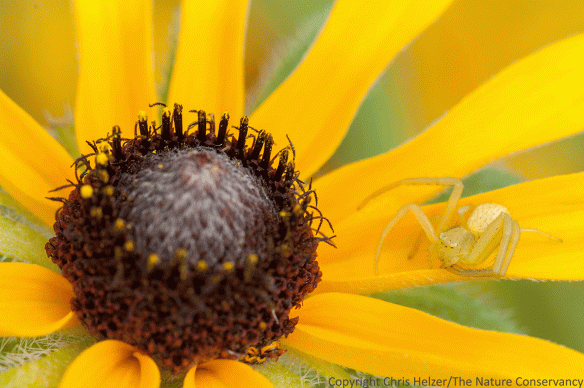
So then yesterday, I was in our Platte River Prairies and noticed a crab spider on a black-eyed Susan flower.  It was a pretty spider (you have to admit that) so I stopped and photographed it.

crab spider

Crab spider on black-eyed Susan flower.  The Nature Conservancy’s Platte River Prairies.

After I photographed the spider, I gave the other flowers nearby a quick look, and sure enough – there were crab spiders on several of those too.  Now, here’s the thing: the other crab spiders might have been different species, or they might not.  I’m not even going to guess.  They had different patterns on their abdomens but were generally the same color.  The first one was much broader, but that’s likely because she’s a female, and that’s how it works with spiders.  The other two might be different species or they could be from different growth stages and the patterns might be different for that reason.  Or, apparently, THEY COULD JUST LOOK DIFFERENT FROM EACH OTHER FOR NO PARTICULAR REASON OTHER THAN TO BE CONFUSING.

crab spider

Another crab spider.  

spider

One more crab spider

I could email photos of the crab spiders to a friend who occasionally identifies them for me, but I’m not going to.  I’m choosing instead to simply admire the aesthetics of these fascinating little creatures, and appreciate some general trivia about crab spiders (for example, their front two sets of legs are extra long for capturing ambushed prey, and some species of crab spiders can change color to match the flower they sit on).  After all, I’m an insect enthusiast, not an insect expert (or a spider expert).  So there.