Photo of the Week – April 28, 2016

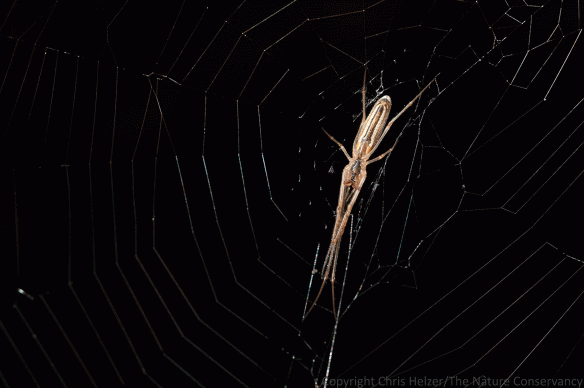
During a walk in our family prairie last week, I found a spider web spanning the entrance to a badger tunnel.

Spider and web at the entrance of a badger hunting tunnel (where a badger had dug a tunnel to catch a ground squirrel or some other small creature. Helzer family prairie. nebraska.

If you look closely, you can see the spider near the top of the tunnel entrance.

When I pulled in close with my camera, the shadow behind the web and the bright sunlight on the spider contrasted beautifully.
ENPO160422_D003

It might be tempting to think the spider was trying to catch a badger except for three things.  First, that would probably end badly for the spider, and natural selection usually takes care of that kind of thing.  Second, spiders often string webs across any opening that could act as a funnel for flying insects.  A badger hole makes as much sense as any other, I suppose.  Third, this wasn’t a tunnel a badger lived in, just a hole dug while a badger was hunting a ground squirrel or some other small burrowing animal.  Most badger-made tunnels are of that ilk, and if you look closely at them, you can usually see the end of the tunnel within a few feet of the surface.

I do think it’s funny to think about what might happen if a spider hung a web across the opening of an active badger home, though.  I’m imagining a badger emerging from its tunnel in the morning and then hopping around shouting “OOOH!! Ick!  Spider web on my head! Spider web on my head!!”
Rising from the ashes. Again and again.

Fire and prairies go together like bologna and ketchup.  (There is no discussion about that, by the way, it’s just a fact.)

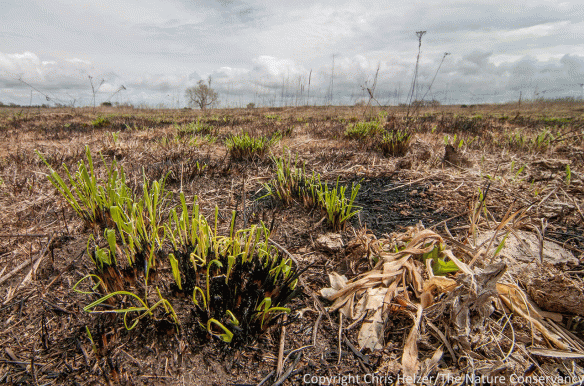
It’s always fun to watch prairies green up following a prescribed fire.  Plant regrowth is rapid and vigorous, especially after a fire that takes place just as the growing season is starting.  In fact, because the soil warms up faster in recently burned areas, we often see plant species emerging weeks earlier where we’ve burned than in unburned prairies.  The photos below were all taken one week after a fire we conducted at The Platte River Prairies this spring.

Rosin

Rosinweed (Silphium integrifolium) and grasses in restored prairie.

A created wetland

Rainwater filled this created wetland after it was burned, creating excellent habitat for migratory shorebirds and many other creatures in what was formerly a corn field.

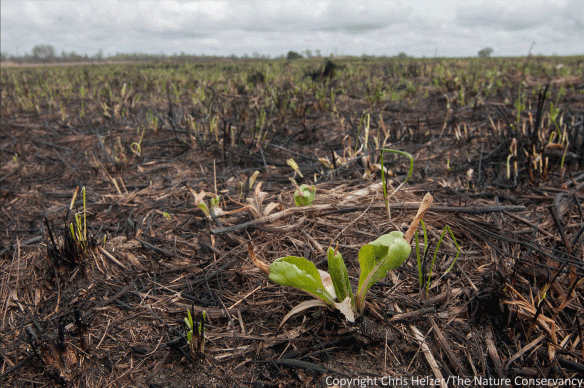
False gromwell (Onosmodium molle) was one of the fastest to re-emerge from this spring's burn.

False gromwell (Onosmodium molle) was one of the fastest to re-emerge from this spring’s burn.

g

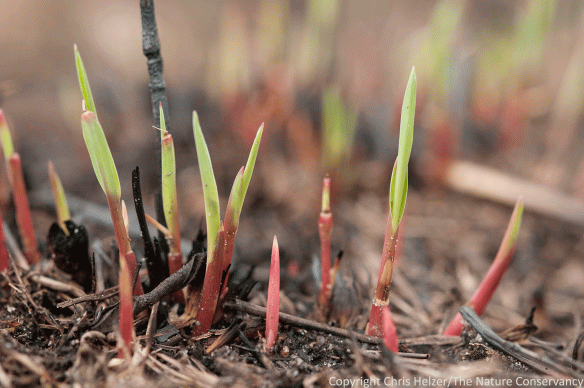
Beautiful two-toned grass shoots were scattered across the entire burned prairie.

Beautiful two-toned grass shoots were scattered across much of the burned prairie.