Photo of the Week – February 25, 2016

After a long week in Texas, it was nice to spend a restful afternoon at our family prairie last Saturday.  The weather was gorgeous and we spent a great day playing with the dogs, cooking hot dogs on a campfire, cutting small cedars, hiking, and (of course) doing a little photography.

Kim spent much of her afternoon thumbing through seed catalogs and planning this year's garden.  The dogs played a lot of frisbee...

Kim spent much of her afternoon thumbing through seed catalogs and planning this year’s garden. The dogs played a lot of frisbee…

When diffuse clouds covered the midday sun for a little while, I grabbed my camera and set out to add some photos to a little project I’ve been working on – finding color in winter prairies.  The subjects that caught my eye on Saturday were prairie plant rosettes.  Most biennial plants (and some short-lived perennials) in our prairies spend their first year as a tightly arranged cluster of leaves close to the ground – a rosette.  Those leaves photosynthesize enough to get the plant’s root system started, giving it a head start on its second year growth.  Often, rosettes are found in areas of prairie that are recently grazed or mowed because competing plants are both short and weak, opening up space for new plants to establish.  Rosettes often stay green much of the winter, but the leaves can also turn other colors like red or yellow.
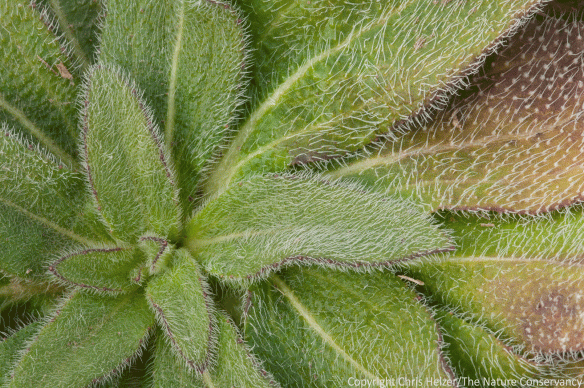
The green fuzzy leaves of black-eyed Susan.

The green fuzzy leaves of black-eyed Susan (Rudbeckia hirta).
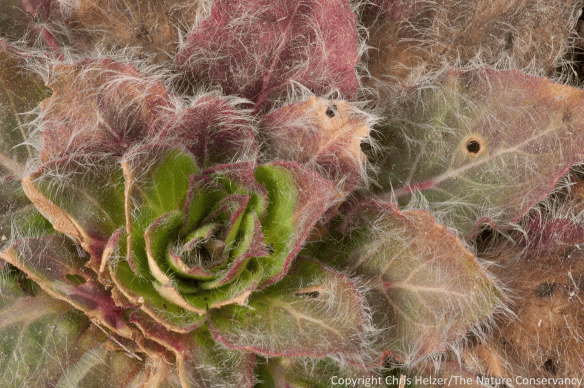
Another rosette.  Maybe common mullein (Verbascum thapsus)?  I don't remember seeing mullein before at our prairie, but that was the best guess of my friend Grace Kostel when I sent her this odd-colored cropped photo...

Another rosette. Maybe common mullein (Verbascum thapsus)? I don’t remember seeing mullein before at our prairie, but that was the best guess of my friend Grace Kostel when I sent her this odd-colored cropped photo…

As I write this, I realize that I don’t actually know for sure how rosette leaves work.  I’ve always assumed that the leaves on a rosette lose their green color for a while during the coldest parts of winter and then green up again in the spring.  That is different from what most prairie forbs (wildflowers) do, of course, because their leaves drop off in the fall and they grow new ones in the spring.  Does anyone know if leaves in a rosette really can turn red/yellow and then green again?
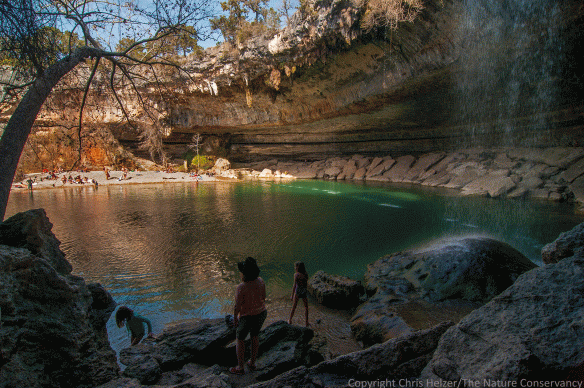
Photo of the Week – February 19, 2016

I have to admit it – my job is pretty sweet.  Every job has its ups and downs, but this week has been mostly ups (apart from being without my family).  I’ve spent the last several days with about 240 other scientists and conservation staff of The Nature Conservancy here in Austin, Texas.  It’s hard not to be inspired and energized when discussing fire, invasives, grazing, ecology, and many other conservation topics with incredibly smart and innovative people.

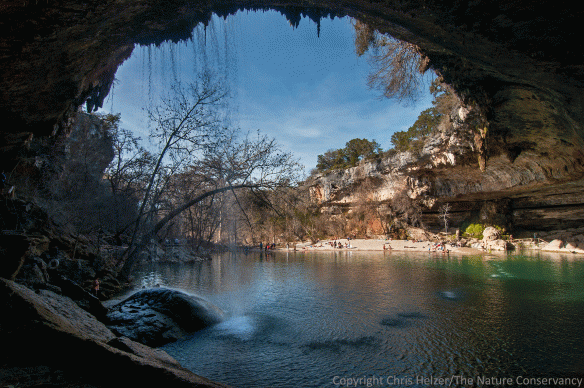
I wrote earlier this week about the first half of the field trip we took in the Hill Country around Austin.  During the second half of that trip, we visited Reimers Ranch Park and Hamilton Pool, the latter of which is an iconic natural feature and recreation site.  It is so popular that demand far outstrips the capacity of the parking lot and park, and we were told that and incredible 70% of visitors are turned away.  (We visited on a Tuesday afternoon in February and the parking lot looked full.)

Hamilton Pool

Hamilton Pool – the beautiful result of a collapse roof of a cave over an underground river.

ENPO160216_D014

ENPO160216_D012

Since my post earlier this week on our tour of the Barton Creek Preserve, I’ve gotten considerable feedback, both in person and electronically, about my description of the site.  The intent of the post was primarily to explore the idea that land managers often have very different objectives from each other because each deals with unique landscapes and situations.  I described the Barton Creek Preserve and its management as it had been presented to me during our field trip there.  Well, apparently, there are some very disparate views about the historical conditions at Barton Creek and the surrounding Hill Country.  I’ve had a fair amount of feedback from Texas ecologists who disagree with the way I characterized the site.

Most everyone agrees that there was soil loss due to years of heavy grazing, but I’m also hearing that the site may have had pretty shallow soils even before domestic cattle and goats were introduced.  Those shallow soils supported (and still support) a diverse flora, including plants that are endemic to the Hill Country.  I’ve also gotten to listen to and read competing accounts of whether the pre-European vegetation of the site’s uplands consisted of grasslands, shrublands, savannahs, or open woodlands.

It’s clear that I’ve unwittingly wandered into a discussion in which I am completely unqualified to participate. I am very happy (and eager) to leave further discussion of the historic conditions of Barton Creek Preserve and the Texas Hill Country to others, and I’ve edited my earlier post to reflect a more balanced account of the site’s ecology.