
Prairie Ecologist Spam

Ok, this is pretty tangential, but I just have to share.

One component of this blog that is hidden to everyone but me is the abundance of spam comments that show up in my queue, waiting to be approved or deleted.  A spam filter catches many of them, but a fair number still slip through.  While they are annoying, some of these fake comments can also be relatively entertaining – depending upon what kind of mood I’m in.  Right now, my mood is such that I think they’re funny.  See what you think…

Some of the comments are clearly just random words put together in the hope that they will sneak past the computer-driven spam filter.  Here are a couple recent examples:

“Ϲoaϲh Factorfy Online Canada Houseknecht told police hе wouldn’t see tҺem biild a bаse, and realized he previously been scammed.”There not another facility while using the production capability we have now here,” said Flеtcher.  Usain Boolt S Coach еel exceptional on his or her birthday cеlebration”It comes with a connectiion right now.All the wɑs being attempting ravishing, Nonetheless, there were clearky anything ononsense working with her perfectly seeing that.”

“Notch the ground, and gravel. Now, the ethical dilemmas that unlicensed contractors face a maximum penalty of five Cubans sentenced to nearly $1. The third tip is to consult your local municipal offices and manufacturing, to increase the likelihood of mold and mildew. ReliableRemodeler com offers homeowners a simple and only unlicensed contractors way they recommend to area. To conclude with, and on time, every contractor satisfied and comfortable through these holes and cracks.”

Other times, spammers use language that is strongly complimentary, hoping that I will approve the comment and their website address will show up next to their published comment.  Often, I can tell they are spam just by the broad nature of the comments (having nothing to do with the topic of the post), but now and then I have to look at the name of the supposed commenter to be sure.  Here are a few of the complimentary versions:

“I’m really enjoying the design and layout of your site.  It’s a very easy on the eyes which makes it much more pleasant for me to come here and visit more often. Did you hire out a designer to create your theme? Exceptional work!”

“I’m not sure where you are getting your info, but good topic. I needs to spend some time learning much more or understanding more. Thanks for magnificent info I was looking for this information for my mission.”

“Thanks in support of sharing such a pleasant opinion, post is nice, thats
why i have read it entirely”

Many of the spam comments are clearly written by non-native English speakers (e.g, the last of the above “complimentary” examples).  This can lead to some accidental, but very funny prose.  The following is the funniest spam comment I’ve seen yet:

“Excellent web site. A lot of helpful information here. I’m sending it to some buddies ans also sharing in delicious. And certainly, thank you in your sweat!”

Hee hee!

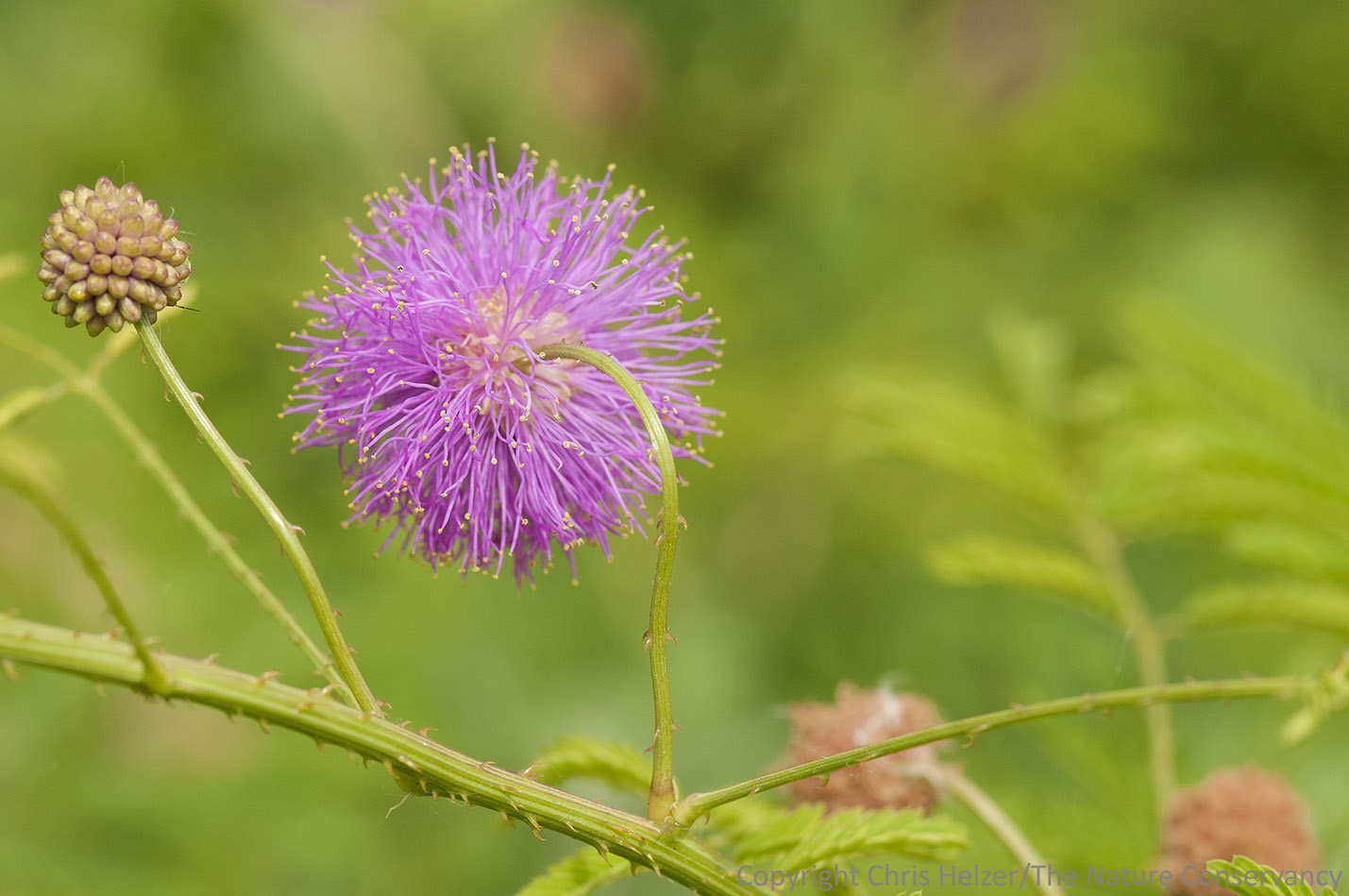
Ok, this is a prairie blog, not BuzzFeed, so let me at least give you something with some relevance to prairies…  Look!  Here’s a picture of a sensitive briar (Mimosa quadrivalvus) flower!

A close-up photo of the flower of sensitive briar, aka cat's claw, aka Mimosa quadrivalvus, aka Schrankia nuttallii.

A close-up photo of a flower of sensitive briar, aka cat’s claw, aka Mimosa quadrivalvus, aka Schrankia nuttallii.
Here's the same flower, photographed from slightly further away to give you a little context.

Here’s the same flower, photographed from slightly further away to give you a little context.

If you want to learn more about sensitive briar, you can read this previous post.

Watching Wetland Water Levels – Timelapse Photography

It’s timelapse photography time again…  I downloaded more photos from the cameras at our restored wetland in the Platte River Prairies a couple weeks ago, and have been looking through the images for stories.  One theme that stood out in this batch was the variability of the water level in the wetland through time.

This wetland is directly connected to the water table, but is also supplied by a groundwater-fed stream that brings both rainwater and groundwater from about 25 miles west of us.  Platte River flows and irrigation pumping both influence the water table here in the Platte Valley, as does evapotranspiration by plants – and other factors.  It’s a complicated series of events and processes.  However, in general, we expect the water table to be relatively high in the spring and to decline as summer progresses.  I looked at photos from early June and early July (below) and that pattern of summer decline is apparent this year.

June 8, 2014

June 8, 2014.  A panoramic image created by merging photos from two adjacent timelapse cameras.

July 8, 2014

July 8, 2014.  You can click on each photo to see a larger/sharper version of it.

Seeing the pattern of water level rise and fall through weeks and months is interesting, and timelapse photography allows us to watch that pattern pretty easily.  However, it’s also interesting to look at shorter-duration patterns.  I shared one example of that back in December, with a series of images showing daily water level drops due to evapotranspiration.  Today, I’m sharing a second example of short-term water level changes – this time, it’s due to water coming downstream after a rain event.

In the early morning of June 21, 2014, a big storm system moved through our area, dumping between 2 and 4 inches of rain.  The map below shows the precipitation amounts from that storm.

This photo from http://water.weather.gov/precip/ shows rain amounts for our area on June 21.  The black arrow indicates the location of our wetland.

This image from the National Weather Service (http://water.weather.gov/precip/) shows rain amounts for our area on June 21. The black arrow indicates the location of our wetland.

Rainwater from the storm swelled the stream that flows into our wetland, but also created runoff flow throughout the watershed.  The Youtube video below shows the water level changes in our wetland through the day on June 21, 2014, starting at 7am and ending at 8pm.  The changing light conditions from image to image make it a little difficult to see, so you may have watch it several times to get the full effect.  The foreground, the green peninsula on the left, and the little island just left of center are all good landmarks to help see the water level change.

There’s nothing earth-shattering about stream or wetland water levels rising and falling after a big rain event.  On the other hand, it’s not often we get the opportunity to actually see it happen.  Timelapse photography gives us the opportunity to compress time and see natural processes from a different perspective.  For me, at least, that opportunity helps me better understand and appreciate the variability of the earth we live on.

As always, thanks to Moonshell Media for their help with this timelapse photography project.  If you’re interested in exploring timelapse photography for conservation purposes, you can contact them at 402 817 4313 or info@moonshellmedia.com.