Photo of the Week – July 17, 2014

A couple weeks ago, I posted a photo of a sunset from the Niobrara Valley Preserve.  In the post, I talked about having to scramble to get into position for the photo before the color left the sky.  Barely a week later, I found myself in the same situation again…

This time, I was at home in the evening, playing an indoor game with my 13-year-old son.  A rainstorm passed through while we played, and as the storm was moving away, the sky started to light up in one of those Great Plains post-storm sunset spectacles.  Mammatus clouds abounded, along with lots of color and texture.  As my son and I enjoyed the view through the window, he told me I should really be out taking pictures.  I replied that I was perfectly happy enjoying the view with him, and that we were in the middle of a game.  A few minutes later, however, the sky was even more spectacular and, since he was insisting, I grabbed my camera and ran for it.

A sky like that deserved a decent foreground, and ideally, I wanted something that could reflect the light.  I jumped in the car and drove west toward the nearest wetland (9 miles away).  As I drove, I was watching the already-fading color and receding clouds through my rear-view mirror…  After what seemed like an hour-and-a-half, I finally reached the wetland and jumped out of the car.

Post-storm clouds over a wetland at Springer Waterfowl Production Area, west of Aurora, Nebraska.

Post-storm clouds over a wetland at Springer Waterfowl Production Area, west of Aurora, Nebraska.

I had time for about one photograph facing east (above) before the color in that part of the sky faded completely.  However, there was still a little color to the west, so I hopped over to a different wetland pool and tried to set something up in that direction.  I’d pulled on some knee-high rubber boots, which did me no good at all as I waded into thigh-high water…

Last light at Springer.

Last light at Springer.

I managed to shoot a few frames before the light disappeared, and then slogged my way back to the bank and dumped my boots out on the gravel road.  Then I squished my way back to the car and drove back home to have a shower.
 

Longhorns on the Prairie

One of the great things about prairies – and nature in general – is that there is way more to discover than I’ll ever have time for.  Especially within the world of invertebrates, there is no shortage of species to learn about, and every one of them has a fascinating story.  During the last two weeks, I’ve started paying attention to longhorned flower beetles, a group of species I’d noticed before while looking for bees.  Not surprisingly, once I started really looking at them, I discovered that there are multiple species and that they are much more common than I’d realized.

This longhorned beetle is likely Typocerus confluens, according to Ted MacRae.  There were a couple different (but similar) species around the day I took these photos.

This longhorned beetle is likely Typocerus confluens, according to Ted MacRae, but he said there are others that look enough like it he can’t tell for sure from a photograph.   The Nature Conservancy’s Platte River Prairies, Nebraska.

These beetles belong to the “flower longhorn” group of insects (family Cerambycidae, subfamily Lepturinae).  Adult flower longhorns are largely diurnal (active during the day) and feed upon a wide variety of wildflowers.  When I started looking for information on longhorns, I turned to Ted MacRae, an entomologist and author of the fantastic blog, “Beetles in the Bush“.

Ted helped me identify the species I’d been able to photograph around here, and gave me some good information on what longhorns are all about.  Ted, by the way, has documented at least 229 species and subspecies of longhorn beetles in Missouri.  That information made me feel better about being unable to identify my photographed beetles myself, but also strikingly ignorant about a very diverse group of insects I’d never really noticed before.  (Such is the way it usually goes with insects.)

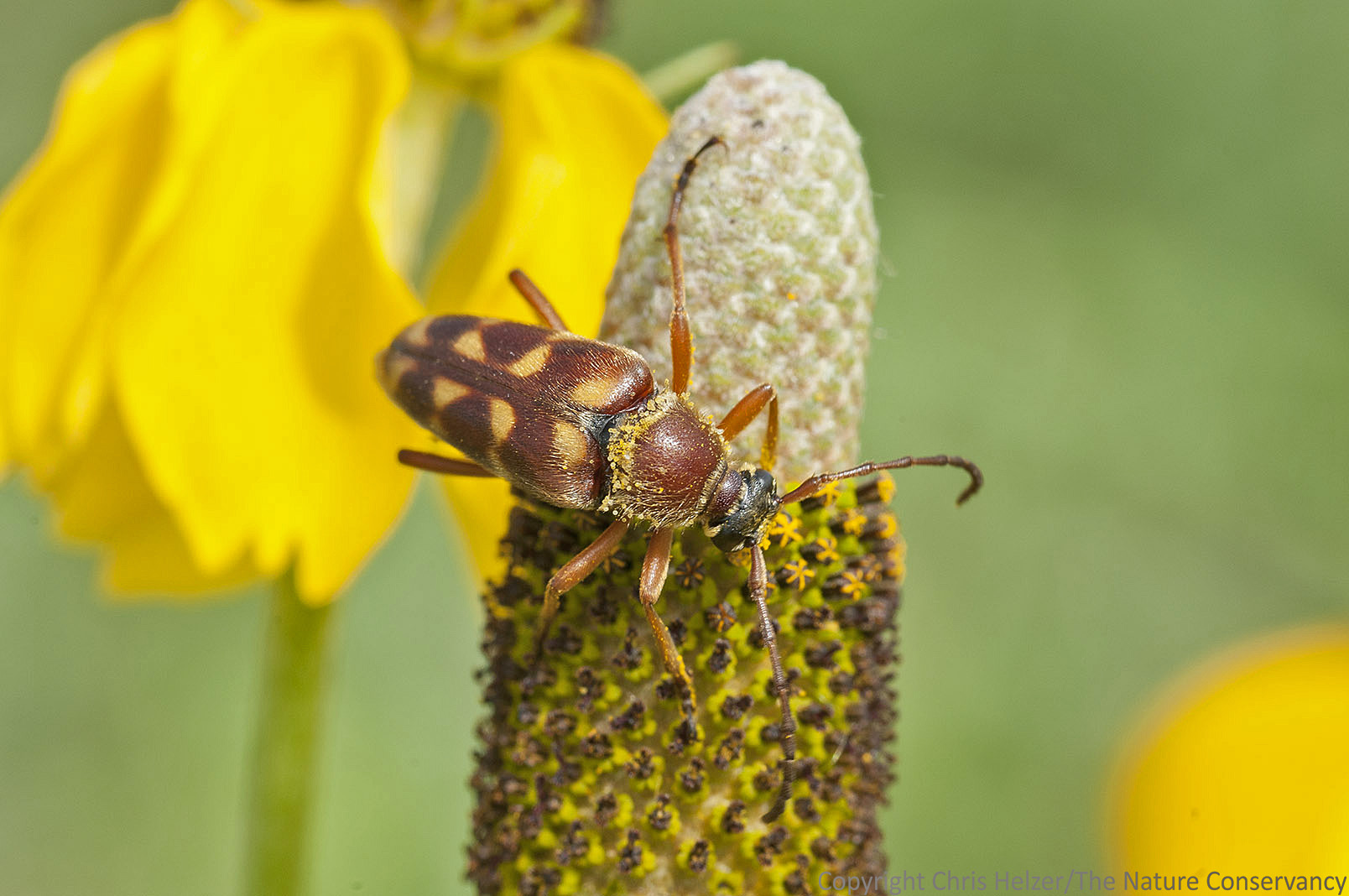
Ted thought this was probably Typocerus octonotatus, a common Great Plains species of longhorned beetles.

Ted thought this was probably Typocerus octonotatus, a common Great Plains species of longhorned beetles.  You might think it looks just like the T. confluens in the earlier photo, but look more closely at the color pattern…  I know, right?!   Helzer Family Prairie, near Stockham, Nebraska.

Flower longhorn beetles are named for their habit of feeding on wildflowers as adults.  As larvae, on the other hand, most longhorn beetles are wood-borers.  That includes many (most?) members of the Typocerus genus – the genus of beetles I’ve been seeing.  However, Ted says the larvae of many Typocerus species in the Great Plains are actually subterranean root feeders on prairie grasses.  That, of course, seems a much more sensible strategy for insects in landscapes with only widely scattered woodland habitats.

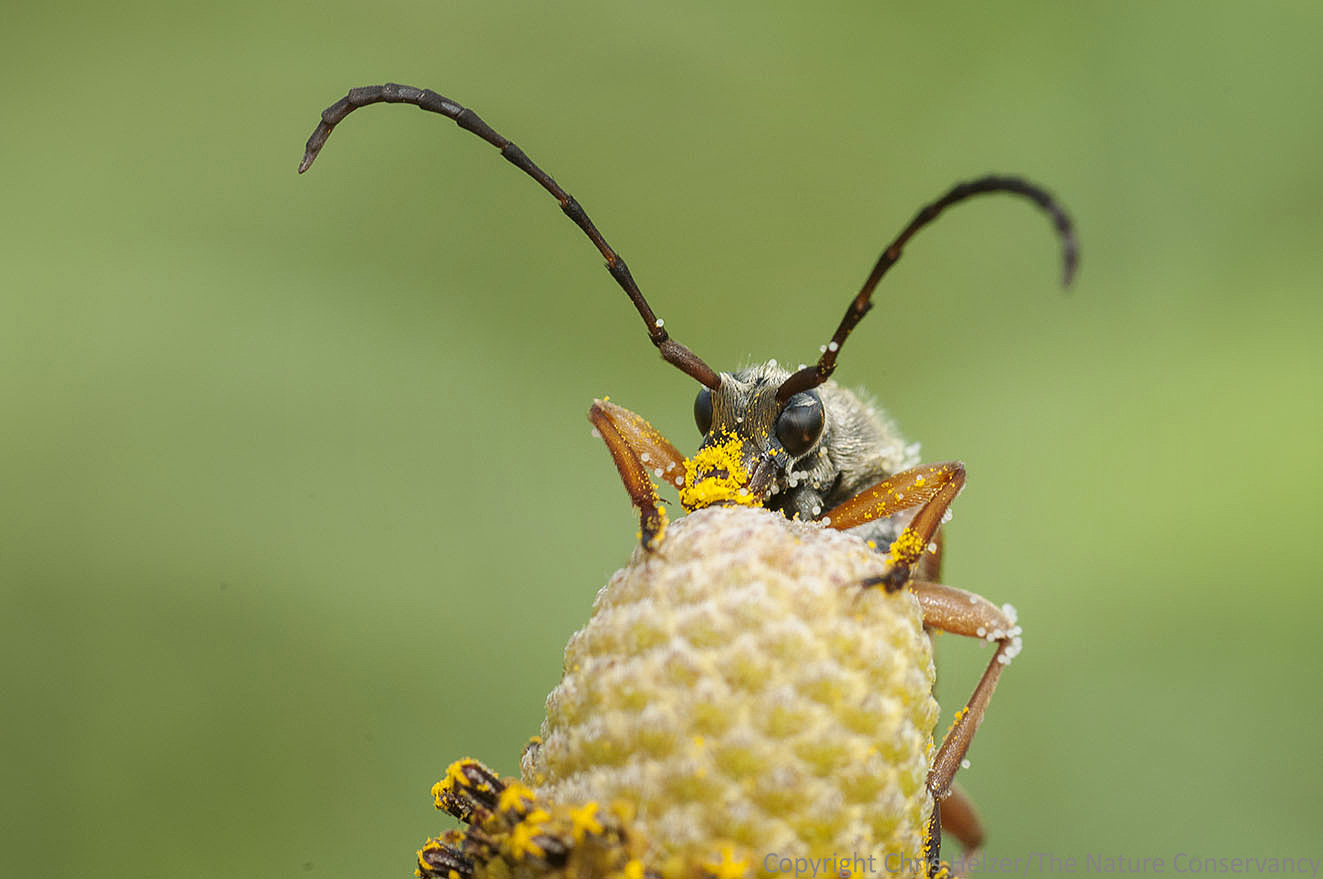
Face on.

A longhorned beetle with a face full of pollen.

Now that I’ve started to pay attention to longhorned flower beetles, I’ll probably never ignore them again.  That’s both a blessing and a curse.  I love learning about new species, but it makes prairie hikes go more slowly because the more species I recognize, the more there is to see.  If this keeps up, it’ll take me all day to walk 100 yards!

Thanks to reading this post, your mind has also been infected with the visual image of longhorn flower beetles.  The next time you walk through a prairie, you’ll likely spot more than one.  (You might want to budget just a little more time for that prairie walk, by the way – sorry about that!)