Photo of the Week – September 29, 2017

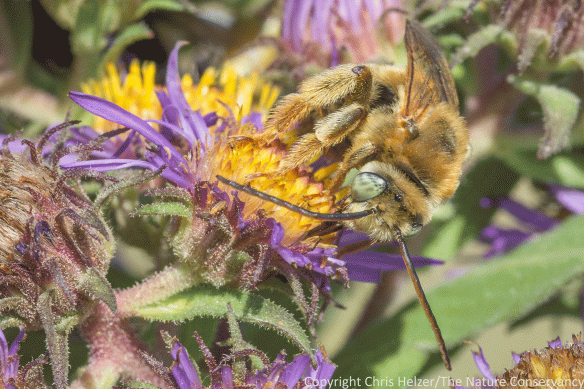
As the growing season comes to an end and most wildflowers wind up their blooming period, insects that feed on nectar and pollen have to work a lot harder to find food.  The few remaining plants with active flowers suddenly become really popular.  In this part of Nebraska, those last remaining wildflowers include species like tall thistle (Cirsium altissimum), heath aster (Aster ericoides), and New England aster (Aster novae-angliae), among others.  The other day, I spotted a lone New England aster plant being mobbed by hungry insects.  Here are some photos…


Over the five minutes or more that I watched the horde of insects on this plant, I saw the same individual blossoms get worked over multiple times by multiple insects.  After all that activity, I can’t imagine any of those insects were really getting much of anything out of those flowers, but they were certainly trying…

Painted lady butterflies are still pretty abundant, but not nearly as abundant as they were a year ago.

How many insects can you find on the photo below?  I can find four painted lady butterflies, a skipper butterfly, three different bees, and a tree cricket.  Not pictured are a couple of grasshoppers and a few other bees that were just below the field of view.
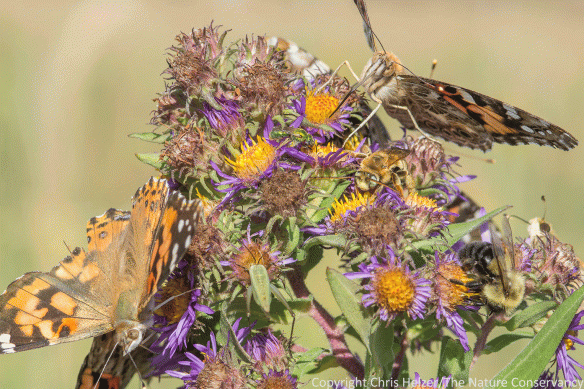
How many insects can you see?  Click on the photo to see a larger version of the image.

I assume the remaining painted lady butterflies will migrate soon, but most of the other pollen and nectar-eating insects around here don’t have anywhere to go.  Some will simply die with the flowering season, but others will spend the winter in a state of dormancy and re-emerge in the spring.  I sometimes use the analogy of watering holes in Africa when talking about flowers and pollinators.  In this case, the analogy seems particularly apt as the last “watering holes” are drying up and the animals relying on them are highly concentrated.  I was surprised not to see any “crocodiles” (e.g., crab spiders) at this particular watering hole, taking advantage of an increasingly desperate prey base.

I appreciate living in a temperate zone where I can enjoy a nice variety of seasons through the year, but I’ll certainly miss seeing (and photographing) flowers and insects over the winter.  It’s hard to focus on indoor work these days, knowing that my opportunities to see those flowers and insects this season are dwindling fast…

Photo of the Week – September 22, 2017

The Chinese mantis (Tenodera sinensis) is an impressive creature.  Introduced to North America, it has certainly made itself at home here.  Entomologists I’ve talked to express varying levels of concern about the presence of the Chinese mantis – as well as the narrow-winged mantis (Tenodera angustipennis) and European mantis (Mantis religiosa).  Most would rather those non-native mantises not be here, but say it’s hard to find strong evidence that they are doing measurable harm to the ecosystems they’ve moved into.  If anyone knows of research that has defined the impacts of these non-native mantises I’d love to hear about it.

The Chinese mantis comes in either grayish-brown, green, or a combination of green and brown.

Regardless of impact, Chinese mantises are fascinating animals, as are our native mantises like the Carolina mantis (Stagmomantis carolina).   While I was out taking pictures last weekend, I ran across three different Chinese mantises and captured the images in this post.  I think they show some of the various attributes of these amazing (and possibly harmful) creatures.

A Chinese mantis feeds on a captured hover fly.  Lincoln Creek Prairie, Aurora, Nebraska.

Seen from underneath, the mouth of the mantis is really otherworldly.  Praying mantises can turn their head 180 degrees – a unique attribute among insects.  That ability helps them scan for both prey and predators.

“Do you mind? I’m eating here…”

This mantis was finishing off a skipper butterfly (a Sachem?) while hanging beneath the flowers of pitcher sage (Salvia azurea).

The “pupils” in the big compound eyes of mantids are actually pseudopupils, and are a trick of the light rather than an actual structure.  Look at the location of the pseudopupil in the earlier photo showing the underside of a mantis’ head…

The mantis in this photo is not looking in a different direction than in the above photo, but the angle of light hitting the eyes makes it look that way.

One additional attribute of praying mantises, especially the big ones, is that they are noticed by the general public, including kids.  I spent last Friday helping with a prairie-based field day for 5th graders, and my job was to get the students interested in invertebrates.  We used sweep nets to catch inverts, and the kids got to catch and hold grasshoppers, katydids, and spiders.  Moving kids from “Spiders are icky!” to “Ha ha – this spider tickles when it walks on my hand!” is a really important process.  If we want people to understand the value of invertebrates, they first have to see them as something other than icky.  In that regard, the absolute star of the day was a big Chinese mantis one of the kids found early in the day.  I kept it and showed it to each group of students I visited with during the day, and it never failed to get oohs and aahs from them.  Everyone got to touch it, and it was big enough that we could easily talk about it’s various body parts, how it hunts, etc.  As an ambassador for invertebrate kind, it was very effective.  An important gateway bug, if you will.