Photo of the Week – September 8, 2016

Back in late June, a group of us were at the Niobrara Valley Preserve collecting data.  During the evening, a storm rolled in from the west.  Against all common sense and safety, I went up on a hill above the Niobrara River to photograph the approaching lightning.

Lightning over

Lightning over the Niobrara River.  The Nature Conservancy’s Niobrara Valley Preserve.

Lightning photography seems much more complicated than it actually is.  Mostly, you just point the camera toward a storm, open the shutter of the camera for a while, and hope lightning strikes within the frame before you have to close the shutter again.  The photos here were taken with exposures between 3 and 8 seconds each.  And, of course, I took about 200 photos (I’m guessing, but that’s probably close) and ended up with a handful of shots with lightning bolts in them.

Lightning

More lightning over the Niobrara River.

Lightning

Even more lightning.  Actually, this photo came before the other two, sequentially, which is why the lightning looks skinnier (it was further away).

They say photography is mostly about being there, and that’s certainly the case with these photos.  Unfortunately, lightning can be awfully dangerous (I was once knocked down by a nearby lightning strike while trying to get off the top of a mountain and really don’t want to repeat that).  Eventually, safety concerns overrode the urge to capture a great image and I skedaddled for shelter.  A more dedicated photographer would have stuck around for the lightning to fill the frame.  On the other hand, I’m still alive to write this post.

There’s something to be said for that.
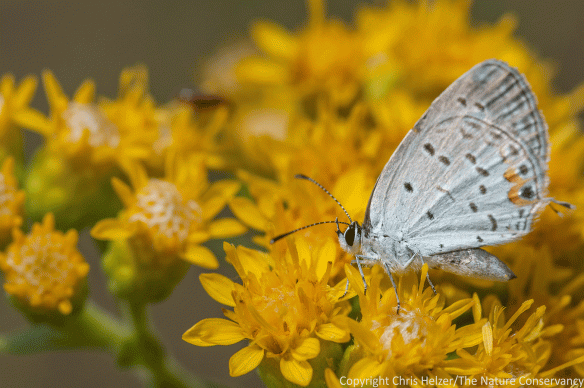
Photo of the Week – September 1, 2016

Two weeks ago, I posted about Yellow Season in prairies.  That annual phenomenon continues, and at our family prairie this week, stiff goldenrod was front and center.  Pollinators and pollen-eating insects seemed to approve.

Eastern-tailed blue

Eastern-tailed blue butterflies were abundant on stiff goldenrod flowers.  They were tricky to photograph, however, because at the slightest hint of danger, they flew from the flower and onto a nearby grass leaf where they sat facing directly away from the sun.  I’m not sure if that was always a risk aversion tactic (hard to see them in the shadows when their wings weren’t catching sunlight) or also a heat management tactic (turning their giant solar panel wings away from the sun to cool off).

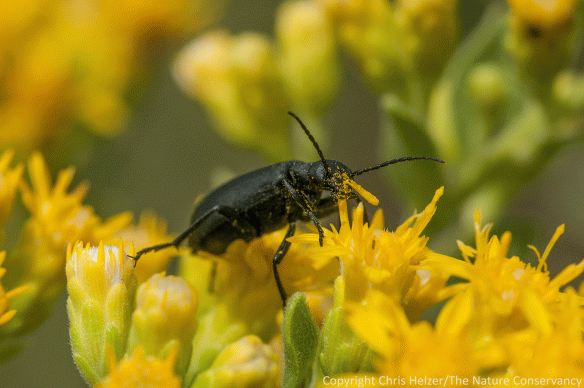
Blister beetles were enjoying meals of goldenrod pollen, but it's not clear whether they were actually pollinating flowers.

Blister beetles were enjoying meals of goldenrod pollen, but it’s not clear whether they were actually pollinating flowers.  Some beetles eat parts of the flowers themselves, not just the pollen.  I couldn’t tell if blister beetles were doing that or not.

Cucumber beetles

Cucumber beetles (here) and soldier beetles (not shown) were also all over the place.  Not much pollen sticks to these smooth beetles, so they probably don’t carry much from flower to flower.

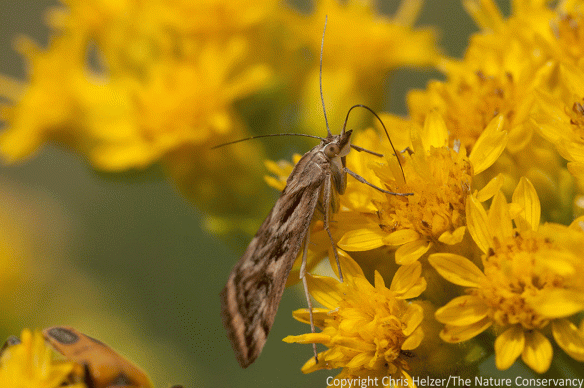
Moths of various species were numerous, but wary, quick, and thus difficult to photograph.

Moths of various species were numerous, but wary, quick, and thus difficult to photograph.  This is the only one I caught.  (You can also see a bit of a soldier beetle in the lower left corner of the image.)

Gray hairstreaks were even more abundant than eastern-tailed blues this week.

Gray hairstreaks were even more abundant than eastern-tailed blues this week.  They also held still better, which was nice.  You can see the long tongue at work on this one.

Bee flies have a rigid

Bee flies are part of a family of flies called Bombyliidae, and and many have a long rigid proboscis and feed on pollen and nectar.  Unlike a butterfly tongue, the fly’s proboscis doesn’t retract, so it just sticks straight out as the bee fly zips around.  The best nickname I’ve heard for these creatures is “beewhal” (get it?  it’s like “narwhal” but for a bee) which is just tremendous.

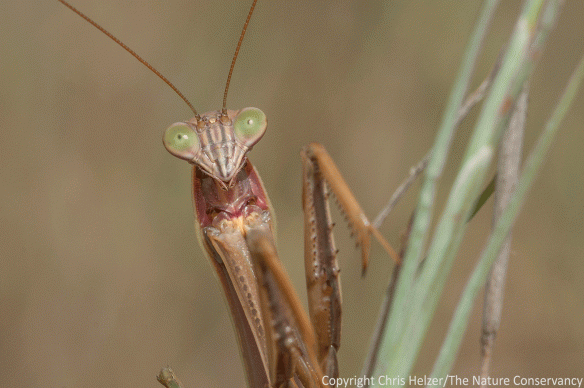
Often, when I post lots of pollinator pictures from a prairie walk, I also include a photo of a crab spider laying in wait. This week I couldn't find a single one! However, there was this big Chinese mantid, which will have to do.

Often, when I post lots of pollinator pictures from a prairie walk, I also include a photo of a crab spider laying in wait for an unwary insect. This week I couldn’t find a single one! However, this big Chinese mantid was lurking about amongst the goldenrod plants, so that will have to do.