A Special Volunteer

Volunteers are a critical part of our stewardship work at the Platte River Prairies.  We don’t have a lot of them, but we’ve been lucky to have some great ones.  All of our volunteers are appreciated, but we have special gratitude for those who commit so much time they are essentially staff – except we don’t have to pay them!  One of those terrific volunteers over the last three seasons has been Sam Sommers, a high school student from Kearney, Nebraska.  When his dad first approached us about Sam doing some volunteer work as a young high schooler, we wondered whether it would be worth our time, but figured that anyone with that much interest deserved our attention.  And man did we get our money’s worth (so to speak)!  He spent the vast majority of three summers working – very hard – alongside our stewardship staff.

Sam Sommers (left) helps last year's Hubbard Fellow Anne Stine and (then) Missouri Dept of Conservation ecologist Mike Arduser with some bee collectionin 2013.

Sam Sommers (left) helps last year’s Hubbard Fellow Anne Stine and (then) Missouri Dept of Conservation ecologist Mike Arduser with some bee collectionin 2013.

Sam is going off to study wildlife biology at the University of Wyoming this fall.  They are lucky to have him.  I could say a lot about how much we appreciate everything Sam has done for us – and we really do – but one of our Hubbard Fellows, Jasmine Cutter, stepped up to do it for me.

By Jasmine Cutter:

When I first got to the Platte River Prairies, I wasn’t sure who I was going to meet when I heard “Sam” mentioned. Based on Eliza’s (former Hubbard Fellow) enthusiasm – “Sam’s the best!!” – and Nelson’s nodded affirmation, I assumed that I was about to meet a celebrity. I have to say, Sam has lived up to the hype. He is tireless, curious, knowledgeable, and a real trouper! Sam is a master of the killstick, a seed-collector speedy enough to rival Chris (editor’s note: ok, he’s really good, but not THAT good), and a tireless thistle destroyer.
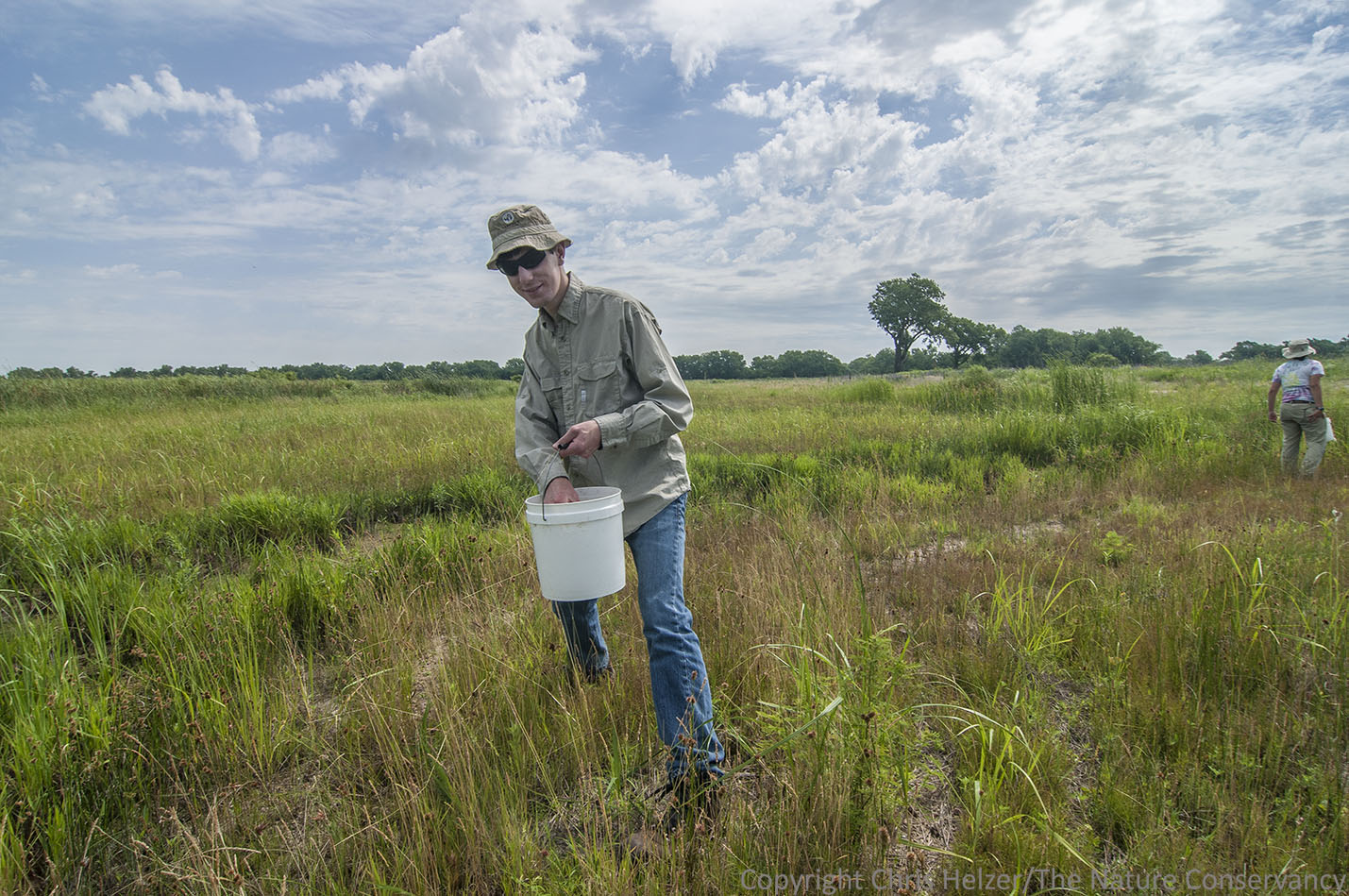
Here is Sam harvesting seeds along a restored Platte River wetland this summer.

Here is Sam harvesting seeds along a restored Platte River wetland this summer.

Coming into our Hubbard Fellowship just as the growing season was starting to take off was pretty overwhelming – long days, many different invasive species to learn, new tools to master, not to mention trying to figure out where all the sites are. Dillon and I often relied on Sam’s seasons of experience working here. His advice and assistance allowed us to operate fairly independently from Nelson, freeing up Nelson to work on other projects. Our introduction to stewardship wouldn’t have been nearly as smooth without Sam’s help.

Really, the thing that impresses me the most about Sam – besides his competency – is his work ethic. He is out here every day dealing with exactly what we’re dealing with: battling the mosquitoes/ticks/chiggers, the sometimes dispiritingly large patches of thistles, the sweaty herbiciding goggles, the heat, the long days… It’s hard to fathom how much more Chris and Nelson have been able to accomplish with Sam here. He has removed hundreds of trees, killed thousands of thistles and other invasive plants, collected dozens of gallons of seeds, and completed myriad other tasks that never would have happened without Sam. With a work ethic like his, I have no doubt that Sam will do great in college – it might even be a restful experience after his stint here. We will greatly miss Sam, and I can’t wait to hear about what he gets up to in the future!
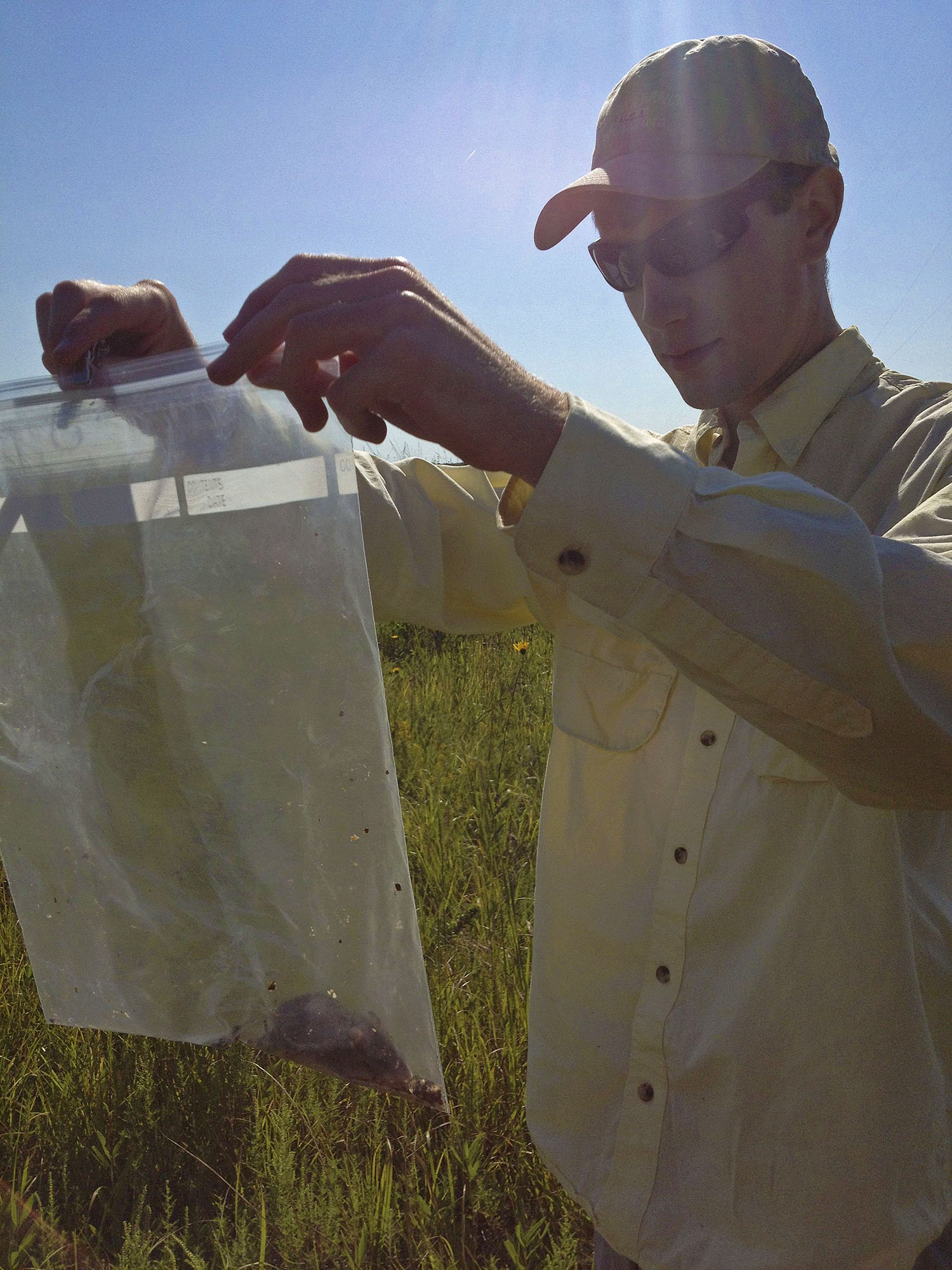
Sam helped Jasmine and Mike Schrad (Nebraska Master Naturalist) with some small mammal trapping this summer.  Photo by Jasmine Cutter.

Sam helped Jasmine and Mike Schrad (Nebraska Master Naturalist) with some small mammal trapping this summer. Photo by Jasmine Cutter.

Sam, THANK YOU very much for everything, and have a great time at college! – Chris H
Emergence of Life in a Wetland

After many years of wanting to, we finally installed some solar-powered pumps and livestock water tanks in our family prairie.  (Thanks to the U.S. Fish and Wildlife Service and Nebraska Game and Parks for providing cost-share money!)  Those two water tanks give the cattle nice cool clean water to drink and allow us more flexibility in the way we design our grazing each year.  Most importantly, they allow us to exclude the pond/wetland from grazing so it can start to function as a wetland rather than as a big mud hole for cattle to stand around in.

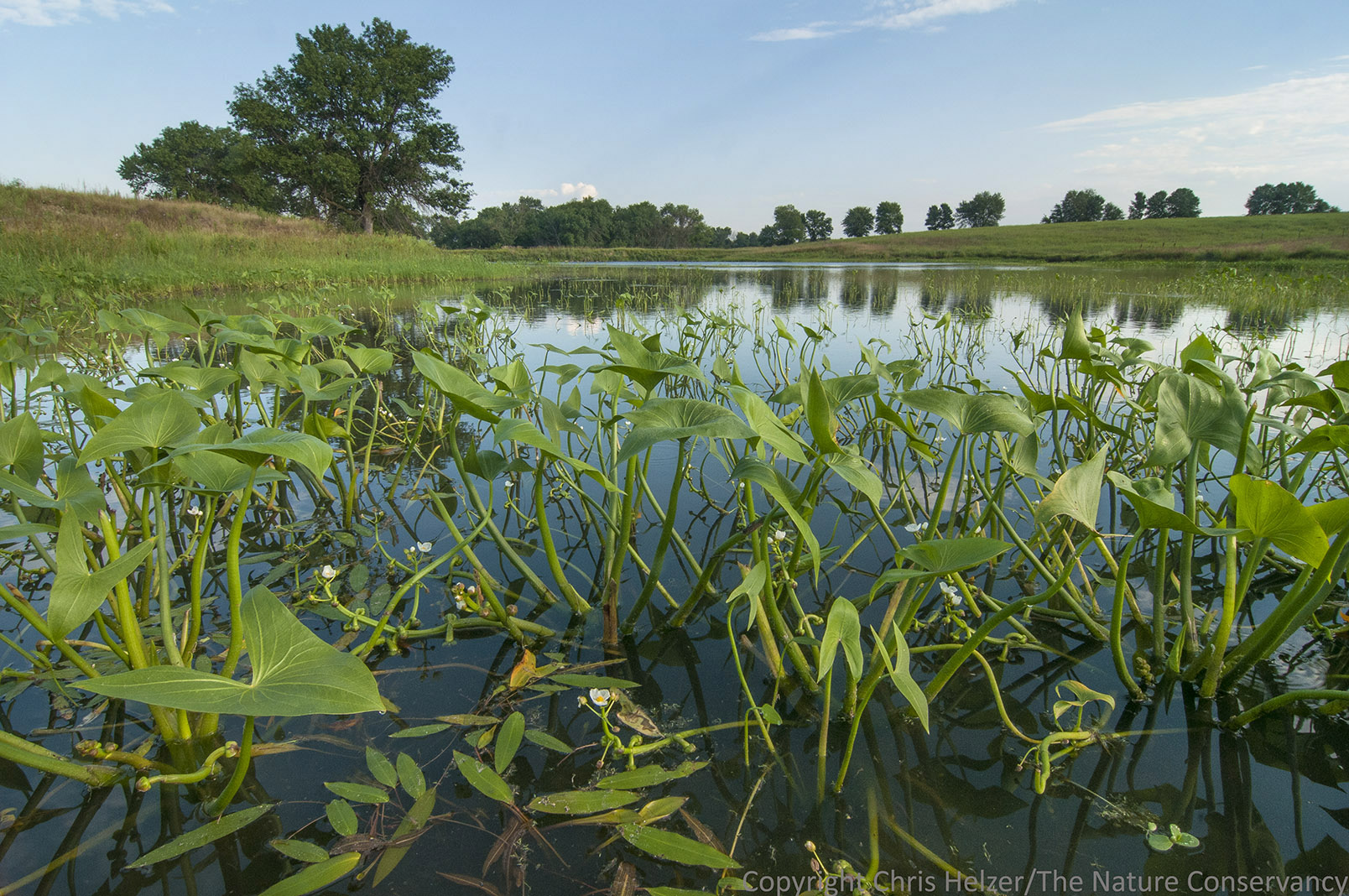
Because we’ve had good rains this year, the wetland has been pretty full.  That’s nice, but it has also prevented much of the wetland-edge seed I planted from germinating and growing.  Despite that, the recovery of the wetland is well underway.  There is now grass growing right to the water’s edge and arrowhead and other emergent plants are starting to appear in shallow water.  I’ve been spraying the few reed canarygrass plants growing nearby in the hope of preventing that invasive species from taking over the margins of the wetland, and hopefully I can get some more diverse wetland plants to establish there instead.

The pond/wetland at the Helzer family prairie with abundant arrowhead (Sagittaria sp.) in the shallows.

The pond/wetland at the Helzer family prairie with abundant arrowhead (Sagittaria sp.) in the shallows.

My daughter and I went for a walk at the prairie over the weekend and visited the wetland to see what was happening.  As I waded into the shallow water to take the above photo, leopard frogs scattered from my footsteps and red-winged blackbirds scolded me for encroaching upon their territories – very good signs of recovery.  However, looking more closely at the arrowhead plants poking through the water, I found even more evidence of new life.

Abandoned exoskeletons of damselfly nymphs were littered around the wetland.

Abandoned exoskeletons of damselfly nymphs were littered around the wetland.

Adult damselflies fluttered around everywhere, and many of them had apparently just appeared on the scene because the larval exoskeletons they’d just emerged from were stuck to leaves and stems all over the place.

ENPO140802_D008

ENPO140802_D010

While I was too late to see the actual emergence of the damselflies, I did manage to find a green darner dragonfly that had just popped out of its larval skeleton and was fluttering its wings and waiting for its body to dry and harden.  I snapped a few pictures of it in place and then carried it over to Anna so she could get a good look at it.

A green darner dragonfly and the larval exoskeleton it had only recently escaped from.

A green darner dragonfly and the larval exoskeleton it had only recently escaped from.

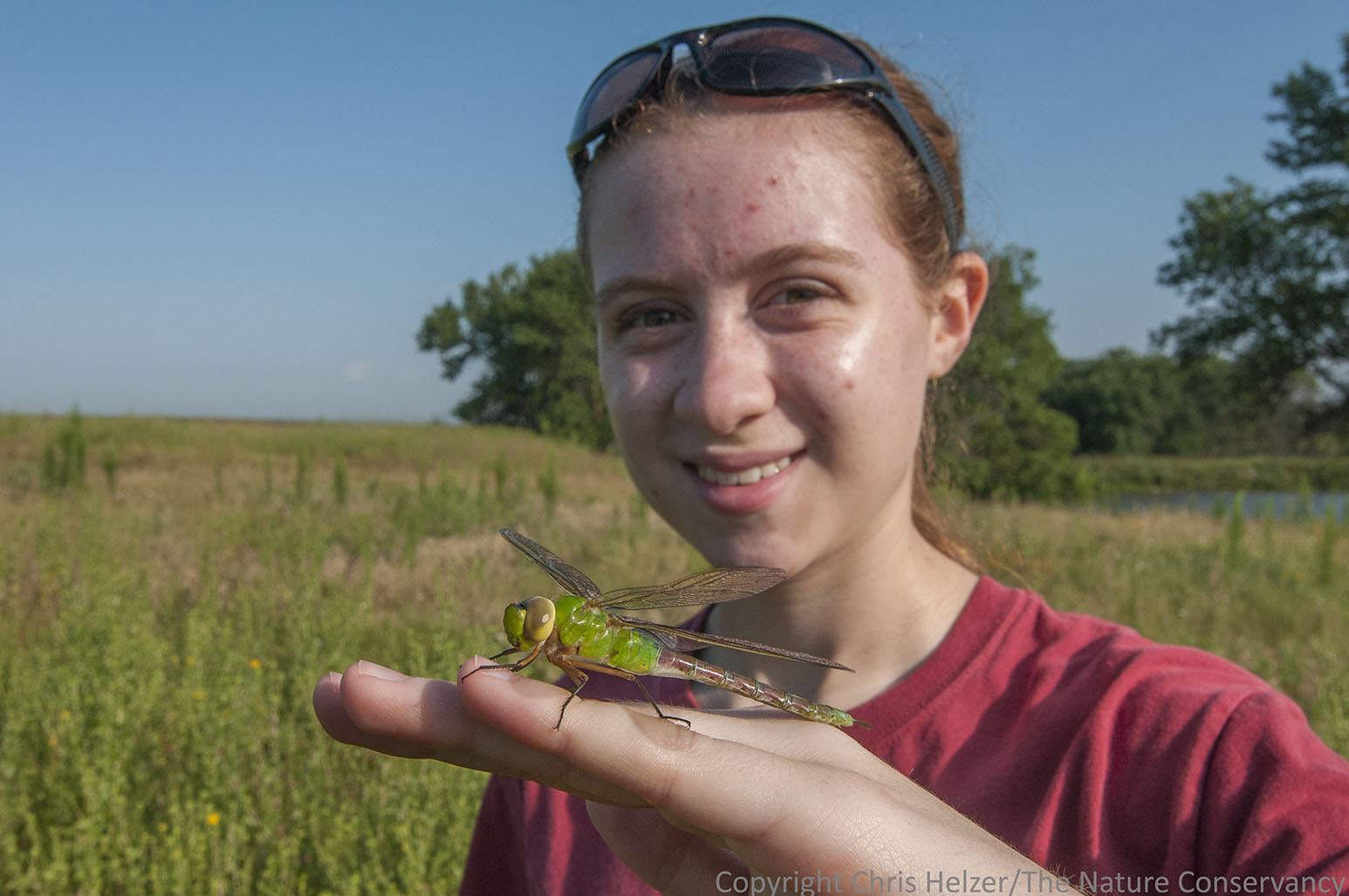
Anna enjoyed getting a close-up view of the dragonfly and even posed for a photo with it.

Anna enjoyed getting a close-up view of the dragonfly and even posed for a photo with it.

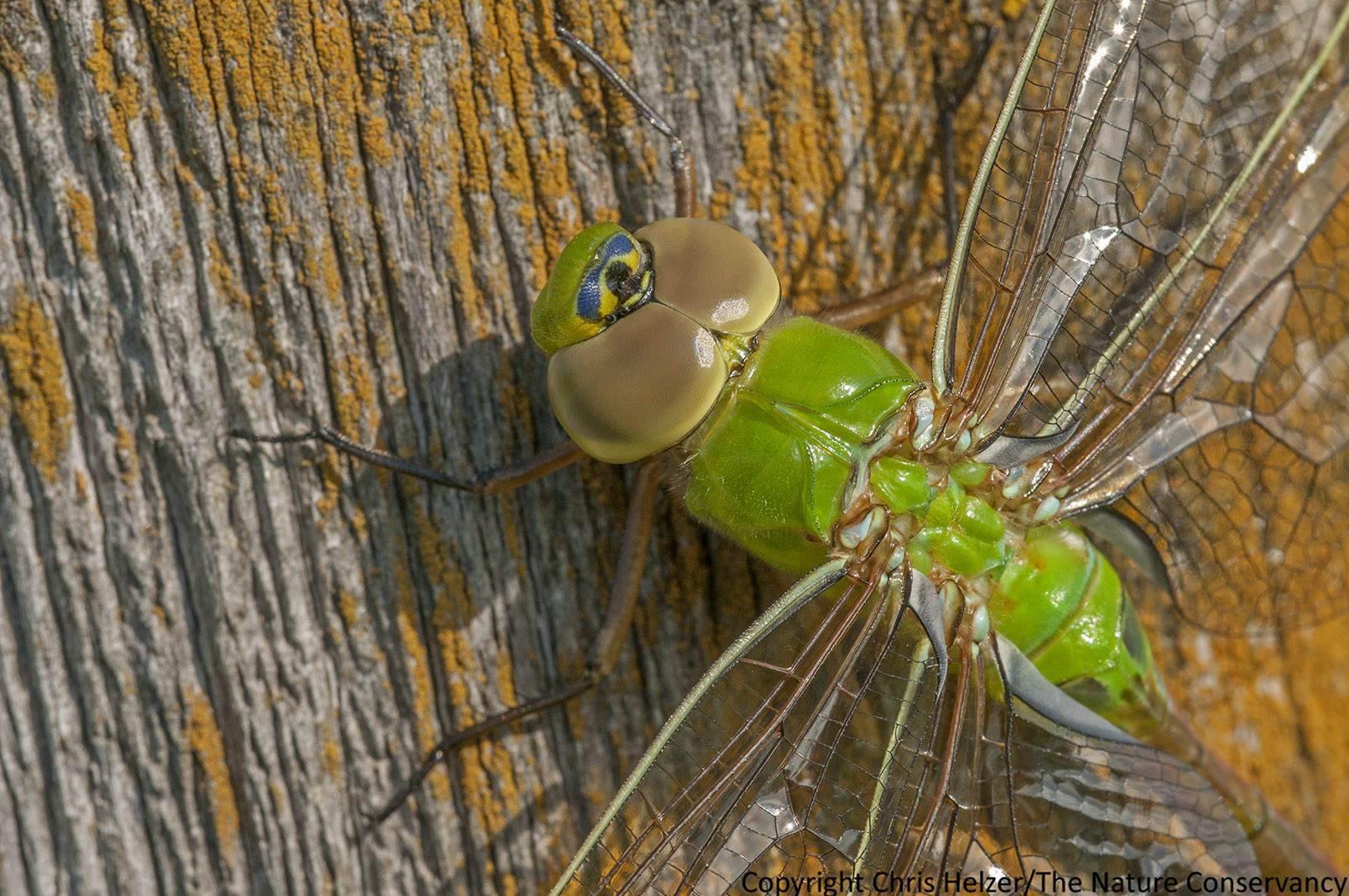
After we became a little better acquainted with the new dragonfly, we set it safely on a fence post so it could finish hardening up in the warm sun.  I took a few more quick photos of it on the post and then left it alone.  It was gratifying to see other dragonfly species zipping around nearby too – I’m hoping that’s a sign that a number of other aquatic invertebrates are also colonizing our recovering wetland.  It should be fun to watch the changes in the coming years.

Our new friend on the top of a fence post.

Our new friend on the top of a fence post.

ENPO140802_D019