
I spotted an upland sandpiper on top of a power pole last week. In central Nebraska, that’s not really noteworthy – upland sandpipers are pretty common across much of the state. They tend to nest in large open grasslands with short vegetation structure, and Nebraska has an abundance of that kind of habitat. This particular sandpiper, however, was perched on a pole surrounded by what looked to be miles of contiguous cropland. Seeing the sandpiper in that context got me thinking about how conservation scientists deal with patterns in data and, more particularly, the outliers that don’t fit those patterns.
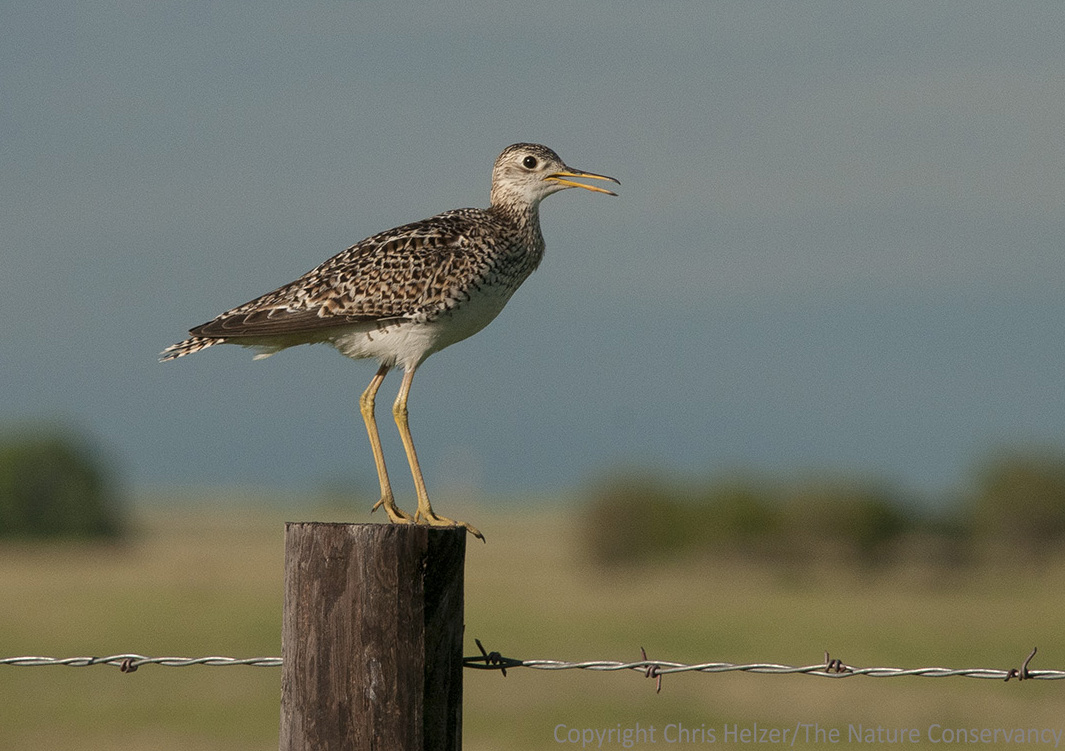
This is not the upland sandpiper I saw surrounded by cornfields, but another one who was living where he was “supposed” to be living – in big open grasslands near Norden, Nebraska.
My graduate research focused on grassland birds in fragmented prairies. I categorized bird species by the size of prairie they tended to nest in. Dickcissels and red-winged blackbirds seemed comfortable in really small prairies, grasshopper sparrows wanted a little more space, and bobolinks and upland sandpipers were usually in large prairies. Now and then, of course, we’d find a bird in a prairie much smaller than it was “supposed” to be in. An outlier. I included those outliers in the data, and their behavior was averaged in with all the other sightings, but I treated them as an anomaly – not something important. I wonder now if that was the right perspective.
As an ecologist, I see anomalies all the time. Behaviors of plants or animals that don’t fit what I know – or think – to be the broad pattern of behavior of their species. For example, during the spring migration of sandhill cranes, we tell visitors that cranes prefer to hang out in harvested fields or open treeless grasslands with short vegetation structure, but now and then we see a group of cranes feeding in tall grass beneath a grove of trees. Plants can be surprising too. Entire-leaf rosinweed (Silphium integrifolium) and Canada milkvetch (Astragalus canadensis) typically grow in lowland sites in our Platte River Prairies, but occasionally, some individuals will establish on top of a sandy ridge. As a third example, I pay close attention to what plant species cattle graze in our prairies. Forage selection varies by season, but there are some plant species cattle just don’t like to eat – except now and then when I find a clearly-grazed patch of Canada goldenrod, tall dropseed, or some other plant cattle “don’t like”.
It’s easy to dismiss those odd observations as unimportant results of unique circumstances. Maybe cranes sometimes find a food source so fantastic it overrides their discomfort with tall vegetation. Rosinweed and milkvetch plants might colonize dry sandy areas because of a lack of competition, but they might not survive for long. And who knows why cattle do what they do sometimes…?
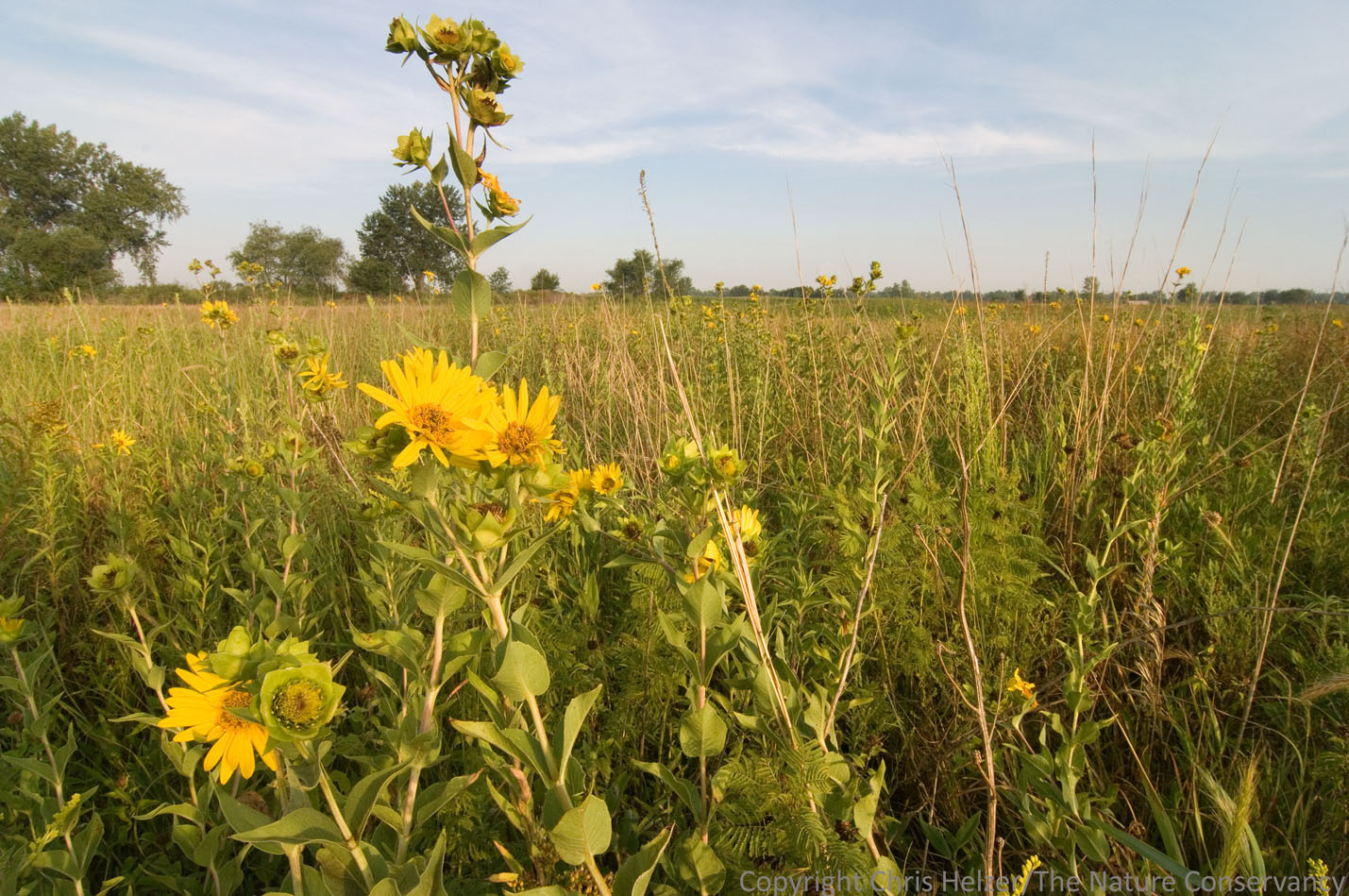
We usually see rosinweed in lowland areas of our prairies, surrounded by other lowland tallgrass prairie plants.
An agronomist friend of mine has shown me photographs of upland sandpiper nests in crop fields he works with. It’s not an unheard of phenomenon, but it’s not representative of how most upland sandpipers act. The birds that nest in those crop fields may be birds that were less able to defend territories in more suitable habitat. Alternatively, maybe those birds are pioneers, forging a new path for the survival of the species!
Rather than dismissing anomalies, maybe we should be pursuing them with as much energy as we spend looking for patterns. In this rapidly changing world, individual plants and animals that can survive where others can’t might just hold the key to conservation success. Maybe those individuals are adapting to conditions in ways others of their species haven’t. If upland sandpipers could figure out how to nest successfully in crop fields, for example, that would open up a great deal of nesting habitat for a species that has largely disappeared from large areas of North America. If rosinweed can adapt to a wider range of habitat types, that might be a pretty important strategy for its survival in the face of a rapidly changing climate. Should we be looking harder for ways to identify and facilitate that kind of adaptation?
It’s a big, beautiful, complex world out there. It’s tempting to categorize everything we see into tidy little bundles to and simplify that complexity. Oddballs can make life difficult, after all. On the other hand, Nikola Tesla, John Lennon, and Steve Jobs were pretty odd, but turned out to have pretty good ideas in the end.
Maybe outliers are noteworthy after all…



 The Prairie Ecologist